The Bathurst Times, Wed 14 Jul 1880 1
LOCAL INTELLIGENCE.
———◦———
…
CELEBRATION.—OPENING OF THE PUBLIC BUILDINGS.—Everything that can be done has been done to make this a success. The Colonial Secretary (Sir Henry Parkes), the Colonial Treasurer (the Hon James Watson), the Minister for Works (Hon John Suttor), the Lieutenant-Governor (Sir Alfred Stephen), Messrs Edward Combes, E Webb, and CE Pilcher, MsLA, have promised to be present. The sports in the afternoon are likely to be good, as all the events have filled, and some of our best pedestrians intend to compete for the prizes. The services of the Bathurst band have been secured. Upon reference to our advertising columns particulars of the handicaps will be found. The Commissioner has arranged that excursion tickets shall be issued to Bathurst at all stations within 50 miles on the 15th July. The entrance to the hall during the banquet will be by the William-street door.
~ ~ ~ ~ ~
The Sydney Morning Herald, Wed 14 Jul 1880 2
LATEST INTELLIGENCE.
———◦———
(By Electric Telegraph.)
————
BATHURST
Tuesday
…
All the arrangements have been completed for the banquet which is to follow the opening of the new courthouse and offices on Thursday. The formal opening will be conducted by the Hon FB Suttor, Minister of Justice. Intimation has been received that the Premier and other members of the Ministry will be present, if public business will permit.
~ ~ ~ ~ ~
The Sydney Morning Herald, Fri 16 Jul 1880 3
OPENING OF THE BATHURST
COURTHOUSE.
———◦———
(By Telegraph.)
(FROM OUR SPECIAL REPORTER.)
Bathurst, Thursday.
The formal opening of the new Courthouse took place at half-past 12 o’clock to-day, by the Hon FB Suttor, Minister for Justice, in the presence of Sir Henry Alfred Stephen, Sir Henry Parkes, Sir John Robertson, Hon J Lackey, Hon R Wisdom, E Combes, CMG, Mr E Webb, MLA, Mr Pilcher, MLA, Mr Benjamin Lee, police magistrate, Bishop Marsden, and Messrs Lee, McPhillamy, WH Suttor, Hellyer, and the Mayor, and other leading local residents. Mr Suttor made a brief speech, congratulating the citizens on the erection of the structure, which would be in harmony with the appearance of surrounding buildings. The sports were abandoned in consequence of the wet weather, which interfered with the demonstration. A half-holiday was observed in honour of the event. At the banquet in the afternoon at the School of Arts, eighty-five ladies and gentlemen sat down. The Mayor of Bathurst was in the chair, with Sir Alfred Stephen and members of the Ministry and Parliament on either side. Mr Benjamin Lee and Mr Macintosh were in the vice-chairs. The hall of the School of Arts was decorated with flags and foliage, and the Bathurst Band attended. After the usual loyal toasts and “The Navy” had been proposed, the Chairman proposed “The Ministry.” Sir Henry Parkes, in responding, said that, though it had been said that the present Government had passed important measures without much difficulty, because Parliament was in favour of them, he should have thought that the success of the Government consisted in conceiving what was in accordance with the national sentiment, and what was likely by its own merit to commend itself to general support. If that were a correct view the present Government might, without any infraction of the principle of modesty, claim credit for several measured of the first magnitude. Amongst them were the Public Instruction Act and the Electoral Act, while there must be some credit, first of all, to the Parliament, there must be something of credit fairly and generously due to those who conducted these measures into law, and, whilst exercising their right under the new Electoral Law, he appealed to the electors of the whole colony to see that the good work of the session was not imperilled or impaired by its successors. The new buildings appeared almost in advance of the city, but they were not in advance of the capacities of the city and district; the evidences of their prosperity being equal to those of any district. Sir John Robertson also responded. Mr B Lee proposed the “Parliament,” and Sir Alfred Stephen, Mr Wisdom, and Mr Pilcher responded. Mr Combes proposed “Prosperity to Bathurst,” and Mr E Webb responded. Mr TJ Hawkins proposed “The Agricultural pastoral , mining, and commercial interests, to which Mr WH Suttor and others responded. “Lady Augustus Loftus and Ladies,” “The Colonial Architect,” “The Press,” and “The Chairman,” concluded the toasts. There was a ball in the evening which was attended by many of the principal citizens.
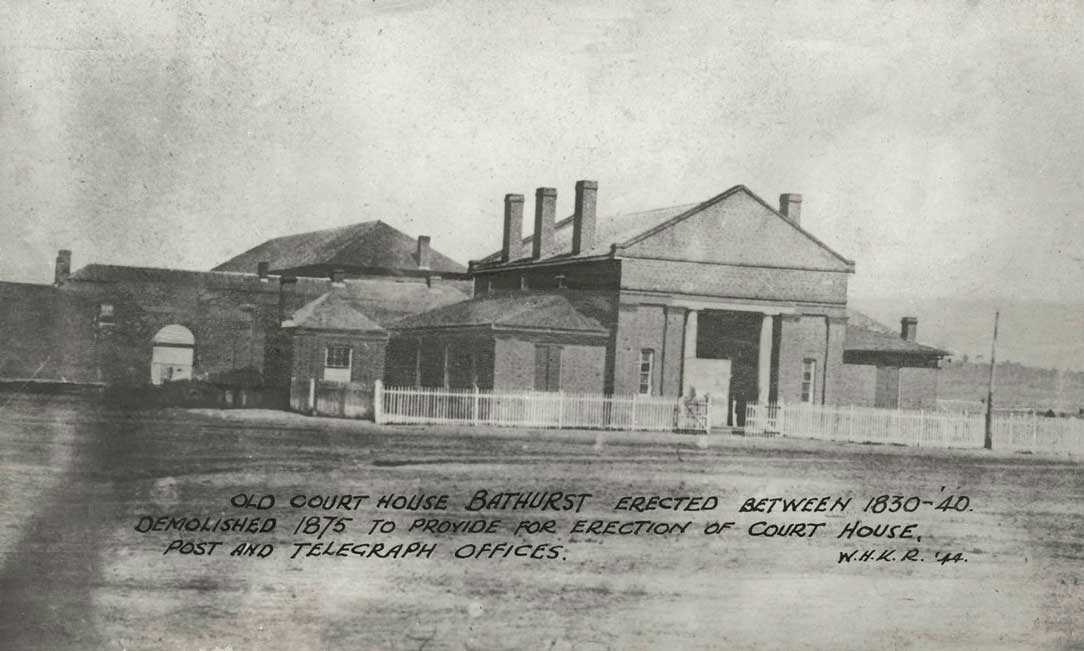
Photo ID: SRNSW 4346_a020_a020000253.jpg
The old Courthouse, erected about thirty years ago, then no doubt considered a building in advance of the time, and in which so many triumphs of forensic power have been achieved, has now finally disappeared, to be remembered, probably, only by the elder members of the Bench and Bar, and those unfortunate litigants, with others, whose fate has been decided within its sombre hall.
The proposal for the erection of the new buildings was first considered in the latter part of the year 1874, when the Colonial Architect, Mr James Barnet, by direction of the then Minister for Works, the Hon John Sutherland, the Hon (now Sir) Henry Parkes, being Premier, prepared and submitted plans for the buildings now just officially opened. The difficulty of erecting the new buildings without disturbing the administration of Justice in the old Courthouse was overcome by arranging the design in the form of three sides of a quadrangle, thus enclosing the old Courthouse, which when removed, would leave the north-eastern side open to Russell-street, and the Market-quare; in the northern wing is the Telegraph Station, and in the southern the post-office. The Courthouse at the rear is connected by a spacious colonnade, joining the wings with the Courthouse portico, leaving the area of the quadrangle 186 feet by 100 feet to form a plantation, which will permit a noble approach to the latter building. The style of architecture chosen is of Greek character, specially adapted to express the dignity expected in a palace of justice, and give that distinctive mark of a public building.
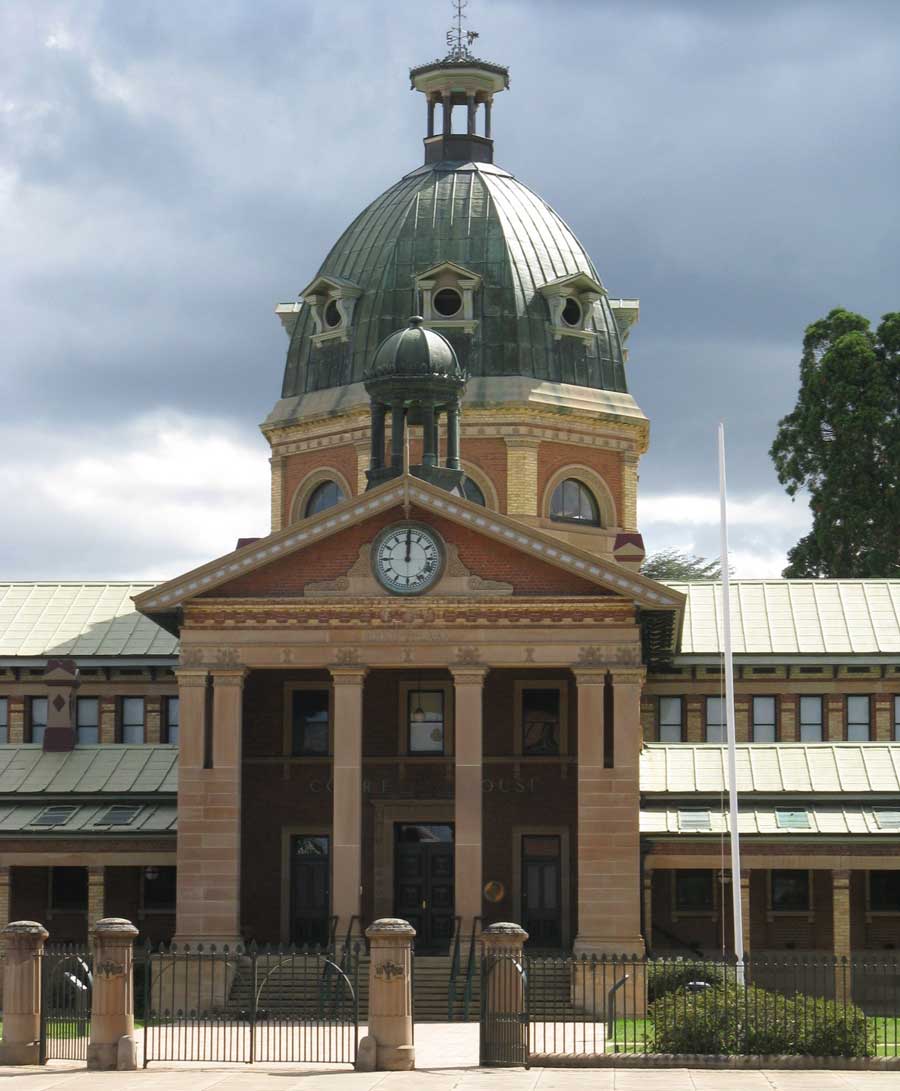
Photo: Peter Bonsall-Boone
In May, 1875, the tenders of Mr Joseph Mills were accepted for the wings only, viz, the post-office, amounting to £4,337, and the telegraph office, amounting also to £4,337, each building have an office 30 feet by 30 feet, with 10 other apartments and necessary out-houses, &c, which were completed and occupied in May, 1877, the furniture and fittings for the same being provided by Messrs W Jones and Son, of Sydney, at a cost of £520; and, in December of that year, the tender of Mr David Jones, of Bathurst, was accepted by the Hon Edward Combes, the then Minister for Works, for the Courthouse building, which overs an area of 210 feet in extreme length, by 110 feet in extreme width, and contains, besides three Court-rooms, thirty subsidiary apartments, also halls, corridors, staircases, stabling, outhouses, yards, and nineteen water-closets, the whole substantially built of brick and stone on concrete foundations. Entering the building from the quadrangle, a broad flight of steps is ascended into a portico 30 feet by 20 feet through a vestibule 14 feet by 12 feet, and then is crossed the eastern corridor, 7 feet wide, to reach the hall or “Salle des pas pordus,” 30 feet square, surmounted by an octagonal dome of concrete, lighted by eight semi-circular windows in the base of the same. The outer dome is framed of wood, surmounted by a bell coto, and the whole covered with copper, rising to the height of 100 feet from the level of the quadrangle to the wind vane, forming a picturesque feature in the distant outlines of the city. On the left of the hall is entered the Circuit-court, 50 feet by 30 feet, and 26 feet in height, with a semi-circular tribute for the Bench at one end, and a gallery for the public at the other, the latter reached by a staircase at the rear, and a balcony in the hall. The Court is provided with convenient fittings, and high dado of polished cedar with canopy over the Bench, surmounted by the Royal arms in proper colours, and lighted by a continuous range of windows immediately under the ceiling, and ventilated by vertical flues within the walls, supplied by fresh air conveyed in tubes from the quadrangle in the front and from the open ground in the rear; surrounding the Court are provided rooms for the Judge and his Associate, the Attorney-General and Crown Law Officers, the Sheriff, the bar, two jury rooms, and two rooms for witnesses, each having separate yards enclosed with brick walls and all necessary conveniences.
On the right of the hall is the Magistrate’s Court also, 50 feet by 30 feet, and 26 feet high, with tribune and gallery all fitted complete, with polished cedar dado, and fittings, Royal Arms, &c, suitable for the purposes of the Court, being lighted and ventilated in similar manner to the Circuit Court, and provided with rooms for the Police Magistrate, Registrar, and Clerk of Petty Sessions.
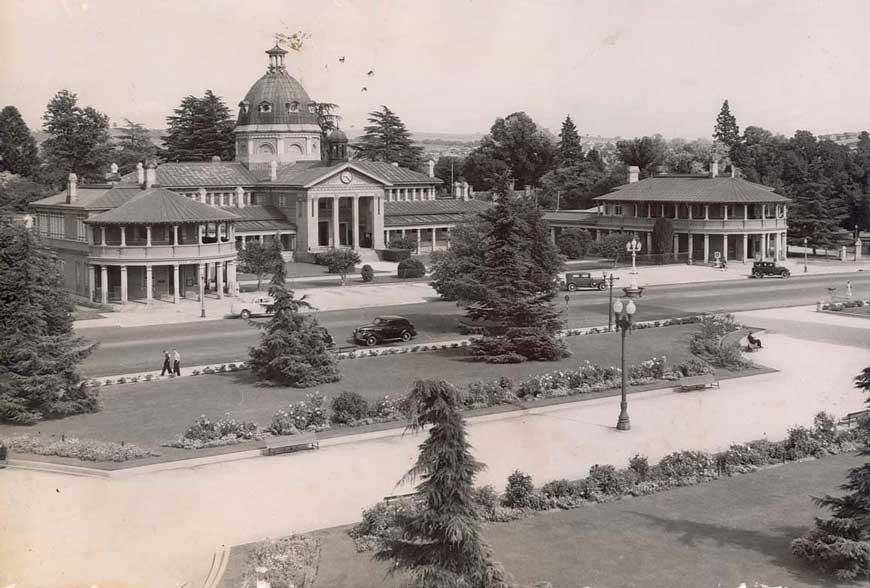
Photo ID: SRNSW 12932_ a012_ a012X2449000070.jpg
At the rear of the Magistrate’s Court, is the Mining Court, 30 feet by 30 feet, and 16 feet high, fronting the Public Reserve, in George-street, and entered on that side, under a colonnade, as well as from the corridor leading from the eastern portico and central hall appropriately furnished, and provided with offices for the Warden and Registrar.
To the right of the portico, on the eastern front, are offices for the Crown Lands Agency, and rooms for the surveyors over the vestibule under the portico; quarters for the court-keeper are provided at the rear of the great hall and staircase. Al together the accommodation for the administration of justice is the most complete yet provided in any building erected in New South Wales, the whole built, and furniture and fittings—amounting to £2433—provided by Mr David Jones, of Bathurst, in a very satisfactory manner within the contract time, under the direction of Mr WE Kemp, as clerk of works, and Mr W Roberts as foreman of works, the total cost of the whole of the buildings, including post and telegraph offices, furniture and fittings, being about £38,000.
Every provision has been made for the proper drainage of the building, and sufficient water supply by underground tanks, &c.
~ ~ ~ ~ ~
The Bathurst Times, Sat 17 Jul 1880 4
OPENING OF THE NEW COURT HOUSE
AND PUBLIC OFFICES.
————
THE ceremony of officially opening the new Court House and public offices took place on Thursday. It had been pretty well understood that the erection of such a handsome block of buildings would not be allowed to pass without some public demonstration, and when the “opening” was first suggested, the proposal met with very general support. This could not very well be otherwise. It was felt that Government had behaved most generously towards Bathurst in this matter. True, the gift of these buildings had not been procured without a considerable amount of agitation, and for many years the transaction of business in the old Police and Circuit Courts was attended with no little inconvenience. But past troubles are not often remembered amidst present joys, and we are disposed to forget, in the possession of the new edifices, whatever was unsuitable or shortcoming in the old. There has therefore been a very cordial desire felt that the celebration which the townspeople decided upon holding, should be attended with success; and in order that all classes might be able to participate in the joy of the event, the proceedings were not confined to one means of entertainment. The original intention was, if possible, to arrange for a procession, as well as a banquet, so that those who could not attend the latter, might take part in the former. But with commendable wisdom, all the local societies, except one, declined to “come out,” and the committee of management then resolved upon the more popular, and certainly the more enjoyable amusement of an afternoon’s sports. Consequently the day’s programme included the formal opening of the Court House, by the Minister of Justice, a banquet at the School of Arts Hall, and proposed sports at the cricket ground. The first thing we have to do is to give a description of—
THE NEW COURT HOUSE.
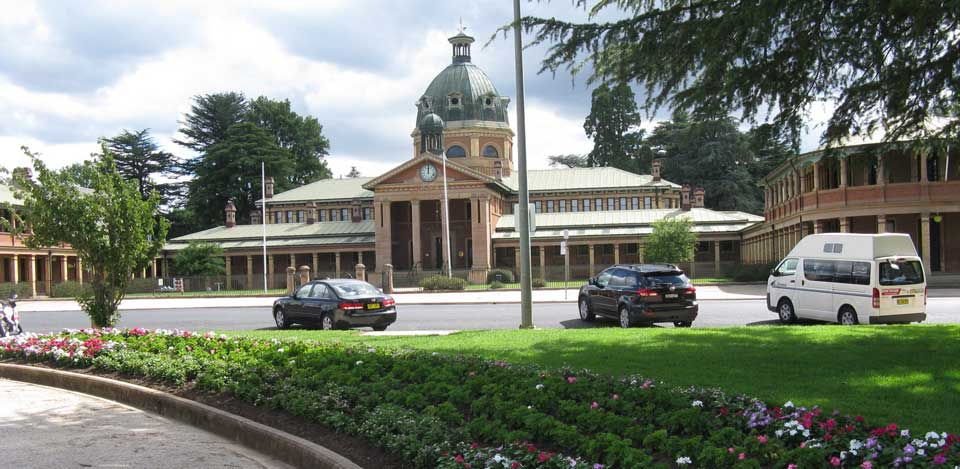
The style of the building is Grecian; and in connection with the Post and Telegraph Offices, to which it is attached, it forms, we suppose, the handsomest group of buildings to be found in the colony out of Sydney. The length of the structure, from end to end is 270 feet, and 150 feet in width. There is a covered passage, or colonnade in front, on either side of the entrance steps, and as it joins the colonnades attached to the Post and Telegraph Offices, the whole combined forms a splendid quadrangle. When the old Court-house is removed, a carriage drive and granite walk (which will be formed on the ground where the old building still stands) will lead to the main entrance from Russell-street. The ground in front will be railed in, and trees will be planted round so as to form a promenade.
Ascending seven stone steps, before entering the Court House, the visitor finds himself under the porch supported by the substantial stone pillars. The stonework over the door is beautifully carved, leaves of plants being traced with skill and delicacy. On the right-hand side of the passage leading to the vestibule, or public hall, is the office of the Clerk of Petty Sessions and Mining Registrar, and facing that is the room set apart for male witnesses. A few steps further on is the Public Hall, 30 feet square, and which is under the dome. This is built both square and octagon, and is lighted by eight windows. It is intended to decorate the interior walls with fresco work, so that it will present a splendid appearance when finished. A handsome lantern is at the top of the dome, placed at a height of one hundred feet from the floor. As indicating the substantial nature of the work of this part of the building, the following particulars of the iron work about it will not be out of place. The dome roof is held down by 16 rolls of 14 inch diameter iron, which is anchored to 12 by 12in plates built in brickwork, 8 feet from the top of the walls. The ribs of the roof are attached to the wall plates by an iron plate each side, six inches in width, and extending 2 feet along each rib; the whole being securely bolted. The lantern is secured to the dome roof with strong double straps and bolts. It has an ornamental vane at the top. We may also mention that the main roof in the elevations, and transverse sections, is finished off with a cast-iron galvanized finials at the ends. A balcony, under and within the dome, is supported by 48 wrought iron ring brackets, the frames of which are of 2½ inch iron, and they are fitted in with four rings, and rivetted at all points of contact. The foot of each bracket is built some distance into the wall. The top strap extends right through and clips the opposite side. The railing round the balcony is made of the best wrought iron. The corner standards are 2 inches in diameter with turned finials and bases. There are 40 intermediate standards, and they are 1½ inches in diameter, and have turned bases. The whole of the standards are continued through the flooring joists, and secured to the brackets with nuts and screws. The middle rail is one inch in diameter, and it passes through all the standards. A brass flower is rivetted on each intermediate standard at its intersection with the middle rail. It should be stated that a fine view is to be obtained, from the lantern, of the country around Bathurst, but strange to say no means of ascent to it has been provided in the plan. The omission is one that could be remedied at a very trifling cost, and we thing the Minister of Works might be induced to order the necessary alterations.
James Barnet. Photo: Peter Bonsall-Boone
Coming down from the balcony we reach, on the left-hand side, a door leading into the Assizes court, and one opposite, opening into the Police court. Entering the former first, we find ourselves in a handsome chamber of 50 feet by 30, the walls being from 14 to15 inches in thickness. The fittings are all made of polished cedar, and with one or two exceptions answer the purpose for which they are made very well. A space is railed off near the entrance for visitors, for whose accomodation [sic] a small gallery has also been provided. Owing, however to some unfortunate defect in the acoustic properties of this court the general public are not able to hear very much of the proceedings. At the left hand side of the court is the jury box; also very badly placed for the occupants, who cannot hear distinctly the statements of witnesses, counsel, or judge. A petition has, however, been sent to the Minister with reference to this defect, and no doubt it will be remedied. At the right-hand side of the apartment a space (much too small) has been reserved for the members of the Press. Ample accommodation is provided for witnesses. A table for the convenience of the legal profession is placed between the dock and the bench. The desk provided for the Clerk of Arraigns is also too small to permit of that gentleman doing his work with any comfort. The bench is built so that the presiding judge can conduct the business of the Court with dignity and comfort. A consultation box stands at the back, so that “his Honour” may retire to consult with the sheriff or other officials without going to his room, which likewise can be reached from the Bench. The style of the judgment seat is in keeping with the building—Grecian in design, and the pannelling [sic] is carved in a most artistic manner. The ceilings of both this and the Police Court are suspended to the roof by 2¾ iron straps. The deck in each court is of the regular melodramatic type, showing a formidable array of spikes. The top and bottom rails are one inch square, the spiked upright bars are 3 feet 6 inches in height. The railings separating the space reserved for the public from the body of the court consist of top, middle, and bottom bars of 2⅜ inch iron, with one inch square upright bars placed seven inches apart with turned caps and intermediate bars three-quarters of an inch square, with forged spear heads. The gates are designed to correspond; the whole being screwed to the floor, and stayed at different positions, so as to secure firmness. The Police Court is of exactly the same dimensions as the Assize Court, and is fitted in a similar manner. The magistrate’s bench, however, is, if anything, a more imposing structure than that used by the judges. The carving on the panels and pillars is most elaborate and elegant. Attention has been paid to the comfort of those having business in the courts, as two large register grates of the latest make are placed in each. At the north-east end, a Court of Mines has been provided, and this can be entered from the police court. It is a smaller chamber than the other two, being 32 feet by 30. It is, however, comfortably fitted up, and will be found most convenient for the transaction of mining business. Each court is lined with polished cedar to a height of six feet from the floor. The arrangements for ventilation could hardly be improved upon. Flues have been extended all round the building, and air tubes have been fixed so that each court and apartment can always be supplied by an abundant supply of fresh air. On either side of the vestibule are two main passages which divide the building. They are 200 feet in length by 7 feet wide. Taking the left hand passage first, we come to the office of the Commissioner for Conditional Purchases and that of the assistant Clerk of Petty Sessions (which is behind the CPS’s room, previously referred to), then the room set apart for female witnesses, next to which are the Crown law offices, office for the Attorney-General, and the jury room, which also can be entered from the court. Going through this chamber, and coming out in the opposite corridor, we find the Judge’s room, which has a door leading to an apartment devoted to the use of the Associate. Then comes the retiring room for the Sheriff. The Court-keepers quarters come next, and they consist of four commodious rooms and a kitchen. The office for the Registrar of Births, Deaths, and Marriages is the next in order, and then the Registrar of the District Court has an office for the work of his department. A comfortable room for the use of magistrates, and private room for the Police Magistrate—which, by-the-way, is cosily furnished—completes the list of apartments in the building.
A side entrance for the public is at the end of this corridor, near the Mining Courts which takes the visitor out by the Telegraph Office. The flooring in the building, which is exceedingly well laid, is made of beech, which the contractor states will stand any amount of wear and tear. Each room or office is provided with a separate yard, in which is an abundant supply of water; this being contained in two tanks placed at each end of the building. They are 21 feet deep and 12 feet in diameter. Every practicable provision has been made to obtain an efficient system of drainage. Pipes have been laid so as to connect it with the drainage pipes of the gaol. As an extra outlet, 9-inch pipes have been laid from the building to the corner of George-street, by which sewage matter can be conveyed to the Jordan Creek. All the stone used in the building was brought from Pyrmont. Nine hundred tons was made use of altogether, and it is stated that the carriage alone cost half the price of the stone. The entire cost of the stonework after paying expenses, including labour, is estimated at 8s per cubic foot—or £4,000 for a total of 11,000 cubic feet. The carving entailed an additional expenditure of £700. It may be added here that the foundation of the building has been made so as to provide for a defect that occurs in the ground round Bathurst, where, in consequence of the porous nature of the soil, and its liability to crack, the foundations of buildings are liable to give way. A layer of sand six inches deep was laid at the bottom of the foundation, so as to give firmness to the wall of concrete that was built over it to the depth of 5 feet. The total cost of the Court House and offices has been about £47,000, which includes some £9,000 paid to Mr J Mills for the erection of the post and telegraph offices.
We may state that some little delay in proceeding with the work occurred after the plans had been completed, in consequence of the Department imagining that the undertaking would cost too much money. In January 1878, when Mr Combes, MLA, was Secretary for Works, a start was made; the contract having been taken by Mr D Jones of this town for the sum of £38,000. As the contractor had had the benefit of 45 years’ experience in the building trade, both in this colony and in England, it was felt that the job could not be in better hands. The result has shown that the anticipations indulged in as to the quality of the workmanship, have not been disappointed, for both the buildings and fittings, so far as strength and durability are concerned, cannot fail to please the most exacting of critics. Whatever work Mr Jones found it necessary to sublet, was done under his immediate supervision, so that there was none of the slurring that is sometimes practised even by good tradesmen. The contractor attributes a great deal of his success with the building, to the very plain directions and excellent plans he received from the Colonial Architect’s Department. He states that during the whole course of his experience he has never handled a better set of plans. The responsible duties appertaining to the position of Clerk of Works, has been efficiently discharged by Mr C Roberts, who, in seeing that the work was faithfully performed, has had a most willing coadjutor in the contractor.
The following are the principal tradesmen who were employed on the building under the supervision of the contractor:—Mr Slack, of Russell-street did all the iron work, and he did it in manner that reflects credit both upon himself and his establishment. The same praise also belongs to Messrs Norman and Bartlett, who carried out the ornamental plastering and cementing in a most satisfactory manner. The stone carving, which we have already noticed, was executed by Mr S Broadbent. The fittings and furniture, which are in the best picked cedar, were made by Mr D Jones, the contractor, on the premises. Mr Mercer, of George-street did the wood carving. Messrs W Jones and W Price made the staircases and fittings. Messrs James and John Naylor performed the final work of polishing, and Mr C Seamons had the contract for painting and decorating. Messrs E Webb and Co supplied the carpets, oil cloths, matting, and drapery. During the erection of the building employment was given to various branches of labour, as follows:—16 carpenters, 8 plasterers, 3 plumbers, 8 labourers, 2 carvers in wood, 1 ditto in stone, 12 masons, 10 bricklayers and 2 labourers, 4 cabinet makers, and 2 polishers. Making a total of 76 in all.
THE OPENING CEREMONY.
The ceremony of opening took place at half-past 1 o’clock, the ladies and gentlemen who assembled to witness the proceedings, meeting in the Circuit Court. The weather was exceedingly wet, but there was a good attendance, nevertheless. The Minister of Justice (the Hon FB Suttor) took his place on the raised dais at the south-west end of the chamber and near him were Sir Alfred Stephen (Lieutenant Governor), Sir Henry Parkes (Colonial Secretary), Sir John Robertson (Minister for Public Instruction), the Hon R Wisdom (Attorney-General), the Hon John Lackey (Secretary for Works), the Mayor of Bathurst (Mr TH Hellyer), Mr Benjamin Lee, PM, Mr E Combes, MP, CMG, Mr CE Pilcher, MP, and many others in different parts of the room, including the Sheriff (Mr C Cowper), and the Colonial Architect (M Barnett). Despite the inclemency of the weather, the ladies mustered in large force, and all classes were well represented.
In addressing the assemblage, Mr Suttor said: It was with no common feelings of gratification that he had accepted the invitation to declare the magnificent building open for the transaction of public business—not so much because he was the head of the Department to which these buildings belonged; but especially because they were situated in a town which he had the honour of representing, and with which he was connected by so many family ties and pleasing recollections. The building was one of the finest which the Government had erected out of the metropolis; but it was not finer than Bathurst deserved. If they looked round and saw what private enterprise had done in this city, and observed the character of their Cathedrals, Churches, Schools, Banks, and the hospital which they were erecting, they would find that they were little, if at all inferior to the architectural beauty of the new Court House. (Applause.) But whatever claims they might have to such a handsome building, he thought the people of Bathurst should feel grateful to parliament for authorising so large an expenditure as the erection of the edifice entailed. He was sure also that they would unite with him in complimenting the Colonial Architect, who had designed the plan; and while giving him credit, he thought they should award due praise to the contractor and tradesmen who carried out the work, and who, he was pleased to find, were residents in their midst. (Applause.) Those who had seen Bathurst a few years ago, and visited it now, would hardly recognise it as the same town they had known in the past. It might be said with truth that it was one of the most flourishing, if not the most flourishing city in the colony, and abounding as it did in all the elements that made a district prosperous, it must grow in wealth and importance as years went on. He did not know that they could have a better illustration of the Bathurst of thirty years ago and the Bathurst of to-day, than the old Court House which was now disappearing, and the structure in which they were. As the old edifice might be said to resemble Bathurst as it was, so might the present building be compared, in its beauty, to the Bathurst of to-day. (Applause.) Speaking more directly as to the object for which this building would be used, he might be permitted to say that it was a source of pleasure to him, and he had no doubt it was to those around him, to see amongst them one who had presided in the old Court House with so much honour to himself, and dignity to the high office he held. He alluded to Sir Alfred Stephen. (Cheers.) He believed Sir Alfred Stephen had visited Bathurst in 1844, in his judicial capacity, and, since then, during the many years he had discharged his high duties, his one desire, and the desire of his successors seemed to be to uphold the dignity of his position and administer the law conscientiously and impartially. He did not think there was any dependency of the British Crown in which there was a better administration of the law than in this colony, where the decisions of the judges were held in such high esteem, and where nothing more could be said against them than that whatever errors might be made, were errors of judgenent [sic]. Referring to the lower courts, he thought they might be congratulated upon possessing such a Police Magistrate as Mr Benjamin Lee. They had been fortunate in having the position ably filled, and the present Police Magistrate was as able as his predecessors. He was assisted, too, by gentlemen who had been on the Commission of the Peace for many years, and he did not think there was any district in the colony where the law was better administered, or where the magistrates were more regular in their attendance to their duties. It frequently occurred that when persons were appointed magistrates, they did not attend as regularly as they ought; but he did not know that Bathurst had much to complain of in that respect. However, he thought it wrong for any one to accept the position of a Justice of the Peace if he had not time to fulfil the duties. While speaking of those whose presence would be necessary to the administration of justice in this building, he thought it only right to say a few words relative to the jurymen. He thought the jurymen of New South Wales would compare favourably with those in any other part of the world, and in reference to Bathurst jurymen, he could only quote the words of Sir Alfred Stephen, who, upon one occasions, had said that the men who discharged the duties of jurors in Bathurst were equal in intelligence and ability to any in the colony. (Applause.) He regretted that the weather had been so unfavourable; but this was very much required, and they had reason to thank the Almighty for pouring down his blessings upon them. (Hear, hear.) It now only remained for him to officially declare the New Court House open for the transaction of public business; and in doing so, he called for three cheers for Her Majesty the Queen. (The cheers were heartily given; the Bathurst band, which was present playing the National Anthem.)
Mr Webb said they ought not to separate without giving three cheers for the Minister of Justice and the Ministry; and the invitation having been heartily responded to, the meeting separated.
THE BANQUET.
This was provided in the School of Arts Hall, and notwithstanding the wet weather it was fairly attended both by ladies and gentlemen; over eighty persons being present. The tables were exceedingly well laid by the caterer (Mr C Simmons.) Owing to the exertions of the Hon Secretary (Mr WC Greville) the Hall was decorated with evergreens and flowers, and the whole of the interior presented a most imposing appearance. The Bathurst band was stationed in the gallery, under the conductor (Mr McCarthy), and discharged its usual duties efficiently.
The chair was occupied by the Mayor, to whose right sat the Lieutenant-Governor, Mrs Hellyer (the Mayoress), the Minister for Public Instruction, Mrs E Webb, and the Attorney-General. To the left of the Chairman were the Colonial Secretary, Mrs FB Suttor, the Secretary for Public Works, Mrs SE Marsden, and the Minister of Justice. The vice chairs were occupied by Mr Benjamin Lee, PM, and Mr JN McIntosh. The other gentlemen present were the Bishop of Bathurst (Dr Marsden), Messrs E Webb, MP, E Combes, MP, CE Pilcher, MP, Drs Spencer and Cortis, Messrs WC Greville, H Crouch. C Maybury, WH Suttor, RJ Black, George Lee, John McPhillamy, John Gardiner (Gobolion), – Reid (Traffic Manager), – Waddell, George Pinnock, C Armstrong, James Fitzpatrick, James Boylson, M Meagher, – Nesbit, J Busby, PJ McCarthy, ET Webb, TJ Hawkins, John Smith (Llanarth), JH Stewart, CJP Lydiard (Superintendent of Police), Whittingdal Johnson, C West, W and P Mugridge, F Halliday, KAH McKenzie, W Kite, – Barnett (Colonial Architect), C Roberts, (Clerk of Works at the new buildings), WC Kelk, Lewis Lloyd, WG Thompson, WH Paul, and a few others. Ample justice having been done to the repast,
The CHAIRMAN rose and proposed, in well-chosen terms, the usual loyal toasts—namely, “The Queen” “The Prince of Wales, and the rest of the Royal Family,” and “His Excellency the Governor,” each of which was duly honoured, while the band played the usual airs.
Mr McINTOSH next gave “The Army and Navy,” both of which forces, he said, were an honour to the country and to the British flag, and had ever proved themselves ready and able to protect the honour of the nation to which they belonged. (Cheers.)
Airs by the bank: “Hearts of Oak,” “and Rule Brittania [sic].”
Mr B LEE, as the son of a soldier who had faithfully served his country for many years, responded in appropriate terms.
The CHAIRMAN said the next toast was that of “the Ministry.” (Applause.) And he regretted very much that the duty of proposing it had not fallen into abler hands. It was not his intention to speak in any hollow terms of the Ministry of the day, but he maintained that the present was the strongest Government we had ever possessed. (Applause.) They had not only shown a disposition to push forward the business of the country; but they did in fact done [sic] more work in less time than any of their predecessors. They had succeeded in passing amongst other measures, such important laws as the new Land Act, an Electoral Act, and an Education Act. (Cheers.) Previously these measures were considered the shoals upon which Ministries were wrecked, and they had never been successfully dealt with until now. Looking, therefore, at the services which they had rendered, he thought the Ministry deserved well of the country, and that they enjoyed the confidence and respect of the people at large. (Applause.) He had much pleasure in proposing the health of “The Ministry.” (Cheers.)
Air by the band: “For they are Jolly Good Fellows.”
Sir HENRY PARKES (who was received with cheers) said that it was worth the while of the Ministry coming to Bathurst if it was only to hear what a set of jolly good fellows they were; and if he believed one-half of what the Chairman had said of them, he would return to Sydney holding a much higher opinion of himself and his colleagues than he did at present. He felt very much the warm manner in which they had drunk the toast. No doubt the Ministry had passed some measures which would benefit the colony. (Applause.) One thing he could say, and that was that they had done their best to carry out those principles in administration which would tend to benefit the country, and do good to all classes of the community. (Cheers.) It might be that they had failed in some things. It was not given to men to succeed in all that they attempted, and in a community of Englishmen a fair allowance ought to be made for mistakes or shortcomings. In such a body as a responsible parliament, composed as it was of men having their own particular views, and differing in their opinions, the most that could be expected from a Ministry was that they should be right in the main, and wise in their endeavours. (Hear, hear.) And if the general conduct of a Ministry was such as to meet with public approval, the people ought to bear with smaller defects. He read the other day the criticisms of an eniment [sic] man, who seemed to find fault with the measures of the Ministry because the parliament had approved of them. As far as he was able to juding [sic], he should have thought that the success of the Government might be attributed to the circumstance that they had been able to conceive measures that were in accordance with the national sentiment, and that would commend themselves to general support. (Cheers.) He thought there was some credit to be attached to a Government who were successful in framing measures that commended themselves to the mass of the community, because it appeared to him that this was an indication that they understood the wants of the country, the parliament, and people. If that were so, he thought the present Government, without outstepping the bounds of modesty, might lay claim to some credit, and regard with satisfaction the great measures which had passed into law. The greatest of them was the Act in regard to Education, and that measure had been carried through Parliament without a single alteration being made in any of its main principles—(applause)—and with such majorities as had never before stamped any important Act of Parliament. (Cheers.) The Electoral Law increased the representation by thirty-one members, and would send men to Parliament on the ground of equality of interests. This Act had been required for many years, and it would remedy the glaring inequalities which had arisen under the old law. Surely credit was due—to Parliament first of all, no doubt, but fairly and generously due to the Government who were responsible for the framing and introduction of these laws. (Applause.) And they would permit him to say in passing, that before many months had elapsed, 104 members would require to be elected under the new law; and he thought it was due to them, and to the electors of other constituencies, to see that what had been done by their representatives in the past was not impaired or imperilled by their successors. (Cheers.) Let none be elected who held uncertain views. Let them insist that the men who came before them should speak out, and let there be no mental reserve or secret conflict of opinion. (Cheers.) He came to Bathurst to take part in the opening of the new Court House. They would allow him to say, and he would say it without any intention to offend, that the new buildings seemed to be in advance of the requirements of the city; but at the same time, they were not in advance of its capabilities. (Applause.) He had said hundreds of times that Bathurst should yield the palm to no other district in the colony; but it lay with the people to make it what it ought to be. It had great advantages, and there were in the vicinity many families of influence, whose influence, if exerted, would make Bathurst second to no place in New South Wales. Looking to the future, the new buildings were not in advance of their requirements, and he hoped they would be found suitable in every respect for the purposes for which they had been erected. He thanked them again for the toast, and he assured them that Ministers would return to the seat of their labour much gratified by their visit to this great and important city. (Cheers.)
Loud calls were made for Sir JOHN ROBERTSON, who, upon rising, said he was in hopes that the very able speech just delivered, would have rendered any remarks from him unnecessary, and he was sure that what had fallen from his honourable colleague met with such general acceptance, that nothing was required from him to recommend it to their approval. He ventured to say, however; that the Government deserved credit for doing so much work in such a short session of Parliament. He had not been in the Lower House himself, and he could not claim to have had any part in the work that had been accomplished there. But they might fairly congratulate his colleagues on the results they had attained. He had noticed the music that had followed the toast; he thought it was, “We won’t go home til [sic] morning.” (Laughter.) Well, the members of the Ministry very often didn’t go home till morning; they sat late and early in legislating for the benefit of the country. (Hear, hear.) He thanked them for the toast, and in doing so, he took the opportunity to thank the electors of a constituency which adjoined their city, for having at the last general election, returned him to a seat in Parliament. This was the first chance he had had of thanking the electors personally since his return, and he did so now, with very great pleasure. He had, at the time referred to, been also returned for Mudgee, and he had been compelled to resign from one of the electorates. Having had much more to do with Mudgee than East Macquarie, he had accepted his old love, and forsaken the new. He thanked them again for the toast. (Cheers.)
Mr BENJAMIN LEE proposed “The Parliament.” The toast was one which did not require anything from him to recommend it to their acceptance, because it was always cordially received wherever it was proposed. And rightly so, for the men who devoted their time and attention to the service of the country deserved the thanks of the people. The present Parliament had got through a great deal of useful legislation, and the beneficial results of the measures which had been passed must soon be felt. From experience, he knew that Parliament endeavoured to do what they could to promote the welfare of the country, and very often acted with great self-sacrifice in discharging their duties. Individuals might fail, but as a body the Parliament rendered noble service, and it was the health of Parliament collectively that they were asked to drink. And when the time came, as it must come, when Parliament would have more important duties to perform, no doubt the country would be found to produce men in the future, as it had produced men in the past, who would be ably qualified to discharge the high functions of statesmen, and serve the people well. He gave the toast. (Cheers.)
Sir ALFRED STEPHEN responded for the Upper House. He hoped the day was far distant when they would so far forget the traditions of their ancestry as to say that a second Chamber was not necessary. (Cheers.) It was not non-electical, but no one could say that any member of the Legislative Council had ever been appointed who had not held a high stake in the country, and had earned the esteem and confidence of the people. (Cheers.) And there was not one who sat in that Chamber who did not do his duty as zealously and conscientiously as any member of the Lower House. And he went further, and said that the Upper Chamber conducted its business as ably as the Lower Chamber. The Legislative Council was not alone appointed to legislate, and to prevent bad legislation; but it was appointed to correct errors when those occurred. Men were but human, and therefore liable to err. Parliament had committed errors, and he said, with deference, but with firmness, that they had been corrected by the Upper Chamber. (Applause.) He thanked them for the toast, and expressed the pleasure which he felt on this occasion in visiting the metropolis of the West.
Mr WISDOM (who was next called upon) said he thought to have escaped the infliction of having to make a speech, but since they desired it, he had much pleasure in acknowledging the toast, and the honour paid him in asking him to return thanks. He was especially gratified, because it was a Western constituency which had first sent him to Parliament. Referring to the remarks of Sir Alfred Stephen, he gave the Upper House every credit for the service which they had rendered, but he could not go the length of his honoured friend, and say that they corrected the errors of the Lower Chamber. The fact was that the Legislative Assembly corrected many errors of the Council, which was a good return for anything the latter did for them. (Laughter.) However, Parliament deserved well of the country, for the zeal and industry with which it had acquitted itself. He had never sat in a House which had done so much business in such a limited time, and he hoped hon members would always be as zealous in the performance of their duties. He could see on the horizon a cloud no bigger than a man’s hand, and a storm would follow. When the time came they would have to see that nothing was done by the men they elected to damage the truly British constitution of this country. (Cheers.) They should have nothing to do with those who ran with the hare and hunted with the hounds, and who were neither hot nor cold. He believed in honesty in political life. He would rather vote for a man who honestly avowed himself against him in certain matters than for one who pretended to agree with him, and then voted against him on the first opportunity. (Applause.) He thanked them for the toast.
Mr PILCHER was also asked to respond, and he did this with much pleasure. With reference to the personnel of the present Parliament they had fair specimens before them in Sir Alfred Stephens [sic], the members of the Ministry, and the members of the House present. A good deal had been said about what the Ministry had done, but he laid claim for the Parliament to a share of the credit, altogether apart from what the Ministry had done. He remembered the time when Sir John Robertson was at the head of as strong a Government as the present; when Sir Henry Parkes was the leader of the strongest opposition they ever had in the House, and when in consequence of the vigour and ability displayed by Sir Henry Parkes, all the efforts of the Government were neutralised. The present Ministry had no such difficulty to contend against. They were equal, no doubt, to any of their predecessors, but at the same time, the facility with which they had passed various measures was undoubtedly due to the wretchedly weak character of the Opposition. (Hear, hear.) And he thought that was the reason why the paragraph referred to by Sir Henry Parkes had appeared. He did not wish to detract one iota from the credit which belonged to the Ministry; but it was the unanimity of Parliament which enabled them to carry through their various measures. The present Parliament had done good service, and the result of their exertions would be felt and appreciated by generations yet to come.
Mr COMBES proposed “Prosperity to the City of Bathurst.” The prosperity of Bathurst was bound up with the prosperity of the district by which it was surrounded. This city was the centre of a district rich in everything that could make it prosperous. But we must have other things if we wish to progress. We must have markets for our beef and produce, and our minerals; and we must try to develope [sic] our resource. By doing this we would promote our own advancement, and benefit the colony. Being a neighbour of the Bathurst people, he felt a special interest in their welfare. It was here that he made his untried gallop in political life, and he had reason to regard the district with affection. We must work and endeavour to push ourselves ahead, and if we cannot command success, we can, at any rate, strive to deserve it. There is no reason why we should not have a population in this colony, equal to that of Great Britain itself. Colonization gallops ahead in these days, and there was nothing to prevent us imitating the example of another colony which had gone into business on its own account, and which, by the wisdom of its policy, and vigour of its administration, had atraised [sic] itself into a mighty nation. (Applause.) He had gre [sic] pleasure in proposing “Prosperity to Bathurst.” (Cheers.)
Air by the Band: “There’s a Good Time Coming.”
Mr WEBB said it afforded him much pleasure to respond to the toast. He was sure they would believe him when he said that he felt a deep interest in the prosperity of Bathurst. They had that day celebrated the opening of the new public buildings, which, he thought, would be regarded as specially suitable to a city so important as Bathurst. Sir Henry Parkes seemed to be of the opinion that these buildings were in advance of our requirements. But the business which would be conducted in these new offices, concerned the interests of 40,000 or 50,000 people, and Bathurst was the centre of the district in which these people lived. He remembered when the old Court House was new, and the inhabitants of Bathurst did not then number more than sixteen hundred. Since then, that was in thirty years, the population had increased to 6,000. Bathurst had kept pace with the general progress of the colony, and its advancement had been much more marked than that of towns of older growth. He hoped the town would continue to improve, and that the day was not far distant when the new buildings would be found inadequate to the necessities of the district. He agreed with Mr Combes in the statement that the progress of Bathurst was bound up in the progress of the district, but we must all work hard and do our duty if we wished to be really prosperous. As to how this country was to be made great, they might differ in opinion; Mr Combes might think one thing, and he (Mr Webb) might think another. But he felt sure of one thing, and it was this, that if ever this was to be a great State that end would be accomplished by Free Trade. (Cheers.) Did they wish to see this colony in the same position as Victoria? If they had Free Trade, free ports, railway communication with the interior and a liberal tariff, they would make make [sic] New South Wales a mighty nation. (Cheers.) Bathurst was a great city, and he did not know where there was such another town in the colony outside of the metropolis. It was the people of Bathurst, with the assistance of the people from the country, who had got these buildings. They had erected a hospital in this city that was to cost £12,000, and which was unequalled in the colony. This was an evidence of their progress. Bathurst people were a go-ahead people; and it was with a good deal of pleasure that he responded to the toast of success to the district. (Cheers.)
Mr WEBB was called upon to propose “The Health of the Colonial Architect, Mr Barnett.” He felt much pleasure in proposing this toast, and he was sure it would be drank [sic] with hearty good will. They must be gratified at the manner in which the new buildings had been erected. They were a credit to the city, and a credit to the gentleman who had designed the plan. It was to be hoped they would be found stitable [sic]. Whatever minor defects might exist, no doubt the Colonial Architect would remedy these. He ave [sic] the toast. (Cheers.)
Mr BARNETT said the compliment was one which he did not expect, and he thanked them very much for the way in which the toast had been received. As far as the erection of the buildings was concerned, the credit belonged to his representative, Mr Roberts, who had superintended the work, as well as to the builder of the Court House, Mr Jones, and to Mr Mills, who had built the post and telegraph offices.
Mr HAWKINS proposed the “Agricultural, Pastoral, Mining, and Commercial Interests;” and responses were made by Messrs WH Suttor, John Smith, Walter Spencer, John Meagher, and J Fitzpatrick.
Sir Alfred Stephen gave the toast of “The Ladies,” and Mr Greville responded.
Mr KELK proposed “The Press,” and the representative of the Herald replied.
The Hon FB SUTTOR proposed the “Health of the Chairman,” in complementary [sic] terms, and Mr Hellyer responded, which concluded the proceedings.
We have been compelled to omit several of the speeches, but they will appear in our next issue.
————
The sports, which were advertised to take place in the afternoon, could not be held in consequence of the wet weather.
~ ~ ~ ~ ~
The Bathurst Times, Wed 21 Jul 1880 5
THE OPENING OF THE NEW
PUBLIC OFFICES.
WITH the exception of the railway extension demonstration in 1876, it seems to us that the most important event which has transpired in the history of Bathurst for considerable period was the opening of the new public offices on Thursday last. It may be said, with truth, that in the celebration that was then held, the citizens saw the consummation of long deferred hopes, for many years have elapsed since the proposal was made to provide this city with public offices of a character befitting the importance of the district. We remember, for instance, when, in 1873, some of the wants of the city were pressed upon the notice of Government through our leading columns. Referring to the absence of a proper building in which to conduct Court business, we said—“We want a proper Court House. Anybody who has gone into the present one, at an assize time, must have felt how loathsome is the atmosphere, when crowds in the gallery and crowds below are watching a trial of more than usual interest. Dirty, dingy, foul, pestilential, with no room and no convenience, the place is a discredit and a distress.” At that time there was no proper accommodation for either the post or telegraph office, and it was the inconvenience to which the public was subjected that made the question one of great moment to the people of Bathurst. The feeling grew every day that we deserved something better in the way of public buildings than those we possessed, and when, in 1875, the tender was accepted for the construction of the post and telegraph offices, there was general satisfaction. The first part of the bargain was clinched, and it was known, that though the whole of the money required had not then been voted this must come as the rest of the work proceeded. Thanks to Mr COMBES, who was Secretary for Works when the first contract was entered into, and to Mr FB SUTTOR, who has been most active in the services he has rendered in this matter as our representative, no unnecessary delay occurred in the progress of the work. The funds were available as the contracts proceeded, and the result we see in the erection of the handsomest block of buildings which Government has yet constructed out of Sydney.
As a rule, after dinner speeches are more remarkable for quantity than for quality; and generally speaking, we are unable to perceive anything specially precious in the utterances of the gentlemen who addressed the celebration banquet at the School of Arts Hall. There were some things said, however, which particularly concern the residents of this district. There is no doubt whatever that within, say the last ten years, Bathurst has made marked progress in more directions than one. This is indicated by the increased number of our public buildings, and the many handsome structures which have been erected by private enterprise. In spite of the depression which has occasionally affected us, as it has affected other communities, Bathurst, to-day, is commercially sound. Such at any rate was the expressed conviction of several men of business who were very decided in declaring their opinions at the banquet; and we believe they were correct. All round there has been improvement, for not only have commercial operation extended, but socially and politically we have advanced with giant strides. And, blessed as we are with all the elements which go to make a community prosperous, there should be little fear or the future. Only there must be no sleepiness of indifference, but continued watchfulness and vigour, on the part of those who, whether in private or public life, have the ability to serve us. It was well suggested by the COLONIAL SECRETARY that Bathurst had great capabilities, and that it was the duty of men who had a large stake in the district to exert themselves in the endeavour to promote its welfare. The hon gentleman observed that “Bathurst, and he had said it a hundred times, ought to yield the palm to no town in the interior of this country;” and he went on to point out that “if all those influences which belonged to the city and district were added to the natural resources—the real elements of prosperity—Bathurst would very soon be a large, populous, and flourishing city. They were in one of the finest districts in the colony, and looking only a very few years in advance of the present day, the new public offices would not be too large for the business of the city and district; and no doubt it was wise, since expenditure had to be incurred in this respect, to erect structures that would answer the requirements of the city for [some words missing here] in all probability, the next two generations, and if the city equalled in that time the capacity of those buildings, they would do well in the race of prosperity.” Let us hope that nothing will be wanting in the future on the part of those who are concerned in our advancement, and that, in the “race of prosperity” referred to, the district of Bathurst will ever maintain a foremost place.
…
CELEBRATION OF THE OPENING OF THE
NEW PUBLIC BUILDINGS.
———
THE BANQUET.
WE continue our report of the proceedings at the banquet which was held in the School of Arts Hall, on Thursday, in connection with the opening of the new Courthouse and public offices.
Mr TJ HAWKINS proposed—“The agricultural, pastoral, mining, and commercial interests.” This was an important toast, and he wished he had the power to do it justice. Much of what he might have said had been said already, and he found that Mr Webb and Mr Combes had, to a certain extent, taken the wind out of his sails. With regard to the agricultural interests, there was no doubt that agriculture was going ahead in this colony. The land in vicinity of Bathurst belonged to private individuals, and had, until recently, been locked up, and lying comparatively idle; but now a great deal of it was thrown open, and was occupied by the highest class of tenant farmers, who were increasing in number every year. He found, from statistics recently published, that Bathurst as a wheat producing centre, was only second to any district in the colony. But the day was not distant when, instead of being second, Bathurst would be first in agriculture, and their advancement would be largely assisted by the improved appliances introduced in farming. Then, as to the pastoral interest, this was advancing, and must always be an important interest. There were extensive tracts of country which could never be utilised for any other purpose than squatting. But there were several localities such as those in the saltbush country, where the pastoralists had much to contend against, and where they required to be tenderly dealt with. In the badly watered country between the Lachlan and the Bogan he had known fortunes to be lost in squatting pursuits; but of course many fortunes were made, and the interest had become a most important one. He did not see why, in districts like Bathurst, the pastoral and agricultural industries should not be combined, and made powerful factors in promoting the welfare of the colony. Relative to the mining industry, they knew that Bathurst was the first place where gold had been discovered in New South Wales. He was himself one of the first to sell an ounce of gold in the colony, and that was sold in Bathurst. (Hear, hear.) At present, gold mining was not what it had been, but there was no reason why fresh fields should not be discovered. There was an abundance of minerals, and these only required discovery and development. Concerning the commercial interest, if other interests flourished, commerce must prosper; and they should all go hand in hand in promoting the welfare of the colony. He had much pleasure in proposing the toast. (Applause.)
Mr WH SUTTOR was the first to respond. He said that he thought his evil genius must have prompted the committee to suggest to him the propriety of returning thanks for the toast of the “Agricultural Interest;” for as a farmer he looked upon himself as a complete failure. He never tried to reap without cutting his fingers; to thresh, without hitting his own head more often than that of his wheat; or to sow a crop that had ever repaid him for his labour. And when our Agricultural society became (as he hoped it would), a teaching body, he fully expected to get the billet of the “frightful example,” to accompany the lecturer, and illustrate by his own failures how not to do it. He did not know that there was any interest to which the world is more indebted than to the agricultural. The wheat market, and the price of the loaf, enter very materially into the daily calculations of all of us; and it was therefore a matter of great importance to them to know that agriculture was a flourishing industry here. He would venture to say that there was no district of this colony more fertile or where a better return was obtained for work done, than here—more especially when they considered the initial expenses and disadvantages under which in many places it was carried on. Dean Swift saw the importance and necessity of a right system of agriculture, when, in his diverting, satirical, and deeply philosophical work, he makes Gulliver, on reaching the Land of Giants, Brobdignag, explain to the King the system of English Government. The King said, “He gave it for his opinion, that whoever could make two ears of corn, or two blades of grass to grow upon a spot of ground where only one grew before, would deserve better of mankind, and do more essential service to his country than the whole race of politicians together.” When they considered how much we sometimes suffer at the hands of self-seeking and importunate politicians, and how much benefit we always derived from our agriculture and our corn fields, he was sure they would agree with the King of Brobdignag. What more beautiful object was there, and one more calculated to excite poetical imagination and philosophical thought than a wheat field ripening in the sun, and with constantly varying green and golden hues waving and rustling in every breeze. Was it too much to say that all human potentialities may lie in a cornfield. Shakespeare, when moralizing upon the fleeting character of human greatness, shows how—
“Imperial Caesar, dead and turned to clay,
Might stop a hole to keep the wind away.”
Might we not reverse the process, and consider how much of what is great and noble in humanity might be extracted from the clod so ruthlessly turned over by the ploughman. Corn produced from the clod under the hand of nature, that great magician, builds up mens bodies and restores the tissues wasted by labour and thought. Is it, then, to consider too curiously, to conceive of Milton’s Paradise Lost, Shakespeare’s greatest thoughts, the oratory of Burke and Chatham, the military genius of Wellington, the mechanical force of Stephenson, as having been imprisoned in a corn-field, or of a statesman’s great idea lying dormant there until made to fructify again in his heart and brain, and prove of inestimable benefit to the whole human race? How many thoughts unknown to him may pass through a baker’s oven. How much, then, does this little cake of baked paste represent? It is life, and all its possibilities, to all of us. To come down to matters more prosaic, he would add a word of warning to his fellow farmers he desired them to consider whether or no our present system of cultivation is not a very wasteful and extravagant one. We take everything from the land and return nothing to it. The mineral and other constituents that go to build up the plant we rear are not in the soil in inexhaustible quantities. Year by year we see that crops grown thus on the same soil decreased in yield. This means we were living on our capital, and were reversing Dean Swift’s order of beneficial employment. We were making our spot of land only to grow one ear and one blade of grass where it formerly grew two. We have a great deal to learn here yet, and a system of agriculture suited to other countries might not be the best for us. What he would suggest was that every farmer should, where practicable, make experiments. On an acre of land a great deal of information might be gained. On an acre they might try many different manures, many varieties of plants, many various ways of tilling the soil, and in that way they might discover what their land was most suitable for. If some of them would do this, and if our Agricultural Society would consent to receive from them and tabulate and publish the results of these experiments, a great deal of very valuable information might be obtained. In conclusion he claimed for it that there was no life more conducive to health, wealth, domestic virtue, peace, and happiness, than that of the farmer. There was no life more humane and civilizing in its influences. There was no industry that had stimulated man’s inventive genius and scientific research more than this. He was quite sure that of all the classes for whom that unfortunate necessity, the Bathurst Courthouse, had been built, the agriculturalists would use it least. He was a great believer in the progress of humanity towards all that was just and right between man and man, and he hoped the day might come in the world’s history when courthouses and their uses would be matters more of antiquarian research than their opening now seemed to be for congratulation. It seemed to him that the heavens were that day weeping at heir inconsistency in rejoicing over the opening of a building the necessity for which they ought to feel to be a source of shame and humiliation. In conclusion, he begged to thank those present for the manner in which they had drunk this toast.
Mr JOHN SMITH (Llanarth) responded for the pastoral interest, which he claimed was the greatest producing interest in New South Wales. They had been told that agriculture was the most important industry. He supposed there was not much difference actually between twenty-four pounds of wool, and twenty-four bushels of corn; but morally there was a difference. They had been that day celebrating the opening of a new Court house. Well, it was wool which had built that, and which had built their city homes. The wealth of the country was built up by the aid of the pastoral interest. There were something like 25,000,000 of sheep in the colony; and calculating each fleece a worth four shillings, it gave an annual revenue of £5,000,000 sterling. They spent all this, and they went to the banks and got more. The price of wool was a certain index to the prosperity of the country. When wool was up there was general rejoicing, and when wool went down, everything suffered. They would be told presently that commerce was the great interest of the country. He had very much respect for commercial men, who conferred certain benefits on the community. They had the knack of accumulating great wealth; they sailed their yachts, and kept their carriages—each, one for himself, and another for his wife. But it must be remembered that the money which was made by commerce came out of the pockets of the people, and from the productions of the country. The only things affected by the squatter were the kangaroo and emu, and the grass which they devoured was converted into wool and gold. And yet this was the industry which the Government had specially selected for taxation. He was sorry the Colonial Treasurer was not a squatter, for if he had owned sheep, he would have hesitated before putting a tax on wool. It the confession had been made that this tax on wool was simply to be a temporary measure, nothing much could have been said against it; but he could see no grounds for taxing the squatter in this way; he could see no reason why a duty should be put on wool, and taken off gold, while grain should be allowed to go free. Unfortunately the squatters were not like other classes—they could not combine to defend themselves, and they suffered in consequence. He could not believe that it was wise to tax the productions of the country, for that was taxing industry. Let the Government tax luxuries, and not those articles the production of which added to the wealth of the nation. As some excuse for taxing wool, it was said that wool was carried by railway much cheaper than formerly, and that squatters paid insufficient rent for their runs. Well, if that were so, let them alter the railway rates, and appraise the rental of the runs at a higher value. But he did not like to see the Government tax their wool, and then send appraisers to their runs. It was burning the candle at both ends. A great deal of the prosperity of the country was due to the energy of the pastoralists, who were the first to cross the mountains, and open up the interior of the country. Considering therefore the services rendered by squatters, they should be dealt with in a liberal spirit, and encouraged, rather than prevented, in the enterprise which had done so much for the colony. He had great pleasure in responding for the pastoral interests. (Applause.)
Dr SPENCER scarcely understood why he had been selected to respond for the Mining interest, unless it was that he had not yet fallen a victim to the mania which had affected so many. For minerals, he wished an increased demand, for tin and copper higher prices, and for gold an easier title to the land which was taken up for mining purposes. He believed that gold mining was yet in its infancy in this colony, and that the time would come when it would receive great developement [sic]. They had treasures lying buried here, it seemed strange to him that men should rush off to Queensland and other places, when, if they set to work in our own colony, they might find their way to rivers of riches. (Applause.)
Mr JOHN MEAGHER, JP, who replied on behalf of the commercial interest, said he had no desire to inflict a speech upon them, but there were a few remarks he might be permitted to make nevertheless. The commercial interests of Bathurst was a subject that might well interest most of those present; and their magnitude was best indicated by pointing to those stately and gigantic buildings of which they had witnessed the opening that day; thus adding another mark of importance and stability to the premier city of the West. If Bathurstians were remarkable for any virtue more than another, it was their modesty in not pushing their district and themselves before the public as they might do, sometimes to their advantage, without being considered obtrusive. However, they had not done so, and perhaps it was all the better, as they had arrived at their present state of solidity thought individual and combined energy, and their efforts were rewarded by having helped to build up the second city in New South Wales. And foremost among those, who had assisted in this direction, he was glad in being able to mention the name of Mr E Webb, MP. (Applause.) To whom, might he ask, could we mainly attribute the present position of Bathurst? Was it not particularly traceable to our past and present indefatigable commercial men? Some eighteen years ago, when he came to Bathurst, it was not half its present size, it possessed not public buildings of any consequence except the gaol. Now it was dotted over with public and palatial buildings that would adorn any city in the old country. We possessed various industrial establishments such as coach and carriage factories, extensive sawmills, tanneries, brewery, wool-scouring establishment, boot and shoe factories, agricultural machine factories, flour mills, which are not surpassed in the colony, and from which we could supply all Sydney with the staff of life; and as the fourth estate, they were so well represented, that people were afraid to sneeze lest it might be chronicled. (Laughter.) Our schools had at all times carried off the palm. We possessed two colleges, which have already distinguished themselves, and which were erected and conducted by the Catholic and Episcopalian denominations, without any aid from the State. Nor were we wanting in one of Sir Henry’s stately “seed-plots.” (Hear, hear, and laughter.) Let them mark that all this progress, and much more had taken place under circumstances that would be calculated to depress and discourage any other community in the colony. For several years past, Bathurst had suffered from various causes, a few of which he would enumerate. The great Lachlan rush was mostly supplied from here, and Tambaroora, the Turon, and Ophir drew their supplies from Bathurst. During Assize time, which usually lasted two or three weeks, Bathurst was like a fair, as it was the only assize town in the west; consequently litigants and others had to come here from beyond Fort Bourke. The extension of the railway again took away the large carriers’ trade which was done here. So in a measure Bathurst people have had to depend for years past on their own immediate resources. While all these unfavourable circumstances were taking place they had contributed less to the support of the official assignees than perhaps any district in the colony, which was another proof of the soundness of the commercial interests of Bathurst. (Applause.) One great impediment has been removed by the extension of our railway. We lost many an order on account of not being able to procure carriers, or guarantee delivery in a given period, as numbers of squatters and others who made Bathurst their market in years past would prefer being supplied from here if they could rely on quick dispatch; Bathurst having the reputation of being the best market out of Sydney for buyers and sellers. Thanks to the steam horse we can now name the hour and minute of dispatch and arrival. Consequently our orders from the interior are returning to us, and while the city may have a quiet appearance, still the assistants in the various stores and warehouses are busily engaged in dispatching goods to most of the western stations. Viewing, therefore, our present position, and comparing it with the past, he though we had every reason to be hopeful for the future. We had succeeded so far, under the banner of Free Trade, in building a solid foundation for future unimpeded commerce to rest on, and if the Government would only protest honest traders against the nefarious Insolvent Act and Bills of Sale now in force, and which were made use of by designing and unprincipled persons as a cloak to defraud legitimate traders, and deprive them (frequently by collusion) of legal means of redress, then, indeed, would they do a service to bona fide commerce, which would conserve the true interests of New South Wales. Let them hope that means might be adopted by our legislators that would bring this desired result into law. Then, indeed, Bathurst would receive the only protection necessary for our trade and commerce. (Applause.)
Mr JAMES FITZPATRICK was also called upon to respond for the commercial interests. He had great diffidence in rising to address them, and he would much rather that the duty had involved [sic] on some senior representative. Besides, Mr Meagher had already responded, and had said so much that it was difficult to add anything more. Many interests were bound up in the commercial interests, and when commerce was in a flourishing state it was an indication that matters generally were prosperous. He quite agreed with Mr Meagher as to the stability of commercial interests in Bathurst. No place was sounder, and though we had suffered depression, this was only temporary, and business was rapidly improving. He thanked them for the toast. (Applause.)
~ ~ ~ ~ ~
Australian Town and Country Journal, Sat 24 Jul 1880 6
THE NEW GOVERNMENT OFFICES
AT BATHURST.
———
THE new Government offices at Bathurst, the inauguration ceremony of which took place last week, are without doubt the finest range of Government buildings out of Sydney, and quite put to shame the wretched hovels, comparatively speaking, which have to do duty as police and supreme courts in the capital city. As long ago as 1874 the proposal to erect these buildings was first mooted, and it was at the latter end of that year that the plans were prepared by Mr James Barnet, the Colonial Architect, and approved of by the Ministry of the day. In May, 1875, tenders were accepted for the wings. Mr Joseph Mills being the successful tenderer for the post office at £4337, and for the telegraph office at the same figure, each building having a main office 30 x 30, with 10 other rooms, and the necessary outoffices. The whole design is in the form of three sides of a quadrangle, the court-house being the centre. The situation, which is fronting the Market-square, is an exceedingly central one for the city of Bathurst. The southern wing is the post office and the northern wing is the telegraph office, both buildings being connected with the court-house by a spacious collonade, [sic] leaving the area of the quadrangle 186 x 100, which will admit of ample room to plant trees, form a garden, and thereby add to the beautifying of the locality. The whole of the buildings are of the Grecian order of architecture.
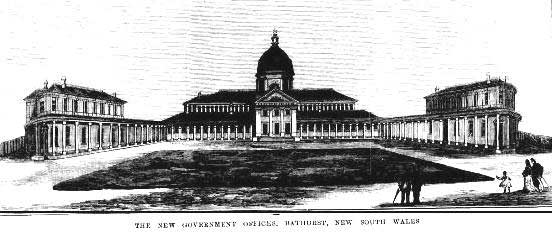
Image: Australian Town and Country Journal, Sat 24 Jul 1880, p.32.
Reproduction: Peter de Waal
The post and telegraph offices were completed in May, 1877, and after being furnished and fitted by Messrs W Jones and Son, of Sydney, at a cost of £520, were occupied. In December of that year Mr Combes, CMG, being the then Minister for Works, accepted the tender of Mr David Jones, of Bathurst, for the erection of the court-house, and conjoined buildings, which are 210ft in length by 110ft in width, and comprise three large rooms for the holding of police, supreme and mining courts; 30 other rooms, beside halls, corridors, staircases, stables, outhouses, lavatories, yards, 19 water closets, the whole of which are built of stone on concrete foundations. From the quadrangle to the portico a broad flight of steps gives admittance to the building, the portico being 30 x 20 and the vestibule being 14 x 12. The centre hall is 30 x 30, surmounted by an octagonal-shaped dome in concrete, lighted by eight semi-circular windows, surmounted by a lantern, it being 100ft elevation from the quadrangle to the lantern. On the left and right of the hall are the supreme and magistrates’ courts, each being 30 x 30, with a height of 16ft. The fittings throughout are of polished cedar, the railings being of iron. The rooms are exceedingly well lighted and ventilated, but are at present rather deficient in acoustic properties. This, however, can be remedied. Each of these courts has its high dado of polished cedar, with canopy over the bench, surmounted by the royal arms. Surrounding the courts are the rooms for the judges, their associates, the attorney-general, Crown law officers, sheriff, members of the bar, jury rooms, witnesses’ rooms, besides rooms for the police magistrate, registrar and clerk of petty sessions. The mining court is equally as well appointed, and has rooms leading from it for the warden and registrar. The contract has been exceedingly well carried out by Mr David Jones, under the direction of Mr WE Kemp, as clerk of works, and the whole of the furniture and fittings were made under the supervision of Mr D Jones. The carpets, oilcloth, matting, and drapery were supplied by Messrs E Webb and Co. Messrs Norman and Bartlett executed the ornamental plastering and cement work, and the stone carving on the dome and pillars is by Mr Broadbent. All the work is of the best and most substantial description, and reflects credit on those engaged in it. Altogether some 900 tons of Pyrmont stone has been used in the buildings. The court-house has taken two years and a half to complete, and 76 first-class tradesmen have found work thereon. The total cost of the whole of the buildings, including fittings, was about £38,000.
Our engraving gives a capital view of the structure, and will enable our readers to form an idea of the architectural effect and general appearance of what is a very handsome pile of buildings, at once a monument to the ability of their designer, an evidence of the energy and enterprise of the contractor, and a credit to the important town in which they exist.
~ ~ ~ ~ ~
The Bathurst Free Press and Mining Journal, Fri 17 Jan 1896 7
LOCAL AND GENERAL.
———◦———
…
A SILENT TONGUE.—Enquiries are being made as to the reason of the silence of the courthouse clock. The bell has been out of order for several months; indeed, never since its erection has it answered the purpose for which it was placed in the tower. The bell limits itself now to one stroke for each hour in the day, while the stroke is followed by a confused noise, resembling a swarm of bees. One jocular townsman remarked the other day that it had the “Government stroke.” The clock itself has been keeping fairly good time lately, but its face is becoming blistered owing to the want of ventilation. The heat from the gas used in illuminating the dial is too great and causes the paint to blister. These matters, small though they may appear to some, should be of sufficient importance to cause the Progress Association to take action, and while the proposed electric staff-pole is being discussed this additional matter might be also dealt with.
1 The Bathurst Times, Wed 14 Jul 1880, p. 2.
2 The Sydney Morning Herald, Wed 14 Jul 1880, p. 5.
3 The Sydney Morning Herald, Fri 16 Jul 1880, p. 6.
4 The Bathurst Times, Sat 17 Jul 1880, pp. 2, 3.
5 The Bathurst Times, Wed 21 Jul 1880, p. 2.
6 Australian Town and Country Journal, Sat 24 Jul 1880, p. 32.
7 The Bathurst Free Press and Mining Journal, Fri 17 Jan 1896, p. 2.