The Sydney Morning Herald, Mon 23 Aug 1880 1
LATEST INTELLIGENCE.
———◦———
(By Electric Telegraph.)
——
…
COWRA.
Saturday.
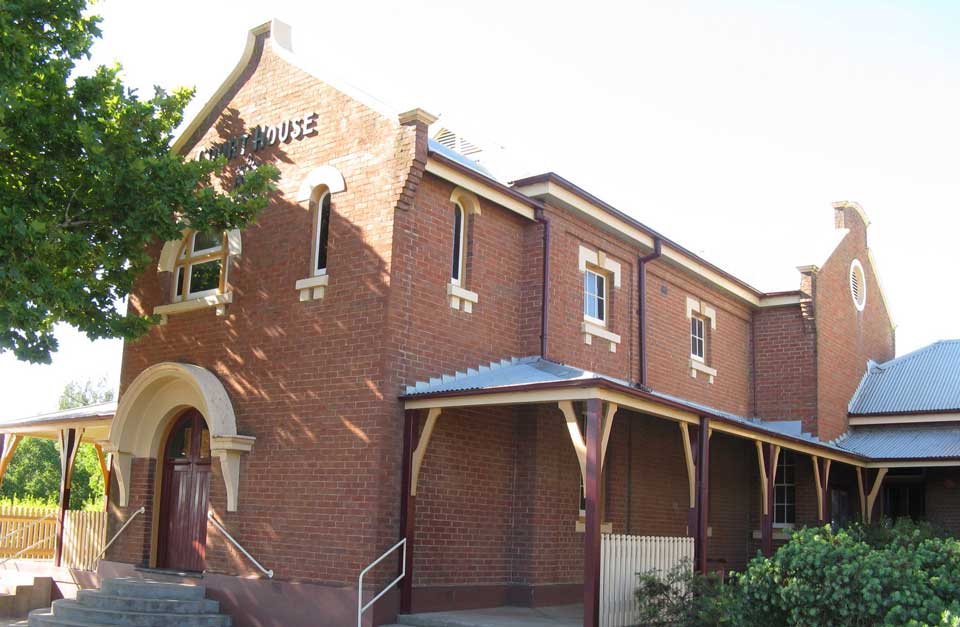
The Hon EA Baker arrived by mail coach today, and the ceremony of opening the new courthouse was performed by him at 4 o’clock, in the presence of a large concourse of people. Seven magistrates were on the bench, and a large number of ladies were also present. Mr Baker, among other topics, took occasion to explain, to the satisfaction of his hearers, the reason of his absence from the show and banquet yesterday, and concluded his remarks by declaring the courthouse duly opened for public business. Mr Lynch also addressed the meeting, as did also Messrs Donnelly and West. Referring to Mr Baker having been requested to stand for this district, a vote of confidence in him was carried by acclamation by the meeting, and cheers were given for the Queen, the Hon EA Baker, Mr Lynch, the local member, and the contractor, Mr Ford. The building was decorated with flags, and the demonstration passed off with the greatest éclat.
~ ~ ~ ~ ~
The Cowra Free Press and Canowindra, Goolagong, Cargo, Grenfell and Young General Advertiser, Sat 28 Aug 1880 2
OPENING OF NEW COURT-HOUSE.
IT having been determined to celebrate the opening of our new Court-house with a public demonstration and banquet, invations [sic] were issued some six weeks back to the various members of the Government requesting their attendance at Cowra on Friday, the 20th instant. In reply to these invitations, letters were received by the secretary from the Hon Sir Henry Parkes, Hon Saul Samuel, Hon R Wisdom, and Hon EA Baker, the former three gentlemen expressing regret at their inability to be present, and the last-named accepting the invitation at a later period telegrams were received from the Hon James Watson and Hon FB Suttor, both declining, on the plea of business arrangements interfering with the visit, and further adding that they had deferred replying with the hope that they might possibly be able to attend. It is a certainty that the idea of giving a banquet would never have been entertained if it was surmised for one moment that only one member of the Cabinet was likely to put in an appearance, but when the replies were received from the Hon’s [sic] Sir John Robertson, J Lackey, J Hopkins, J Watson and FB Suttor, it was too late to countermand the order that had been given to the caterer by the committee. We were assured, however, that we could depend on the attendance of the Hon EA Baker and A Lynch, Esq, MP, our surprise, coupled with chagrin, was consequently stretched to its widest limits when we were placed in receipt of a telegram at 7 pm on Thursday stating that Mr Baker would arrive at Carcoar at 9 pm on the following evening (the day appointed for the ceremonial and banquet), and would proceed from thence to Cowra on the following day. On perusing the telegram referred to, we were at once made painfully aware of the fact that some extraordinary misunderstanding had occurred respecting dates, likewise that it was quite out of our power to remedy the mischief at that late hour. The committee consequently did the best they could under the circumstances, and and [sic] altered the title of the banquet from “Ministerial” to “Show,” and arranged a programme of toasts in keeping therewith.
On Saturday morning a number of gentlemen, driven by Mr JL Waugh, of Grenfell, and Mr H Dennis proceeded to the Cross Keys, where they met the Hon EA Baker, accompanied by Mr Waddell, of Orange, and escorted both gentlemen into town. After a hurried consultation amongst the Demonstration Committee, it was decided that the Court-house should be formally opened that afternoon at 4 o’clock, by the Minister for Mines, as the representative of the Government. The determination of the committee having been immediately circulated throughout the town, at the appointed hour a goodly number of our townsfolk, including a tolerable sprinkling of the fair sex, assembled within the walls of the new structure. Mr Ford, the contractor, had made provision for the seating of a large number within the building, and he also tastefully decorated the verandah with flags and banners. At about 4.30 pm, Messrs AR West, D Donnelly, GH Greene, TH West,—Burcher, J’sP, and a number of other gentlemen took their seats on the bench, and shortly after Mr A Lynch, MP, entered and introduced in a few chosen terms the Hon EA Baker, Minister for Mines to the bench.
Mr AR West had much pleasure in meeting the Hon M Baker, who, though not the representative of the Carcoar electorate, had always evinced a deep interest in its progress and welfare, as well as that of the colony at large. He (Mr West) regretted that the building was still incomplete, owing to tenders not having been called for the promised additions; he, however, trusted that the matter would be attended to without further delay, and that in time we should not alone be favoured with a District Court but a Court of Quarter Sessions as well. (Cheers.)
Mr Donnelly viewed the previous and that day as red-letter days in the history of Cowra, and he much regretted that circumstances had prevented other Ministers of the Crown from being present with them then. He was strongly in favour of the establishment of a District Court, and alluded to the inconvenience litigants were subjected to under the present system to recover amounts exceeding £10. He desired to impress on the Government the fact that the population of the district of Cowra was now considerable, increasing daily, and in the course of a few years would be doubled. The land was acknowledged to be the most fertile in the colony, and he felt assured that in the course of time every available spot would be settled upon by an industrious class of yeomen. (Cheers.)
Mr Baker, on rising, was presented with the keys of the building by the contractor, Mr Ford. After expressing the pleasure he experienced in being called upon to perform the pleasing office of formally opening their new Court-house, he desired to refer before proceeding further to a matter of a personal nature—(he alluded to the banquet)—in order to dispel the idea that any discourtesy was intended towards the people of Cowra. The secretary (Mr Ryall) had been good enough to forward an invitation to himself and other Ministers to be present at a banquet on Friday, 20th instant, and he at once replied accepting the invitation. The invitation, however, by some means got mislaid, and he through some unaccountable means received the impression that the banquet was to take place on Saturday, instead of Friday; he accordingly made arrangements for leaving Sydney on Friday evening, notwithstanding the fact that he could have done so on the previous day but for the unfortunate mistake. In corroboration of his explanation, he alluded to his have telegraphed to Mr Waddell, of Orange, asking that gentleman to meet him at Blayney;—judge his surprise then, when on arriving at Blayney he was informed that the banquet was to take place on Friday, instead of Saturday. He hoped that his old Cowra friends would acquit him of any act of intentional discourtesy, and that they would accept the explanation offered. He assured them that it would have given him much pleasure to avail himself of their hospitality, and to have mingled with them once more on the occasion referred to. He was always deeply impressed with the importance of the Cowra district, and felt convinced that its great resources would bring it to the fore in time. Since his last visit the town had much improved, and had progressed at such a rate as to necessitate the erection of the building he now had the pleasure of opening. The contract cost of the structure was £1690, and it was now the intention of the Government to erect three additional rooms at a cost of £700. Respecting the latter amount, he might say that Mr Lynch’s energy and importunity had secured for them the additional grant. Mr Lynch was a most indefatigable representative—he was continually knocking at Minister’s doors seeking something for his constituents, and his incessant importunities were so irresistible that Ministers frequently granted his requests in order to get rid of him (Laughter and applause). They required furniture in harmony with their Court-house, and he was assured that if his friend Mr Lynch applied to the proper quarter a sufficient sum would be granted. Although not the representative of the district, he (Mr Baker) would attend to the latter matter if written to. He had no idea that he would be called upon to open the Court-house that day, and was consequently unprepared to make a lengthy speech. If the colony required expensive public buildings as well as roads and railways, it must be prepared to find the means for construction. Ever since he became a representative he had always advocated the construction of good roads, and as long as he occupied a public position he would still do so; but, as he before remarked, if the people required this, and insisted on the construction of other public works, they must be prepared to defray the cost. The expenditure for the present year was estimated on £5,000,000, while the revenue amounted to only £4,500,000, consequently to meet the deficit fresh taxation must be resorted to. He appealed to them as sensible men, and asked them whether they could expect to have such expensive works without paying for them. If a squatter desired to make certain improvements on his holding he had to pay for them, and thus it was in every phase of life—if we required anything we must be content to pay for it. He had referred to this matter now, as in a short time the question of finances would be before the country in all its bearings. Respecting the necessity that existed for the establishment of a District Court at Cowra he fully agreed with the remarks that had been made, as he had always favoured the proposal of bringing law home to every man’s door, and could quite understand the inconvenience suitors and business people were subjected to in being compelled to travel long distances to seek redress. He promised to assist Mr Lynch to his utmost in getting Cowra appointed as a place for holding District Courts (Cheers). He thanked them for the kind reception extended to him, and again expressed the regret he felt at being the victim of a mistake as to the date of holding the banquet. He had now much pleasure in declaring the Court-house open for the transaction of public business.
Mr Lynch regretted that the mistake had occurred inasmuch as his friend Mr Baker would never have a better opportunity of meeting many old friends as the previous day afforded. He had much pleasure in bearing testimony to the able support he had received from Mr Baker respecting everything appertaining to the Carcoar electorate. When the Electoral Bill was before the House, Mr Baker sat by his side night after night and fought for a second representative for their electorate, and this was only attained on getting some 500 or 600 electors attached to the Carcoar electorate that would otherwise have been apportioned to one of the districts included in the late Lachlan electorate. He trusted to find his friend the Minister for Mines returned to Parliament as the representative of the Carcoar electorate, whether he (Mr Lynch) were returned or otherwise. He was quite prepared to give place to a better man, if the time to connect the two great trunk lines of railway of the colony was once established. They would have a good representative in Mr Baker. Respecting the £700 for additions to the building they were then assembled in, he had represented to the Minister for Works that the additions were absolutely needed in the event of Cowra being appointed a place for holding District Courts and Courts of Quarter Sessions; the matter was then referred to the Colonial Architect, who reported favourably, and the expenditure of the amount was sanctioned. He (Mr Lynch) complimented the people of Cowra on the neat character of the structure, which he felt assured would be adapted for requirements for many years to come.
Mr AR West complimented the contractor, Mr Ford, on the excellent and faithful manner in which he had performed his contract.
Mr Donnelly also complimented Mr Ford, and added that it reflected credit on the town to have a man amongst them who was able to execute his contracts in such a satisfactory and diligent manner.
Cheers were given with great gusto on the call of Mr West for Messrs Baker, Lynch, and Ford.
Mr Baker considered that he was hardly entitled to the compliment paid him by Mr Lynch, and in justice to that gentleman he must credit him with being indefatigable in striving to promote the interests of his constituents. He was continually badgering Ministers with requests for the construction of public works in various portions of his electorate, and his insinuating manner was so winning that there was no denying him. As long as they had a representative like Mr Lynch they might rest satisfied. On some occasions, when making a request for some purpose, the Minister would reply, “It cannot be done, Mr Lynch; why it was only the other day that £1000 was granted for the construction of a Court-house.” But Mr Lynch would not accept a refusal, and he invariably succeeded in carrying his point. (Cheers.)
Mr Lynch denied that he had ever asked the Government to expend money in the construction of works that were not absolutely required. He instanced Cowra as being a portion of the electorate in which the Government had not exercised a lavish expenditure of public money. Only £1000 had been sanctioned for the erection of a Post and Telegraph Office—a sum that would be only sufficient for a miserably shabby structure. He would not rest satisfied until that amount was increased to £2000 (cheers.) What would visitors say on coming to the town to find a good Court-house and an insufficient Post and Telegraph Office he maintained that the public buildings, being a portion of the Government estate, should be in harmony one with the other, and that if the wants of the district were properly supplied now in that respect, its claims would be comparatively trifling in the future. He would insist on getting the additional £1000 for the Post and Telegraph Office. (Mr Baker: This is the way he badgers the Ministers.) (Laughter.) Mr Baker was entitled to credit for being the first to suggest, through the columns of the S M Herald and Grenfell Record, some years back, the benefits that would accrue to the colony at large from the construction of the loop line of railway to connect the Western and Southern lines, and he hoped that the proposal would ere long be reduced to a certainty, and that the line would be an established fact (cheers.) The fertility of the lands along the course of the Lachlan, as well as those through which the line was surveyed, was acknowledged on all side, and he felt safe in predicting that with the advent of railroad communication they would in time be able to boast of an attendance of 10,000 instead of 1000 at their P A and H Shows. Respecting a suitable site for their Show Ground, he promised to support an application for the dedication of an eligible spot, and would see that the matter was attended to without delay. He was pleased to see Mr Baker once more among them, and hoped he would be favourably impressed with the rapid progress the district was making. (Cheers).
After three lusty cheers had been given for the Queen the assemblage dispersed, and the proceedings terminated.
————————
PA AND H ASSOCIATION’S SHOW
BANQUET.
IN consequence of none of the Ministers being in attendance to partake of the banquet prepared in their honour on Friday evening, the 20th instant, its character was changed to that of a P and A Show dinner. At about 7 pm between thirty and forty gentlemen sat down to a sumptuous spread at Robertson’s Victoria Inn. The room was tastefully decorated and well lighted, while the viands and wines were of the best quality procurable—to be brief in this respect, the high character of the caterer was in every particular fully maintained. The chair was occupied by WR Watt, Esq, JP, who was supported on his right by JH Turner, Esq, President of the Association, and EJC North, Esq, PM; and on his left by A Lynch, Esq, MP, and GH Greene, Esq, JP. The vice-chairs were filled by AR West, Esq, JP, and WB Simpson, Esq.
After the usual loyal toasts had been duly honoured,
Mr AR West (vice-chairman) proposed “Success and Prosperity to the Cowra Pastoral, Agricultural, and Horticultural Association.” He regretted that the toast had not fallen into abler hands; still as one of the promoters of the organization, he felt pleasure in being in a position to share in the triumph that day achieved. At the outset they had met with many difficulties, principally due to previous failures, but nothing daunted, they persevered, and the great success they had that day witnessed was the result of their labours. He was aware that they were still far from perfect, and he hoped that many of the valuable suggestions offered by visitors would be acted upon in the future, and thereby conduce to the progress and success of the Association. The thanks of the Association were due to their Carcoar, Grenfell, and Blayney visitors, for the liberal, kind, and valuable support they had so cheerfully rendered, and to whose assistance and counsel the success attained might in a great measure be ascribed. He had much pleasure in proposing the important toast entrusted to him. (Cheers.)
Mr JH Turner presumed that as President of the Association the duty of responding to the toast devolved upon him. Respecting the position of President, he felt that he was the wrong man in the wrong place (No, no!) He would like to see a squatter at the head of the Association, and hoped to see an alteration affected next year (No, no!) It was not his desire to shirk work, but he considered that a squatter at the head of affairs would be more adapted to the position than a bank manager. (A voice: We are quite satisfied with you.) He was pleased to notice the large number of exhibitors who had come from Forbes, Grenfell, Carcoar, Blayney, and other districts, to assist them, and he trusted they would have an increased support at their next Show. There was no doubt as to the opposition encountered by the promoters of the Association at the commencement of its career; still it was a singular source of satisfaction to all that they had been enabled to overcome it. It was certainly a misfortune to be deprived of the assistance and support of the Cudgelo and Neila station through a misunderstanding; he hoped, however, to find the difficulty repaired next year, as they required the support of one and all to make their Shows the success they desired. Former failures in connection with the formation of an Association had militated against their efforts in inaugurating the present Society, owing to the want of perseverance and pluck to conduct matters to a successful issue in the face of disadvantageous circumstances. He was not a public speaker, must be excused if he omitted mention of much that ought to have been noticed. He was convinced that no one could say one word in disparagement of the judges, who had performed their work carefully, impartially and well. Mr Costello, of Goolagong, was entitled to all praise for the enthusiasm and zeal with which he had entered into the project of forming the Association, as well as for the liberal support he had subsequently given in the way of exhibits. He also thanked all the exhibitors for their support, and the company for the manner in which they had received the toast. (Cheers.)
Mr H Mawby proposed “The Judges” in a neat little speech.
Messrs EJC North and JL Waugh responded.
Mr Simpson (vice-chairman), after a few introductory remarks, proposed, “Our Parliament, coupled with the name of Mr A Lynch.”
The toast was received with full honours.
Mr A Lynch thanked them for the manner in which they had received the toast, and one which he felt proud to be called upon to respond to—it being in every country a time honoured toast. He considered that the present Parliament was a fair reflex of what the people made it, and would compare favourably with any of its predecessors. A parliament in a free country ought to be a fair embodiment of the popular will of the people, and if it was corrupt or tyrannical the electors were to blame for making it so. The various constituencies were empowered to elect their own representatives, and the Government was selected from that body; it would therefore be seen at a glance that all power was derived from the free and independent electors. Now his advice to the people would be, “Return men as your representatives who not only thoroughly understand the wants and requirements of your district, but are identified and conversant with its interests as well as those of the entire colony.” (Applause.) He was aware that the Cowra district was not accorded its fair share of the public revenue, but what could he be expected to do against a House composed to seventy-two members, who were all clamouring for the lion’s share of the plunder. He instanced the sum of £1000 placed on the estimates for the erection of a Post and Telegraph Office as a case in point, and contended that such a sum would be barely sufficient for a decent lock-up. He was determined, however, to get the vote doubled if possible. He also referred to the £700 required for the additions to the Court-house as having been settled. He trusted before long to see the country divided into large municipalities or Shire Councils, such as are in existence in Victoria, as by such a system the people would learn to govern themselves, and in the course of time every such organization would be independent of the Government. In the colonies of Queensland and Victoria the system was found to work admirably, and the people are not dependent on the passing of the Estimates for grants of money for roads, bridges, and other public works. It matters little to the people of those colonies whether their Estimates were passed in June or January, but with us it was very different, as our Estimates were passed at a time in the year that caused all our roads to be made in the middle of winter, when the cost is actually double what it would be in summer. If every district in the colony had the control of its own finance for local works and improvements, non of a useless character would be undertaken, and the strictest economy would be experienced in the expenditure of the funds at its disposal. The Government were favourable to adopting such a scheme as that he had shadowed forth. He believed he was ahe [sic] first member of the House to attract the attention of the Government to the feasibility of carrying such a project into execution. He presumed they desired to learn something about the deficit in the revenue that had caused so much alarm throughout the colony lately, but from which he apprehended little inconvenience. The remedy he would suggest he felt convinced would place them once more in a solvent position without increasing the burdens of the people. It was this:—Let there be retrenchment in every department of the public service. Every one who is even slightly acquainted with the civil service of the country must admit that the immense staff of officials maintained it out of all proportion to the population. In corroboration of this statement he would only refer to the Department of Lands, which has 1500 officials connected with it—and nearly all the other departments are equally overcrowded. He was certainly in favour of considerably reducing these, which he was satisfied could be accomplished without impairing the efficiency of the public service in the remotest degree. He would also cease to subsidise an ocean mail service, as he he [sic] viewed such an expenditure as a waste of public funds. It was obvious to all that the news brought by the mail steamers was anticipated by telegram fully six weeks before their arrival. With the complete system of telegraphy now in operation throughout the civilised world he considered that subsidies to steamship companies would be readily dispensed with without loss or inconvenience to the colonists. He maintained that the trade of the country was sufficiently attractive to induce the largest steamships in the world to visit Sydney as a commercial transaction, without additional aid, and as a proof of this the Orient company have offered to convey the mails without one shilling subsidy, thereby effecting a saving to the country of £60,000 annually. He contended that with this sum, and what could be saved by retrenchment in other sources, a sufficient sum would be realised to more than cover the deficit in the revenue. By the Electoral Act recently passed, Carcoar would be privileged to return two representatives instead of one as formerly, so they might now depend on having their wants fully attended to. He was pleased to find that they had already selected one gentleman to represent them in the new Parliament whom he was convinced would honestly and faithfully watch over their interests. Mr Baker, the gentleman he alluded to, had always evinced a deep interest in the electorate, and had at all times rendered him valuable assistance in everything concerning the district when required. When the Electoral Bill was being discussed, Mr Baker stood shoulder to shoulder with him in fighting for the additional member. He was proud to find that they appreciated his disinterested efforts in their behalf by inviting him to enter the field as a candidate for parliamentary honours at their hands and he trusted to find him returned as one of their future representatives. His (Mr Lynch’s) day dream was the railway, and he trusted before long to see the iron horse steaming through their town connecting the West and South in the bonds of commercial prosperity (cheers). He again thanked them for the enthusiastic and hearty manner in which they had received the toast. (Loud cheers).
Mr Lynch next proposed, “Prosperity to the Pastoral, Agricultural, and Commercial interests of the district of Cowra,” in a few well-chosen terms. Mr SG Alford responded.
Mr Turner proposed, “Our Visitors.” Messrs Greene and Waugh responded.
Mr Wharrie proposed “The Ladies.” Mr Stewart acquitted himself admirably as the ladies’ champion in responding.
“The Press” was acknowledged by Mr O’Brien on behalf of the Carcoar Chronicle, and Mr AR West in the interests of the Free Press.
Mr Mawby proposed the health of the Chairman and Vice-Chairman.
After the compliment had been suitably acknowledged the company broke up, thus terminating a most convivial (though at times somewhat boisterous and noisy) gathering. We regret that circumstances compelled us to retire at an early hour, thereby precluding us from obtaining a report of the speeches delivered at a late hour in the evening. We have to thank Mr AR West for kindly responding for us, and trust to be in a position to return the compliment some day.
1 The Sydney Morning Herald, Mon 23 Aug 1880, p. 5.
2 The Cowra Free Press and Canowindra, Goolagong, Cargo, Grenfell and Young General Advertiser, Sat 28 Aug 1880, p. 2.