Below also see: George William Harrington, 1869,
George William Harrington, 1871,
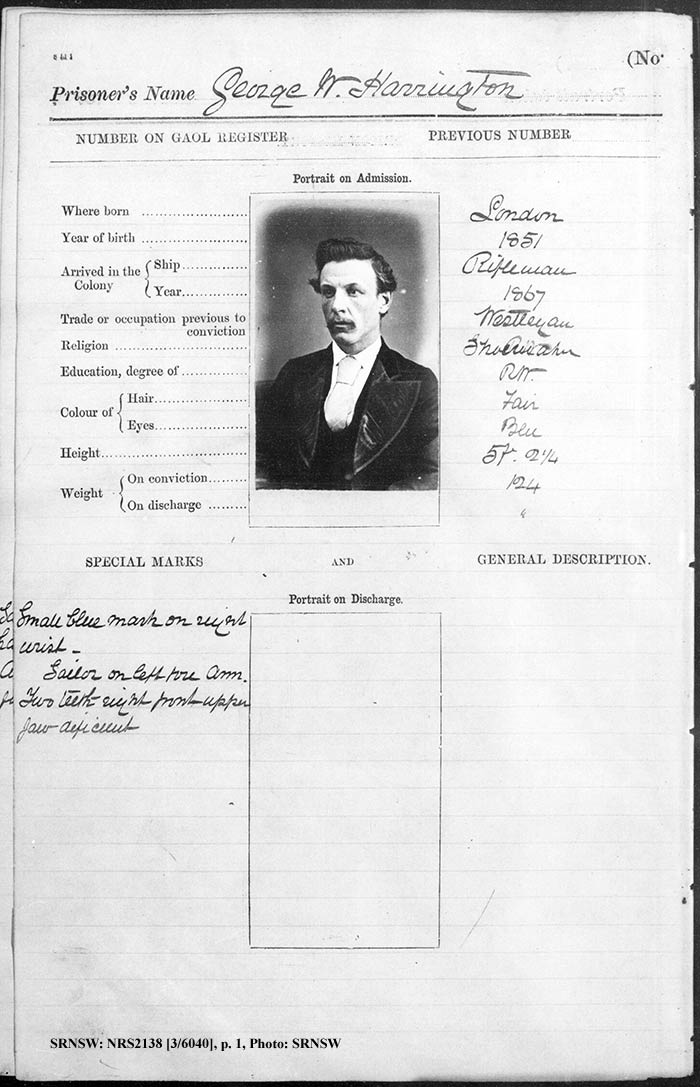
George William Harrington, 1875,
Hugh Sutherland, 1878,
George Harrington, 1880,
John Broom and George Sutherland, 1887,
Henry Wilson, 1890,
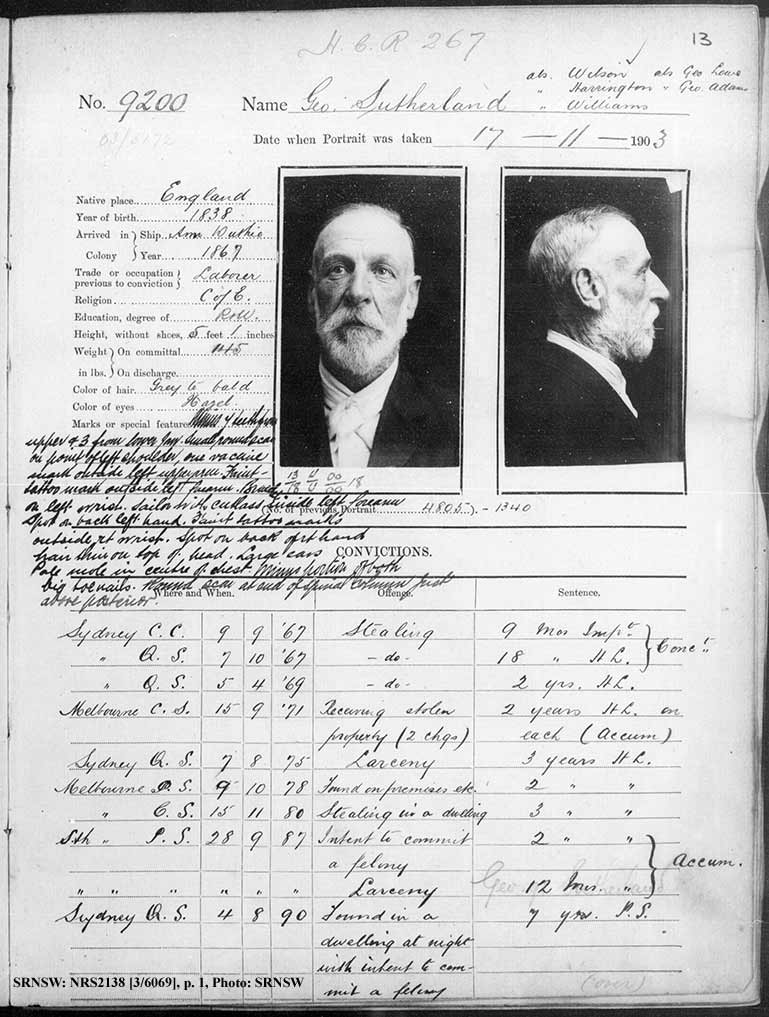
George Sutherland, 1903
The Sydney Morning Herald, Fri 30 Aug 1867 1
CENTRAL POLICE COURT.
THURSDAY.
BEFORE their Worships the Police Magistrate, Messrs Levey, Day, Birrell, Smithers, and Powell.
...
George William Harrington, 16 (said to be a recent arrival from Europe), was charged with larceny. Constable Gamill deposed that in consequence of information received from William Mansfield, of Market-street, dealer, he went in search of prisoner, and about an hour afterwards found him in the Victoria Theatre; charged him with having stolen a ring, the property of Mansfield; he denied the stealing, but said that he found it on the floor of Mansfield's shop; produces a ring which was given to witness by Robert Horne. William Mansfield, of Market-street, dealer, deposed that, yesterday afternoon, prisoner purchases a pair of trousers and other articles; he went behind the counter to try on the trousers; soon after this he (witness) went out, and on his return his boy told him something, and he missed from the till a diamond ring; the ring before the Court is the same, and is worth £15; from what the boy told him hr suspected the prisoner, and reported the matter to the police; he said that he had engaged with Mr Horne, of Pitt-street, as a waiter, and when he was engaged in looking for prisoner, Horne brought the ring. Francis Thompson, in the employ of prosecutor, deposed that after Mansfield went out, prisoner returned and asked to look at some coats; witness went to bring a coat which was hanging outside, and on his return found prisoner behind the counter and the till on the floor; witness told him to give up what he had taken, or he would give him in custody, whereupon he took from his pocket two gold sleeve links; no constable was near, or he would have given prisoner in custody; he told Mr Mansfield on his return, who then missed from the till the diamond ring; witness did not miss the ring, because prosecutor usually took it with him when he went out. William Marshall, waiter at Horne's restaurant, Pitt-street, deposed that prisoner was yesterday hired by Mr Horne as a waiter, to commence at 6 o'clock; between 5 and 6, prisoner gave him this ring; he said he found it on the Racecourse; when witness heard of a ring having been stolen, he gave this ring to Horne, who gave it to Mansfield. Prisoner offered no defence. Committed for trial.
~ ~ ~ ~ ~
Empire, Sat 7 Sep 1867 2
CENTRAL POLICE COURT.—FRIDAY.
————
(Before the Police Magistrate and
Messrs Day, and Hill.)
...
George W Harrington was charged with stealing a silver watch and chain, vale £2 10s, the property of William Farr, of William-street, Woolloomooloo. From the evidence it appeared that the prisoner was in the habit of visiting Farr's (tobacconist) shop; on Tuesday last prosecutor left his shop about 11 am; on his return about 1 o'clock, he found that the watch and chain were gone. CG Jackson, watchmaker, of William-street, deposed that on Tuesday last the prisoner brought the watch and chain produced, and wanted to know what it would cost to repair it; witness told him; and prisoner then asked him to buy it; he at first refused; prisoner said that he bought the watch two years ago in London for £2 10s; witness at last gave prisoner 7s 6d for the watch. Mr Farr deposed that the watch produced (the one sold to Jackson) is his property, and the one stolen from him on Tuesday last. Prisoner was committed to take his trial at the ensuing Court of Quarter Sessions.
~ ~ ~ ~ ~
The Sydney Morning Herald, Sat 7 Sep 1867 3
CENTRAL POLICE COURT.
FRIDAY.
BEFORE their Worships the Police Magistrate, Messrs Pinhey, G Hill, and Day.
...
George William Harrington was brought before the Court on habeas corpus, being under committal for stealing a diamond ring, charged with larceny. William Parr, of Castlereagh-street, tobacconist, deposed that for a bout a week the defendant was a daily customer for cigars until the 26th August, on which day he missed a silver watch and guard, and after which he did not see the prisoner until now: the watch and guard produced are his property, and worth 50s. Christopher G Jackson, of Woolloomooloo, watchmaker, deposed that the watch produced he bought of the prisoner; he said that he bought it in England for 50s; witness subsequently, on information received, gave the watch and guard to the police. Prisoner offered no defence. Committed for trial at the Quarter Sessions.
~ ~ ~ ~ ~
Empire, Tue 10 Sep 1867 4
CENTRAL CRIMINAL COURT.—MONDAY.
————
(Before his Honor Mr Justice Faucett and a
general jury of four.)
...
LARCENY.
George William Harrington was indicted for that he, on the 28th day of August, at Sydney, at the house of one William Mansfield, did, steal, take, and carry away one diamond ring, of the value of £15, the property of the said William Mansfield.
Prisoner, who was undefended, pleaded guilty, and was remanded for sentence.
~ ~ ~ ~ ~
The Sydney Morning Herald, Tue 10 Sep 1867 5
CENTRAL CRIMINAL COURT.
MONDAY.
BEFORE his Honor Mr Justice Faucett.
...
LARCENY.
George W Harrington was indicted for that he did, on the 28th August, 1867, at Sydney, enter the premises of one William Mansfield, and steal therefrom a ring, valued at £15, the property of the said William Mansfield.
The prisoner pleaded guilty, and was remanded for sentence.
~ ~ ~ ~ ~
Empire, Wed 11 Sep 1867 6
CENTRAL CRIMINAL COURT.—TUESDAY.
————
(Before his Honor Mr Justice Faucett.)
SENTENCE.
George William Harrington, who yesterday pleaded guilty to stealing a gold diamond ring of the value of £15, the property of one William Mansfield, was brought up for sentence.
His Honor said that the prisoner was under the age of sixteen years, he thought it would be a pity to send him to a common gaol but that he was a fit subject for a reformatory school. The sentence, therefore, was that the prisoner be sent to such reformatory school as the Colonial Secretary shall appoint, and be there detained for the period of fourteen months.
~ ~ ~ ~ ~
The Sydney Morning Herald, Wed 11 Sep 1867 7
CENTRAL CRIMINAL COURT.
TUESDAY.
BEFORE his Honor Mr Justice Faucett.
LARCENY.
George W Harrington, who pleaded guilty yesterday to a charge of stealing a ring, valued at £15, the property of William Mansfield, was brought up for sentence.
His Honor, on account of prisoner's youth, he being under sixteen years of age, considered him a fit person to be dealt with under the Reformatories Act. He sentenced the prisoner to be sent to such reformatory school as the Colonial Secretary might dictate, there to remain for a period of fourteen months.
~ ~ ~ ~ ~
Empire, Tue 8 Oct 1867 8
METROPOLITAN COURT OF GENERAL
QUARTER SESSIONS.
MONDAY, OCTOBER 7th.
(Before his Honor Judge Ellis.)
Mr Butler prosecuting.
STEALING.
George William Harrington was charged with feloniously stealing one watch, and one watch chain, on the 26th August last, at Sydney, the property of one William Farr. The prisoner pleaded guilty. Remanded for sentence.
~ ~ ~ ~ ~
The Sydney Morning Herald, Tue 8 Oct 1867 9
LAW.
————
METROPOLITAN COURT OF GENERAL
QUARTER SESSIONS.
MONDAY, October 7.
BEFORE his Honor Judge Ellis, Mr Butler prosecuting.
STEALING.
George William Harrington, charged with feloniously stealing one watch and one watch chain, on the 26th of August last, at Sydney, the property of one William Farr. The prisoner pleaded guilty. Remanded for sentence.
~ ~ ~ ~ ~
Empire, Thu 10 Oct 1867 10
METROPOLITAN COURT OF GENERAL
QUARTER SESSIONS.—WEDNESDAY.
————
(Before Judge Ellis, Mr Butler prosecuting.)
SENTENCE.
George William Harrington, who pleaded guilty, on Monday, to the charge of feloniously stealing one watch and one watch chain, at Sydney, on the 26th of August last, the property of one William Farr, was brought up for sentence this morning. Sentence—Eighteen month's hard labour in Sydney gaol.
George William Harrington, 1869
Empire, Mon 29 Mar 1869 11
WATER POLICE COURT.—SATURDAY.
(Before the Water Police Magistrate.)
...
George W Harrington was charged with stealing a green stone and gold chain from George T Rice. He was remanded until Monday.
~ ~ ~ ~ ~
Empire, Wed 31 Mar 1869 12
WATER POLICE COURT.—TUESDAY.
(Before the Water Police Magistrate and Messrs Levy
and Renwick.)
George W Harrington was charged with stealing a green stone and a gold chain, of the value of £5, from a person named GF Rice. The offence was clearly established, and he was committed for trial at the next Quarter Sessions.
~ ~ ~ ~ ~
The Sydney Morning Herald, Wed 31 Mar 1869 13
WATER POLICE COURT.
TUESDAY.
BEFORE the Water Police Magistrate, with Messrs Levey and Renwick.
...
George Harrington appeared on remand, charged with stealing a green stone and gold chain, valued at £5, the property of GT Rice. Prisoner was committed to take his trial at the next Court of Quarter Sessions.
~ ~ ~ ~ ~
Empire, Tue 6 Apr 1869 14
QUARTER SESSIONS.—MONDAY.
(Before his Honor District Judge Dowling.)
...
LARCENY.
George William Harrington was charged with stealing a Maori idol, and a gold chain, the property of George Thomas Rice. Prisoner, who was undefended, pleaded not guilty. Prosecutor was a dealer in curiosities and other things from the South Sea Islands. Prisoner went into Rice's shop and selected a parcel of curiosities which he said he would purchase. Rice went out from the shop to get change, and while he was away prisoner took the idol and a gold chain out of the parcel and decamped. Prisoner afterwards disposed of the idol to Dr Cox for 5s. The jury found the prisoner guilty, and he was sentenced to two years' hard labour in Parramatta gaol.
~ ~ ~ ~ ~
The Sydney Morning Herald, Tue 6 Apr 1869 15
LAW.
————
METROPOLITAN COURT OF QUARTER
SESSIONS.
MONDAY.
BEFORE Mr District Court Judge Dowling and juries of twelve.
Mr Butler prosecuted for the Crown.
...
LARCENY.
George William Harrington was indicted for stealing a Maori idol and gold chain from the shop of Mr Rice, in Lower George-street. The evidence shewed that the prisoner went to Mr Rice's shop, on the 4th March, and pretended that he was desirous of purchasing curiosities to take with him to England. He asked for change of a £10 note, and while the prosecutor went out for change, the prisoner made off with the idol (formed of New Zealand greenstone, and valued by Rice at £3) and the chain. Detective Hogan apprehended the prisoner on the day before Good Friday, with the stolen chain in his possession. The Maori god was traced to the possession of Dr JC Cox. Prisoner, it appeared, had been a patient in the Infirmary, and a few days after his recovery, about the 7th of March, he went to Dr Cox, professedly, to thank that gentleman, for his kindness to him in the Infirmary. He offered the idol for sale; and the doctor was induced, from motives of charity, to give the prisoner 5s for it. Prisoner was found guilty. Prisoner had been convicted twice previously, and he was sentenced to two years' imprisonment in Parramatta gaol.
George William Harrington, 1871
The Argus, Thu 14 Sep 1871 16
MELBOURNE CRIMINAL SESSIONS.
————
Subjoined is the list of prisoners now in the Melbourne Gaol awaiting trial at the Melbourne Criminal Sessions, which commence to-morrow in the Supreme Court. The list is the largest which has been published for many months, but that is to be accounted for in a great measure by the fact that there are now no Bourke General Sessions, and prisoners of the class who used to be tried at those sessions are now committed to the Criminal Sessions:—
...
George W Harrington, stealing from a dwelling—two charges.
...
In addition to the above prisoners, there are several other persons to be tried, who are admitted to bail.
~ ~ ~ ~ ~
The Argus, Tue 19 Sep 1871 17
At the Criminal Sessions yesterday,
...
The first of several charges of stealing in a dwelling preferred against George Harrington, was proceeded with. He was convicted of receiving watches, jewellery, and money, stolen from Robert Bradshaw, hotelkeeper, of Richmond. The jury seemed disinclined to believe him capable of the smart piece of crime laid to his charge, viz, running upstairs to the bedroom of a public-house while the landlord supposed him to be in a back-parlour, breaking open a drawer containing money, watches, &c, possessing himself of the contents, and returning to the parlour to have a second supply of refreshments, all in the course of some eight or ten minutes, without being detected. The prisoner was remanded for sentence.
~ ~ ~ ~ ~
The Argus, Wed 20 Sep 1871 18
CRIMINAL SESSIONS.
————
OLD COURT-HOUSE—MONDAY, SEPT 18.
(Before Mr Justice Molesworth.)
Mr JH Dunne prosecuted for the Crown.
...
STEALING IN A DWELLING.
George Harrison was charged with stealing two watches, one chain, a locket, a brooch, and some money, of the value altogether of £40, from Robert Bradshaw, of the Victoria Hotel, Victoria-street, Richmond.
Mr Byrne defended the prisoner.
On the evening of Monday, the 3rd July, about 8 o'clock, the prisoner entered the back parlour of the hotel. He asked for brandy, and invited Bradshaw to join him. He gave the landlord a £1-note. Bradshaw ran upstairs to his bedroom, where he kept his money, and got the change. The prisoner asked for the newspaper, and the landlord gave it to him and left him alone in the room. Ten or twelve minutes afterwards he went back to the room. The prisoner ordered another drink, and left immediately after it had been served. Bradshaw had occasion to go upstairs shortly afterwards for change. The drawer in which he kept his money, watches, &c, was gone. He found it on the landing, minus its contents. When he changed the prisoner';s note he had locked the drawer. There was a chisel in the room. It had evidently been used to force the drawer open. The parlour where the prisoner had been sitting was at the foot of the staircase leading up to the bedroom. The prisoner was at the house on the previous day. Detective Williams, in company with other detectives, went to the boarding-house of Mary Ann White, in Simpson's-road, on the morning of the 22nd August. The prisoner was in his room. He said, "I expected you here; I know you detectives have been shepherding me for some time." They told him they had a search-warrant. It referred to another matter. He said, "Search away; you haven't got me to rights this time." There was a locket on the table. The prisoner said it was not his, but the property of the young woman in the next room. Subsequently, when the young woman said, "George gave it to me," the prisoner said, "I did give it to her, and I will account for it." Williams asked, "How do you account for it?" "Oh, never mind," he replied. The locket was one of the articles missed from the Bradshaw's drawer. Detective Williams said he told Miss White that if she told him anything that would enable him to recover a quantity of stolen property he would get a light sentence passed on the prisoner. Mrs Bradshaw saw the locket, together with a quantity of other jewellery and some money, in the drawer on the morning of the 3rd July. Mary Selina Hawthorn White, when examined, said she believed that the prisoner gave her the same locket about a month before he was apprehended. The prisoner boarded at her mother's house for about six weeks. During that time he never was straitened for want of means. The police apprehended her on the same occasion as the prisoner, and she was in custody for several days. Williams told her he would get her discharged, and she was discharged on the following Friday. She was engaged to the prisoner. She did not know how the locket got into his room; she left it in the kitchen on the night previous to the apprehension of the prisoner.
Mr BYRNE commented on the improbability of a man who expected a visit from the detectives having stolen property lying ready for their inspection on his table. In the short period he was in Bradshaw's house what time had he to run up stairs and break open a drawer in a dark room?
The jury found the prisoner "Guilty" of receiving.
He was remanded for sentence, as there was another charge against him.
The Court adjourned until the following (this) day.
————————
OLD COURT-HOUSE—TUESDAY, SEPT 19.
(Before his Honour Mr Justice Molesworth.)
STEALING FROM AN HOTEL
George W Harrington, the young man convicted on the previous day of receiving jewellery stolen from an hotel in Simpson's-road, was again placed in the dick charged with stealing jewellery the property of Mr Anderson, from the Supreme Court Hotel. Mr Anderson had, on the 13th July, locked up a box containing about £70 worth of jewellery. On the following morning the property was missed. Shortly afterwards Harrington sold a watch identified by Mr Anderson to a person named Cook, at Emerald-hill.
Prisoner was found "Guilty of receiving," and sentenced to two years' hard labour. For the offence of which he was convicted on the previous day, he was also sentenced to two years' hard labour, cumulative.
George William Harrington, 1875
The Sydney Morning Herald, Mon 9 Aug 1875 19
LAW.
————
COURT OF QUARTER SESSIONS.
SATURDAY.
Before Mr District Court Judge Wilkinson.
Mr WJ Foster prosecuted for the Crown.
...
STEALING IN A DWELLING.
George William Harrington was charged with having, on the 23rd of July last, stolen from the dwelling of one Owen Nolan a sum of about £70, and a silver watch, the property of the said Owen Nolan. Prisoner pleaded not guilty, and was undefended. The prisoner, who was an assistant steward on board the Ann Duthie, having lodged at the Waratah Hotel, Upper William-street, before, went there on the night of the 23rd ultimo, and obtained a bed. On that evening it was discovered that a drawer in which was kept about £70 had been broken open, and that a box containing gold, notes, and silver—the latter to the value of about £14, and cheque—valued in all as stated, had been abstracted. On the following day the prisoner was arrested by detective officer William Camphin, who found on the prisoner four sovereigns, half a sovereign, a £1 note, six half-crowns, one florin, 1d, two 6d pieces, two 3d pieces, and one 1d piece. There was also found on the prisoner some bills, and a receipt for a registered letter that had been posted by prisoner to somebody in Victoria. From something that he heard, Detective Camphin went to a house at Rushcutter Bay, and received a cash-box which contained £12 6s in silver. Out of the parcel of silver coins, there were picked two pieces which were particularly described by the landlord, as having been stolen. The residents of the house at Rushcutter Bay described prisoner as coming there on the night of the robbery with lots of gold, notes, silver, and papers. The jury returned a verdict of guilty against the prisoner, who early in 1867 received a sentence of nine months, at the end of that year a sentence of 18 months, in 1869 a sentence of three years; while in 1871, in Victoria, he received two sentences of two years.
...
SENTENCES.
...
George William Harrington, found guilty of stealing in a dwelling to the value of £5, was sentenced to three years' hard labour in Darlinghurst gaol.
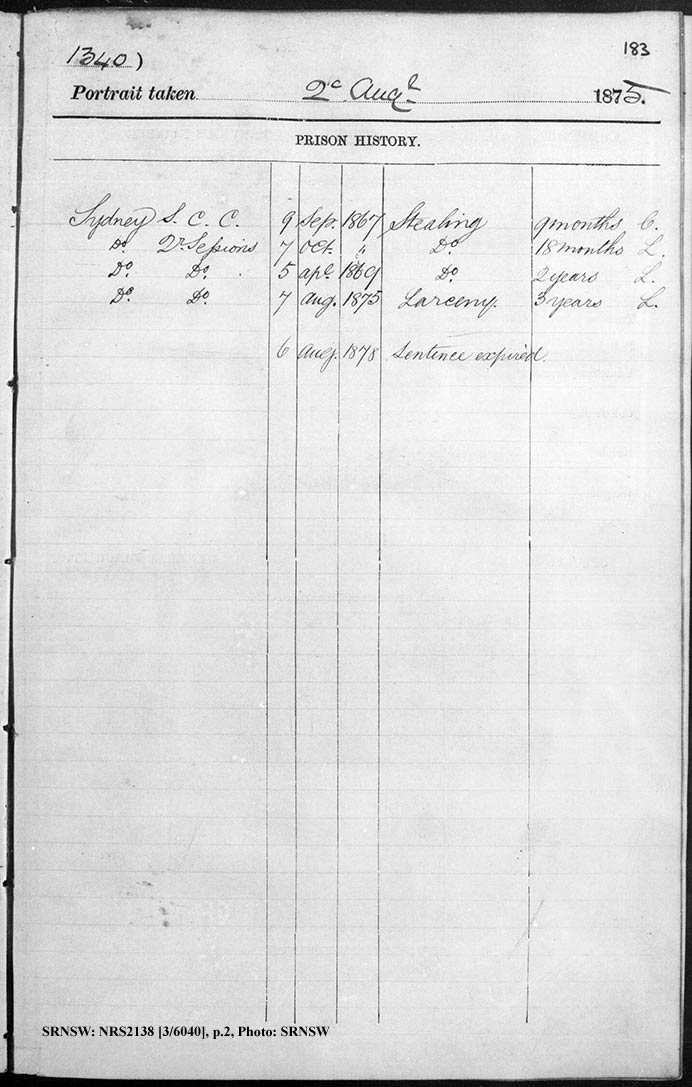
George W Harrington, Gaol photo sheet. No. 1340 20
 |
 |
Gaol Photo Sheet - Transcribed Details
Gaol Register No. 1340
Portrait Taken: 2nd August 1875
Prisoner's Name: George W Harrington
|
Year of birth: 1851 Arrived Ship: Rifleman Trade or occupation Religion: Wesleyan Education, degree of: R & W Colour of hair: Fair Colour of eyes: Blue Height: 5' 21⁄4" Weight On committal: 124 |
General Description:
|
|
(No. of previous Portrait ... ) PRISON HISTORY |
|||||
| Where and When | Offence. | Sentence | |||
|
Sydney SCC Sydney Q.S ditto ditto
|
9 7 5 6 6 |
9 10 4 8 8 |
1867 1867 1869 1875 1878 |
Stealing ditto ditto Larceny Sentence expired |
9 months C. 18 months C. 2 years L. 3 years LL.
|
Hugh Sutherland, 1878
The Argus, Fri 11 Oct 1878 21
POLICE.
———o———
At the CITY COURT on Wednesday, before Mr Call, PM, a man well known to the police, named Hugh Sutherland, [aka George William Harrington], was charged with being unlawfully on the premises of the Melbourne Club Hotel, in Stephen-street. Mr Aers, the landlord of the hotel, stated that, having retired to rest at an early hour on the night of the 1st, he was aroused from his slumbers between 11 and 12 o'clock by hearing some person in his bedroom, and on getting out of bed he observed a man endeavouring to unstrap a portmanteau. An alarm was given, but the intruder managed to escape downstairs, and decamp into the street. He was followed by the barman, however, who, after a chase, succeeded in coming up with the burglar, and gave him into custody. During the man's flight it was noticed that he threw something away, which proved to be a watch and chain belonging to Mr Aers. The prisoner, who, it was stated by the police, had served terms of imprisonment both in this colony and New South Wales for hotel robberies, was sentenced to two years' imprisonment with hard labour.
George Harrington, 1880
The Argus, Fri 5 Nov 1880 22
Last night Detective Nixon arrested a man named George Harrington, alias Sutherland, upon a charge of stealing two gold brooches and a pair of earrings from the premises of Mr Thomas Samuel Davis, of the Cross Keys Hotel, Clarendon-street, Emerald-hill. The prisoner, who is a well-known hotel chief, was captured by Nixon with the whole of the property in question in his possession. He will be brought before the City Bench this morning.
~ ~ ~ ~ ~
The Argus, Mon 8 Nov 1880 23
POLICE INTELLIGENCE.
————
...
George Harrington, alias Sutherland, was charged with stealing two gold brooches and a pair of ear-rings, the property of Mr Thomas S Davis, of Emerald-hill, and was, on the application of Detective Nixon, remanded to appear before the local Bench on Wednesday next.
~ ~ ~ ~ ~
The Argus, Tue 16 Nov 1880 24
CENTRAL CRIMINAL COURT.
——o——
OLD COURT-HOUSE.— MONDAY, NOV 15.
(Before His Honour Mr Justice Stephen.)
Mr CA Smyth prosecuted for the Crown.
...
PLEADED GUILTY.
George Harrison pleaded guilty to a charge of stealing from a dwelling.
~ ~ ~ ~ ~
The Argus, Thu 18 Nov 1880 25
The sittings of the Central Criminal Court for November were concluded yesterday, before his Honour Mr Justice Stephen. Wm Frost, for larceny, was sentenced to two years' imprisonment; George Harrington, for stealing from a dwelling, was sent to gaol for three years; Wm Farmer, who pleaded guilty to a charge of bigamy, was sent to gaol for two years; and Ah Ruh, for wounding with intent to do grievous bodily harm, was sent to gaol for six months.
John Broom and George Sutherland, 1887
The Cootamundra Herald, Sat 7 May 1887 26
QUARTER SESSIONS.
THURSDAY.
Before His Honor Judge Forbes.
The Quarter Sessions opened on Thursday before his honor Judge Forbes.
Mr Pitcairn prosecuted on behalf of the crown.
ATTEMPTED UNNATURAL OFFENCE.
John Broome [aka John Broom] (on bail) was charged with attempting to commit an abominable offence upon one George Sutherland, at Temora, on the 2nd February last. Prisoner pleaded not guilty, and was defended by Mr O'Donnell. The following were the names of the jury empanelled to try the case:—J Vaughan, J Connell, RM Ogilvie, J Corby, P Halinan, M Sawyer, SE White, M Cooney, P Sullivan, sen., P White, G Troy, and W Curry.
Mr Pitcairn, having opened the case, detailed the circumstances of the offence, and submitted that the facts were so clear that the jury could have no doubt as to the crime having been attempted by prisoner. The only defence that he could conceive of was that prisoner's previous good character might be urged in his favour. But if prisoner was as honest as daylight or how industrious he might be in the ordinary walks of life, it did not tend to show that he was incapable of committing the offence he was charged with. People who had experience with cases of this description were aware that filthy offences were committed by persons who bore most exemplary characters.
Constable Cannon, of Carathool, deposed that he arrested prisoner at Broken Dam, where he had been employed as a boundary rider by Mr Hannah; he made no reply to the charge.
Thomas Peadon, proprietor of the Beehire hotel; Broken Dam, about 20 miles from Temora, deposed that he remembered seeing prisoner at his hotel about the 2nd February; he was accompanied by a man named Sutherland; on that day about 4 o'clock in the afternoon James Wilson, Patrick O'Hare, and witness saw prisoner and the man named Sutherland in an adjoining room to the bar. Witness here detailed the particulars of what he saw, which were of a disgusting nature and unfit for publication.
Witness was cross-examined at considerable length by Mr O'Donnell. It was elicited that it was two months after the offence took place that witness laid the information.
James Wilson, groom in the employ of last witness, deposed to seeing the offence committed.
Patrick O'Hare and Robert Dunstan gave evidence in corroboration of that given by the previous witnesses.
Mr O'Donnell addressed the jury, and said the circumstances looked very black against the prisoner, but he asked the jury to bear in mind that, although the information had been laid against the prisoner two months after the alleged offence had been committed, he did not attempt to leave the neighbourhood. Mr O'Donnell read a number of testimonials from influential people in the district testifying to the good character hitherto borne by the prisoner; and he contended that the witnesses were drawing upon their imagination. He thought Peadon, the publican, should have taken some steps to prevent the crime being committed, instead of drawing the attention of other people to it. It was a significant fact that the man Sutherland was not brought forward.
His Honor said that if Sutherland was here he would in all probability be placed alongside the prisoner.
Mr O'Donnell said he was aware of that, but Sutherland would have been able to make a statement.
His Honor summed up, and said that certificates of character should be taken in a reasonable way. Regarding cases of robbery character for upright and honest dealing could be urged in a prisoner's favour; but in the present case it did not matter what character prisoner had previously borne, as nobody but himself was suspected. He might commit such offences, and still bear an upright character. The evidence against prisoner was very direct: and if the jury believed the evidence, the prisoner was as guilty as any man that ever stood in the dock; but if, on the other hand, they thought there was any reasonable doubt, the should give the prisoner the benefit of it.
The jury retired to consider their verdict at 11.25, and after an absence of eight minutes returned into court with a verdict of guilty, with a recommendation to mercy.
Mr O'Donnell said a few words on behalf of the prisoner.
His Honor on sentencing prisoner said the offence was proved upon the strongest evidence, and the jury could come to no other verdict. The crown could have charged prisoner with having committed the offence. It was quite competent for him (the judge) too order prisoner to receive a certain number of lashes; but, in view of the recommendation of the jury, he would not inflict that punishment. The sentence of the court would be that prisoner be kept to penal servitude for a period of five years.
The sentence caused considerable consternation in the court. Prisoner appeared to be dumbfounded, and was removed to the gaol in an apparently dazed condition.
This being the only case for trial, the court adjourned Sine die.
Henry Wilson, 1890
Evening News, Fri 11 Jul 1890 27
CAUGHT RED-HANDED.
————
At the Central Police Court to-day, before Mr W Johnson, Henry Wilson, 42, engineer, was charged with having been found by night in the house of John Duffy, the Agricultural Hotel, the corner of Pitt and Campbell streets, with intent to commit a felony. Detective Keating stated that last night he went to the hotel, and Duffy told him that he had caught prisoner in the act of trying to open a chest of drawers. Upon examining the drawers he found a hole or mark about half an inch square on the top of them, and there were chips of wood on the floor. In reply to the charge, prisoner said "All right." He found a knife on the prisoner with one of the blades bent. The prosecutor stated that a was asleep in the bedroom at about a quarter past 9 last night, and was awoke by a scraping noise. He got up, turned up the gas, and saw the prisoner close to the drawers. When he saw him get up, prisoner threw himself on to his back on the floor at the same time remarking "My God, what a drunken man may do!" There were valuables and money in the drawers. Prisoner, who pleaded guilty, was committed for trial at the Quarter Sessions.
~ ~ ~ ~ ~
The Sydney Morning Herald, Sat 12 Jul 1890 28
POLICE.
————
Mr Whittingdale Johnson, SM, presided at the CENTRAL POLICE COURT yesterday.
...
Henry Wilson, 42, engineer, was charged with having been found by night in the dwelling of John Duffy, licence of the Agricultural Hotel, Pitt and Campbell streets, with intent to commit a felony. Detective Edward Keating deposed that at about 9.20 on Thursday evening he arrested the accused, who, the prosecutor had informed him, had been found in the act of cutting open a chest of drawers; he found a quantity of chips of wood on the floor; in reply to the charge, he said, "All right;" prisoner said he would plead guilty if he were tried at the Central Court.
John Duffy stated that at 9.15 on Thursday night he was awakened by a scraping noise in his bedroom; he turned up the gas, and saw the accused, who remarked, "What a drunken man will do;" accused was perfectly sober; he detained him until the arrival of the police; there was a bout £16 worth of valuables in the drawers.
Accused pleaded guilty, and was committed to take his trial at the Court of Quarter Sessions.
~ ~ ~ ~ ~
Evening News, Tue 5 Aug 1890 29
SENTENCED AT THE SESSIONS.
————
The following prisoners pleaded guilty at the Quarter Sessions yesterday, and were sentenced by his Honor Judge McFarland:
...
Henry Wilson, entering a dwelling at night with intent to commit a felony, seven years' penal servitude;
~ ~ ~ ~ ~
The Sydney Morning Herald, Tue 5 Aug 1890 30
METROPOLITAN QUARTER SESSIONS.
MONDAY.
(Before his Honor Judge McFarland and a jury of 12.)
JURORS FINED.
John Kickham, gentleman, of McLaren-street, St Leonards, was fined £2 for non-attendance as a juror.
...
ENTERING WITH INTENT.
Henry Wilson, arraigned with having on the 10th July, 1890, been found on the premises of James Duffy with intent to commit a felony, pleaded guilty. The record showed that the following sentences had previously been passed against the prisoner:—Sydney Quarter Sessions, October 17, 1867, 18 months' imprisonment, with hard labour, for stealing; Sydney Quarter Sessions, 1869, two years' imprisonment, with hard labour, for stealing; Melbourne Petty Sessions, November 5, 1871, four years' imprisonment, with hard labour, for receiving stolen property on two charges; Sydney Quarter Sessions, August 7, 1875, three years' imprisonment, with hard labour, for larceny; Melbourne Petty Sessions, October 9, 1878, two years' imprisonment, with hard labour, for being illegally on the premises; Melbourne Petty Sessions, November 15, 1880, three years' imprisonment, with hard labour, for stealing from a dwelling; and Melbourne Petty Sessions, September 28, 1887, three years' imprisonment, with hard labour, for stealing from a dwelling.
His HONOR, in sentencing the prisoner, said it appeared from the records that between October, 1867, and the present time prisoner had been sentenced in various court of justice to imprisonment for 172 years, and now at the end of that time he had pleaded guilty to another charge of entering a house with intent to steal. He presumed that altogether this colony and Victoria had been put to an expense of something like £750 or £800 on account of the prisoner's convictions, at a moderate calculation. For him to pass a sentence of two or three years, therefore, would be perfectly idle in the interests of the prisoner or the public, and he should inflict a penalty that would be an example to him. The sentence of the Court was that prisoner should undergo a sentence of seven years' penal servitude.
Henry Wilson (aka George Harrington), Gaol photo sheet. No. 4805 31
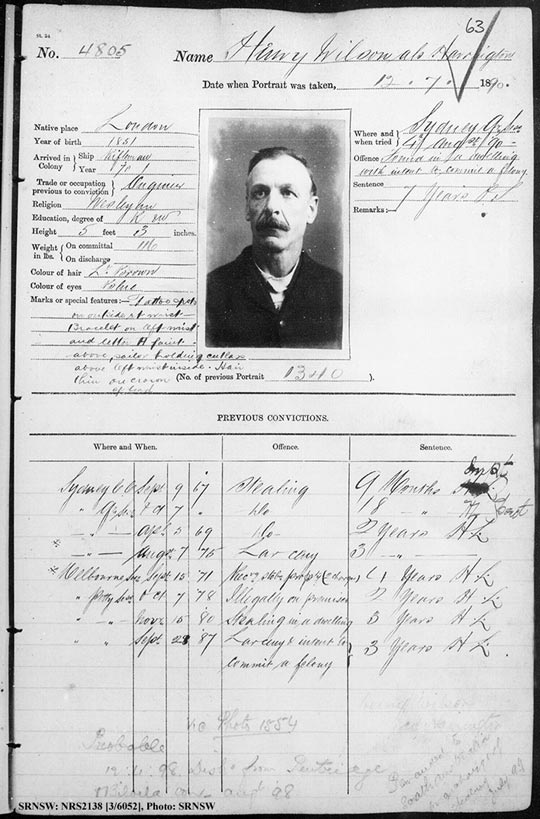 |
Gaol Photo Sheet - Transcribed Details
Gaol Register No. 4805
Portrait Taken: 12-7-1890
Name: George W. Harrington
(aka Henry Harrington)
|
Year of birth: 1851 Arrived Ship: Rifleman Trade or occupation Religion: Wesleyan Education, degree of: R & W Colour of hair: Light brown Colour of eyes: Blue Height: 5' 3" Weight On committal: 116 |
Where and when tried: Sydney Q.S. 4th August 1890 Offence: Found in a dwelling with intent to commit a felony Sentence: 7 years PS
|
|
(No. of previous Portrait ... 1340) PRISON HISTORY |
|||||
| Where and When | Offence. | Sentence | |||
|
Sydney CC Sydney Q.S ditto MELBOURNE SC SYDNEY Q.S MELBOURNE PC ditto ditto |
9 7 5 15 7 7 15 28 |
9 10 4 9 8 7 11 9 |
1867 1867 1869 1871 1875 1878 1880 1887 |
Stealing ditto ditto Receive stolen property (2 charges) Larceny Illegally on premises Stealing in a dwelling Larceny with intent to commit a felony |
9 months H.L. 18 months H.L. 2 years H.L. 4 years H.L. 3 years H.L. 2 years H.L. 3 years H.L. 3 years H.L |
|
Photo 1554. Probable 12-4-1898 Discharged from Pentridge. Biloela conf - Aug 1898. Remand to South Australia on a charge of stealing July 1899. |
|||||
George Sutherland, 1903
The Sydney Morning Herald, Sat 28 Nov 1903 32
LAW NOTICES.
...
QUARTER SESSIONS LIST.
————
List of Causes.
The sittings of the Sydney Quarter Sessions will commence on Monday, before Judge Backhouse. Mr Harris will be Crown Prosecutor. Following is the list of causes:—
...
George Sutherland, indecent assault;
~ ~ ~ ~ ~
The Sydney Morning Herald, Fri 4 Dec 1903 33
LAW NOTICES.
...
SYDNEY QUARTER SESSIONS.— Friday, December 4.
...
George Sutherland, indecent assault.
~ ~ ~ ~ ~
The Daily Telegraph, Sat 5 Dec 1903 34
METROPOLITAN QUARTER SESSIONS.
(Before Judge Backhouse and Juries.)
Mr H Harris appeared for the Crown.
CHARGE OF ASSAULT.
George Sutherland, an old man, was found guilty of having on November 9 last in Hyde Park, Sydney, assaulted a boy. He was remanded for sentence.
~ ~ ~ ~ ~
The Sydney Morning Herald, Sat 5 Dec 1903 35
QUARTER SESSIONS.
(Before Judge Backhouse and juries.)
Mr Herbert Harris, Crown Prosecutor.
ASSAULT.
George Sutherland, an old man, pleaded not guilty to a charge of having on November 9 last, at Sydney, assaulted Owen Gordon. Accused was undefended. Accused entered the witness box and denied the story of the prosecutor. Under cross-examination, Sutherland said that he was a shoeblack. He had been sentenced to terms of imprisonment totalling 32 years since 1865, for breaking and entering and stealing. He had to work somehow, and that was why he took to cleaning boots. No one would employ him on account of his character. The jury convicted the accused and he was remanded for sentence.
~ ~ ~ ~ ~
The Daily Telegraph, Tue 8 Dec 1903 36
METROPOLITAN QUARTER SESSIONS.
(Before Judge Backhouse and Juries.)
Mr H Harris appeared for the Crown.
...
SENTENCES.
George Sutherland, an old man, convicted of having assaulted a boy, was sentenced to 18 months' imprisonment with hard labor.
~ ~ ~ ~ ~
The Sydney Morning Herald, Tue 8 Dec 1903 37
QUARTER SESSIONS.
(Before Judge Backhouse and juries.)
Mr Herbert Harris, Crown Prosecutor.
...
SENTENCES.
...
George Sutherland, an old man, who had been convicted of a serious assault, was sentenced to imprisonment with hard labour for 18 months.
~ ~ ~ ~ ~
George Sutherland, gaol photo sheet No. 9200 38
 |
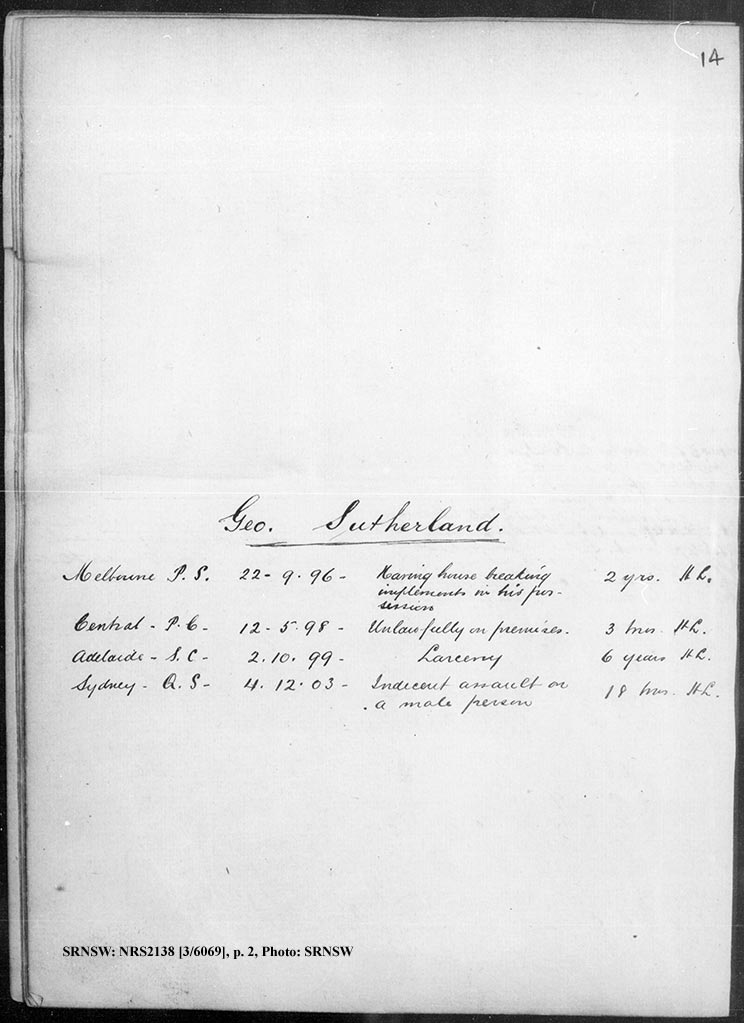 |
Gaol Photo Sheet - Transcribed Details
Gaol Register No. 9200
HCR 267
03-5173
Portrait Taken: 17-11-1903
Name: George Sutherland
(aka George Wilson, George Lowe, George Harrington, George Williams)
|
Year of birth: 1838 Arrived Ship: Ann Duthie Trade or occupation Religion: C of E Education, degree of: R & W Colour of hair: Grey to bald Colour of eyes: Hazel Height: 5' 1" Weight On committal: 145 |
|
|
(No. of previous Portrait ... 4805 ) - 1340 PRISON HISTORY |
|||||
| Where and When | Offence. | Sentence | |||
|
Sydney CC ditto MELBOURNE GS SYDNEY Q.S MELBOURNE PS ditto GS South Melbourne PS Sydney Q.S
Adelaide SC Sydney Q.S |
9 5 15 7 9 15 28 4
2 4 |
9 4 9 8 10 11 9 8
10 12 |
1867 1869 1871 1875 1878 1880 1887 1890
1899 1903 |
Stealing ditto Receive stolen property - 2 charges Larceny Found on premises etc Stealing in a dwelling Intent to commit a felony Found in a dwelling at night with intent to commit a felony Having house breaking implements Unlawfully on premises Larceny Indecent assault on a male person |
9 months HL 2 years HL 2 years HL on each charge. Accum 3 years HL 2 years HL 3 years HL 2 years HL
3 months HL. 6 years HL. 18 months HL. |
George Harrington, 1905
Evening News, Fri 6 Oct 1905 39
DARLINGHURST SESSIONS.
——————
SENTENCES TO-DAY.
————
At the Darlinghurst Sessions to-day, his Honour Judge Docker sentenced the following, who had pleaded guilty:—
...
George Harrington, 65, who pleaded guilty to stealing, was sentenced to five years’ penal servitude. The prisoner was shown to be an old offender, as since 1867 he had been sent to gaol in Sydney, Melbourne, and Adelaide on various charges. His longest sentence was seven years, inflicted in 1890 at Sydney. Including his present punishment, Harrington has been sentenced to about 42 years’ imprisonment.
~~~~~
George Harrington, Gaol photo sheet. No. 9854 40
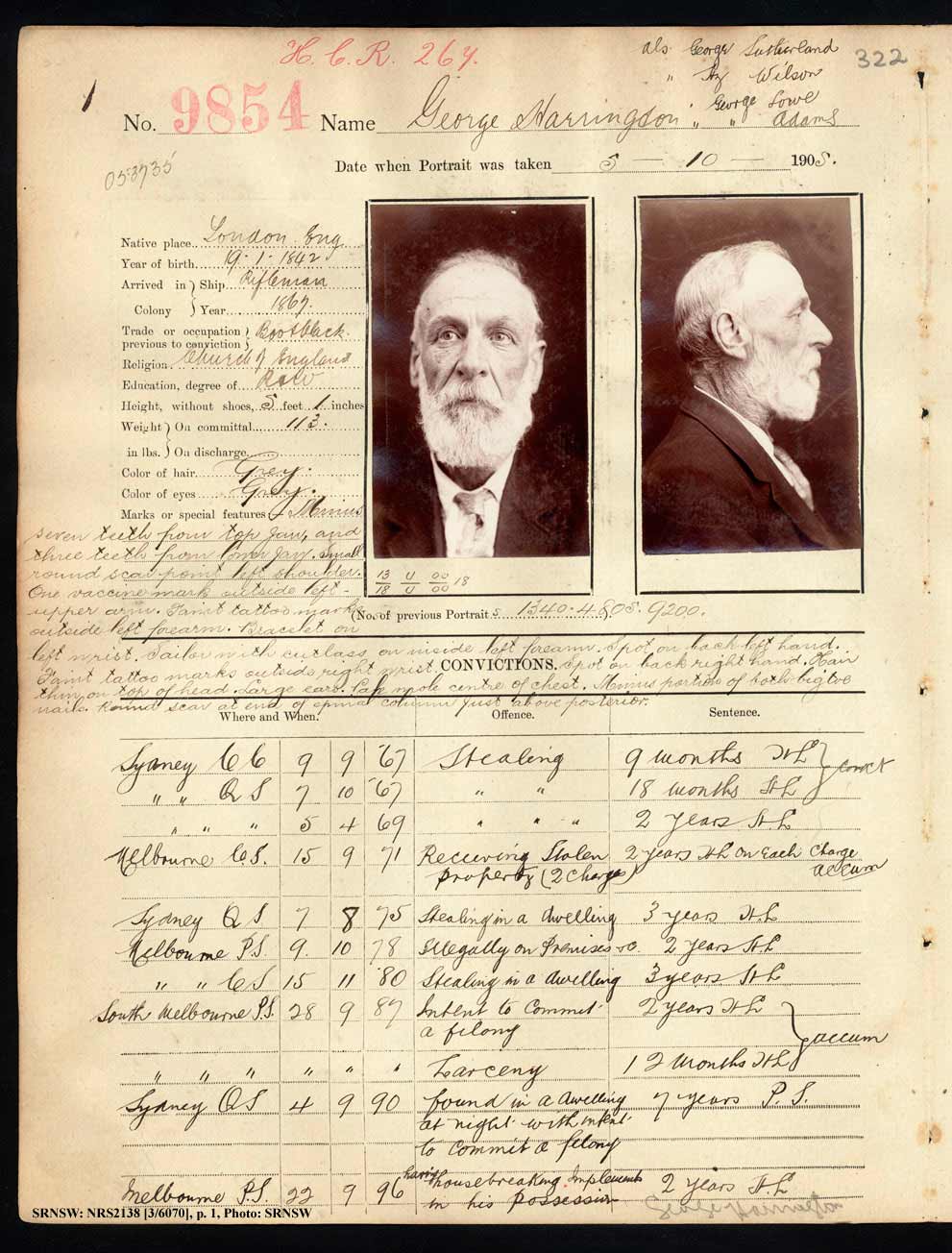 |
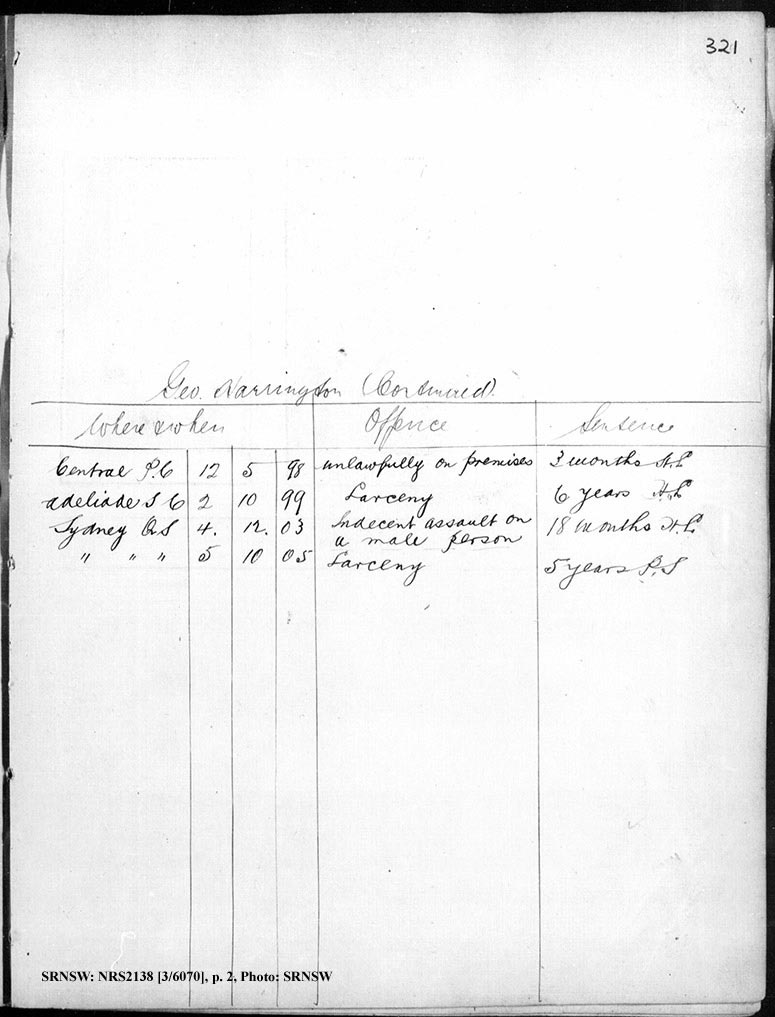 |
Gaol Photo Sheet - Transcribed Details
Gaol Register No. 9854
Portrait Taken: 5-10-1905
Name: George Harrington
(aka George Sutherland, Henry Wilson, George Lowe, George Adams)
|
Year of birth: 19.1.1842 Arrived Ship: Rifleman Trade or occupation Religion: Church of England Education, degree of: R&W Colour of hair: Grey Colour of eyes: grey Height: 5' 1" Weight On committal: 113 |
|
|
(No. of previous Portrait ... 4805 ) - 1340 PRISON HISTORY |
|||||
| Where and When | Offence. | Sentence | |||
|
Sydney CC ditto MELBOURNE GS SYDNEY Q.S MELBOURNE PS ditto GS South Melbourne PS Sydney Q.S |
9 5 15 7 9 15 28 4 |
9 4 9 8 10 11 9 8 |
1867 1869 1871 1875 1878 1880 1887 1890 |
Stealing ditto Receive stolen property - 2 charges Larceny Found on premises etc Stealing in a dwelling Intent to commit a felony Found in a dwelling at night with intent to commit a felony |
9 months HL 2 years HL 2 years HL on each charge. Accum 3 years HL 2 years HL 3 years HL 2 years HL
|
|
George Harrington (Continued) |
|||||
|
Central PC Adelaide SC Sydney Q.S ditto |
12 2 4 5 |
5 10 12 10 |
1898 1899 1903 1905 |
Unlawfully on premises Larceny Indecent assault on a male person Larceny |
3 months HL. 6 years HL. 18 months HL. 5 years P.S. |
1 The Sydney Morning Herald, Fri 30 Aug 1867, pp. 2, 3.
2 Empire, Sat 7 Sep 1867, pp. 4, 5. Emphasis added.
3 The Sydney Morning Herald, Sat 7 Sep 1867, p. 5. Emphasis added.
4 Empire, Tue 10 Sep 1867, p. 5.
5 The Sydney Morning Herald, Tue 10 Sep 1867, p. 2.
6 Empire, Wed 11 Sep 1867, p. 5.
7 The Sydney Morning Herald, Wed 11 Sep 1867, p. 3.
8 Empire, Tue 8 Oct 1867, p. 5.
9 The Sydney Morning Herald, Tue 8 Oct 1867, p. 2.
10 Empire, Thu 10 Oct 1867, p. 5.
11 Empire, Mon 29 Mar 1867, p. 3.
12 Empire, Wed 31 Mar 1867, p. 2.
13 The Sydney Morning Herald, Wed 31 Mar 1869, p. 2.
14 Empire, Tue 6 Apr 1867, p. 3.
15 The Sydney Morning Herald, Tue 6 Apr 1869, p. 2.
16 The Argus, Thu 14 Sep 1871, p. 5.
17 The Argus, Tue 19 Sep 1871, p. 5.
18 The Argus, Wed 20 Sep 1871, p. 7.
19 Sydney Morning Herald, Mon 9 Aug 1875, p. 2.
20 SRNSW: NRS2138, [3/6040], Darlinghurst Gaol photographic description book, 1874-1876, No. 1340, pp. 183a, 183b, R5098.
21 The Argus, Fri 11 Oct 1878, p. 3.
22 The Argus, Fri 5 Nov 1880, p. 5.
23 The Argus, Mon 8 Nov 1880, p. 7.
24 The Argus, Tue 16 Nov 1880, p. 6.
25 The Argus, Thu 18 Nov 1880, p. 5. Emphasis added.
26 The Cootamundra Herald, Sat 7 May 1887, p. 9. Emphasis added.
27 Evening News, (Sydney, NSW), Fri 11 Jul 1890, p. 5.
28 The Sydney Morning Herald, Sat 12 Jul 1890, p. 13. Emphasis added.
29 Evening News, (Sydney, NSW), Tue 5 Aug 1890, p. 3.
30 The Sydney Morning Herald, Tue 5 Aug 1890, p. 7.
31 SRNSW: NRS2138, [3/6052], Darlinghurst Gaol photographic description book, 1890, No. 4805, p. 63, R5103.
32 The Sydney Morning Herald, Sat 28 Nov 1903, p. 6.
33 The Sydney Morning Herald, Fri 4 Dec 1903, p. 7.
34 The Daily Telegraph, Sat 5 Dec 1903, p. 18.
35 The Sydney Morning Herald, Sat 5 Dec 1903, p. 6.
36 The Daily Telegraph, Tue 8 Dec 1903, p. 10.
37 The Sydney Morning Herald, Tue 8 Dec 1903, p. 4.
38 SRNSW: NRS2138, [3/6069], Darlinghurst Gaol photographic description book, 1903-1904, No. 9200, pp. 13, 14, R5110. Emphasis added.
39 Evening News, (Sydney, NSW), Fri 6 Oct 1905, p.5.
40 SRNSW: NRS2138, [3/6070], Darlinghurst Gaol photographic description book, 1904-1905, No. 9854, pp. 321-2, R5111. Emphasis added.