Clarence and Richmond Examiner and New England Advertiser, Tue 13 Apr 1880 1
OPENING OF THE NEW COURTHOUSE.—At a meeting of gentlemen convened by circular, and held yesterday afternoon, it was decided that the opening of the new Court-house next week be celebrated by a public banquet, to which his Honor Sir William Manning would be invited. The time was left open until the convenience of his Honor could be consulted.
…
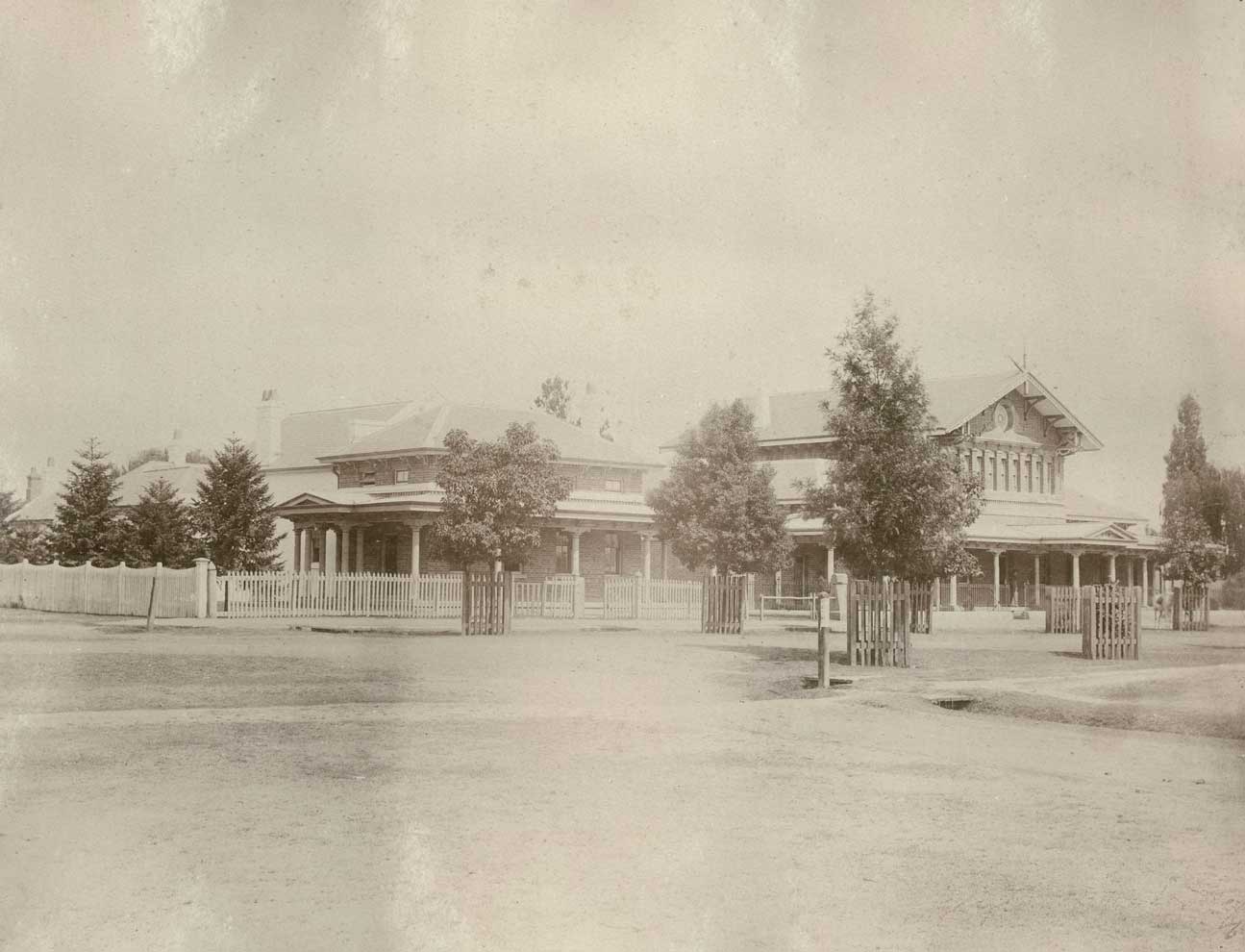
Photo ID: SRNSW 4346_a020_a020000316.jpg
“UNDER THE ARCADE.”
…
————
I suppose the next excitement in Grafton will be the sitting of the Circuit Court and the opening of the new Court-house. I hear great preparations are in contemplation to celebrate the event, and for which purpose a meeting has been summoned by circular for Monday, the 12th instant. In the meantime, divers opinions are expressed as to the form the celebration shall take. Some think it should be a ball. This is objected to on the ground that such a ball would necessarily be either too exclusive or too common. I do not quite see the force of this objection; although there is a little cliqueism in these matters in Grafton, there can be no necessity for the introduction of such things into a public celebration. If they are, I can quite understand a remark made by a friend of mine in reply to this objection, to the effect that it might be exclusive and still common. There are others who favour a public dinner, but this is objected to on the ground that ladies cannot take part. To my notion this is somewhat absurd. Why cannot ladies partake of dinner and enjoy themselves at the social board? Their presence I am sure would materially add to the enjoyment of the majority of the other sex. Possibly the calling it “dinner” is objectionable because of the associations usually attending such modes of public celebration. I would suggest that it be called a banquet, and let the viands be of a suitable character, in place of the ordinary heavy food that is usually provided for our public dinners, very often to the great annoyance of those who have to carve for a hungry multitude, and utterly destructive of their enjoyment. A third suggestion is that it should be a picnic. This receives much favour, as being that mode of celebration in which a greater bulk of the people can join, and at a more moderate expenditure than either of the former. A picnic is a sort of celebration in which all classes can join, without any feelings such as usually enters within the walls of a ballroom. Besides this, it would afford an opportunity of displaying to our visitors something of the extent and resources of the river and district, by a run up the Orara to the Meat Works, and the upper river.
~ ~ ~ ~ ~
Clarence and Richmond Examiner and New England Advertiser, Tue 20 Apr 1880 2
THE NEW COURT-HOUSE.
A BRIEF description of the new Court-house, opened yesterday by his Honor Sir William Manning, may prove acceptable to our readers throughout the district as well as to former residents, who are always anxious to hear of the progress of Grafton. The building is of brick, set upon the best concrete foundations. These are very massive, the concrete being laid most carefully in layers of 8 inches at a time, and should prove most stable. At the level of the ground floor plates a damp course is laid, composed of two courses of slate bedded with cement, and will effectually prevent the damp striking upwards. All the stones used throughout the building is best Pyrmont stone, imported from Sydney. The Court room is under the main roof, giving a height of 25 feet. The Police Magistrate’s and occasional Court room, and all the other offices and rooms being under separate roofs. The main roof is formed in four trusses, with king-posts and struts morticed and tenoned together, and further secured with 2¼ in wrought iron straps; the roofing material used being the very best Welsh countess slates. The Court room is ceiled [sic] with pine, with being to girders and cross-boxing to form moulded panels, the latter with ornamented piercing, its dimensions are 50 x 35, and, as we have already said, 25 feet high. Immediately within the first entrance a varnished cedar partition in panels shuts out the view of the Court from the exterior, and a staircase on the left hand gives access to the gallery extending across the whole front of the main building, and to the depth of 12 feet. This is intended for the accommodation of the public. The dais is overhung by a canopy of varnished cedar with panelled and moulded back and covered soffits, with pilasters and moulded caps and bases, and moulded bracket cornices and blocking, the whole surmounted by the Royal Arms picked out in colours. Immediately in front of the centre of the dais is the Associate’s desk, enclosed with cedar panelling. On the left of the Judge, and contiguous to the dis, is placed the witness box, approached by a couple of steps; on the opposite of the room, backed by the wall, is the jury-box, composed of two long seats thrown well back but affording barely enough room, and each provided with desks. Fronting these again is the seat and desk provided for the gaoler, and in the same line adjacent the reports’ desks with roomy seat. Fifteen feet within the partition before mentioned a low iron railing crosses the room, separating the public from the body of the Court. Just within this railing is the dock, fronting the dais, and separated from the public behind by a cedar partition. Beneath the witness b ox is provided a seat for the Sheriff’s bailiff; ample space is provided in the middle of the room for members of the Bar and the legal profession. Ventilation has been studied here most carefully—air flues being formed under the eaves with galvanised iron grating to both faces of the walls. Ventilating flues of piping, 9 x 4½, are also fixed in the side walls, and at the back, connecting with which are two 18in, pipes of galvanised iron carried in from the front of the verandah, and branching to the various air flues. The same provision of flues is made around all the offices. Nine windows in front, and the same number at the back, with five more on each side, afford light and air in abundance. Two doors on each side give access to the Court from either passages. On the left hand side of the Court-room, from which it is separated by a passage 6ft wide, running the full length of the building, is an office for the Clerk of Petty Sessions, 35 x 15; and in the rear of this two jury rooms, each 15 x 15; these rooms are all 14 feet high. These and other rooms are provided with fireplaces.
On the other side of the Court-room is a similar passage, giving access to the Judge’s retiring room, 17 x 15, Crown lawyers, barristers, and witness’ rooms, each 15 x 14, these rooms, as well as those opening from the opposite passage, have verandahs 8ft wide, with small enclosed yards 11ft wide, paved with clean chiselled flags with cemented joints, and are all provided with separate closets and urinals. A verandah 10ft wide runs the full width of the building and yards (about 100 ft), and is approached by three flights of stone steps leading to the main entrance and each of the passages. The of this verandah is supported on turned wooden posts, with moulded caps and bases. The front porch having overhanging eaves to match the main building, has on it a carved shield with year “1879.” The exterior woodwork is painted in three colours, and all the interior fittings, where of cedar, varnished. A wrought iron palisading, on a dwarf stone wall, furnished with one pair of gates, and two single ones, runs the full width of the frontage, and is returned on each side to the outer yard walls.
The acoustic properties of the Court-room can scarcely be said to have had a fair trial yesterday, when the noise of tramping feet on the bare boards made it most difficult to catch the words of the witnesses.
The building stands on the land fronting Victoria-street, between the old Court-house and the gaol frontage, and is an ornament to this part of the town.
We have only to add that the contractor was Mr JC Low, who has performed his work most satisfactorily. The building has been erected under the inspection of Mr R Laing, acting clerk of works for the Government, who has been most attentive in his supervision and general cars as to matters of detail.
…
JURY ACCOMMODATION.
TO THE EDITOR OF THE CLARENCE EXAMINER
SIR,—In the new Court-house I was surprised to see how little accommodation for jurymen has been considered, and the great distance the witness box is placed from the jury box. It was quite far enough in the old Court-house for many of the jurors, but now they are likely to loose many a word from a witness of indistinct utterance. In the Sydney Supreme Court-house the witness is close to the jury box, and with good reason.
Again, the absence of seats for jurors in waiting, and who must now, if they wish to be in Court, stand, and be jostled and mixed up with the crowd; this unpleasant omission might be remedied.
I am sure that those who are accustomed to sit as jurors will think with me—that in these arrangements of the new Court-house the comfort of the jurors has been ignored. The comfort of the lawyers has almost alone been attended to, not only in the Court itself, but in the Chambers and retiring rooms, which are, doubtless, superior to most of their own apartments in Sydney.—Yours, An Old Juryman.
~ ~ ~ ~ ~
The Sydney Morning Herald, Tue 20 Apr 1880 3
(FROM OUR OWN CORRESPONDENTS.)
…
GRAFTON.
Monday.
The Assize Court was opened in the new courthouse this morning, Sir William Manning being the Judge. There was no address or ceremony; but the Judge quietly opened the court with the usual formalities.
~ ~ ~ ~ ~
Clarence and Richmond Examiner and New England Advertiser, Tue 27 Apr 1880 4
GRAFTON CIRCUIT COURT.
THURSDAY, APRIL 22.
BEFORE His Honor Sir William Manning.
…
————
Before the commencement of the last case, and while the business of the Court was suspended for a short time, Sir William Manning addressed a few remarks to those present.
His Honor said as he would be leaving the next day, he would now take the opportunity of saying a few words. On his arrival in Grafton that day week he had been informed that it was contemplated to hold a banquet in celebration of the opening of the new court-house, and a number of gentlemen waited upon him to invite him to attend a fix a day. Had the banquet arranged for been carried out, he would have been expected there to express his opinion about their beautiful court-house. The banquet was abandoned from causes which he did not inquire into, and which did not concern him—and he might add that personally he did not care for banquets—and therefore did not regret the omission on that score. He did not, however, like leaving the district without congratulating its inhabitants and the district surrounding it on the admirable temple of justice with which the Government has presented them. He could truly say, after the experience of a long sitting, that there were in his very few English courts at all equal to it, and, as he learned, but few there even to this day which could compare favourably with it. It is abundantly large, excellent in its proportions, well lighted, well ventilated, and first-rate in its acoustic properties. He could see no defect in its construction except an excess of light immediately opposite the Bench, but that was easily corrected during the sitting by a few yards of uncostly material as blinds. In the general subordinate arrangements of the interior for the Bench, the Bar, and the public, there is nothing left to be desired. But in some of the other fittings he would suggest amendments. The jury box is so short as to be only seated for 10 persons, and he had consequently been obliged at times to allow two of the jurors to sit in chairs outside. He was told also that it was too narrow for convenience. These were matters that were easily corrected. There was also a deficiency of seats for jurors in attendance, but there is abundant room for them, and he had no doubt they would be supplied. Where the reporter’s seat is there is space for three rows of seats, and he would suggest that they be placed one above the other, with the reporters on the highest seat, and that the rest be reserved for jurors. He would also recommend that the Associate’s or Clerk’s box should be lowered to some extent, and that the witness box should be placed on that side of the Bench which in nearer to the jury box, instead of being at the somewhat extreme distance of its present position. This is all he had to say on the unfavourable side, and a few pounds would set all right in those respects. They said in law, “Exceptio probat regulam” (the exception proves the rule), and as he could find no fault beyond these trifles by them he proved rather than impaired the strong commendation with which he commenced. He would add a few words as to the subordinate accommodation outside the Court-room itself—that is to say, the judge’s and magistrates’ rooms, the small or occasional second court-room, those for the Bar and solicitors, the office of the Clerk of Petty Sessions, together with various other accommodation, that he absolutely had not one word to say in disparagement, but only now congratulate you all for having been so admirably supplied by the liberality of the Government, and the skill of the Colonial Architect, with all that can be required to make your Court-house convenient and complete in every particular. His Honor added that the Colonial Architect had visited the court early that morning, and had promised to have the trifling alterations carried out as suggested.
Mr Madgwick suggested to his Honor, if the alterations in the fittings of the Court-house were carried out as mentioned by him, that the reporters’ seat should be open at both ends for convenience of access, and his Honor said he would make a note of it.
…
“UNDER THE ARCADE.”
…
————
What a grand fiasco this celebration banquet has turned out—a complete failure. “What a shame,” is the universal cry “Under the Arcade.” I have been endeavouring to find out the cause of this disgrace to the town—announcing a banquet, inviting the guests, and then quietly informing them, “Very sorry, cannot carry out the banquet.” I hear some members of the committee assign as the cause the cause the disagreeableness of two or three persons in town who did not happen to be in the lead; others, again, say those in favour of a ball would not attend, neither would those in favour of a picnic. These excuses are all very well in their way, but I fancy the cause of failure springs from another source entirely; but I will say nothing about just now beyond expressing my opinion that the management has been bad from the start. The select-circular-system is not exactly the form in which to popularise movements of the kind referred to. If a simple advertisement, inviting the attendance of those interested in celebrating the opening of the new Court-house, had been inserted in the local papers, Grafton would not have been subjected to the degradation it has over the affair from beginning to end.
~ ~ ~ ~ ~
Clarence and Richmond Examiner and New England Advertiser, Sat 1 May 1880 5
MALARIA IN THE NEW COURT-HOUSE.
TO THE EDITOR OF THE EXAMINER
SIR,—I have been a juryman at the courts held in Grafton for a number of year, and was summoned as one for the Circuit Court held last week. I was highly pleased with the new Court-house, notwithstanding some little defects in the internal arrangements, which will, no doubt, be rectified before the next court. The spacious verandah afforded shelter from the frequent showers which fell each day during the week to those who preferred the open air when not called on the jury. There was also plenty of sitting room for those jurymen who preferred hearing cases on which they were not called to pronounce a verdict. I took a seat, along with others, on one of the forms provided by the thoughtful consideration of the judge for jurymen in waiting, just in front of the “reporters’ box,” and for so doing am insulted, along with my brother-jurymen, by the reporter of the Observer, who launched out in the following strain in his Saturday’s paper:—
“Another inconvenience, and detrimental to health, was seen in the placement of reserve jurors in front of the reporters’ box. Two walls of solid flesh, right in front of the reporters, like animal barricades, not only interposed a view of the Court—a necessary convenience to the Press,—but positively dangerous to health. Two such solid batteries for expending animal gas in front of the reporters’ faces, perhaps impregnated with disease, are more than should be endured by gentlemen who valued their health. In summer time, notwithstanding the excellent ventilation above, the reeking atmosphere around the reporters’ box would be unbearable, and we confess that we would prefer the crown of our hat, for taking reports in the gallery, than run the risk on inhaling diseased animal gas from the mess of jurymen in front of the reporters.”
A more impertinent, unwarranted, and low insult has never in my experience been offered to any respectable body of men—an insult which, from the very facts of the case, is also heaped upon the Judge by whose direction we were authorised to sit where we did. Were I disposed to retaliate I would suggest where the noxious effluvia may have come from.—Yours, &c., A Juryman in Waiting.
~ ~ ~ ~ ~
The Sydney Morning Herald, Thu 20 Jan 1881 6
(FROM OUR CORRESPONDENTS.)
…
GRAFTON.
Wednesday.
A dastardly outrage of an agrarian character has been committed near Copmanhurst. A farmer, named Hunter, has had a valuable horse shot dead; a second horse was found dead under suspicious circumstances, and two others were wounded with slug shot. The police have the matter in hand.
The furniture for the new courthouse has arrived, and the public business will be conducted in the new building after this week.
1 Clarence and Richmond Examiner and New England Advertiser, Tue 13 Apr 1880, pp. 2, 3.
2 Clarence and Richmond Examiner and New England Advertiser, Tue 20 Apr 1880, p. 2.
3 The Sydney Morning Herald, Tue 20 Apr 1880, p. 5.
4 Clarence and Richmond Examiner and New England Advertiser, Tue 27 Apr 1880, pp. 2, 3.
5 Clarence and Richmond Examiner and New England Advertiser, Sat 1 May 1880, p. 2.
6 The Sydney Morning Herald, 20 Jan 1881, p. 5. Emphasis added.