The Sydney Gazette and New South Wales Advertiser, Sat 20 Nov 1834 1
AGRICULTURAL REPORT
FOR
OCTOBER, 1834.
———◦———
ILLAWARRA.
The wheat throughout the district looks remarkably well, and if the weather continues as warm and fine a week or two longer, the reaping hook will be actively in use in a fortnight hence; slight appearance of rust is visible amongst some patches of a few fields, but nothing to cause the farmers to be dissatisfied with their crops generally.
MAIZE—Persons who are planting largely are still busily engaged in that occupation now; that planted at the commencement of the month is up and looks healthy and vigorous; the land, from the late and frequent showers, is in the best possible state for the reception of seed.
POTATOES—This crop looks well.
VINEYARDS—The vines here have made strong shoots this season, and present a good show of set grapes.
HORSES AND NEAT CATTLE are in good condition, and the milch cows having a plentiful supply of grass and water, furnish the dairy with large quantities of milk.
We understand that Mr George Brown of Illawarra, has the contract for building the new Court-house and lock-up and cells at Wollongong.
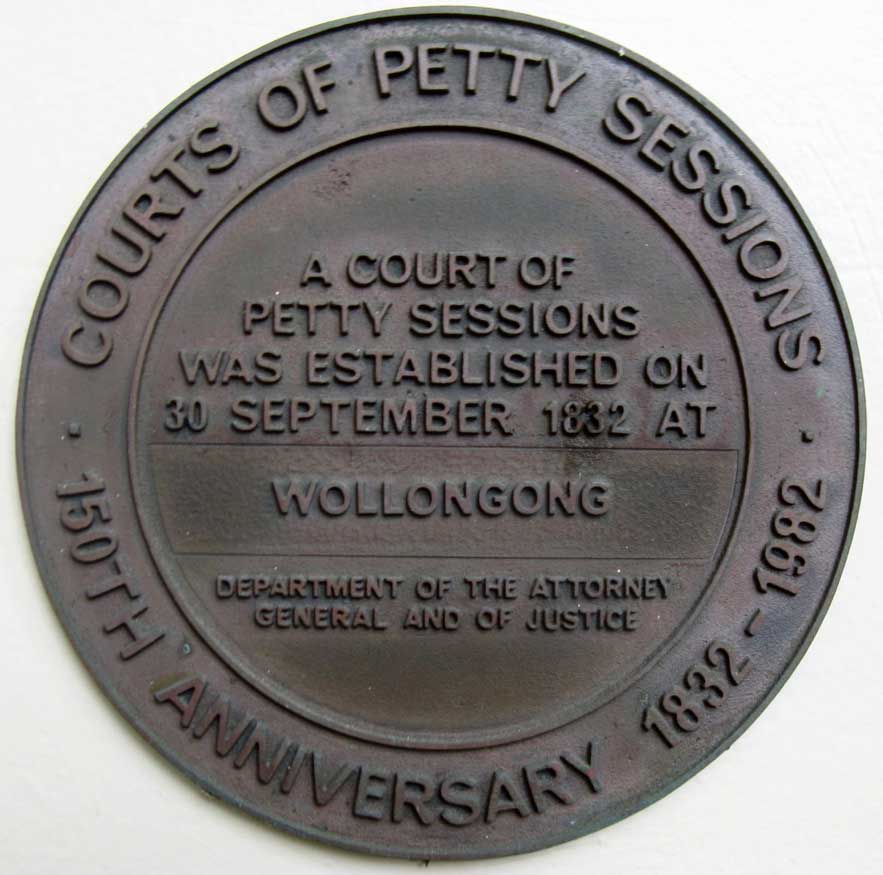
Photo: Peter de Waal
Major Mitchell has very much gratified the inhabitants of Illawarra, by already furnishing them with a chart of his new line of road to and through the district. Those who are in the affair can also view a plan of the intended township of Wollongong at the Police-office there. The design is good, the site suitable, and the plan neatly executed.
~ ~ ~ ~ ~
The Sydney Morning Herald, Mon 19 Jan 1857 2
NOTES ON WOLLONGONG.
SUGGESTED BY A RECENT VISIT.
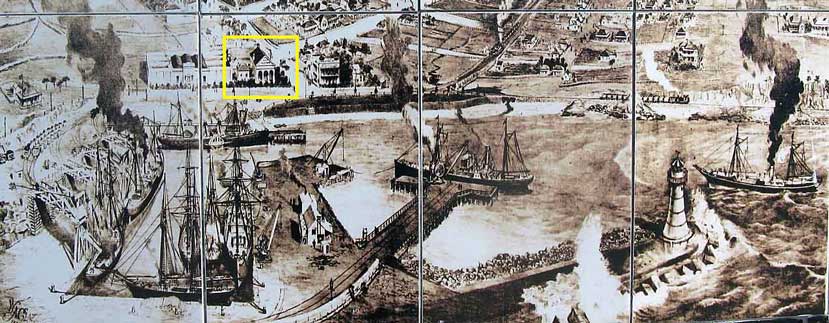
THIS favourite watering place is beautifully situated on the south-east coast of New South Wales. It lies at the foot of some lofty mountains, conspicuous among which is Mount Keera, [sic] rising proudly immediately in the rear of the township. The Pacific Ocean in front, with its perpetual roar, presents a sublime prospect, whilst the breezes continually wafted across its briny surface, are to the convalescent exceedingly delightful and refreshing. There is a long extent of sea beach of sandy formation, bounding the shore, but some places are rocky and of considerable height and abruptness. Flag-staff Hill, on the height of a promontory at the entrance to the quay, is well adapted for the purpose to which it is applied, and is besides a favourite place of resort for obtaining a good view of the sea, and witnessing the surging of the waves. At its base there is a convenient secluded place for bathing, naturally formed by an intersection and cavity of the rocks, but visitors uninitiated in the art of swimming cannot safely venture much distance out, as the shallow water is not of great extent. Strange to say, with the exception of the steamers—and a very notable exception they are—there are few or no boats about the basin or harbour of Wollongong. During our visit (a short one of fourteen days) we only observed a lime smack, and a couple of small boats, belonging, we supposed, to the steam companies. The consequences are that there is not such thing as fishing except in a small way by the juveniles, and a fish is a rare luxury on the tables of the hotels. Perhaps it is owing to the general roughness of the water that boating is not cultivated by the inhabitants to the same extent as pigs and butter; but we cannot help wondering, nevertheless, that there are not greater aquatic symptoms here than there seems to be with so splendid a seaboard at command.
The town of Wollongong, taken as a whole, has a very dilapidated and decayed appearance. There are few well-built houses in it, whilst there are a great many indifferent ones. It seems full of public houses, majority of which are of miserable proportion and exterior, and appear almost trade less. Three of these, however, are honourable exceptions to the general rule, being large, commodious, and comfortable hotels. There are, besides some private boarding-houses, respectably conducted, the fare at which is all that could be desired. The invalid or the tourist, therefore, need be under no apprehension as to food and shelter, as the places we have alluded to will, we are confident, supply all his wants, fish excluded. To return to the township generally; the most of the houses seem old and of flimsy construction. With the exception of the three principal hotels and the churches, there is scarcely a strongly-built house in the place. Weatherboard, lath and plaster, and slabbing seems to be the favourite materials for building purposes.
The Episcopalians, Roman Catholics, and Presbyterians have each neat and substantial places of worship. The Catholic church in particular is a handsome edifice, agreeably situated on a lawn, with a full view of the ocean in front. The Wesleyans have a small chapel in the main street, whilst the Congregationalists have a building in course of erection which, when completed, will be a commodious and pleasing structure.
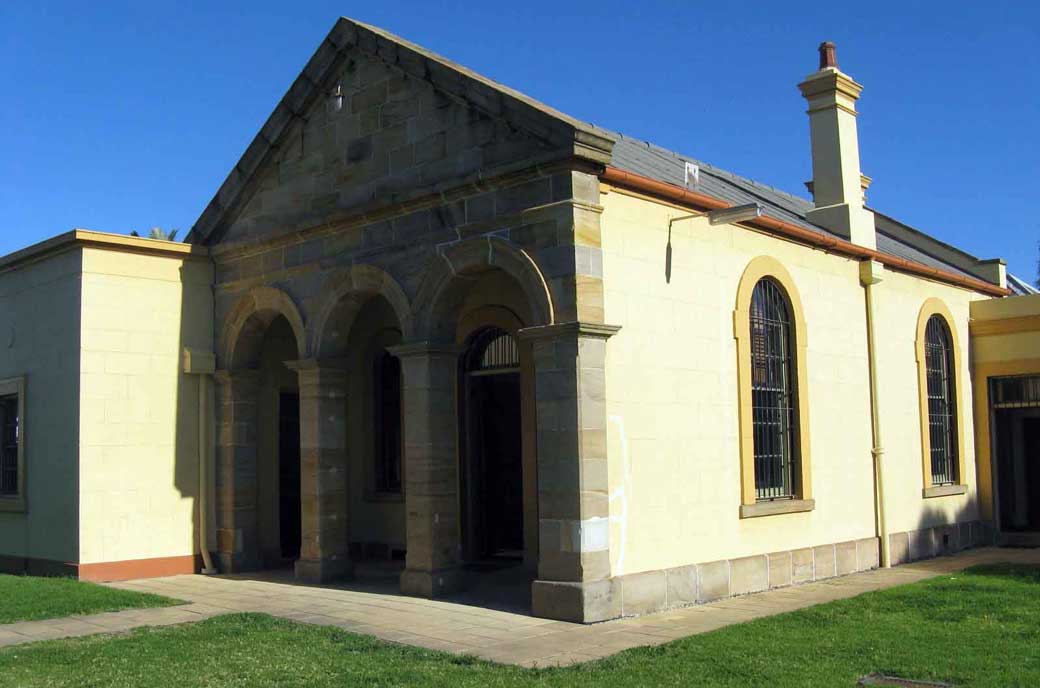
The most disgraceful building (we mean disgraceful as to the appearance in relation to its uses) in Wollongong is the Court-house. Situated at the entrance to the town, near the quay, where the population is thin, its position is extremely inconvenient; whilst, as to size and quality, it appears positively revolting. We wonder much that the magistracy have tolerated so long so wretched and dilapidated a hovel, for it is nothing else in appearance. The Court-room seems only about eighteen feet long and twelve broad, into which are packed a bench of half-a-dozen magistrates, the clerk, chief constable, and staff, two lawyers and a host of litigants. Having leisure, we went inside for a time one Court day, but after hearing one case, felt glad to quit the confined atmosphere. Besides, the building seems absolutely tumbling down. The bricks are mouldering away, while the verandah is tottering from decay, the fire-place has sunken in, and the ceiling is falling; their Worships meanwhile imperturbably endeavouring to enforce the ancient precept, Fiat justitia, ruat cœlum.
And there (happily perhaps) seems to be no lack of JP’s, no less than five being present at one time on the day that we visited the bench—in fact the magistrates (like the Wesleyan preachers in America compared with the soldiery) are twice as numerous as the constable, there not being more than five of the latter, as we were informed, while there are ten of the former, belonging to the district. We were struck with the simplicity with which justice and court matters are administered at this country bench. The very lawyers seem affected with innocence. The Small Debts’ Court was formally opened, not by the bailiff pronouncing the usual “O’yez, o’yez,” &c, but by the chief constable requesting one of his staff to proclaim simply, “The Court of Requests is open, gentlemen,” which was accordingly done. The announcement one would have thought excluded the fair sex from all participation in the proceedings, unless certainly the Emerald crier in question considered with some of his countrymen that the “ladies were the men for him.” However that may be, the first cause was called on and proceeded in due form, according to Wollongong. This was an action brought by a dairy farmer of the district against the agent of the Illawarra Steam Company at Wollongong, to recover the value of a keg of butter, &c, which it was alleged had been duly deposited at the wharf store for shipment to Sydney, but which through some neglect of the agent in question or his subordinate, had been lost. The plaintiff’s attorney was proceeding in eloquent terms to expatiate on the importance of the case to the community in general, and his client in particular, and speculated upon the effects which the verdict would have in either shaking or confirming the confidence of the public in the steamers, when he was stopped by one of his Worships requesting him “to prove the delivery as that was all the Court had to consider.” Evidence was then given that the keg, legibly branded, had been deposited with the clerk at the receiving store, who had made some entry of it on a piece of paper; and then in order to shew that it had never reached its destination, the plaintiff’s attorney handed the plaintiff an account from his agent in Sydney, and asked him if he had ever received credit for the consignment from such agent. The defendant’s attorney objected to evidence of this kind, but the Bench admitted it, and the plaintiff’s attorney submitted thereon that he had sufficiently made out his case. There was no evidence whatever to connect the defendant with the transaction, and his liability as an agent was taken for granted. The Bench, however, after a little more deliberation, and on the point being slightly urged by the defendant’s attorney, thought that the evidence was not sufficiently strong as to the non-receipt of the goods in Sydney, and postponed the case until the evidence of the plaintiff’s agent could be obtained. This it was mentioned would entail considerable expense, and one portion of the Bench thought, on the suggestion of the plaintiff’s attorney, that an affidavit of the fact would be sufficient. Luckily, however, the majority of their worships were against so illegal a proceeding, and the case, in its middle, stood adjourned to the next sittings, and that without costs of the day, to the so far successful party. Call the next case. Such is the artless way in which legal matters are carried on here. The people seem all so quiet, and dullness reigns so supreme, that to a casual observer there scarcely seems any necessity for magistrates, constables, or court-house at all.
About the worst feature connected with Wollongong is the rough and unformed character of the streets, and in all but the main thoroughfare they are most inconveniently overgrown, with the all-pervading grass and clover. In wet weather this state of things is extremely unpleasant, and makes the visitor wish that municipal institutions were extended to the country districts, and Wollongong in particular.
To compensate, however, indeed to more than compensate for the absence of well-formed streets, there are several delightful walks and roadways in the vicinity of Wollongong. To those who love the invigorating breezes of the ocean, perfumed with the odour of the algae, a scramble along the sea shore will be particularly refreshing; whilst those whose idol is the land and mountain dell can betake themselves, with gratification, towards Dapto and the lake of Illawarra, or ascend the rugged steeps of Mount Keira. The tourist, if he wishes, can easily accommodate himself with horses, as these and carriages are kept on hire at several places in town.
On the whole, despite its disadvantages and dullness, Wollongong is a most pleasing retreat to the invalid and recruit. The air is most salubrious and refreshing—the constant roar and commotion of the ocean is novel and interesting—and the inhabitants are kind and conciliating. So well pleased are we with our visit that, should nothing interfere to prevent, we hope, on a future occasion, to renew our acquaintance with the ever verdant district of Illawarra.
January 14th, 1856.
PS Since writing the foregoing we have been informed that a sum of money has, for some years past, been voted by the Government for the erection of a new court-house at Wollongong. If so, why has such a lengthened delay been allowed in the construction of the building? It is sorely needed.
~ ~ ~ ~ ~
The Illawarra Mercury and Southern Coast Districts Advertiser, Mon 21 Sep 1857 3
LOCAL.
————
…
NEW COURT-HOUSE, WOLLONGONG.—This building has been but slowly proceeded with hitherto, owing to the frequent interruptions to the work caused by the inclement weather during the winter. The foundation, which is of considerable depth, has been completed, and the brick work of the body of the structure has been commenced with such vigor [sic] as to give promise of early completion.
~ ~ ~ ~ ~
The Sydney Morning Herald, Tue 22 Sep 1857 4
WOLLONGONG.
(From the Illawarra Mercury of yesterday.)
NEW COURT-HOUSE, WOLLONGONG.—This building has been but slowly proceeded with hitherto, owing to the frequent interruptions to the work caused by the inclement weather during the winter. The foundation, which is of considerable depth, has been completed, and the brick-work of the body of the structure has been commenced with such vigour as to give promise of early completion.
~ ~ ~ ~ ~
The Sydney Morning Herald, Wed 4 Nov 1885 5
FORMAL OPENING OF THE NEW COURT-
HOUSE AT WOLLONGONG.
Wollongong, Tuesday.
————
The ceremony in connection with the opening of the new courthouse at Wollongong was performed at noon to-day by Sir Alexander Stuart in the presence of a large gathering of the residents. There were also several visitors present, though a large number were much disappointed at the Hon WB Dalley not being present, but it was understood that gentleman was unavoidably absent. Amongst those present were Messrs Charles Cowper (sheriff), Kenneth Stuart, AA Turner (police magistrate), A Lysaght (member for the district), Major Owen, WJ Wiseman (Mayor), W Robson (senior magistrate of the district), DM Campbell, and a number of others. The new building is situated on Church-hill, and has been erected upon a piece of land purchased for £500. The contract has been carried out by Messrs Wilson and Walker, of Sydney, at a cost of about £1000. It is a very substantial-looking building, having an ornamental front, and is surmounted by a small tower, which gives it a finished and attractive appearance. The contract was commenced about two years ago, and has been carried out in a highly satisfactory manner. The courthouse comprises a large courtroom 50 by 31 feet 3 inches, the height being 25 feet from floor to ceiling. The room is fitted up with a dock, gallery, and the other ordinary fittings, of elegantly polished wood. It is well lighted, and every attention has been given to the matter of ventilation. On the western side of the courtroom are the Judges, magistrates, clerks, bailiffs, record and jury rooms; and on the eastern side are the rooms for the Crown prosecutor, barristers, solicitors, and witnesses. These rooms are well finished and furnished comfortably throughout. Underneath the main building provision has been made for the caretaker by the erection of three rooms and a pantry. One cell has also been provided under the building.
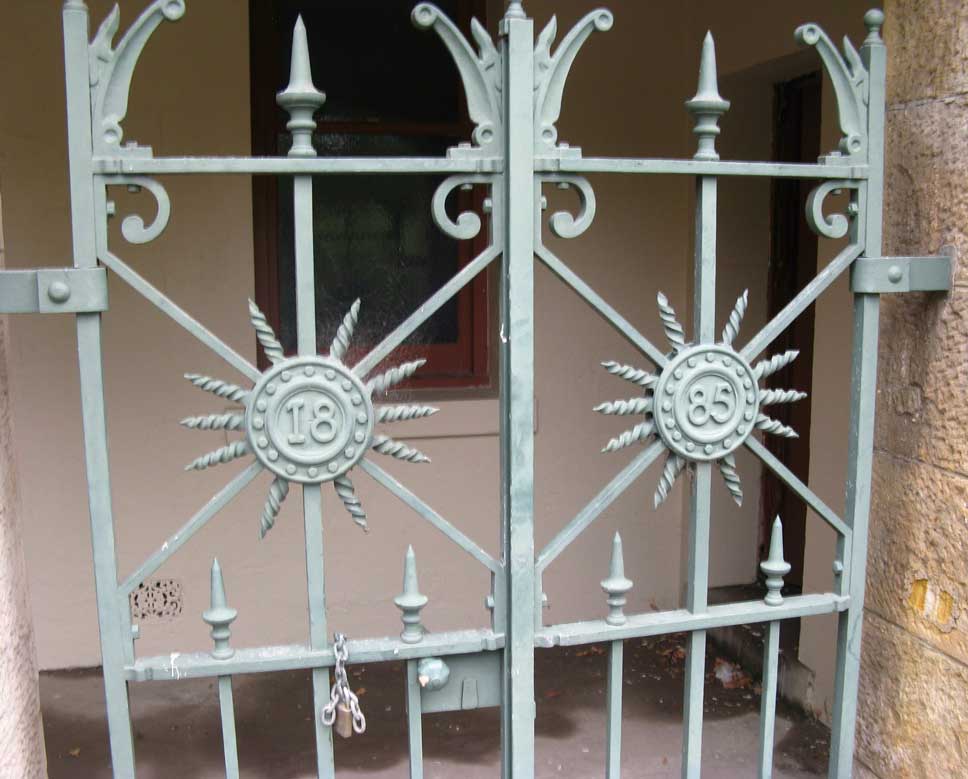
courthouse. Photo: Peter de Waal
Much interest was taken in the opening ceremony, and the building, which occupies an elevated position, is certainly an ornament to the neighbourhood.
MR TURNER, the police magistrate, before calling upon Sir Alex Stuart to open the courthouse, delivered a short address, in which he gave a concise history of the circumstances which led to the erection of the new building. He said for many years past they had suffered much inconvenience in consequence of the surroundings of their old courthouse, which was also altogether too small for the requirements of Wollongong. Representations were made to the proper authorities, and, after some correspondence had passed, money was placed on the estimates for the erection of a new building. It was through the efforts and influence of their late member, Sir A Stuart, that the proper sum was provided, and the consequence was that they now had the elegant structure they were opening. The building was an ornament to Wollongong, and would meet the requirements for some time to come. Their late member had been previously invited to open the building, and cordially accepted the invitation; but unfortunately he was compelled through failing health to relinquish Parliamentary life. He was happy to say, however, that that gentleman had still consented to fulfil his promise, and had kindly visited them again to open the courthouse. In conclusion, he called upon Sir Alexander Stuart to open the new building.
SIR ALEXANDER STUART, who was received with great applause, said that he would be one of the most ungrateful of men if he had declined the kind invitation sent him to be present on the occasion of opening their new courthouse. He said this because he had always received, at the hands of the people of Illawarra, the most marked distinction, and the utmost good feeling. It had therefore occurred to him that there should be no hesitation on his part to be present on the occasion. It had been intended not only that he should be present, but that he should be present as their member, and as Prime Minister of the country; but, unfortunately, the state of his health had rendered it necessary for him to relinquish those high positions, and to content himself by appearing before them as a citizen like themselves. He was glad to say that his health had improved since the had given up the vast responsibility of Prime Minister, and he was therefore able to appear before them on the present occasion. (Applause.) At the very moment of his resignation they kindly desired that the engagement he had already made should be continued, and he was only too thankful to have an opportunity of appearing amongst his friends even though it would be to take a farewell of them. (Applause.) They had met for the purpose of declaring their new building open. There was no doubt when he first had the honour of becoming acquainted with the wants of the district one of the first matters of importance brought under his notice was that of a good and commodious courthouse—a place where they could conduct their business without that fear of interruption, which was so great in the old courthouse that some of the Judges were compelled to have recourse to the Temperance Hall in order to be somewhat out of the noise. It was a pleasure to him to be still in his place in Parliament, to point out the growing importance of their district, and to urge that the courthouse should be built, that they should have a building not merely adequate for the condition of the district then but sufficient for some time to come. (Applause.) He believed that the district was destined, as soon as it became connected with the metropolis by the railway, to assume large proportions. (Applause.) He could congratulate them all, and especially those gentlemen who urged the matter upon the attention of the Government and himself, upon the successful result of their efforts. (Applause.) The courthouse seemed to him to be commodious, and well fitted for the purpose for which it was intended. (Applause.) They might all congratulate themselves upon having worked together to such good purpose as to be able to meet in such an elegant and comfortable building. (Applause.) He was glad to see the building well filled on the present occasion, especially as one portion of it was empty—(laughter)—he referred to the dock. (Laughter.) He felt that he could not wish for the building to be always well filled. (Laughter.) After having referred to the unsuitable character of the old courthouse, he said it was for better that the surroundings of a court of justice should be of a character which should uphold the majesty and dignity of the law. (Applause.) Whilst he could not in one sense wish the new courthouse to be always well filled, he could, at all events, wish that most impartial justice might be always awarded in the court—(applause)—that they would not have one law for the rich and another for the poor, but that whoever transgressed would have to pay the penalty of the law. (Applause.) It was quite true that a Judge might make mistakes, because if he was always right he would be more than human. (Applause.) But they could all wish their Judges to have a clear perception of their duties, and to be endowed with so much discrimination as to be enabled to give just and satisfactory decisions. (Applause.) They did not desire merely the outward fabric, but they desired to have in their building a man endowed with clearness of mind and with decision of character to determine the rights of parties who might be brought before him. If their new building tended to promote this desirable end then the money which had been spent on it would not have been spent in vain, and they would feel that they had done a good work. (Applause.) They owed much to the magistrates of the district, and the progress committee, for the energy they had taken in connection with the erection of their new building. As far as he was personally concerned, he felt that he had been sufficiently rewarded for what he had done by the opportunity of seeing so many kind faces around him on the present occasion. In conclusion, he said that he had very great pleasure in declaring the courthouse opened. He wished them every success. He should always have the most pleasant recollections of his visits to the Illawarra district, and he was sure whether he was permitted to take part in the calmer atmosphere of the Legislative Council, or whether he was relegated to the seclusion of private life, the success and improvement of the district would be looked upon by him as one of those things in which he had always taken, and should always take, a great pride. (Applause.)
Brief congratulatory addresses were delivered by Mr Charles Cowper and Mr Lysaght, MLA, after which the proceedings terminated with cheers for Sir Alexander Stuart and for the Queen.
~ ~ ~ ~ ~
The Illawarra Mercury, Thu 5 Nov 1885 6
THE NEW COURT-HOUSE
DEMONSTRATION.
———○———
THE OFFICIAL OPENING.
Shortly after noon on Tuesday, the grand new Court house on Church Hill, in this town, was formally opened by Sir Alexander Stuart, the late respected member for this district. A considerable assemblage mustered within the spacious building, the fair sex being very conspicuous on the occasion. The jury seats were occupied by most of the Magistrates of the district, and the floor of the Court and the gallery by the general public.
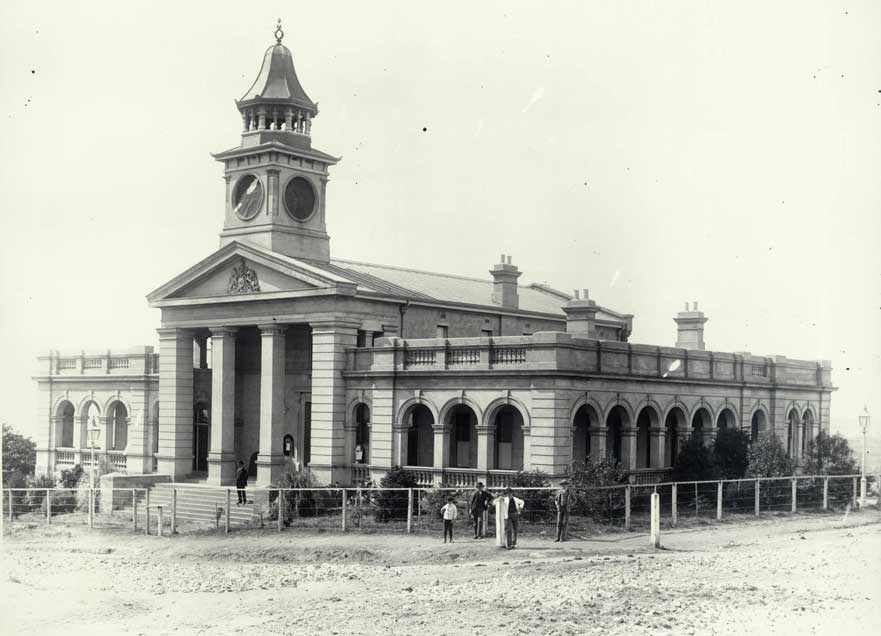
Photo ID: SRNSW 4481_a026_000530.jpg
On the Bench were Sir Alexander Stuart, KCMG, Mr A Lysaght, MLA, Mr AA Turner, PM, Mr WJ Wiseman (Mayor), Mr C Cowper (Sheriff), Major Owen, and Mr W Robson, JP, (the oldest magistrate in the district present).
Mr Turner, in presiding, said it was with feelings of great pleasure that he was privileged to take part in the proceedings. Many of them were aware, and many of them were not aware, of the circumstances which had led to their assembling there that day. For many years past great inconvenience had been experienced in the old Court-house. The noise was intolerable, the colliery engines every and anon interrupting public business. These things were represented to proper quarters, and after some correspondence, a sum of £500 was placed on the estimates for the purchase of a piece of ground, and £2000 for building a Court-house. The £500 bought the land, but the sum intended for building purposes was insufficient. This was represented to proper authorities, and through the efforts and influence of our late member (Sir Alexander Stuart) a sufficient sum was provided—(applause)—and it has resulted in the present structure, which is an ornament to the town. When the Court-house was nearing completion, it was arranged that Sir Alexander Stuart should open it, and he hade great pleasure in calling upon him to do so.
Sir Alexander Stuart, who in coming forward, was received with applause, said it would have been very ungrateful on his part had he declined the honor of opening the new Court-house when asked to do so, after the kind treatment he had received at the hands of the people of Illawarra. He said it was not only intended that he should be present, but that he should be present as the member for Illawarra and as Prime Minister of the colony. But the state of his health, unfortunately for himself, had made it necessary for him to relinquish his position, and made it necessary for him to appear before them as a private citizen. He thanked God that his health, since he had given up his position, had much improved, so much so that he was able to appear before them. They had met that day to declare the building open. When he first became acquainted with the district one of the first things represented to him was the necessity of a good Court-house, where the business could be conducted without interruption, which was so great in the old one, and which made it necessary for the Judge once or twice to resort to the Temperance Hall. It was a pleasure to him to point out whilst in the House the adequate position of the district, and of its importance when it became combined with the metropolis. His advice was to look ahead, to build a place not only for the present, but to build a place wherein business might be transacted for a long time to come. He congratulated them on that being done in a very marked degree. The Court-house, he said, seemed to him to be commodious and well fitted for the purpose. Whether it be in administrating the law or the settling of disputes that arise from time to time as the district grows in importance, if justice be carried out, a justice that will be for rich and poor alike, then its purpose will be fulfilled. (Applause.) That a Judge ill make mistakes is quite natural, he is but human. Whoever has the administration of justice here, we can wish that he will have that clear preception [sic] and discrimination which is necessary, and that he will without fear or favour give his decision accordingly, and what ever that decision be let up accept it, (though it may go against our own feelings), as the just interpretation of the law. If this building tends to promote such a thing, then those amongst us who have been engaged in the building will feel that our work has not been in vain. He did not believe that they would have had this Court-house if local efforts had not been made. No member of the Legislative Assembly could get those things—it was apart from his place. A debt of gratitude was due to those gentlemen who enabled him by information supplied to advocate an extension of the building as first contemplated. If he had been the means in any way of accomplishing the building, he was well paid by seeing it in its present form. In addressing himself to Mr Turner, he said he had great pleasure in declaring the building open, and he felt honored in being the mouthpiece in declaring it so. In conclusion, he wished every success to the district of Illawarra, in which his associations were of the most pleasing nature during the time he had the honor of being its representative, and he would at all times, whether in the calmer atmosphere of the Legislative Council or in other spheres of life, do what he could for the district, and would look back upon it with pride. (Applause.)
The Sheriff said that as the Government officer having charge of the Court-houses he was pleased to congratulate the people of the police district of Wollongong upon the very fine Court-house just opened. He felt a special pleasure in attending on the occasion, as it was in connection with this district that his late father (Sir Charles Cowper) started in political life (in 1843). The new edifice was one well adapted for the purposes intended, and he hoped before long to have the pleasure of seeing the site properly enclosed with a suitable fence and the grounds planted with trees.
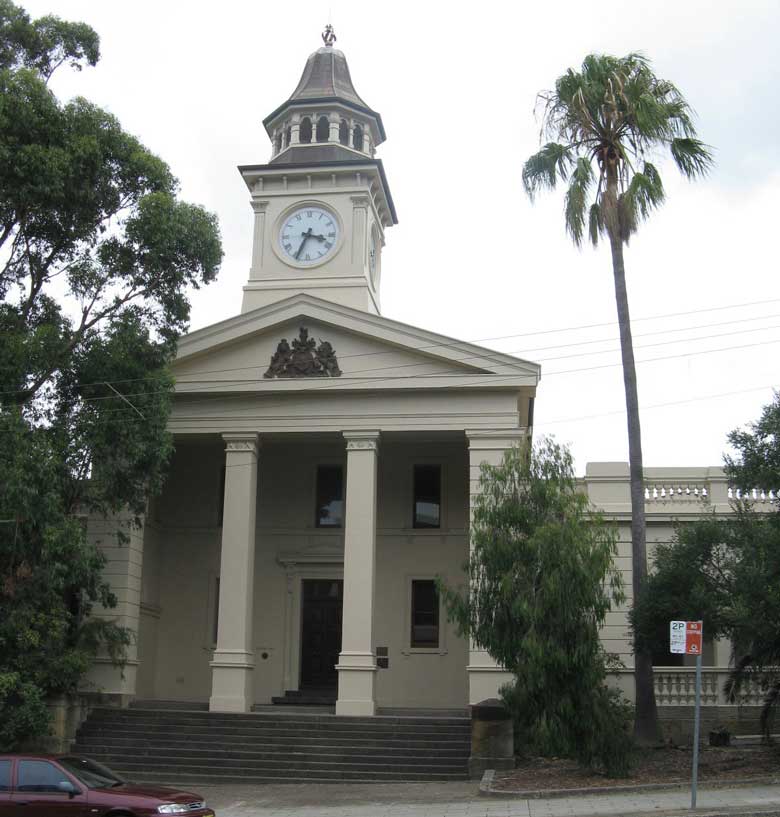
Mr Lysaght, MP, at the invitation of the chairman (Mr Turner) shortly addressed the audience. He said he well remembered the very first Court-house in Wollongong, which was built in 1834. Then, again, the Court-house now being suspended was erected about 25 years ago. He enumerated the Police Magistrates that presided in Wollongong until Mr Turner, the present occupier of that position, entered upon it. So rapid was the progress of the district that within thirty more years several such Court-houses as the one opened that day would be required throughout the locality. He hoped Mr Turner would long be spared to preside over the Bench. He (Mr Lysaght) had differed from Mr Turner as a Magistrate, but he believed there was not a more conscientious or upright Justice of the Peace in the colony than was that gentleman.
Three cheers for the Queen and for Sir A Stuart concluded the proceedings.
The report of the banquet in the evening will appear in next issue.
~ ~ ~ ~ ~
The Illawarra Mercury, Sat 7 Nov 1885 7
THE NEW COURT-HOUSE
DEMONSTRATION.
———○———
THE BANQUET.
In the evening of Tuesday about 50 gentlemen sat down to an excellent dinner provided by Messrs R Parkinson and G Clout, in the Temperance Hall, the walls of the building being decorated by many of the exhibits that graced the hall on the occasion of the recent flower show. Mr AA Turner, PM, occupied the chair, Mr WJ Wiseman (Mayor of Wollongong) and Mr A Campbell filling the vice-chairs. Ample justice having been done to the sumptuous repast provided, ladies were admitted to seats on the platform, and the “toasting” part of the proceedings commenced, after the chairman had read apologies from the Minister of Public Instruction, Messrs FA Franklin, JP, WJB Jenkins, JP, and John Brown, JP.
The usual loyal toasts were proposed and drunk most enthusiastically.
“The Army, Navy, and Volunteers,” was proposed by Mr MH Moriarty, CE, and responded to by Major Owen, Captain McCabe, and Lieutenant Foster.
Mr B Lipscomb proposed “The Parliament of New South Wales.”
Sir Alexander Stuart, who was received with great applause, responded on behalf of the Legislative Council, and Mr A Lysaght on behalf of the Assembly.
Mr Hewlett proposed “The Ministry,” and in doing so spoke in complimentary terms of Sir Alexander Stuart, late member for Illawarra and ex-Premier.
The Chairman proposed “Sir Alexander Stuart.” He said the name of that gentleman was received throughout th colony, and especially in this district, with respect. He (Mr Turner) could not say anything of their guest that they did not know. It was a fortunate day for Illawarra when it secured the services of Sir Alexander Stuart. The sorrow of the people of this district was great when they heard that his health had failed, and it was even greater when it became known that the state of his health prevented his services form being any longer available to Illawarra and the colony generally. He hoped, however, that that gentleman would soon be sufficiently recovered to resume his old place and that he would be long spared to advance the best interests of this country. (Cheers.)
Sir Alexander Stuart, who, on rising, was greeted with much applause, said he felt that he was not deserving of the high encomiums that had been passed upon him by Mr Turner. That gentleman had said that it was a fortunate day for Illawarra when it secured his services. He would say that he considered himself fortunate in having the honor to secure so comfortable a seat in Parliament. If he had been able to do anything for the district it afforded him the utmost pleasure to know that his efforts in that respect were appreciated. He had gladly availed himself of the invitation to be present at the demonstration of opening the Court-house, as it gave him a chance of returning thanks to the people of the district in a much more cordial manner than by advertisement in the newspapers. He thought it was on the second occasion of his seeking the suffrages of his electors that it was stated by some of his political opponents with the object of injuring his candidature that it was not his intention to sit for Illawarra, as he did not consider the seat sufficiently dignified. He said then that he would always sit for Illawarra so long as Illawarra thought fit to return him as its representative. It was with feelings of profound regret that he severed his connection with the district. In taking a retrospect of his association with Illawarra, he stated that his first acquaintance with it was in connection with the railway movement. That was before he had any idea of becoming a candidate. When he had the honor of holding the position of Colonial Treasurer in 1877 and 1878 he was so impressed with the advantage that the railway would be, not only to this district but to Sydney—and he hoped that when the railway was opened it would be shown that it was of equal importance to the city—that he had money placed on the Estimates to cover the cost of construction. (Mr TW Garlick: You were the first member to advocate the Illawarra from any hustings.) Yes, he did speak of it from the hustings. They were, however, deposed from their position, his opponents making it one of their cries that he had conspired to rob the country by bringing forward the Illawarra railway matter. He had always stuck to the movement, and when called to office again had the money again placed on the Estimates, and this time succeeded in carrying it through. (Cheers.) It was his intention when he had completed his business arrangements to take a trip to England—not, as had been currently stated during the elections, to become Agent-General, but for the benefit of his health. He had not given up the hope that he would recover his health sufficiently to again take part in the public affairs of the country. (Cheers.) He had not been expelled from office, but had of necessity to retire under the force of circumstances. He had a large majority up to the last—such a majority as few Prime Ministers could boast of. But when he found that the Opposition were determined to hinder the business of the country by every means in their power, he, acting under the advice of his medical attendant, felt it incumbent upon him, in the interests of his health, to resign. The great measure of the last Parliament, and for which they were called to office, was the carrying into law of the Land Act. He would not say that that law was perfect. No measure that was ever passed was perfect. He was surprised at persons who ought to know better saying on the hustings that the first thing the new Parliament would have to do would be to sweep away the Land Act. That would be suicidal on the part of the Parliament, and it could not be done—the bulk of the people would not permit it. One thing that satisfied him that the Land Bill was a good measure was this—that in every district affected by the bill there had been manifested a great deal of feeling. At the Murrumbidgee a candidate who was opposed to Mr Dibbs said that the Act required amendment because it was opposed to the squatters. At the adjoining electorate a candidate said that it required amendment because it was opposed to the free selectors. Three years ago when he threw out the then Ministry on their land policy he laid down ten main principles and went to the country on those principles and was successful. He said when the measure was introduced that it would not give satisfaction to either squatter or selector. They both imagined that the land was for their exclusive use. He regarded the land as belonging to the people. (Cheers.) The land law was a measure that would do even-handed justice to the people. His idea was—and it had been carried out—to divide the land into three divisions and to reserve from alienation large tracts in the western district for twenty years. Though there were now large arid tracts in the western district consequent on the small rainfall, he had no doubt that in time means would be discovered of making the land there of great value to the country, and he thought that he would be falling short of his duty if he allowed the land there to become alienated. He believed that under the arid land there was an abundance of water. One of the officers with the Soudan Contingent—Captain Parrott—had been engaged for some time in making scientific experiments in the desert neat Suakim, and he had confidently expressed the opinion that water would be discovered there under the sands sufficient to supply the whole of the British forces. He had seen the papers and maps prepared by Captain Parrott in the Government Printing office. His successor in office had sent home to the war authorities these elaborate maps, which would be found a valuable addition to scientific discoveries. He believed that it would be found that there were underground rivers in the western districts of this colony, that would turn the wilderness into a perfect Paradise. He would look upon his action with regard to resuming those areas with delight if it were found that such was the case. He would not enter into details with regard to the measured dealt with my his administration during his term of office. He was satisfied to be judged by results. He might say, however, that many important acts had been added to the statute-book. He could not let that opportunity pass without reference to the great and crowning act of his administration—the sending of the contingent to the Soudan—an idea conceived by his friend and colleague, the Hon Mr Dalley. (Applause.) That act allowed the Imperial Government that there was federation in the highest sense between the scattered portions of the great British Empire; that the motto “Nemo me impune lacassit”—no one shall injure me with impunity—was recognised throughout the colonies, so that no enemy could put forward a finger to touch England without it being felt and resented throughout the whole British Empire. It had been alleged by those who wished to make a split in the political cam that Mr Dalley had taken the step not only without the sanction of Parliament, but without his sanction or approval. He believed he was the first person made acquainted with Mr Dalley’s intention. That gentleman telegraphed to him in New Zealand, and he wired back at once his entire approval and concurrence with the brilliant idea. It had been said that had he been on the spot the contingent would not have been despatched. That may or may not have been. He may not have had the audacity to conceive the idea or the ability to carry it out. It had been said by some that Government had brought the colony into contempt by this action. This he denied. On the contrary their action was regarded with amazement in Europe, showing as it did to the world that this colony was capable of rendering assistance to the mother country in the hour of her danger. (Cheers.) Before concluding he would like to make a few remarks on a matter that had been spoken of frequently on the hustings, viz, the reconstruction of the Ministry by his successors. It had been alleged that they held office unconstitutionally—that they were simply a band of robbers appropriating the Ministerial offices. He had acted constitutionally throughout. In fact, it was the only constitutional way in which the dissolution could be carried out. The Ministry had never been defeated, and they continued up to the last to command a large majority. Finding that circumstances rendered it necessary that he should seek rest, he resigned, and consequently all his Ministers resigned. The Governor had the power to send for any gentleman who was able or had a prospect of being able to command a majority of the House. He had hoped that Mr Dalley would take the head of affairs, but he had declined on account of ill-health. The Governor then sent for Mr Dibbs, and had acted constitutionally in doing so. The present members of the Ministry were all personally known to him. Many of them had worked with him. He hoped they would not be hounded down, but that they would receive fair play; if so, he had every faith that they would carry on the business of the country satisfactorily. He knew that their member would give them fair play, and deal with measures, not men. One of the measures that would be taken up by them was the Local Government Bill, which had been introduced by himself. Under that measure all matters such as roads and bridges would be under local control—such works as the Duck Holes bridge, for instance, the correspondence in connection with which between himself and the roads authorities would fill a volume. Such works should be done when they were wanted by the people interested, who knew their requirements, and who paid for the work. It would be far better that hey should take their own money, raised by local taxation, supplemented by a liberal allowance from the general revenue, and expend it in their own way on works that they knew were urgently needed. One of the great advantages from such centralization would be that it would make a demand for local professional men, such as surveyors and engineers. Under present circumstances there was no demand for professional men except in connection with the Civil Service. He was glad of that opportunity to say a few farewell words. Though he had never promised to be a roads and bridges member, it could not be said he had neglected local wants. He would always look back with pride at his having been instrumental in having the building erected that they had opened that day and in honor of which the banquet was being held. The Public school and post and telegraph office he had also secured. There was another thing he would look back upon with pleasure, and that was that he was instrumental in having the encroachment of the sand drift prevented, and the skulls and bones that he had been horrified to see scattered about here and there buried out of sight by the reclamation of the waste lands on the sea beach. Then there was the resumption of the recreation ground which they had done him the honor to name after him—a work in connection with which, however, he did not claim much credit, as most of the work had been done by the people of the district. In saying farewell he thanked them heartily, and though not now acting as their representative he left many among them whom he claimed as friends, and he hoped their friendship would be of life-long duration. (Great applause.)
Mr ER Evans, JP, proposed—“Our Member—Mr Lysaght.”
Mr Lysaght returned thanks for the hearty manner in which the toast had been drunk. He said that while admitting that Sir Alexander Stuart had done much for the district, he denied his statement that he had the bones and skulls on the beach covered. That work had been done privately, and the money raised by subscription locally. Though much had been said of the Government, he still had his own opinion about it. He still had his opinion of the Land Bill, notwithstanding all that had been said in its favour, and he believed that it required many amendments to make it acceptable to the masses of the people. He would go into the House as an independent member and would support measures not men. He would not pledge himself to the present Government or any Government. He would like to see a third party in the House—an Australian party—and even an Australian Government. He believed it was possible to form a strong Government of Australian born members, who could carry out useful measures of legislation. He intended to do his utmost for the district and the colony generally, but he never expected to have the high honors thrust upon him that had been showered upon Sir Alexander Stuart. He had an interest in the district, though it was small compared with the interest of many before him. It was the birthplace of himself and his children, and it had been his ambition for may years to represent the district in Parliament. He had been sent there by the voice of the people, and it would be his endeavour to do his utmost to advance the interests of Illawarra. He hoped that when he appeared before them again they would be as satisfied with him as they were with Sir Alexander Stuart. (Applause.)
“The agricultural, mining, and commercial interests” was proposed by Mr A Campbell, and responded to by Messrs T Armstrong, JP, TW Garlick, and A Parsons, JP.
Mr J Fraser, JP, proposed—“Municipal Institutions,” which was responded to by Mayor Wiseman.
“The Contractors,” by Mr G Cochrane; responded to by Messrs Wilson and Walker.
Mr D Williams, JP, proposed “The Press;” responded to by Mr Tonkin (SM Herald), W Young (Daily telegraph), A Campbell (Illawarra Mercury), and DM Campbell (Wollongong Argus).
“The Ladies” was ably proposed by Mr H Owen, and suitably acknowledged by Mr Finlayson.
“The Chairman,” proposed by Sir Alexander Stuart, was duly responded to be Mr Turner, and the proceedings terminated by the company singing “God Save the Queen.”
The Harmony Band discoursed several appropriate airs during the evening.
~ ~ ~ ~ ~
The Sydney Morning Herald, Mon 22 Aug 1887 8
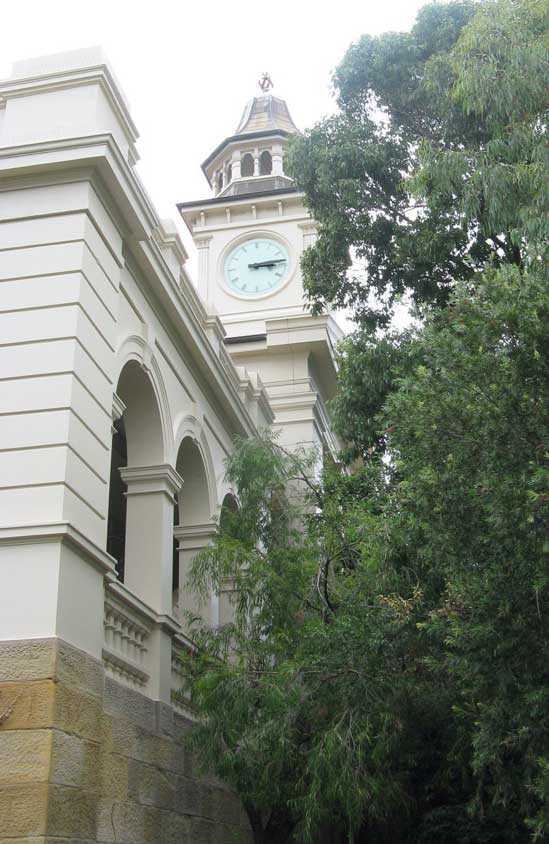
Photo: Peter de Waal
THE MINISTER FOR WORKS IN
THE ILLAWARRA DISTRICT.
———◦———
(By Telegraph.)
(FROM OUR OWN REPORTER.)
———
Kiama, Sunday.
The Hon John Sutherland visited the Harbour Breakwater at Wollongong at an early hour on Saturday morning. A number of men and a diver are engaged in the work of deepening the entrance to the harbour. The contractor, Mr Ranken, informed the Minister that at one place at the entrance to the harbour, where formerly there was only 11ft of water at low tide, there was now 16ft of water at dead low tide. Large quantities of rock have been removed, and the improvements should prove beneficial to the port. Mr Sutherland expressed himself pleased with what he had seen, and said there was a great future before Wollongong. A number of the inhabitants of the town induced the Minister to pay a visit to the new Courthouse. The people made complaints regarding the erection of a barbed wire fence in front of the building. The fence, which was erected by the late Government, was said to be unsightly, and positively dangerous. Mr Sutherland promises to lay the matter before Mr Clarke, Minister for Justice, as it was his Department. Mr Sutherland said the courthouse was the finest of its kind he had met with in the colony.
~ ~ ~ ~ ~
The Illawarra Mercury, Tue 2 Jun 1891 9
STARTING THE TOWN CLOCK.
———○———
The Wollongong Town Clock in the Courthouse tower is to be started tomorrow (Wednesday) at 4 pm by the Mayor (Mr JA Beatson), who has been requested by the contractor to do so.
~ ~ ~ ~ ~
The Illawarra Mercury, Thu 4 Jun 1891 10
THE CLOCK STARTED.
———○———
According to arrangements, the Town Clock was started at 4 o’clock yesterday afternoon by Mrs A Beatson, the worthy mother of a worthy son (the Mayor, Mr JA Beatson). The latter gentleman entertained Mr Jerger (the contractor for the clock) and a few representative townsmen at a champagne lunch immediately after the event, but of that further notice has to stand over until next issue. It may be stated that the clock, though now going, will not strike for a few days, owing to matters of detail not being perfected in connection with that part of the instrument.
~ ~ ~ ~ ~
The Sydney Morning Herald, Thu 4 Jun 1891 11
THE NEW CLOCK AT THE WOLLONGONG
COURTHOUSE.
———◦———
(By Telegraph.)
(FROM OUR CORRESPONDENT.)
Wollongong, Wednesday.
This afternoon, on the invitation of the Mayor, Mr JA Beatson, several townspeople assemble to witness the formal starting of the new clock now placed on the courthouse. The ceremony of starting the clock was performed by Mrs Beatson, mother of the Mayor. After the ceremony those present adjourned to the Mayor’s private residence, where the event was celebrated in due form. It appears that the idea of a clock had been initiated by Sir A Stuart when Premier and member for the electorate, and it has taken since that time to bring the matter to completion. The contractor (Mr Jerger) was complimented on the beauty and completeness of the article, which is said to be one of the best in the colony.
1 The Sydney Gazette and New South Wales Advertiser, Thu 20 May 1834, p. 2. Emphasis added.
2 The Sydney Morning Herald, Mon 19 Jan 1857, p. 3. Emphasis added.
3 The Illawarra Mercury and Southern Coast Districts Advertiser, Mon 21 Sep 1857, p. 2.
4 The Sydney Morning Herald, Tue 22 Sep 1857, p. 5.
5 The Sydney Morning Herald, Wed 4 Nov 1885, p. 5.
6 The Illawarra Mercury, Thu 5 Nov 1885, p. 2.
7 The Illawarra Mercury, Sat 7 Nov 1885, p. 2.
8 The Sydney Morning Herald, Mon 22 Aug 1887, p. 3. Emphasis added.
9 The Illawarra Mercury, Tue 2 Jun 1891, p. 2.
10 The Illawarra Mercury, Thu 4 Jun 1891, p. 2.
11 The Sydney Morning Herald, Thu 4 Jun 1891, p. 5.