Australian Town and Country Journal, Sat 31 Oct 1896 1
BORDER TOWNS ON THE MURRAY.
————
TOCUMWAL.
———
VI.
———
Almost midway between Corowa and Moama is situated the thriving and rapidly rising little township of Tocumwal, on the New South Wales side of the Murray, and forming one of the principal crossing-places on the river, which is here spanned by a fine iron bridge, constructed at a cost of £17,000 by the New South Wales and Victorian Government, and enabling considerable quantities of Riverina wool to pass into Victoria for transport by rail to Yarroweyah, nine miles distant, to Melbourne. Formerly the teams had to proceed to Echuca by way of Moama. The nearest railway station in New South Wales at present is at Jerilderie, thirty-seven miles distant, but when the Berrigan extension is completed the terminus will be almost midway between Jerilderie and Tocumwal. The country around Tocumwal, like most other portions of the Riverina district, is admirably adapted for wheat growing, although until within the last few years, used chiefly for pastoral purposes. The areas under cereals in the Tocumwal district during the season 1895-1896 was 20,400 acres, which has since become largely increased by reason of the general adoption of the halves system, the pastoralists leasing considerable portions of their estates to farmers from Victoria. There is no uniform system of leasing, the mutual arrangement between landowners and lessees varying according to surrounding circumstances, but the general results are the same, namely, the advancement of the interest of both, especially the landowners who have theirs estates put into first-class cultivatible [sic] condition at little or no cost to themselves. The most liberal arrangement, certainly that most encouraging to the farmer, was introduced by a leading station owner near Tocumwal. He let suitable blocks of his land on three years leases with the right at the end of the third year to sow a crop of lucerne with the last crop of wheat put in by the tenant. The tenant has the wheat and the landlord the lucerne, after which the ground is allowed to remain fallow for some time, the tenant in the meantime removing to another block. Under this arrangement the landlord provides the seed and bags, the tenant doing all the rest. Upon Barooga and Tuppal Stations the halves system is in full and remunerative play. Naranghi, the property of Messrs Brown, is nearly all under wheat. The area under cereal cultivation within a radius of five miles of Naranghi is at least 25,000 acres, and the average produce 13 bus[hels] to the acre. In the neighbourhood of Barooga, the pine country is chiefly a sandy loam, but cultivation has effected wonders with it, there being miles of lucerne, and carrying four sheep to the acre. Tuppal Station with its 160,000 acres of magnificent country, has over 10,000 under wheat on the halves system, the leases being for seven years each at 5s per acre, with the right to purchase at £4 per acre. Of course if the land is not purchased the improvements are lost to the tenant. About 16,000 acres have been reserved for lease or purchase in this manner, thus indicating the way in which some of the large estates are gradually being broken up by the ever increasing demand for agricultural land. On Momalong Station, belonging to Mr JS Hersfall and the Hon Rupert Carrington, a singular system is in operation. To the west of Finley the Retreat Block of 35,000 acres is to be thrown open by the owner on the halves system; and on Barooga Station a large portion has been handed over to the agriculturist by the owner, Mr P McFarland, who say it pays better than sheep. Formerly Mr McFarland allowed the farmers the option of purchasing the land, but he finds that the leasing system is preferred by most of them.
The extension of the railway line to Berrigan is expected to be followed by a still more rapid development of the halves system, especially in view of the encouragement afforded by the New South Wales Railway Commissioners for sending the produce to Sydney.
The township itself presents the customary features of a rising centre of pastoral and agricultural industry, but the residents are looking hopefully forward to the time when they may become connected with the railway system. The town possesses some good public buildings, these being the Court House and police barracks, a public school, post and telegraph office and savings bank, Mr PA Dunne being the courteous and obliging postmaster, and Mr HL Yates his assistant. Customs Office, stock office, school of arts, Hillson’s Hall (which has a proscenium and stage, and is much used for balls and entertainments), and a substantially built Commercial Bank. There are also two large stores, and several hotels. The Tocumwal Hotel, Mr Jas Burbury, is an excellent place to stay at, the others are respectively Tattersall’s, The Bridge, and the River Murray Hotels. There is a race club, cricket and football clubs, a railway league, and a progress committee, the latter having been of invaluable service to the town and district. Several of the views given are from photos, by Irving, of Tocumwal.
~ ~ ~ ~ ~
The Albury Banner and Wodonga Express, Fri 13 Oct 1899 2
PROGRESS OF RURAL DISTRICTS IN
NEW SOUTH WALES.
———◦———
TOCUMWAL.
The recent publication of the population statistics of Australasia shows the surprising advancement of New South Wales is at present making, especially in the rural districts. Towns are springing up exceedingly fast in many far-removed districts, where a year or two back no signs of life whatever existed. Old towns that for years had remained in a chronic condition of stagnation, are leaping into new life, and are showing amazing evidence of progress and prosperity. In no district of New South Wales is this remarkable evidence of vitality more apparent than in the major portion of the Riverina district, and this notwithstanding the fact that three-fourths at least of the districts have suffered for five years past from a continuous drought of unparalleled severity. During the week there has been forwarded to us an interesting outline of the history of the town of Tocumwal, which was published in the year 1895, and which supplies an astonishing proof of the wonderful progress a town in a purely agricultural district can make when energetic and capable men are at the head of affairs. We regret pressure on our space will not admit of its full republication, but from this interesting synopsis of the history of Tocumwal it is interesting to learn that its rapid progress dates from 1888, when the Progress Association was formed under the presidency of Mr Francis Manning, Mr John de Lacy O’Reilly being the first secretary.
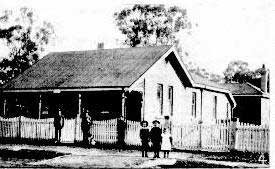
Image: Australian Town and Country Journal, Sat 31 Oct
1896, p. 19. Reproduction: Peter de Waal
The first bank, a branch of the Commercial Banking Co, of Sydney, under the management of Mr Francis Manning, was opened about this time. A branch of the Bank of New South Wales was opened later on, but it closed early in 1894. In 1889 an additional survey of town lots was made after agitation. A Government land sale was then held, at which one of the half acre lots realised £185. Following this Tattersall’s Hotel, Jensen and Co’s store and other business places were opened in the same year. In 1890 (principally by the efforts of Mr J Roche) a Mechanics Institute and free library was founded; it now contains 420 volumes. The town was also brought under the Police Act, Registrar of Birth, Deaths and Marriages appointed, St Peter’s Catholic Church erected on land donated by Mr PA Dunne, a Wesleyan Church on land donated by Mr Edward Hillson, and a town common gazetted. During 1891 a fierce agitation was carried on over the bridge sire, the Cobram people trying to get it there. The visit of the Minster on November 18th finally decided in favour of the Tocumwal site. In 1892 tenders for the erection of the bridge were accepted. Mr E Hillson, JP, founder of Tocumwal, died in June of this year. In 1893 bridge work commenced, new court-house completed, show grounds gazetted; January 4th, 1894, saw the first issue of the Tocumwal Times, the first newspaper. Telephonic communication with Finley opened on November 28th. The country around Finley (the native name of which by the way is Carswotha, the place of pines) is now largely devoted to agriculture, and is peopled by an intelligent, industrious class. The yield of grain in the Tocumwal and Finley districts in 1880 could have been stowed in one bullock dray; this year (1895) the estimated yield will be 635,000 bushels.
Since then, writes our contributor, the bridge has been opened, the Catholic Church has been enlarged by one half, and the walls of an Anglican Church are mounting upwards on land presented by Mr GF Sugden, the town boundaries have been extended, and many buildings erected. The area under crop has also more than doubled since the foregoing article was written, farming settlement has also increased quite fivefold in the districts of Tocumwal and Finley, and general prosperity is only retarded by a succession of bad seasons. These cannot always last, and there is bound to be a good future ahead of it.. The increased settlement consists of a most desirable class of farmers, principally from Victoria and Tasmania. The crops are now languishing for rain, and prospects for this season are the reverse of cheery. The Mechanics’ Institute library has been also very much enlarged.
1 Australian Town and Country Journal, Sat 31 Oct 1896, p. 20. Emphasis added.
2 The Albury Banner and Wodonga Express, (NSW), Fri 13 Oct 1899, p. 16. Emphasis added.