Illustrated Sydney News, Sat 9 Apr 1892 1
NOTES FROM GLEN INNES, NEW
SOUTH WALES
GLEN INNES is the youngest town of note on the tableland of New England, and has made rapid progress. The town proper dates back less than forty years, having been surveyed in 1853 by the Hon JJ Galloway, at which time it is said to have been one mass of scrub. But this state of affairs was not destined to last long, for in August of the following year the first sale of town lots were put up at auction at Wellengrove, a settlement of fourteen miles distant. Two months later the country lots were easily disposed of. Wellengrove, it may be mentioned, was settled on prior to Glen Innes, and intended as the centre of power; but, owing to the spirit and energy shown by the early settlers of Glen Innes, it was obliged to retire and rest contented in its own simplicity. Among the early pioneers, the late Mr Colin Ross may be truly said to have been the first. He was engaged in squatting pursuits, and eventually departed for the Inverell district. But Mr James Martin, whose portrait is given on this page—a gentleman occupying several public positions—lays claim to having been the first white man resident in Glen Innes. This is no small matter, and he delights to draw attention to it, relating anecdotes of old squatting days and the doings of those merry times. Our worthy friend has piles of highly interesting information on which he centres one’s attention for hours. Even in those early days one finds him managing the first post office, running the first store, and elected as first returning officer for the municipal electorate after the division, and from then to now he has ever been to the front in all matters likely to be of benefit to the town. A son of the above, Jas C Martin, was the first boy born in the township and the first child registered in the district, making No. 1 on the record. The first building was erected about 1850, by Mr George Martin, under the supervision of the late Mr Colin Ross. Justice was meted out in the bark-roof stable at the back of Regan’s Hotel. On Sundays this unassuming structure was used for divine service, the late Dean McCarthy having frequently preached there. The first Church of England was erected on the present site of Trinity Hall, the débris having been sold some years ago for the magnificent sum of £10. The Rev SC Bode was its first incumbent, and the Rev A Cameron was the first minister of the local Presbyterian Church, the late Dean McCarthy, RC, being a constant visitor. The first stone court-house was a substantial rubble building, erected by Mr Whan, and contracted for by Mr C Fletcher, who also started the second store in a wooden building now used by the Roads Office. The first bank was opened by Mr TOS Green, under the management of Mr RM Robey. The late Captain Ditmas built the first hotel, and rented it to his overseer, Samuel Regan. Several stories still go the round relative to the jollifications carried on in and around this at one time favourite hostelry. The first racecourse was about a mile from the town, and near to where the first pony races have just been held. The people of Glen Innes can truly be said to belong to the sporting world; in fact, one course has been found insufficient to satisfy their cravings. The present new course is the outcome of an opposition club, and has just held its first meeting, which, as anticipated, proved to be a big success. The site on which Glen Innes stands has been wisely chosen, and to-day the town presents very creditable results, as seen by the accompanying illustrations. The buildings are large and lofty, the banks, courthouse, and Town Hall especially having pretensions to something considerably above the average. The new school now in course of erection promises to be of an imposing nature. The hospital, again under the care of Dr Wrigley, is beyond criticism. Exception can be taken only to the lack of foresight shown in the erection of the gaol, a fine one indeed, capable of sheltering a hundred prisoners in good times, and costing the modest sum of £17,000. This expensive toy came into existence about six years ago, and is handed down to the present generation as a huge ‘white elephant,’ the daily, or even nightly, carousings of the citizens being of such a model character that the old lock-up is found sufficiently accommodating for all requirements. Besides public buildings, there are three flour mills, one brewery, one cordial manufactory, two tanneries, and stores of all sizes and descriptions.
The population of the town and vicinity numbers 2500; of the district, 9000.
The soil is well-adapted for the growing of fruit, the scarcity of which strikes the stranger very forcibly. Attempts have been made to promote this industry, however; but the efforts have been so often frustrated, owing to the ravages created by frosts, that any good result is considered hopeless. The surroundings of the town are picturesque and varied, Stonehenge being well worth a visit. It is distant about eight miles, and affords an illustration to the Australian of its famous prototype in the Old Country. The masses of granite, evidently thrown out at some remote period, and sporting themselves on a large plain in various positions, singly and in heaps, go to make up a novel and attractive sight.
The residence of Mr Simpson, the squatter, is to be found here, almost hidden amidst a clump of dark-tinted foliage, around which, and from rock to rock, his favourite white Angoras
Leap and play
In a happy, sportive way.
The photographs of Glen Innes were kindly supplied to our artist by Mr HB McKie, manager of the Commercial Bank, and by Mr Debenham.
~ ~ ~ ~ ~
Evening News, Thu 9 Mar 1893 2
THE PREMIER AT GLEN INNES.
————
GLEN INNES, Wednesday.—The Premier, accompanied by Messrs FA Wright, A Hutchison, and G Cruickshank, MsLA, arrived here this morning at 9 o’clock, and was met at the station by the Mayor, aldermen, and a large number of townspeople, and was escorted to Tattersall’s Hotel. At 11 o’clock, Mr FA Wright introduced a deputation to Sir George Dibbs in reference to the erection of a new post office, a courthouse, and the establishment of a circuit court. The premier promised to use his influence in the matter. Speaking on the item for a special endowment for roads in the municipality, the Premier remarked that he was glad Glen Innes was hard up, and he would be better pleased if all the municipalities were impecunious, as then they would bring their influence to bear in passing the Local Government Bill . He was determined that the bill should be passed this year. Regarding the gaol, the Premier was in favor of utilising it for a reformatory for juvenile offenders. Ser George Dibbs will open the show this afternoon and will be banqueted to-night.
~ ~ ~ ~ ~
Australian Town and Country Journal, Sat 21 Jan 1899 3
GLEN INNES IN THE FIFTIES.
————
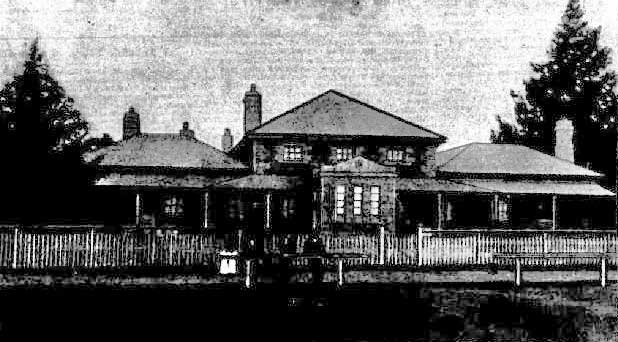
Town and Country Journal, Sat 21 Jan 1899, p. 22.
Reproduction: Peter de Waal
Our two illustrations show the new courthouse completed at Glen Innes last month; and also a picture of the first courthouse erected in that town nearly fifty years ago.
The new edifice, which was built mainly through the strenuous efforts of Mr FA Wright, the present member for the district, is an imposing building, adjoining the post office, and almost in the heart of the principal thoroughfare, and was built by Mr Nicholas Josephson and Company. The police magistrate at this court is Mr Corbett Lawson, who, under existing arrangements has a large jurisdiction under his control, he having to attend to the magisterial duties at Inverell, as well as Glen Innes. The officer in charge of police is Senior-sergeant Flynn, a painstaking and efficient, and decidedly popular officer, who succeeded Senior-sergeant Travers upon his promotion to a sub-inspectorship at Broken Hill.
Mr Farquer McRae, an old and respected resident of the district, supplied to a “Town and Country Journal” representative the following facts, which will probably be of interest to many of our readers:
Mr McRae first saw Glen Innes at Christmas, 1854. At that period there was only one store in the village, which stood upon the site now occupied by Mr JF Utz’s large emporium. The business was conducted by Mr James Martin, who also filled the office of postmaster. Mr Martin is still a resident of Glen Innes, and is returning officer for the electoral division of that place. At the period before mentioned there were two buildings in the course of erection, one of them being a store for Messrs Fletcher and Ross (at present occupied by Mr George Clarke, decorator); the other a brick building, the first in Glen Innes (standing where the Great Central Hotel now flourishes), which was opened on July 1, 1855, with the sign of the Beverley Arms Inn, by Mr Samuel Regan. The only other buildings around Glen Innes at this period consisted of a few “bark and slab” huts. At this time the courthouse and lockup were in Wellingrove, a place then of far more importance than Glen Innes, and situated about fourteen miles from the present post office. About the year 1858 the courthouse and lockup were transferred to Glen Innes. Some of the magistrates of the day were: Captain Ditmas, of Clarevaulx; and Messrs McInnes and Dumaresq, of Furruckabad. Mr AO Wyatt (who is represented in the picture of the old courthouse) was CPS, which office he continued to hold until he was succeeded by Mr George Martin (brother of the late Sir James Martin), who afterwards became PM, which office he continued held up to 1897, when he was promoted to Wagga. Chief Constable Proctor was in charge of the station at this time, with Robert Carter as lockup keeper. Proctor was followed by Sergeant Pear, in 1859; then Sergeant Heatherington. After him came Sergeant Reynolds, who was succeeded by Sergeant Walker, who received a well-earned promotion after he had shot the outlaw Thunderbolt, in 1870. Lachlan Currie became lockup keeper in 1858. The last named, well advanced into the “sere and yellow,” is still in the Glen Innes district, and many an interesting episode he can relate of those “golden times.”
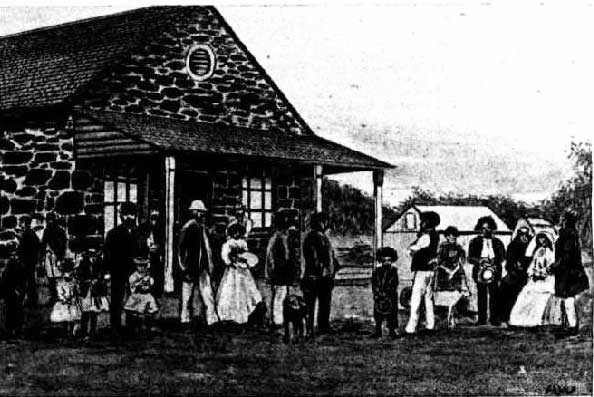
Country Journal, Sat 21 Jan 1899, p. 22. Reproduction: Peter de Waal
For some years the courthouse did duty as a place of public worship for different denominations, until they had churches of their own erected, and also served for public meetings, lectures, etc.
The first police magistrate to visit Glen Innes was Mr Cowper, PM, at Tenterfield, who came once a month, and “the first judge,” said Mr McRae, “was Judge Francis, who came, I think, in 1861.” “Ah!” said Mr McCrae, as his memory seemed to linger on the far-away days, “those were the good old times; money was plentiful, wages were good, and no one need be out of employment.” “Drink” was common, and the few hotels were driving a “roaring trade.” For a number of years all drinks were a shilling a glass. “Offenders were frequently before the court,” said our informant; “and, he added, smiling, “some of the JsP would be as drunk as those brought before them. The first doctor I remember in Glen Innes was a Scotchman who often appeared in a faded Highland dress. He died in Armidale lockup in the sixties, where he was waiting his trial for the death of a child to whom he administered poison in mistake for medicine, in one of his drunken freaks.” Mr McRae has many other stories of the old days, showing that Glen Innes thirty or forty years ago was a very different place to the thriving township of to-day.
1 Illustrated Sydney News, Sat 9 Apr 1892, p. 12. Emphasis added. The Trove newspaper pages 2 and 3 are missing. Therefore the above article is correctly on page 12 and not 10 as found on the website.
2 Evening News, (Sydney, NSW), Thu 9 Mar 1893, p. 6. Emphasis added.
3 Australian Town and Country Journal, Sat 21 Jan 1899, p. 22. Emphasis added.