The Sydney Morning Herald, Wed 30 Jul 1902 1
SOUTH COAST.
…
Nyngan, Tuesday.
At a large meeting of magistrates to-day it was decided to invite the Minister for Justice to open the new courthouse at an early date. A public meeting has been convened to invite the Minister for Lands and the Minister for works to be present at the ceremony.
~ ~ ~ ~ ~
Western Champion, Fri 11 Jul 1902 2
NYNGAN
…
The new Nyngan Court-house is almost completed for the transaction o business.
~ ~ ~ ~ ~
Western Champion, Fri 18 Jul 1902 3
NYNGAN
The new Court house is now completed and was finally passed on Thursday by Mr WJ Little, district architect, Dubbo.
~ ~ ~ ~ ~
Western Champion, Fri 29 Aug 1902 4
OUR NEIGHBOURS.
————
(From Our Exchanges)
————
…
NYNGAN
…
It has been decided that our handsome Court House will be opened on Friday afternoon next, Mr BR Wise, Attorney-General, one of the ablest men in the State Ministry, coming especially from Sydney to carry out the ceremony. He will probably be accompanied by other Ministers as well as Members of Parliament and Government officials.
~ ~ ~ ~ ~
The Sydney Morning Herald, Mon 1 Sep 1902 5
SOUTH COAST.
…
Nyngan, Friday.
The Courthouse was opened to-day by the Police Magistrate, Mr Treatt, who delivered a lengthy address on the principles and aims of the law. Mr Augustus Lyne, coroner, the doyen of the Nyngan Bench, made an appropriate address. A large company of country magistrates were on the bench. The building was attractively decorated with flags and bunting. There was a large attendance, including many ladies. A banquet took place in the evening.
~ ~ ~ ~ ~
Nyngan Observer, Bogan River and District Representative, Sat 6 Sep 1902 6
THE NYNGAN COURT-HOUSE.
————
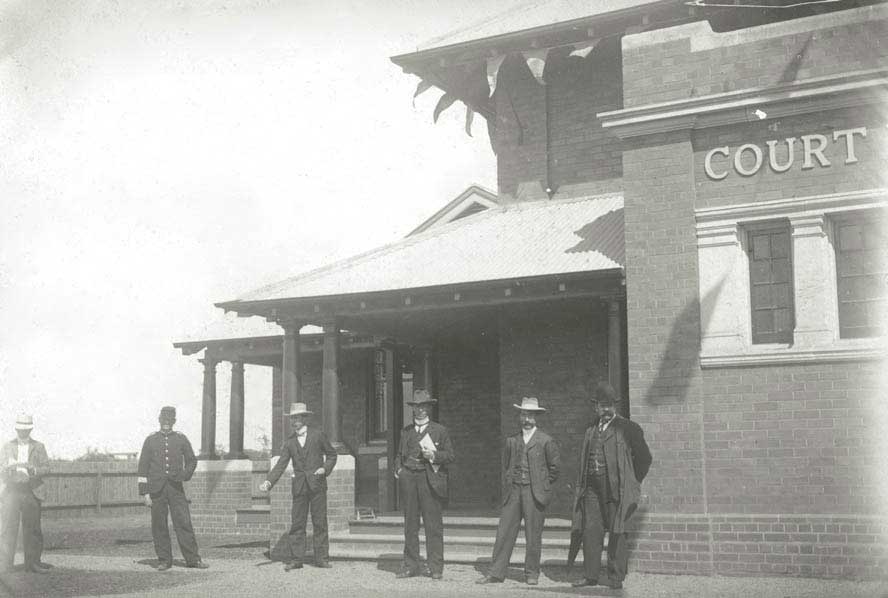
THE official opening of this building took place last Friday afternoon, and though a great deal of the importance of the function was discounted through the unavoidable absence of the Attorney-General, the ceremony was most interesting and thoroughly enjoyed by all those who took part therein. Consequent on the absence of Mr Wise, the programme as originally arranged had to be departed from in several particulars, notably in reference to deputations regarding town and district requirements, but these matters have since been brought under his notice by letter. As the time for the opening drew near, people began to assemble in the grounds, and amidst town residents we were pleased to see a fair sprinkling of country friends, and many made an inspection of the building, admiring its many beauties and general arrangements. The outside was gaily decorated with numerous flags and bunting, which hung in graceful streamers from the turret, and for this decoration we were indebted to Mr Kelk’s forethought and taste. The hall was comfortably filled with spectators, amongst whom were a number of ladies who graced the proceedings with their presence, and about 3 o’clock the buzy [sic] of conversation was hushed by Sergeant Burrows demanding “silence,” and the district magistrates with Mr FB Treatt, PM, walked in and took their seats on the Bench. The Mayor and Aldermen were allotetd [sic] seats at the solicitors’ table.
Mr Treatt said he was sure he voiced the sentiments of the town and district when he regretted the absence of the hon and learned Attorney-General on that occasion, and explained that he had been appointed as his deputy to officially open the court. Mr Wise had shown such statesmanlike qualities that he was sure of a hearty welcome in any progressive community; his legislation with reference to arbitration in industrial disputes had placed him in the front rank. In matters of the heart, also, the learned gentleman had shown his interest, as in the aid for discharged prisoners, and the bill for the care of young children and the most civilised way of dealing with them, and in other beneficent directions, so that they had cause to regret the absence of the able, learned and eloquent gentleman. On behalf of the magistrates he welcomed the opening of the new building, where the law would be administered with integrity and impartiality. In a British community, where the law was recognised as supreme, the opening of a new hall of justice was a complete justification for their trouble in assembling together that afternoon, and Mr Treatt then went on to explain the fundamental principles of British law. He briefly touched on the evolution that had taken place during the centuries, whereby cruelty and severity had in a very great measure been supplanted by the remedial principle. Its glory now was that it was not revengeful, but that it sought to develop the good, to remedy things, and this was most apparent in the matter of bringing up the children. The children, he said, were the “pence of the population,” and if they took care of the pence the others would take care of themselves. A great German writer had said show him the young men of 25 years of age and he would tell what the future of the nation would be. He (the speaker) however, said, let the children be properly taken care of and the young men would be better. He then quoted the remarks of Captain Nietentein, comptroller-general of the State reformatories, in his reports, wherein he advocates the establishment of children’s day industrial schools, so that they might be kept away from the evils of the streets and bad companionship, and properly taught and disciplined. A special court should also deal with juvenile cases. These matters were so important that they should be strongly emphasised and brought under the attention of the legislature, for as Macaulay had pointed out the Goths and Vandals who were the menace of civilisation, would in the future be found, not amongst the millions of Asia, but in the slums of our great cities and towns. Ruskin had declared that history was not war, but the way households were conducted, and John Bright held that the foundation of a nation was happy homes. Gladstone’s ideal was for the law to make it easy to do the right thing and difficult to do wrong, and that should be their aim in all their endeavours, especially as regarded the younger part of the population. A lady writer, Rosa M Barrett, a talented writer and winner of a prize essay on these subjects, had shown the necessity for remedial law as far as the young were concerned, by showing that in America it had been found there were no less than 250 criminal descendants from one very bad pair. In parentheses, Mr Treatt referred to the granting of women’s suffrage in this State, and said that in the future the fairer sex had a great future before it in remedying many evils of which women alone knew. Remedial checks were necessary to enable men to change; if the environments were better, many more would become good and noble members of society. It remained with him to declare the court open for the conduct of public business, and in doing so he remarked on the beauty of the building, and complimented the contractors on the way they had carried out their work. Visitors from other towns had wondered why Nyngan should possess such a building—but perhaps that was because they were jealous. The Government deserved every credit for erecting such an adornment to the town. Ruskin, who was a great exponent of the teachings of architecture, had pointed out that graceful and beautiful buildings had a tendency to elevate the civic mind, and he had no doubt the building would also make a spirit of emulation for the future improvement and adornment of the town. Remembering the work to be transacted within those walls, he had to declare the Court-house open in Name of the Great Architect of the Universe, the Source of all law, and did so at the request of and behalf of the Attorney-General. He trusted and believed that the PM and the honorary magistrates would ever discharge therein their duties without fear or favour, affection or illwill.
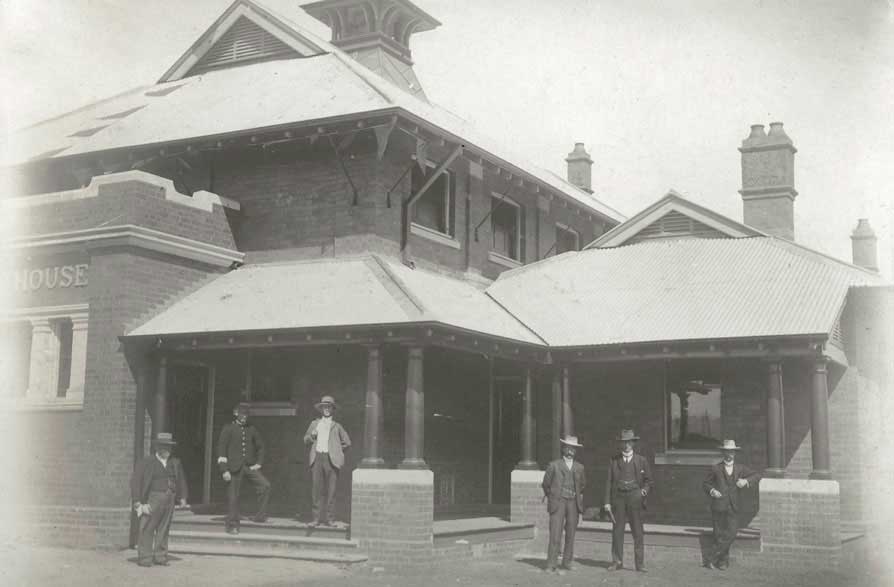
Photo ID: SRNSW 4346_a020_a020000110.jpg
The Mayor (Mr Flashman), on behalf of the town and district expressed his congratulations on the opening of that handsome building as a court of equity and conscience, as he was sure it would be under the presidency of the PM and honorary magistrates. The Colonial Architect regretted that he had to return to Sydney at once, and thus was unable to attend that afternoon, but that gentleman had given him a few particulars which would no doubt prove interesting. The first negotiations for the erection of a courthouse took place in 1884, but it was not until 1899 that the first estimates were prepared, and they provided for a building to cost £7800. These were amended and the cost brought down to £4200, and the present contract had been completed for the sum of £3717. They all thanked the Department for such a handsome building, and the town and district appreciated the honor. The Colonial Architect had stated to him that the Messrs Rigby had carried out the work to the entire satisfaction of himself and the Department. He regretted the absence of the Attorney-General, and thanked the PM for attending as his deputy and complimented him upon the able manner in which he had declared the court open.
Mr A Lyne, as the senior magistrate, made a few remarks appreciative of the building, and gave his assurance that all who had the misfortune to attend there would have justice meted out to them.
Mr FH Mayger, on behalf of the country magistrates, expressed his pleasure at being present at the opening of this beautiful temple of justice, where he was sure even-handed justice would always be dealt out.
The assemblage then heartily joined in singing a verse of “God save the King,” and the ceremony closed.
———
Subsequently, a large number of residents and visitors assembled in the CPS room, when refreshments were provided and numerous toasts proposed and honoured.
——————————
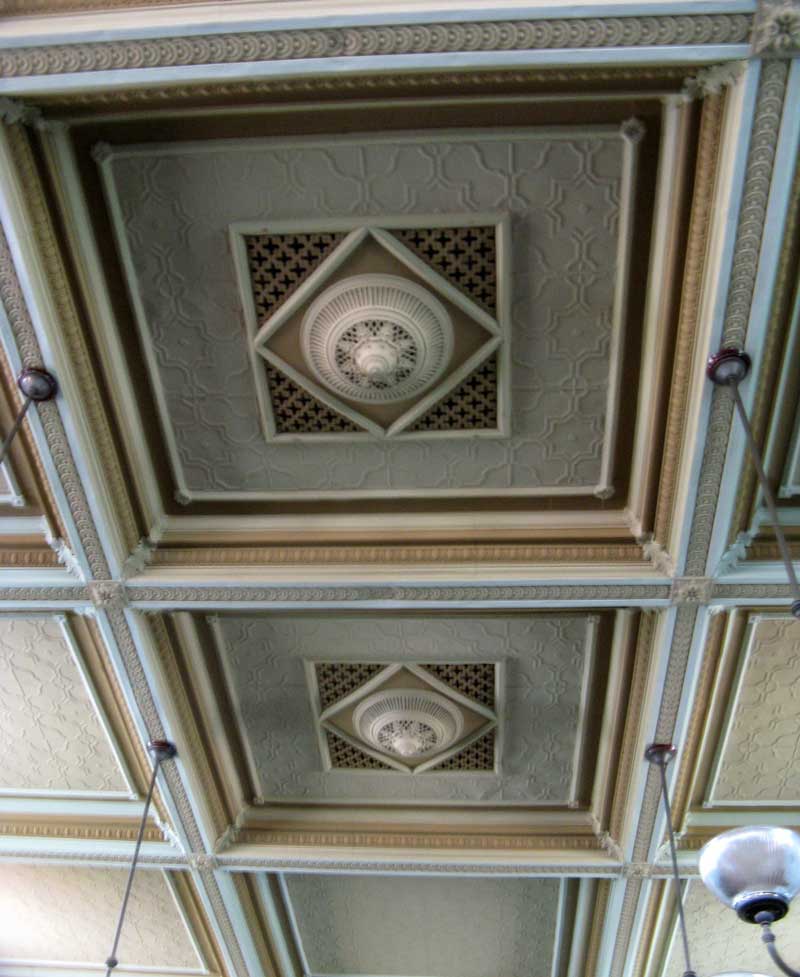
Photo: Peter de Waal
In the evening, about 30 gentlemen sat down to a splendidly served dinner at Barrett’s Hotel. The Mayor (Mr Flashman) occupied the chair, and Dr Hickey the vice-chair. After full justice had been done to the bountiful spread, the toast of “the King” was duly honoured. The chairman then proposed the toast of “the Ministry, coupled with the name of the Attorney-General, whose deputy was then present.” The present Government was deserving of great credit for giving them the building that had that day been opened, and it had shown its interest by many acts of legislation for the benefit of the people in the Western districts, for instance, the Western Lands Act and other measures, and the Cobar-Wilcannia railway. He complimented the PM on his able and eloquent speech that afternoon, which all had appreciated. Mr Treatt said he had a legal doubt as to whether his position as deputy empowered him to reply to such an important speech, but he would allow his heart to go in advance of his head. The Ministry had endeavoured to travel the path of progress in the best interests of the country, and had had to carry on its business under many adverse circumstances. In conclusion, Mr Treatt proposed “the well-being of the town and district.” Good wine needed no bush, and he hoped that Providence would shortly visit the district with beneficient [sic] rainfalls, and that the long drought would pass away. Amongst the lessons it should teach was that of an earnest grappling with measured to remedy and palliate the drought fiend, to search for concealed or suspected waters. If they thoroughly learnt that lesson, the drought would be a blessing in disguise. He wished them the success they deserved with all his heart. The Mayor briefly replied, agreeing with the PM in the lessons to be learnt from the drought. Mr Kelk in responding remarked that a visitor that day had remarked that he hardly knew which he ought to eulogise most, the pluck and perseverance of the men of the district, or the beauty of its ladies. It was indeed wonderful how men could continue to fight against such terrible odds. He characterised the afternoon’s function as a magnificent success. Mr Scully also expressed his appreciation of the address in the afternoon, and thought the building did the contractors every credit. Mr Doyle said the toast could not be replied to under more painful circumstances that existed at present, when the prospects were at their lowest ebb. He would strongly urge the necessity of water conservation and the search for artesian water, the discovery of which would be a grand thing for the town and district, the capabilities of which were equal to any other part of the State, for agriculture, wool and mutton. He hoped Mr Treatt’s kind wishes regarding end of the drought would speedily be brought about. Mr K Murchison urged that they should agitate for cheaper land, as people were now paying double and treble its value. There was not a pluckier or more generous people to be found than those in the Nyngan district. Other toasts honoured and responded to were “Mr Doyle, president of the P and A Association,” “The Chairman,” and “The Press,” the company breaking up early to admit of country friends attending the entertainment at the Town-hall.
———
There was a fair attendance at the repetition of the comedy “Uncle” at the Town-hall, the front seats especially showing up well. The members played their parts even better than on the first occasion, the result no doubt of more confidence, and a better knowledge of “the business.” The play passed over very successfully, though we are sorry to say the cricket club will not receive any financial benefit from the entertainment. The programme concluded with the side-splitting farce, “Turn him out,” which was excellently played and sent the audience home in the best of humours. Subsequently, a dance was held for a couple of hours.
——————————
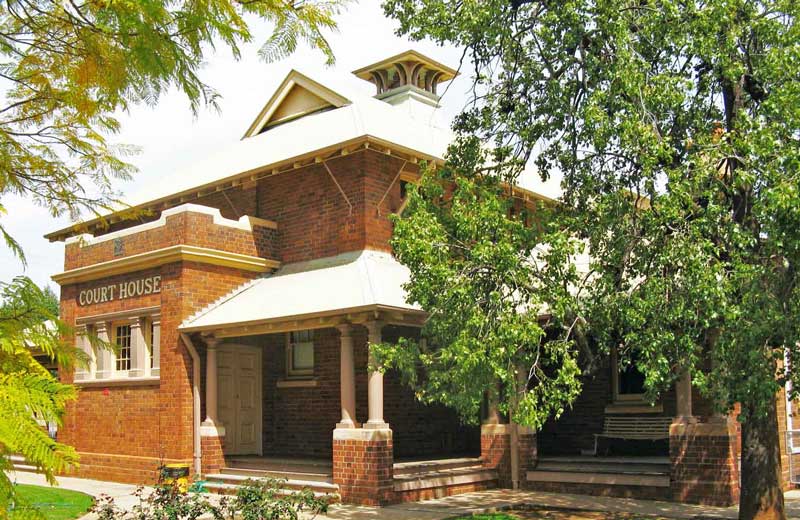
The Court-house is in the Romanesque design of architecture, and comprises courtroom, approached by a portico, CPS office, witness, jury, and judge’s room. The building is constructed of the best local bricks, supplied by Mr W Setter, with the exception of the external faces of the court block which are of Sydney machine-made open-kiln bricks, with Dubbo freestone enrichments to enhance portico, which came from the establishment of Mr W Larcombe, monumental mason of Dubbo. The courtroom is 48ft by 30ft, surrounded by 4ft 6in corridors. It is a beautiful room I every respect, finely lighted and well ventilated, and judging by last Friday’s experience possesses excellent acoustic properties. At the southern end, a raised bench of polished cedar provides ample accommodation for the magistrates, with a lower desk in front for the deposition clerk, whilst suitable sitting provision is made for witnesses and jurors and a table for solicitors, whilst at the end of the room sitting accommodation is provided for the public. The ceiling of the courtroom is a rich design in compressed zinc by Wunderlich patent. Throughout the building the fittings are all cedar and afford all conveniences required. Leading from the corridor on the eastern wing is the CPS office, a fine room, 36ft by 19ft 2in, fitted with every requisite for the transaction of public business, and at the rear is a small room for the storage of records, plans, etc. The western wing is occupied by the witnesses’, jury and judge’s rooms. The building, it may be stated, is so designed as to admit of future extensions when Circuit Courts are required to be held at Nyngan. In the erection of the structure special attention has been given to ventilation. Two large 19in inlet tubes are fixed on either side under floors, from which branch vents are taken and distributed through the building; and three large ventilators carry off hot air from the ceilings, leading to the ornamental turrets over the roof of the courtroom. The contract, consisting of Courthouse, and quarters for sergeant of police, etc, has been carried out by Messrs Rigby Brothers, of Bathurst, with the greatest of credit and satisfaction, under the supervision of Mr WJ Little, district architect, Dubbo, at a total cost of £3,800. Local timber was supplied from Mr Utley’s Nyngan mills for framing, roofing, flooring and ceilings of the building. The whole of the plumbing work was done by Mr H Southwood, the local plumber. During his short visit here last Friday, the Colonial Architect (Mr Vernon) expressed his extreme satisfaction at the excellent manner in which the whole work had been completed, and the Messrs Rigby entirely deserve all the compliments that have been passed upon the thoroughness of their work. In next issue we hope to publish an illustration of the building.
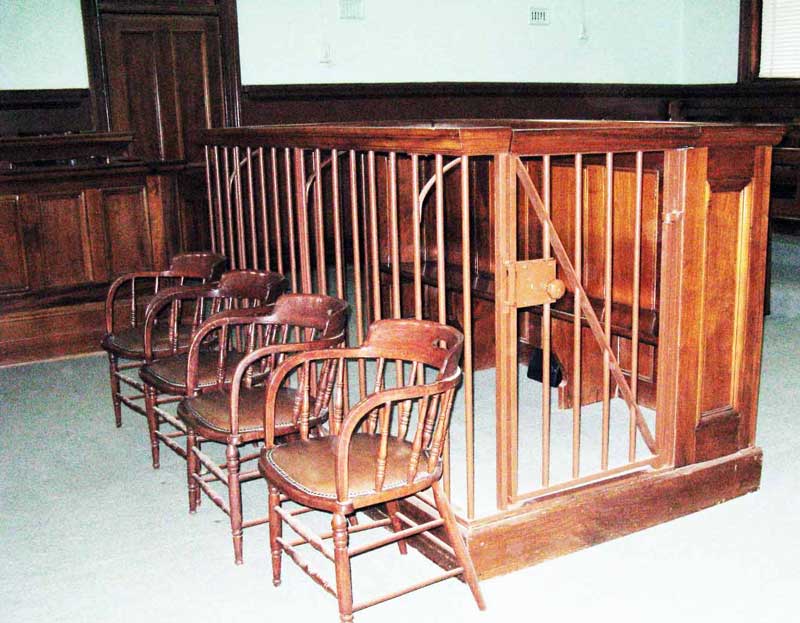 Nyngan courthouse, the dock. Photo: Peter de Waal Nyngan courthouse, the dock. Photo: Peter de Waal |
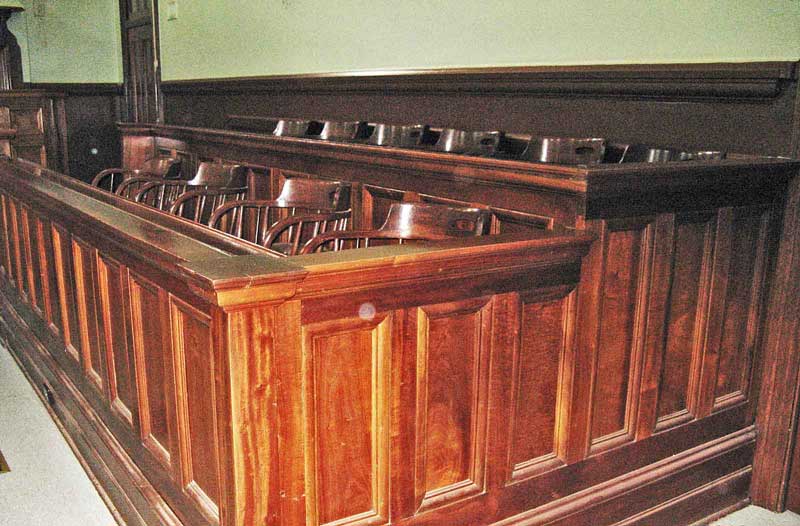 Nyngan courthouse, jury box. Photo: Peter de Waal Nyngan courthouse, jury box. Photo: Peter de Waal |
The quarters erected for the sergeant-in-charge of the district consist of a substantially built brick cottage facing Bogan-street, at the rear of the Court-house. In addition to the large and airy dwelling rooms, it has a most conveniently fitted kitchen, with cooking range, sinks, and other necessaries appreciated by the housewife; whilst the washhouse has a copper, fixed tubs, etc. water is laid on throughout, and plunge and shower baths provided. Cupboards, etc, are foxed in the several rooms, and altogether it is one of the best dwelling houses in the town.
~ ~ ~ ~ ~
Nyngan Observer, Bogan River and District Representative, Sat 13 Sep 1902 7
Nyngan Court House.—In this issue we give an illustration of the Nyngan Courthouse, opened on Friday, August 29, by Mr FB treatt, PM, on behalf of the Attorney-General. For the photograph from which the picture was re-produced we are indebted to the skill and kindness of Mr FW Tibbits, of the AJS [Australian Joint Stock] Bank, an enthusiastic photographic amateur.
1 The Sydney Morning Herald, Wed 30 Jul 1902, p. 12.
2 Western Champion, (Parkes, NSW), Fri 11 Jul 1902, p. 6.
3 Western Champion, (Parkes, NSW), Fri 18 Jul 1902, p. 6.
4 Western Champion, (Parkes, NSW), Fri 29 Aug 1902, p. 6.
5 The Sydney Morning Herald, Mon 1 Sep 1902, p. 5.
6 Nyngan Observer, Bogan River and District Representative, Sat 6 Sep 1902, p. 4.
7 Nyngan Observer, Bogan River and District Representative, Sat 13 Sep 1902, p. 4.