The Hay Standard and Advertiser for Balranald, Wentworth, Maude, Booligal, Wilcannia, Menindie, Bourke, &c, Wed 18 Aug 1880 1
HAY GAOL.
————
To travellers approaching Hay from the north the new gaol is a conspicuous feature. Messrs Witcombe Bros having completed their part of the contract, the building will be handed over to the Government as soon as the connection with the waterworks is perfected.
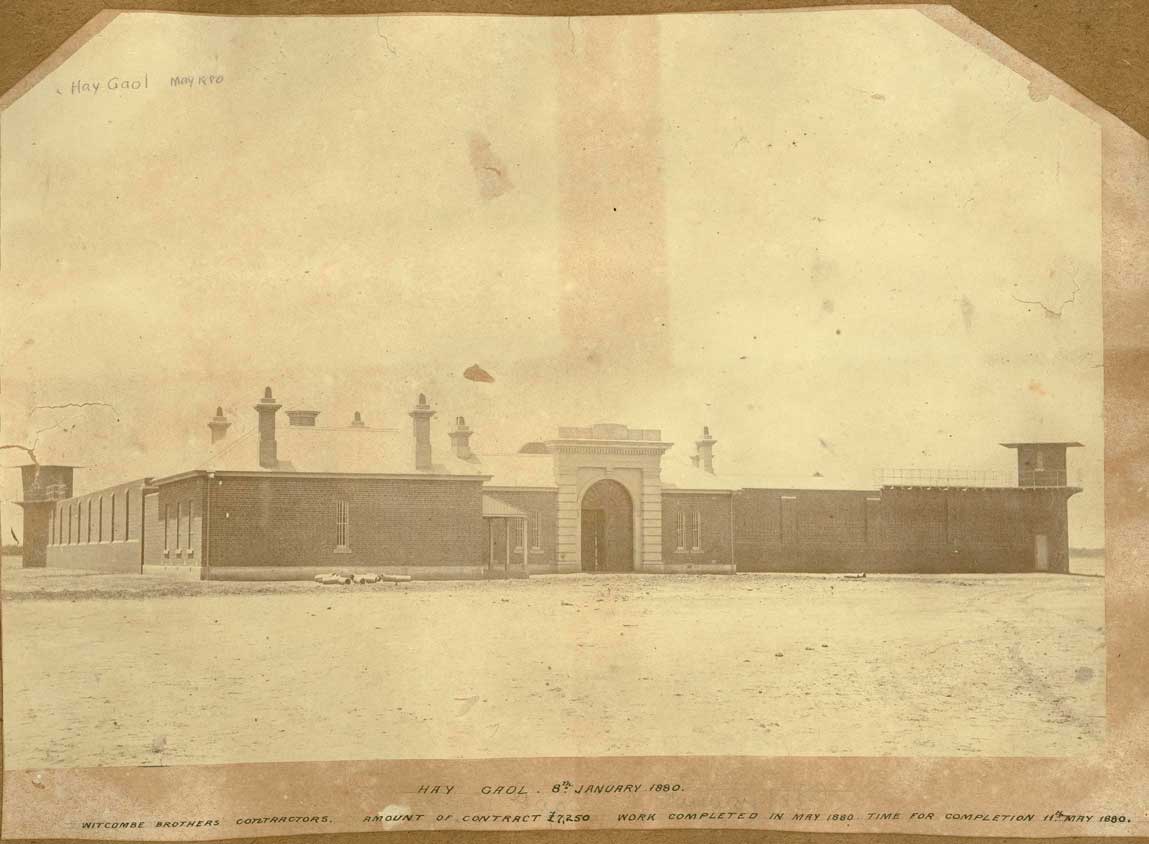
Handwritten caption: “Hay Gaol 8th January 1880. Witcombe Brothers
contractors. Amount of contract £7,250. Work completed in May 1880.
Time for completion 11th May 1880.”
On the left hand side of the huge entrance gate are the gaoler’s quarters, containing sitting room, dwelling room, two bed rooms, and a store. There is a good wide verandah both back and front, and as the rooms are very lofty, coolness, the great desideratum of Riverine dwellings, is secured.. There has been no trouble spared to finish the work neatly, and if it were not for the iron bars in every window one would imagine that the building was intended for the town house of some merchant. Once we leave the gaoler’s quarters, however, no doubt can be entertained as to the nature of the main building. On all sides are to be seen lofty walls capped with watch towers. It will be a clever prisoner that will succeed in scaling the 16 feet of perpendicular brickwork. There are 12 cells in all, 10 being apportioned for men, and two for females. Hope must depart from the mind of any unfortunate incarcerated in one of the cells in the main corridor. Nothing but a smooth, cemented surface in the interior to gaze upon, and the knowledge that the door between him and the corridor is one sheet of inch iron, is not calculated to inspire any hopes of escape.
The hospital is a noble room 35 feet long, lofty and thoroughly ventilated. The surgery and bath room adjoin the hospital.
Dr Watt says that “Satan finds work always for idle hands to do.” To prevent the Prince of Darkness asserting his sway, there is a large work room, which will be the scene of busy labor.
The cook house is provided with two 30 gallon copper boilers, firmly embedded in brickwork.
Everything that ingenuity can devise is employed to render the gaol secure, but no doubt some prisoner will endeavor to break his bonds.
The exercise yard are 160 feet by 180 feet; not an inch of the ground but is within the ken of the watch tower, which surmounts the wall that separates the prisoner from the outer world.
From the watch tower a fine view of the town is obtained.
Some idea of the amount of labor expended in the construction of the huge edifice may be obtained when we find that the quantity of bricks used was over one million.
The rain water off the large surface of roofing is conducted by spouting and pipes into an underground tank, 16 feet deep, with force pump and two raised 400 gallon tanks in one of the exercise yards. As the rain in Riverina is a charming uncertainty, means have been taken to ensure a permanent supply of water by connecting a 3-inch main to the water works.
The drainage from such a large establishment is naturally a formidable affair. It consists of a drain from the gaol to the river, starting from 3 in and being 9¾ ft deep at its entrance to the river, its total length being 640 yards.
The work throughout the whole establishment is beautifully finished, in fact, almost annoyingly so, as one is disappointed in not being able to discover any flaw in the workmanship, which (we sincerely hope that none of our readers will ever view the Hay gaol except as spectators) reflects every credit on Messrs Witcombe Bros, the enterprising contractors.
~ ~ ~ ~ ~
The Riverine Grazier, Sat 10 Jan 1885 2
HAY MUNICIPAL COUNCIL.
The Council met on Thursday at their Chambers, at 4 pm. Present: The Mayor (in the chair) and Aldermen Hills, Murray, Newton, Chambers and Andrew.
…
WATER ASSESSMENT APPEALS.
…
Hay Gaol, raised from L20 to L30. Mr Everett appeared against the increase, and said no water was used for drinking, as that was taken from the underground tanks. The Mayor said the population of the gaol was increasing, and also the garden. Mr Everett said there was a 16,00 gallon tank in the yard. He would recommend the Government, if the assessment was sustained, to connect the railway water pipe with the gaol. The average of prisoners was the same as the two past years. He had more in 18(??) than in 18(??)). Reduced to L25.
~ ~ ~ ~ ~
The Farmer and Settler, Tue 6 Jul 1915 3
HAY GAOL CLOSED.
FOUR OFFICERS TO ONE PRISONER.
The NSW Attorney-General has ascertained that it is cheaper to house prisoners at the Hotel Australia than at some of the country gaols in the State. “My attention has been drawn to the fact,” said Mr Hall yesterday, “that at Hay there are four officers, whose sole duty is to look after one solitary prisoner. To do this would cost about £582 per annum, so you see it would be far more economical to bring him to Sydney, and allow him to occupy a suite of rooms at a hotel. However, I do not propose to do that. I have removed him to another gaol, closed the institution at Hay, and transferred the officials to other gaols. The closing of these country gaols has been brought about by the decrease in crime.”
~ ~ ~ ~ ~
The Sydney Stock and Station Journal, Fri 25 Jun 1915 4
HAY GAOL CLOSED.
“My attention has been drawn to the fact,” says Mr Hall, State Attorney-general, “that at Hay there are four officers whose sole duty is to look after one solitary prisoner. To do this would cost about £582 per annum, so you see it would be far more economical to bring him to Sydney, and allow him to occupy a suite of rooms at the best hotel. However, I do not propose to do that. What I have done is to remove him to another gaol, and to close the institution at Hay, and transfer the officials to other gaols. It is very gratifying to have the opportunity of closing these gaols, which has been brought about by the decrease in crime.”
1 The Hay Standard and Advertiser for Balranald, Wentworth, Maude, Booligal, Wilcannia, Menindie, Bourke, &c, Wed 18 Aug 1880, p. 6.
2 The Riverine Grazier, Sat 10 Jan 1885, p. 2.
3 The Farmer and Settler, (NSW), Tue 6 Jul 1915, p. 4.
4 The Sydney Stock and Station Journal, (NSW), Fri 25 Jun 1915, p. 6.