Evening News, Thu 1 Apr 1880 1
POLICE COURTS.
————
The bench of the Water Police Court to-day was comprised of Messrs Solomon, Gray, and Field, and the following cases were disposed of:—
…
A CAPITAL CHARGE.
Phillip John Hardy, alias William John Brown, 26, described as a telegraph operator, a native of Queensland, was committed to take his trial at the next Central Criminal Court for an unnatural offence.
~ ~ ~ ~ ~
The Sydney Morning Herald, Mon 10 May 1880 2
CENTRAL CRIMINAL COURT.
The following is the list of cases to be tried at the Central Criminal Sessions, which commence to-day, at the Court House, Darlinghurst:—W Ellison, jun, rape; John Roberts, attempt to murder; Matthew Carroll, forgery (two counts); James Ryan, George Reeve, T Cochrane, P O’Brien, and P Riddell, inflicting grievous bodily harm; J Connors, Annie Chapman, unlawfully wounding; Emily Thompson, Emily Thompson, jun, murder; Henry Crossing, David Jones, attempt to commit a felony; William Chapman, James Chapman, wounding with intent to murder; Phillip John Hardy, [aka John William Brown], bestiality; Harry or Joseph Millard, larceny; Henry Allen, burglary; Mark Kilkenny, burglary; Lewis Sampson, perjury; WE Jordan, bigamy; John O’Brien, Henry Sykes, John Scowen, murder; John Doran, larceny; John Coombes, arson; William Gore Beverley, embezzlement; Edward McCann, John Townsend, Edward Lewis, garrotting and robbery; Francis Hemming, rape.
~ ~ ~ ~ ~
The Daily Telegraph, Thu 27 May 1880 3
![NSW Executive Council chamber interior, c. 1890, situated in the Colonial Secretary Building. Photo: SRNSW [NRS4481], Government Printing Office Glass Negatives, photo 1445.](../../images/trials/1880-Brown-Interior-Executive-Council-Chamber-1890.jpg "NSW Executive Council chamber interior, c. 1890, situated in the Colonial Secretary Building. Photo: SRNSW [NRS4481], Government Printing Office Glass Negatives, photo 1445.")
Colonial Secretary Building. Photo: SRNSW [NRS4481],
Government Printing Office Glass Negatives, photo 1445.
The sittings of the Central Criminal Sessions were continued at the Darlinghurst Court-house yesterday, before His Honour Mr Justice Faucett. Mr Heydon conducted the prosecution on behalf of the Crown. Lewis Sampson was brought up and had his sentence reduced from three years to two years and 11 months. John O’Brien, Henry Sykes and John Seawen were found guilty of the murder of Patrick Sullivan, at the Glebe, on the 31st March last, and sentenced to death. The jury recommended the prisoners to mercy, and his Honor said he would place their recommendation before the Executive Council. Philip J Hardy was put on his trial for committing an unnatural offence, [bestiality with a dog], in the Domain on the 1st April last. The jury were unable to agree upon their verdict, and were locked up for the night.
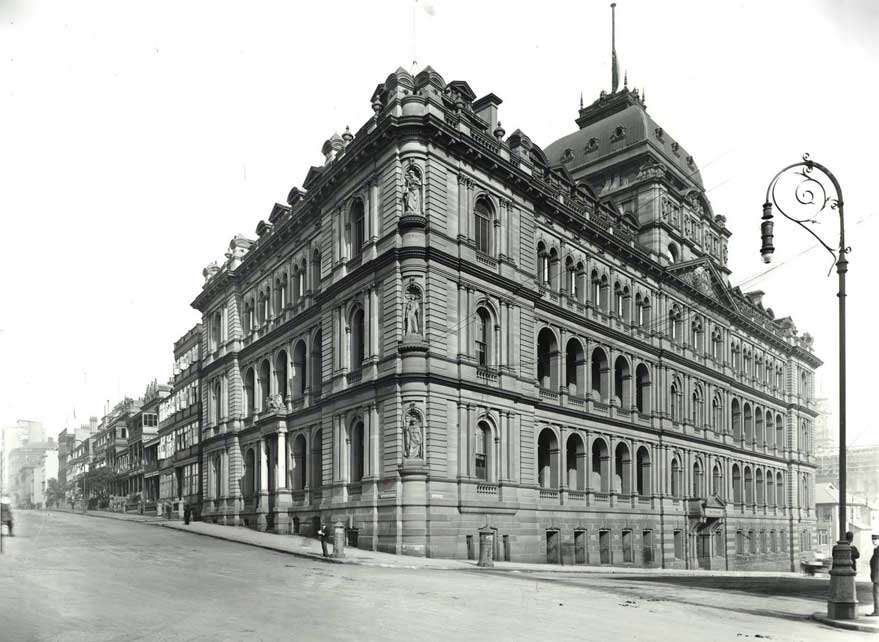
Sydney, completed 1879. Photo ID: SRNSW 4481_a026_000329.jpg
~ ~ ~ ~ ~
Evening News, Thu 27 May 1880 4
CENTRAL CRIMINAL COURT.
————
WEDNESDAY, MAY 26.
…
UNNATURAL OFFENCE.
Phillip J Hardy pleaded not guilty to a charge of the above nature. Mr Buchanan and Mr Irving, instructed by Mr Lowe, appeared for the defence. The jury retired at 25 minutes past 4 o’clock, and not having agreed at 9 pm, were locked up all night.
THIS DAY.
At 10 o’clock this morning the sittings of the Court were resumed. The foreman of the jury in Hardy’s case stated that there was no prospect of their agreeing. His Honor then discharged them. The Attorney-General applied that the prisoner should be liberated on his own recognisances. This was done, and Hardy left the court.
The Court was then adjourned sine die.
~ ~ ~ ~ ~
The Sydney Morning Herald, Thu 27 May 1880 5
CENTRAL CRIMINAL COURT.
WEDNESDAY.
(Before his Honor Mr Justice Faucett.)
A number of cases were put off, to be heard at the Quarter Sessions next week.
…
UNNATURAL OFFENCE.
Philip J Hardy was arraigned on a charge of committing the above offence, at Sydney, on April 1, 1880. Mr Heydon again prosecuted on behalf of the Attorney-General, the prisoner, who pleaded not guilty, being defended by Mr Buchanan and Mr Irving, who were instructed by Mr J Lowe. His Honor, in summing up, commented upon the evidence for the Crown of the three constables, two of whom, it appeared, waited for some time behind a fence until the commission of the offence, and then pounced upon the prisoner and charged him with it. He took it that the duty of a constable was to try and prevent crime, and not to wait until it was committed. Their excuse was that, although they had some suspicion for a considerable time before they arrested this man, yet they did not feel themselves justified in seizing him. However, whether they were right or wrong, it only remained for the jury to say whether or not they believed their story; and if they had any reasonable doubt, to give the prisoner the benefit of it. Several witnesses as to character were called, whose evidence showed that prisoner had hitherto borne a good character.
The jury, being unable to agree, were locked up till 9 o’clock. On being called upon at that hour they were still divided in opinion, and were, therefore, locked up for the night.
…
NEWS OF THE DAY.
———◦———
…
The sittings of the Central Criminal Court were resumed yesterday morning before his Honor Mr Justice Faucett. Thomas Cross, alias Wilson, pleaded guilty to forging and uttering an order, and was sentenced to two years’ imprisonment, with hard labour, in Darlinghurst gaol. John O’Brien, Henry Sykes, and John Scowen were found guilty of murdering Patrick O’Sullivan, at the Glebe, on March 31. The jury recommended them to mercy. They were each sentenced to death. Philip J Hardy was charged with committing an unnatural offence, but the jury were unable to agree, and were locked up for the night.
~ ~ ~ ~ ~
The Daily Telegraph, Fri 28 May 1880 6
After a sitting extending to nearly three weeks the Central Criminal Sessions were concluded yesterday, when the jury empanelled for the trial of Philip J Hardy, charged with committing an unnatural offence, and who had been locked up during the night, were brought into court. The foreman said that they had not agreed, and were unlikely to do so. His Honor then discharged them, and the prisoner was bound over in his own recognisances to appear when called upon. The Court then adjourned sine die.
~ ~ ~ ~ ~
The Sydney Morning Herald, Fri 28 May 1880 7
NEWS OF THE DAY.
———◦———
…
The sittings of the Central Criminal Court have at last been concluded. The last of the list of cases, Philip J Hardy, charged with the commission of an unnatural offence, was heard on Wednesday; but the jury, being unable to agree, were locked up all night. Yesterday morning they were called into court, and being still unable to come to a decision were discharged. The prisoner was then discharged upon his own recognizances to appear for trial when called upon.
1 Evening News, (Sydney, NSW), Thu 1 Apr 1880, p. 2.
2 The Sydney Morning Herald, Mon 10 May 1879, p. 7. Emphasis added.
3 The Daily Telegraph, Thu 27 May 1880, p. 2. Emphasis added.
4 Evening News, (Sydney, NSW), Thu 27 May 1880, p. 3.
5 The Sydney Morning Herald, Thu 27 May 1879, pp. 5, 7.
6 The Daily Telegraph, Fri 28 May 1880, p. 2.
7 The Sydney Morning Herald, Fri 28 May 1879, p. 5.