Below also see: Reginald Morton, 1922,
Reginald Morton, 1930,
Reginald Reuben Morton, 1931,
Reginald Reuben Morton, 1935,
Reginald Reuben Morton, 1936,
Reginald Reuben Morton, 1937,
Reginald Reuben Morton, 1941
The Gundagai Times and Tumut, Adelong, and Murrumbidgee District Advertiser, Tue 23 Sep 1913 1
HITTING AN OLD MAN.
————
At the police court on Friday and old man named Samuel Ratliff, 71 years of age, proceeded against Rheuben [sic] Morton, aged 19 years, for assaulting him at Gundagai on 21st August last.
Mr WJ Fraser prosecuted.
Prosecutor [Samuel Ratliff] deposed that at about 4 o’clock on the date in question was going into Beatty’s shop, when Morton poked out his face, and said, “Hit this.” He declined the invitation, when Morton hit him under the left ear, and “knocked him out.” He gave Morton no cause to punch him.
In reply to defendant, prosecutor denied that he had pinched him. He did not pull off his coat and want to fight, neither did he rush to pick up a big stone. Neither did Morton say he wanted to have nothing to do with him. He did not follow defendant with his hands full of stones, nor did he hit him on the chin.
John Lyons, employed at Beatty’s shop deposed that he saw Morton poking his head out at Ratliff, as if inviting him to hit it, and saying, “I’ve given you a chance to hit me, and you won’t;” he told Morton not to be teasing the old man, when Morton hauled out and hit complainant and he was “knocked out.” Morton then walked up the street, and left Ratliff lying on the street.
In reply to defendant, Lyons said Ratliff made a “swing” at defendant.
In defence, Rheub [sic] Morton deposed that he had no occupation. He was 19 years of age. He didn’t work, because he could get no work. He said Ratliff followed him from Hunt’s hotel up to Beatty’s, and was “itching round to get a hit at him—he could see it. He did not poke out his chin, and invite Ratliff to hit it, but the latter made a hit at him. Then he hit Ratliff, and knocked him down, but he didn’t hit him too hard, it was only a light punch.
In answer to Mr Fraser, defendant admitted four previous conviction[s]. He had also hit a man and “knocked him out” at Cootamundra on Wednesday night. He said the police were “dogging” and following him all over the town, and he did not know what to do with himself.
The Bench found the case proven.
Mr Fraser said he did not think Morton realised his position. It was likely he might become a danger to the community later on.
The PM said it was a cowardly thing for a strong young man to hit an old man of over 70.
The defendant said that when he got out of this trouble he intended to start a boxing saloon, and give the kiddies some fun.
Fined £2, together with 7s court costs, £2 2s professional fees, and 7s witness expenses. In default, one month in Young gaol.
~ ~ ~ ~ ~
The Gundagai Times and Tumut, Adelong, and Murrumbidgee District Advertiser, Tue 2 Dec 1913 2
GUNDAGAI QUARTER SESSIONS.
———
INDECENT ASSAULT.
———
…
—————
THEFT OF CALICO.
———
At Gundagai Quarter Sessions on Friday, [Reginald] Reuben Morton [19] was charged with having on 16th Nov last indecently assaulted one George Carr , a male person.
Mr EE Weekes, assigned by the Crown, appeared for accused.
Jury:– JJ Grubb, JJ Gardiner, H Godfrey, J Quirk junr, D Withers, P Bourke, RD French, J Murphy, S French, WH Sibthorpe, GR Walker, and AP Stuckey.
Geo Carr, a lad of 14 years, deposed: On Sunday, 16th inst I was on the flat getting my cows. Previously I was at Sunday School. Was on the flat about 4 o’clock, in the company of Clive McLaughlin. I was speaking to Mr Bell, and accused committed the offence stated. I threatened to tell Constable Bradley. He let me go and caught hold of Clive McLaughlin. I don’t know what he did to Clive, as I ran away crying. I had a prayer book in my pocket, and the cover got broken.
To Mr Weekes: I have known accused for many years. Am frightened of him. Was talking to him on the flat for about five minutes. Was with Mr Bell. Once before he threatened to do me harm. Some merry-go-round men were fishing. I was sitting down and accused pulled me up and knocked me down.
To the Crown Prosecutor: Once before he took a whip from me and threatened to thresh me with it.
Clive McLaughlin, a lad of 11 years, deposed that he was on the flat on 15th inst, with Carr. (He corroborated previous witness’ testimony as to the assault.) When accused let Carr go he he [sic] grabbed held of witness, and the offence described in the information was committed on him. Bell interfered, and accused let him go.
To Mr Weekes: Accused is a silly sort of fellow. He did not make me cry. I told my brother about the offence, and he told my father, who told Carr.
Thos Bell deposed: On Sunday, 16th inst, I was on the flat, and saw accused and the boys. (He described the offence.) I first interfered in Carr’s case, and then in McLaughlin’s. Got the boys away. Accused wanted to fight me.
Mr Weekes addressed the jury, and told how accused was a bit silly.
Accused was found guilty, and sentenced to 12 months’ imprisonment in Darlinghurst Gaol, with hard labor.
The other charge against accused (assaulting C McLaughlin) was not heard. The case was postponed.
~ ~ ~ ~ ~
Reginald Reuben Morton, Gaol photo sheet 3
![SRNSW: NRS2138, [3/6084], Darlinghurst Gaol photographic description book, 1912-1914, No.13387, pp. 145, R5117.](../../images/trials/1913-Morton-6084-gaol-photo-13387-p.-145-Reginald-Reuben-Morton.jpg "SRNSW: NRS2138, [3/6084], Darlinghurst Gaol photographic description book, 1912-1914, No.13387, pp. 145, R5117.") |
|
![SRNSW: NRS2138, [3/6084], Darlinghurst Gaol photographic description book, 1912-1914, No.13387, pp. 146, R5117.](../../images/trials/1913-Morton-6084-gaol-photo-13387-p.-146-Reginald-Reuben-Morton.jpg "SRNSW: NRS2138, [3/6084], Darlinghurst Gaol photographic description book, 1912-1914, No.13387, pp. 146, R5117.") |
Gaol Photo Sheet - Transcribed Details
No. 13387
Date when Portrait was taken: 11-12-1913
Name: Reginald Reuben Morton
|
Native place: Gundagai Year of birth: 20-7-1894 Arrived Ship: BS Trade or occupation Religion: C of E Education, degree of: R and W Height: 6' 1⅛" Weight On committal: 188 Colour of hair: Brown Colour of eyes: Brown |
Marks or special features: Scar on left thumb, top joint of left ring finger deformed scar top joint of right middle finger scar on chin and over right eye |
|
(No. of previous Portrait ... ) CONVICTIONS |
|||||
| Where and When | Offence. | Sentence | |||
|
Gundagai PC ditto ditto ditto ditto Gundagai Q.S Central PC ditto |
19 18 4 26 19 28 26 19 |
8 9 10 6 9 11 8 9 |
1907 1911 1911 1912 1913 1913 1916 1919 |
Stealing Indecent language Drunk and disorderly Riotous behaviour Assault Indecent assault on a male person Assume designation of Constable Unlawfully wear military decoration |
Sent to the Sobraon 20/ and costs or 14 days HL. 20/ or 7 days HL. 5/ or 24 hours and sureties 40/ or 1 month. Paid fine 12 months HL £3 or 1 month HL £20 or 4 months HL on each |
|
13387 Reginald Rubin [sic] Morton |
|||||
| Where and When |
Offence. |
Sentence |
|||
|
Central PC |
6 |
1 |
1921 |
Assault Constable |
£2 or 14 days HL |
Reginald Morton, 1922
Evening News, Thu 27 Jul 1922 4
HEAVY PENALTIES
————
FOR POLICE ASSAULTS
————
…
For having assaulted Constable Mills, Reginald Morton, 32, was sentenced to six months’ hard labor, while for indecent language, he was fined 20/- or seven days.
It was stated that when arrested the defendant kicked the constable deliberately in the stomach and on the groin. The latter drew his baton, and both collapsed, and had to be taken to hospital.
Defendant was said to have a long list of convictions, dating back to 1907.
~ ~ ~ ~ ~
Reginald Morton, Gaol photo sheet 5
![SRNSW: NRS2467, [3/6107], State Penitentiary photographic description book, 8 Feb 1922-5 Sep 1922, No. 18733 p. 375.](../../images/trials/1913-Morton-6107-gaol-photo-18733-Reginald-Morton.jpg "SRNSW: NRS2467, [3/6107], State Penitentiary photographic description book, 8 Feb 1922-5 Sep 1922, No. 18733 p. 375.") |
Gaol Photo Sheet - Transcribed Details
No. 18733
Date when Portrait was taken: 28-7-1922
Name: Reginald Morton
(aka Reginald Reuben Morton)
|
Native place: Gundagai Year of birth: 20-7-1894 Arrived Ship: Trade or occupation Religion: C of E Education, degree of: R & W Height: 6' 2⅛" Weight On committal: 197 Colour of hair: Brown Colour of eyes: Brown |
Marks or special features: Scars on left knee, Top joint of left ring finger deformed scars on w2 joint of right middle finger, on chin & over right eye |
|
(No. of previous Portrait .. 13387) CONVICTIONS |
|||||
| Where and When | Offence. | Sentence | |||
|
Central PC ditto ditto ditto Cooma PC Gundagai PC Redfern PC Redfern PC Gundagai PC |
26 19 6 27 28 5 24 23 18 |
8 9 1 7 8 11 8 1 5 |
1916 1919 1921 1922 1923 1923 1923 1924 1925 |
Assume designation of Constable Unlawfully wear military decoration Assault Constable Indecent language Not pay rail fare Riotous behaviour Assault Police Indecent language Indecent behaviour |
£3 or 1 month HL £20 or 4 months HL on each £2 or 14 days HL 23/6 or 7 days HL £2-7-10 or 1 month HL £1 or 7 days HL £2-1-6 or 14 days HL £3-11-6 or 21 days HL £2 or 1 month |
|
And 6 previous Convictions for which see Photo No. as above |
Reginald Morton, 1930
The Albury Banner and Wodonga Express, Fri 6 Jun 1930 6
COOTAMUNDRA
————
…
At the local court, Reginald Morton, charged with assaulting the police while on duty, was sentenced to six months’ hard labor in the Goulburn reformatory.
~ ~ ~ ~ ~
Reginald Morton, Gaol photo sheet 7
![SRNSW: NRS– [17/1497], State Penitentiary photographic description book, 4 Jun 1930-19 Sep 1930, No. 24866, p. –. #1](../../images/trials/1913-Morton-1497-gaol-photo-24866-Reginald-Reuben-Morton-p.-1.jpg "SRNSW: NRS– [17/1497], State Penitentiary photographic description book, 4 Jun 1930-19 Sep 1930, No. 24866, p. –. #1") |
|
![SRNSW: NRS– [17/1497], State Penitentiary photographic description book, 4 Jun 1930-19 Sep 1930, No. 24866, p. –. #2](../../images/trials/1913-Morton-1497-gaol-photo-24866-Reginald-Reuben-Morton-p.-2.jpg "SRNSW: NRS– [17/1497], State Penitentiary photographic description book, 4 Jun 1930-19 Sep 1930, No. 24866, p. –. #2") |
Gaol Photo Sheet - Transcribed Details
|
Name Reginald Morton No. 24866 Date when Portrait was taken: 16-6-1930 |
Finger Print |
||||||||
|
Native Place Gundagai Year of Birth 20-7-1894 Arrived in State Ship Trade or occupation Religion C of E Education, degree of R & W Height, without shoes 6' 2" Weight in lbs. On committal 224 Colour of hair Brown Colour of eyes Brown Marks or special features Scars onleft thumb. Top joint of left ring finger deformed. Scars on top joint of right middle finger, on thin & over right eye. |
|
||||||||
|
CONVICTIONS St 7574 97939 |
|||||||||
|
Court. |
Date |
Offence. |
Sentence |
Name. |
Gaol No. |
||||
|
Cooma PC Gundagai PC Redfern PC Gundagai PC |
28 5 24 18 |
8 11 8 5 |
1923 1923 1923 1925 |
Not pay rail fare Riotous behaviour Assault police Indecent behaviour |
£2-7-10 or 1 month HL £1 or 7 days HL £2-11-6 or 14 days HL £2 or 1 month HL |
Reginald Morton Reginald Reuben Morton Amos Morton Reginald |
426 Goulburn 558 256 Goulburn |
||
|
P.T. Over |
|||||||||
|
Parkes PC Parkes Goulburn PC ditto Cootamundra PC |
9 9 9 25 26 |
11 11 10 12 5 |
1927 1927 1929 1929 1930 |
Interfere with the comfort Indecent language Threatening language Drunk Assault police |
£2-11-6 or 1 month HL £5-11-6 or 2 months HL £2-3-6 or 14 days HL £1-4-6 or 7 days HL 6 months HL |
Reuben Morton ditto Reginald Morton ditto ditto |
537 Goulburn
736 Goulburn 896 Goulburn
333 Goulburn |
||
|
13 previous convictions |
|||||||||
Reginald Reuben Morton, 1931
Goulburn Evening Penny Post, Mon 13 Apr 1931 8
LAST CHANCE
———◦———
DEFENDANT’S WORD
————
“WILL LEAVE CITY”
————
By giving an undertaking that he would leave Goulburn, Reginald Reuben (“Blucher”) Morton was able to avoid being sent to gaol when he appeared at the Goulburn Police Court on Saturday morning.
Fined £5 or 10 days’ for offensive behaviour, Morton was also convicted on a charge of assaulting Constable Charles Pockett.
“Give me a chance and I promise to leave town,” pleaded Morton. He was reminded by the Police Magistrate, Mr ME Soane, of a similar undertaking he had given on a previous occasion, breaking his promise as readily as he had made it.
WORD OF HONOUR
Defendant again appealed for a chance, adding that he would go away that day, and if “caught” here again, the PM “could give him six months.” He gave the magistrate his word of honour.
As he intimated that he was not prepared to take Morton’s word, Mr Soane bound him over in a bond of £10 to be of good behaviour for 12 months, and to come up for sentence if called in within that time. Six months’ gaol will be the penalty if Morton breaks his bond.
Evidence was given by Constable Pockett that he saw Morton chasing young women and youths about Auburn Street at 9.30 on Friday evening. Several women complained to him and he cautioned defendant, who later moved amongst the crowd att a political meeting, jostling people.
VIOLENT PRISONER
When ordered to leave the meeting, Morton went into Belmore Park and there accosted two or three men. In company with Constable Snow, witness went over to Morton, who resisted violently when an attempt was made to arrest him. Constable Pockett was struck twice and Constable Snow was kicked in the stomach. Even after he was handcuffed Morton struggled fiercely.
Constable Snow gave similar evidence. Morton, who was shown to have a long record of offences dating back to 1907, admitted the offensive behaviour charged, but denied the assault. He declined to tender evidence from the witness box, contenting himself with asking the police witnesses a few questions.
Reginald Reuben Morton, 1935
Goulburn Evening Penny Post, Mon 26 Aug 1935 9
RR MORTON FINED
—————
ASSAULT AND RESISTANCE
—————
“DON’T MAKE A SPEECH”
—————
A woman fainted and the meeting came to an unexpected end following an interruption caused at the Salvation Army Citadel last night by Reginald Reuben Morton, who appeared at the Goulburn Police Court this morning on charges of offensive behaviour, assaulting Captain Woodland and resisting the police.
He pleaded not guilty to behaving in an offensive manner in the Salvation Army Citadel, and to assaulting Captain Woodland. In pleading guilty to resisting the police he said there was “only a little bit of a straggle.”
On that charge he was fined £1 in default two days’, and on the charge of assaulting Captain Woodland was fined £5 or 10 days’ and in addition, was ordered to enter into a bond of £20 to be of good behaviour for 12 months.
In view of the fact that Captain Woodland said he did not regard Morton’s behaviour in the Citadel as offensive, that charge against Morton was dismissed.
Sergeant Bartholomew said that when he attempted to arrest Morton he resisted violently. Witness and Constable Raynor threw Morton to the ground, and with the assistance of two others he was handcuffed. He was taken to the police station and charged.
Captain Woodland gave evidence that at about 8.30 pm defendant was sitting in the hall, and as they were singing the last hymn he came forward and in a very loud voice, and with an accusing finger pointed at witness’ wife and at Mrs Major Taylour, and shouted out.
He kept on speaking whilst witness closed in prayer and then retired to the rear of the hall. Witness went down and asked him to leave quietly. He eventually left the hall. Witness said that if he did not go away quietly witness would have to send for the police. “Words passed and he eventually gave me a very severe blow on the cheek,” recalled the witness, who said he then informed the police.
The SM: Was the defendant sober?
The Captain: He was certainly under the influence of liquor.
MEETING BROKEN UP
Replying to Sergeant Turnbull, Captain Woodland said that during the interruption of the service one woman fainted and the end of the meeting was completely broken up. Asked if Morton’s behaviour was offensive to him the Captain said it was not, but it was so uncalled for to the ladies that he took action.
Asked by the SM if he wanted to ask any questions, Morton said he had been a Salvationist himself, and it was very hard for him to go along to the meeting —–
the magistrate told him not to make a speech.
Captain Woodland: He has never been officially sworn as a Salvationist.
Replying to a question as to whether he and someone else had made a tug-of-war of him (Morton), the Captain said he had caught hold of the lapel of Morton’s coat.
Morton made another statement, but the SM warned him again not to make a speech. Asked if he wanted to give evidence Morton replied in the negative.
Sergeant Turnbull said Morton had a very long list of previous convictions. Upon seeing the list the SM said it was a very bad record dating back to 1907.
Morton asked the magistrate to take into consideration the fact that he had not had a serious conviction since 1930. He said also that he was a returned soldier. 10
“That doesn’t give you license to go on as you are doing,” replied Mr Atkinson. “It is a most serious thing to break up a religious meeting.”
The SM added that as his behaviour was not considered offensive by the captain he was discharged in connection with that charge. Fines were then imposed on the other charges as stated.
~ ~ ~ ~ ~
The Sydney Morning Herald, Tue 27 Aug 1935 11
COUNTRY NEWS.
———◦———
…
FINED FOR ASSAULT.
Goulburn, Monday.
There was an interruption at the end of a Salvation Army meeting last night, and this morning Reginald Reuben Morton was fined £1 for resisting police and £5 for assaulting Captain Woodland. He was also ordered to enter into a bond of £20 for 12 months.
Captain Woodland said that at the meeting defendant came forward and shouted some remarks. Witness eventually persuaded him to leave the hall, but outside he struck witness on a cheek.
Reginald Reuben Morton, 1936
Goulburn Evening Penny Post, Tue 28 Jan 1936 12
LIVELY CHASE
————
STREET DISTURBANCE
————
A disturbance in Auburn Street on Friday night, culminating in the police chasing a man through a milk bar, led to the appearance of Reginald Reuben Morton, 42, at the Goulburn Police Court on Saturday on charges of offensive behaviour and resisting the police. He pleaded not guilty.
Sergeant Fyfe said that, with Sergeant Turnbull, he saw defendant in Auburn Street near a milk bar, where there was a large crowd of men, women and children. He saw Morton make a vicious punch at a man, but he missed is mark. He immediately kicked the man and then walked at a fast rate through the milk bar, knocking people aside as he did so. He was overtaken by witness, Sergeant Turnbull and Constable Raynor at the rear of the milk bar.
“We asked defendant to accompany us peacefully to the police station,” said witness. “He refused, and had to be thrown to the ground and handcuffed. He struggled very violently.”
Witness said Morton’s boot came in contact with witness’s shin, the blow removing some skin from it. He was then taken to the lock-up where he resisted violently when being searched. He had to be overcome again before he could be placed in a cell.
Constable Raynor gave corroborative evidence.
Morton said he was insulted by a man in the street, and that had caused all the trouble.
Sergeant Turnbull said defendant had a number of previous convictions, and was at present on a bond of £20 to be of good behaviour.
Morton was fined £2, in default four days’ gaol, for offensive behaviour and for, resisting the police, and was ordered to enter into a bond of £10, with a similar surety, to be of good behaviour for 12 months, in default one month’s gaol.
The case was heard before Messrs TP Manion and PD Davenport, J’sP.
Reginald Reuben Morton, 1937
The Albury Banner and Wodonga Express, Fri 27 Aug 1937 13
GUNDAGAI SENSATION
———◦———
ALLEGED STABBING AFFRAY
————
Arrested in the early hours of Wednesday morning, following an alleged stabbing affray, Reginald Reuben Morton, alias Blucher Morton, aged 44 years, appeared at the Gundagai Police Court later in the day, charged with having maliciously wounded Bertie Andrew Spencer Sheather, with intent to do grievous bodily harm.
Mr Pullen, JP, remanded Morton for eight days, and on the application of the police, bail was refused.
News of the alleged affray caused a sensation in Gundagai, where both Morton and Sheather are well known. Sheather, a young man, is at present in a serious condition in the Gundagai District Hospital, where an operation was performed to save his life.
The incident concerned a party of Gundagai dancers, who were returning from a function at Brungle. Shortly after 3 am an altercation occurred in a bus, in which 25 men and women were travelling, mid-way on the Prince Alfred bridge at Gundagai. During the altercation, Sheather sustained a severe wound in the lower part of the right side of the body.
Sheather was at once taken to the Gundagai District Hospital, where an operation was performed by Dr Walker. Had the wound been one-sixteenth of an inch deeper it would probably have been fatal, as one of the main arteries would have been severed.
The alleged affray caused consternation among the members of the party, especially among the women, who screamed. Sergeant Pyne, after making certain investigations, arrested Morton.
At a late hour on Wednesday night the condition of Sheather was reported to be satisfactory, although still serious.
~ ~ ~ ~ ~
Goulburn Evening Penny Post, Fri 27 Aug 1937 14
MAN WOUNDED
————
ALTERCATION IN
BUS
————
AT GUNDAGAI
————
Arrested in the early hours of Wednesday morning, following an alleged stabbing affray, Reginald Reuben Morton, alias Blucher Morton, aged 44 years, formerly of Goulburn, appeared at the Gundagai Police Court later in the day, charged with having maliciously wounded Bertie Andrew Spencer Sheather, with intent to do grievous bodily harm.
Mr Pullen, JP, remanded Morton for eight days, and on application of the police, bail was refused.
News of the alleged affray caused a sensation in Gundagai, where both Morton and Sheather are well known. Sheather, a young man, was later admitted to the Gundagai District Hospital where an operation was performed to save his life.
The incident concerned a party of Gundagai dancers, who were returning from a function at Brungle. Shortly after 3 am an altercation occurred in a bus, in which 25 men and women were travelling, mid-way on the Prince Alfred bridge at Gundagai. During the altercation, Sheather sustained a severe wound, thought to be inflicted by a knife, in the lower part of the right side of the body.
NARROW ESCAPE
Sheather was at once taken to the Gundagai District Hospital, where an operation was performed. Had the wound been one-sixteenth of an inch deeper it would probably have been fatal, as one of the main arteries would have been severed.
The alleged affray caused consternation among the members of the party, especially among the women, who screamed. Sergeant Pyne was awakened about 3.30 am, and after making certain investigations, in company with a constable, arrested Morton, who is a man physique, weighing about 17 stone.
Because of the serious condition of Sheather, the police opposed any application for bail.
Yesterday the condition of Sheather was reported to be satisfactory.
~ ~ ~ ~ ~
Goulburn Evening Penny Post, Mon 1 Nov 1937 15
JURY DISAGREES
————
MORTON IS
REMANDED
————
Gundagai: Reginald Rheuben [sic] Morton, of Gundagai, and formerly of Goulburn, who faced a serious charge at the Gundagai Quarter Sessions last week will stand his trial again. The jury failed to reach a verdict.
Morton faced charges of maliciously wounding Bertie Andrew Spencer Sheather, of Gundagai, with intent to do grievous bodily harm. The case continued until midday on Wednesday, when the jury retired. On Thursday the jurymen were discharged as they were unable to reach a verdict, consequently Morton was committed to stand another trial at the next sittings of the Gundagai Quarter Sessions in February. Bail was allowed.
The Crown alleged that the assault had taken place in a bus on the way home from a dance. Morton, so Crown witnesses stated, had made remarks to which exception was taken. Bertie [Andrew Spencer] Sheather, of Spring Flat, stated that Morton struck Barton with his fist, Barton hit Morton. They all got out of the bus and he saw Morton put his hand in his trouser pocket and draw a knife. He ran at him (Sheather) and hit him on the left shoulder with a swinging blow. Sheather then ran along the bridge holding his side, which was bleeding profusely.
Dr N[orman] Walker stated that the wound was a serious one. It was in the right side of the abdomen and was bleeding considerably. Several arteries were severed and the main artery to the kidney was missed by half an inch. The wound penetrated to the kidney. Corroborative evidence was given.
[Reginald Reuben] Morton, in his evidence, stated he was an invalid pensioner and was 44 years of age. On the return journey from the dance some of the passengers were constantly “poking borac[ic]” at him, jeering and tantalising him. He tried to make up a civil conversation with Sheather. They told him he was not a returned soldier. He was told to be quiet and the next thing he knew was that he had received two punches from Barton. He said: “This is the end. I must do something here.” He hit at Barton and missed. Others attacked him. One pounded him and others kicked him. He thought he would do something to frighten them and pulled out his knife. The whole reason for pulling out the knife was that he wanted to protect himself from the effects of his war injuries. Whilst he had the knife in his hand he felt something touch him. He did not know what happened after that. He found later that they “touched” him for fifteen quid. The first thing he knew about the wounding was when Sergeant Pyne told him.
Dr J Byrne stated that Morton was lacking in mental development and was an excitable type of man. He was not prepared to certify that Morton was insane.
~ ~ ~ ~ ~
Office of the Clerk of the Peace letter, Tue 2 Nov 1937 16
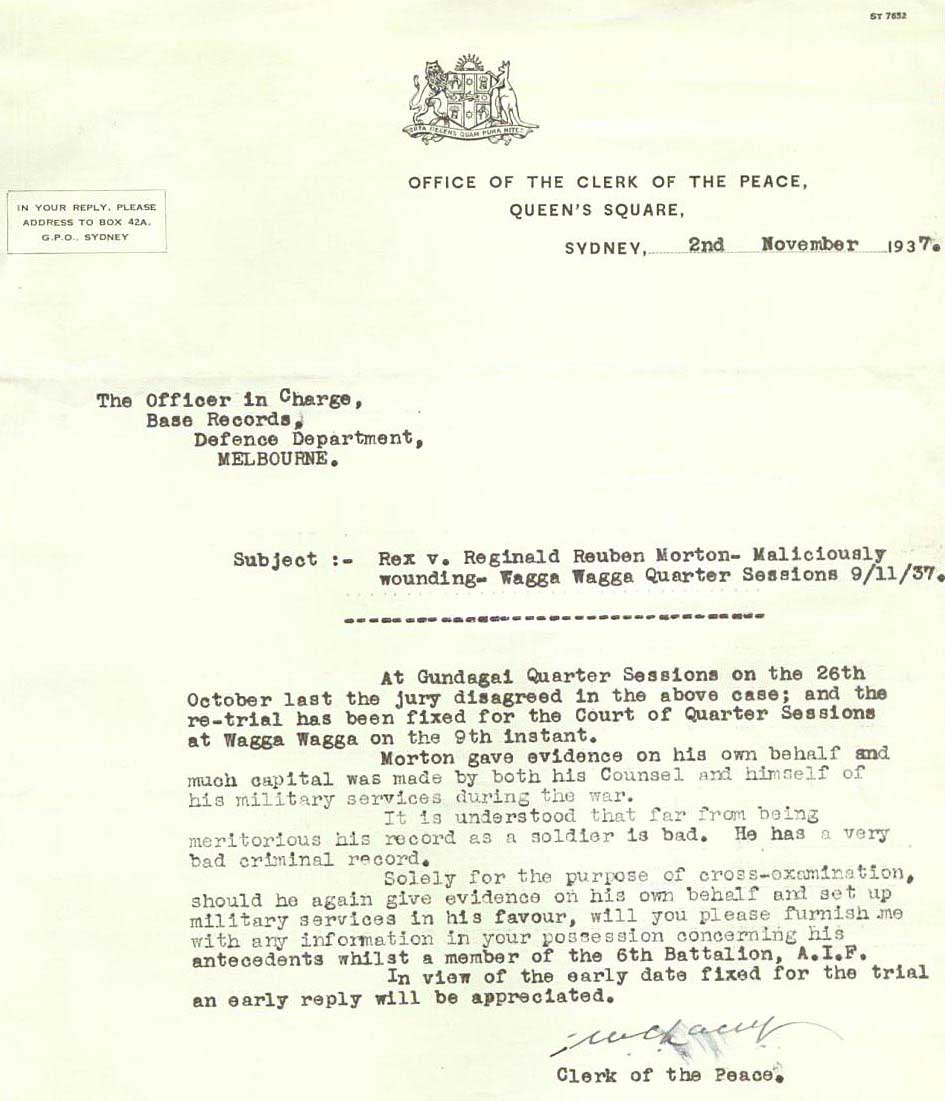
~ ~ ~ ~ ~
The Albury Banner and Wodonga Express, Fri 5 Nov 1937 17
STABBING CHARGE
———◦———
IN MOTOR BUS AFTER A DANCE
At the Gundagai Quarter Sessions, before Judge Coyle, the jury failed to reach a verdict, after a retirement of 12 hours, in the case in which Reginald Reuben Morton was charged with maliciously wounding Bertie Andrew Spencer Sheather, with intent to do grievous bodily harm. Morton was committed to stand his further trial at the Gundagai Quarter Sessions in February. Bail was allowed.
The prosecution alleged that Morton stabbed Sheather with a penknife, following a brawl in a motor bus, which was returning from a dance, on the morning of August 25.
Dr Norman Walker stated that Sheather had been seriously wounded, and had been an inmate of Gundagai Hospital for three weeks. The wound had penetrated to the kidney.
Morton, from the witness-box, stated that he was mobbed by passengers in the bus, and drew a knife to frighten them. He did not remember stabbing Sheather.
~ ~ ~ ~ ~
The Wagga Wagga Advertiser, Wed 10 Nov 1937 18
WAGGA QUARTER SESSIONS
———◦———
Tuesday, November 9
————
(Before His Honor Judge Coyle)
————
Reginald Rupert Morton was charged with maliciously wounding Bertie Andrew Sheather, of Spring Flats, Gundagai. He was also charged with assaulting Sheather, thereby occasioning bodily harm. He pleaded not guilty.
Mr N McGhie prosecuted for the Crown, and Mr Sheahan appeared for the defendant. A jury of 12 was empanelled.
Bertie Andrew Spencer Sheather said that on August 24 he went to a dance at Brungle in a bus, in which was also the accused. On the return trip the accused was sitting in front of a man named Barton. When near Prince Alfred Bridge the accused made a remark which accused took exception to, and he and the accused came to blows. The crowd got out of the bus and the accused came around to the back of the bus. The accused first went towards Barton. Then witness saw the accused take a pocket knife from his pocket and rush at him. He caught witness by the shoulder, swung him around, and stabbed him in the back.
Witness produced the clothes he was wearing and indicated holes in the waistcoat and coat, which he said were made by the knife. He said he had not been drinking on the night in question. He thought the accused was sober. He had previously been on friendly terms with the accused.
To Mr Sheehan, witness said he did not know that the accused was regarded by some of the young men in Gundagai as “the village idiot.” He did not see young men giving the accused wine at the dance. Witness did not see anyone jump on the accused’s shoulder, nor did he see Barton throw his coat over the accused’s head.
MEDICAL EVIDENCE
Dr Walker, of Gundagai, said he saw Sheather on the morning of August 24. Sheather had a wound three or four inches in depth in his right side. Several arteries and veins had been cut. The wound was consistent with having been caused by a pocket knife. Sheather was in hospital for three weeks. Without prompt attention the would could have been serious.
Sergeant Pine, of Gundagai, said that by reason of what he had been told, he spoke to the accused. When he told the accused that he was going to lock him up, the accused said, “No, Sergeant, I am going to my hut to get a gun to do of the —– up.” Witness then proceeded to arrest the accused, who struggled violently. With the assistance of Constable Cook, the accused was arrested. On searching the accused, witness found a pocket-knife in his pocket. There were fresh bloodstains on the blade. The accused was sober and coherent at the time of his arrest.
FIGHT IN BUS
William Alfred Barton of Gundagai, said he was in the bus on the night in question. The accused made a remark which witness objected to, and he told the accused. The accused then struck witness, who retaliated and a fight took place. He got out through a window of the bus and went to the back of the vehicle. The accused got through the door and went to the back of the bus and made towards witness, who threw his coat at the accused. Sheather was standing nearby, and after the accused had fumbled in his pocket, he rushed at Sheather and struck him. Later he saw Sheather, who had a wound in the back and was bleeding.
To Mr Sheahan, he said he did not regard the accused as an idiot or as “soft.” He did not look on this as a matter of great bravado.
Wilfred Selwyn Moye said he was the proprietor of the bus which was used on the trip to Brungle. He was driving the vehicle. On the return journey he stopped the bus because the accused and Barton were fighting. Later the accused and Barton fought at the back of the bus. Then he saw the accused take something from his pocket.
Lionel Sanderson, a passenger on the bus, said he saw the accused with a knife in his hand.
Myrtle Edith Bond, a resident of Gundagai, said she was a member of the party in the bus. She gave evidence concerning the alleged fight.
To Mr Sheahan, she said she did not see any drink at the dance at Brungle.
Norman Oliver Thomas, a passenger on the bus, also gave evidence.
ACCUSED'S STATEMENT
In a statement from the dock, the accused [Reginald Reuben Morton] said he was a war pensioner. He was a passenger on the bus, and on the return journey some of the passengers started chipping him in every shape and form. Mrs Bond, he said, referred to him as “a —– big mad mongrel.” There were other remarks passed which hurt his feelings. It was suggested that he was not a returned soldier. He told Mrs Bond that it would suit her better to go back to her husband in Albury instead of carrying on with other men. The next thing, he received two blows from Barton, and Sanderson also struck him twice. Mrs Bond and Barton did not get out of the window of the bus, but went out ahead of him. When he went around the back of the bus five or six people “got into him” and struck him from all quarters, and he was forced to the deck of the bridge. He was kicked and punched and he pulled the knife out for his own protection and to save his life. Why he drew the knife was to frighten them. An overcoat was thrown over his head and he was forced to the ground again. He was trying to save himself, but he did not know that anyone had been wounded. He did not draw the knife, he said, with the intention of doing anyone any harm. He was a returned soldier, clean living, and he interfered with no one.
Major Howarth, officer in charge of the Salvation Army, Wagga, said he had known the accused for about 12 months. From his own observations he thought the accused was 50 per cent below normal mentality. He thought the accused would not harm anyone unless provoked.
Dr John Byrne, Government medical officer at Gundagai, said he knew the accused was a war pensioner. He had treated him, and on October 23 examined the accused and learned that he was suffering from laryngitis, from which he had apparently been suffering for 12 months. He formed the opinion that the accused was sub-normal. He had also examined the accused on September 6 and found he had some abrasions on the chin in the healing stage, and a slight swelling on the jaw.
18 MONTHS’ GAOL
After a retirement of an hour and a half the jury returned with a verdict of guilty on the malicious wounding charge with a recommendation to mercy.
Mr Sheahan referred to the mentality of the accused, and asked His Honor to weigh with his sentence the recommendation of mercy by the jury.
A list of more than 40 prior convictions against the defendant was read.
His Honor sentenced the accused to 18 months imprisonment, and remarked that but for the recommendation
of mercy the sentence would have been greater.
~ ~ ~ ~ ~
The Albury Banner and Wodonga Express, Fri 12 Nov 1937 19
EIGHTEEN MONTHS FOR
WOUNDING
———◦———
Found guilty of having maliciously wounded Bertie Sheather, at Gundagai, on August 25, Reginald Rupert [sic] Morton was sentenced to 18 months’ imprisonment at the Wagga Quarter Sessions on Tuesday.
It was alleged that Morton and Sheather were returning in a bus from a dance when an altercation occurred between Morton and man named William Alfred Barton. Sheather got out of the bus and was standing near the rail of the bridge when Morton rushed at him and stabbed him in the back with a pocket knife.
Morton’s defence was that he was mobbed and used the knife in self defence. A list of more than 40 convictions for varying offences was read our against him, and Judge Coyle said that but for a recommendation to mercy by the jury he would have imposed a more severe sentence.
~ ~ ~ ~ ~
Goulburn Evening Penny Post, Mon 15 Nov 1937 20
18 MONTHS
————
MORTON FOUND
GUILTY
————
POCKET KNIFE USED
————
At his second trial, a Gundagai jury having failed to agree, Reginald Rupert [sic] Morton, 45, was found guilty at Wagga Quarter Sessions last week, of having maliciously wounded Bertie Andrew Spencer Sheather, by stabbing him with a pocketknife. He was sentenced by Judge Coyle to 18 months’ imprisonment.
Evidence showed that there had been a squabble after a dance, and Morton’s counsel, Mr WF Sheridan, suggested that his client had been aggravated, and made a butt of jokes, and that he had drawn a knife in self-defence.
Morton was one of a party of 25 which travelled by motor bus from Gundagai to attend a dance at Brungle, and on returning to Gundagai early in the morning of August 25 a fight started in the ’bus on the bridge over the Murrumbidgee River.
The bus was stopped and the party got out, the brawl continuing on the bridge. Morton, it was stated, took a knife out of his pocket, opened it and stabbed Sheather in the side, inflicting a deep wound which necessitated Sheather’s treatment in hospital for three weeks. Sheather, it was stated by witnesses for the prosecution was not concerned in the fight, but was an onlooker.
“BURNT OUT”
Morton, a strongly-built man wearing service medals, made a long, rambling statement from the dock, in which he described himself as a burnt out returned soldier suffering from laryngitis and other throat affections. His voice was very gruff, and at times he had difficulty in making himself understood.
“They were poking ‘borak’ at me about returned soldiers and the Salvation Army,” Morton said’ and one of the women passengers called me a big mad mongrel. I then tried to light a cigarette, but received a punch. I then made a swing at Barton, but missed, and a fight started.
“We got out of the ’bus and Barton threw a coat over my head and said: “Come on, we’ll knock the [word(s) missing here]” About six of them stuck into me from the back and front and I fell down. I struggled up again, but they still attacked me, and I drew my knife out of a pocket. I was knocked over again and they kicked and hit me, and fell all over me.
FOR PROTECTION
“I drew the knife for my own protection and because I thought it might frighten them, and I did not know anything about the wounding until I was charged.”
Sergeant Pyne stated that when he asked Morton to go to the police station, Morton violently resisted arrest, and had to be hit with a baton to quieten him.
Major Howarth, Salvation Army officer at Wagga, said that he had formed the opinion that Morton, mentally, was fifty per cent below normal, but that if he was left alone he would not hurt anyone.
The jury after a retirement of ninety minutes, returned a verdict of guilty of malicious wounding, with a strong recommendation to mercy on account of Morton’s apparent low mentality.
A long list of previous convictions, extending right back to 1907, was read.
In passing sentence, Judge Coyle said that the sentence would have been heavier had it not been for the recommendation of the jury.
Reginald Reuben Morton, 1941
The Gundagai Independent, Mon 17 Feb 1941 21
ARMED MAN DEFIES
POLICE
————
SATURDAY EVENING’S SENSATION
————
PEOPLE SCATTER AS SHOTS ARE FIRED
————
OVERPOWERED, AND TAKEN TO HOSPITAL
————
THERE Was A Sensation in Gundagai on Saturday Evening, When A Well-known Local Man, Reuben Morton, Armed with A .32 Calibre Rifle, Defied the Police From 7 pm Until 10.50 pm During the Four Hours Several Shots Were Fired.
Hundreds of people assembled at the Southern end of Prince Alfred Bridge and along the Hume Highway towards the Hume Hotel, awaiting developments. When shots rang out there was a scatter and many dived for cover, whilst others raced to get away from possible danger.
Finally, Morton was overpowered, and later taken to the Gundagai Hospital, where he was admitted. Fortunately no one was injured by any stray bullets.
Morton, who is aged 46 years, is a military pensioner, and is a familiar figure in Gundagai. Standing over six feet in height, Morton is a big man, and very powerful. At about 6.45 pm near the Royal Hotel, Morton is alleged to have assaulted a man, and was given in charge. Constables Johnson and Lawler, of the police patrol service, were handy, and approached Morton. Morton went down Homer Street, crossed Morley’s Creek and made for South Gundagai across the flat.
Constables Johnson and Lawler followed in the police car, and one policeman got out and went after Morton, who with a bottle in his hand allegedly threatened the policeman. Several people followed the police at a distance. … …
RIFLE PRODUCED.
Constable Johnson told Morton that another had laid a complaint against him and asked Morton to go with him to the police station. Morton refused and made for the tourist camp. Followed by Constable Johnson the man is alleged to have picked up some stones and said, “If you come near me I will kill you with this bottle” at the same time making vicious swings with it.
At this stage, Constable Johnson drew his gun and ordered Morton to stop, or else the constable would shoot. The man ran, got clear through the fence and continued across the bridge embankment.
Constables Johnson and Lawler followed Morton and negotiated the railings on the southern end, ran down the bank, and then to a hut. Constable Johnson then saw Morton come round the corner allegedly with a rifle under his arm. Morton is then alleged to have walked to a post near the hut, loaded the rifle and pointed it at the truck. Constable Johnson immediately got his gun and fired over Morton’s head.
CROWD GATHERS
By this time people commenced to gather at the southern end of the bridge, and within an hour there were hundreds at the scene.
Morton returned to the hut but refused to leave the place or put down the rifle. Later Const Johnson threw his rifle on the grass and asked Morton to put his away, but the Constable was allegedly threatened and told to go away.
ASKED TO HAND OVER RIFLE
At this stage Sergeant Brindle and Constable Koch arrived and went to Morton’s hut where they found him in possession of a .32 calibre rifle. Sergeant Brindle endeavoured to pursuade [sic] the man to hand over the rifle. After some persuasion Morton agreed to put his rifle away.
SHOT CAUSES SCATTER
Constable Koch then went through the gate of the fence around the hut and then went up to the dwelling. He heard a gun being cocked, and he returned to the roadway. As Constable Koch approached Sergeant Brindle a shot was fired, the bullet is alleged to have passed between the Sergeant and the Constable. This was soon followed by another shot.
People on the bridge ducked for cover, and certain ones raced to get to a safer distance.
PRIEST’S BRAVE ACT
Father Lehane, parish priest of Gundagai, then approached Morton, and attempted to get him to put away the rifle, but was unsuccessful. Fr Lehane returned to the crowd; but later made another attempt.
MORE POLICE ARRIVE
Constable Quinn and McBurney arrived from Nth Gundagai shortly and Sergeant Brindle called for reinforcements from Cootamundra, Inspector Lake, Detective Humphries, sergeant Blackburn and Constable Loy rushed to the scene from Cootamundra.
SHOTS RING OUT AS MORTON IS
OVERPOWERED
Later Fr Lehane approached Morton again, and then entered the hut with him. The police then got along side the hut and a little later Morton, evidently suspecting something, came to the door, rifle in hand. Morton was hit on the head with a baton, and Constable McBurney dived for his legs and threw him to the ground.
In the mellee [sic] that followed Morton who still had hold of his rifle, fired five shots in rapid succession; but the police had the rifle on the ground and the barell [sic] facing towards the hut and the flying bullets did no harm.
Finally Morton was overpowered, and then placed in a truck, and later taken to the Gundagai Hospital, where he was admitted. Two policemen were stationed as guards at the institution.
————————
CHARGED WITH
INTENT TO MURDER
———◦———
MORTON IN COURT THIS
AFTERNOON
————
BAIL NOT APPLIED FOR
————
This afternoon Morton appeared before JC Carters and LM Boyton J’sP, and was charged with that on the 15th day of February, 1941, he did shoot at James Roy Brindle (Police Sergeant) and Donald Joseph Koch (Police Constable) with intent to murder.
He was remanded until 25th February.
Mr MacDermott appeared for Morton, and in view of certain circumstances did not apply for bail.
Other charges pending against Morton are—
(1) That on 18th February, he did unlawfully assault Frank B Walker, a traveller.
(2) That on the same day he did resist Constables Johnson and Lawler in the execution of their duty.
~ ~ ~ ~ ~
Goulburn Evening Post, Wed 19 Feb 1941 22
MORTON CHARGED
————
ALLEGED INTENT TO MURDER
————
At the Gundagai Police Court on Monday afternoon Reginald Reuben Morton, 46, military pensioner, was charged with having shot at Sergeant JR Brindle and Constable DJ Koch with intent to murder.
The charge was a sequel to the sensational episode at South Gundagai on Saturday night, when an armed man who had previously broken away from two police officers who were attempting to arrest him for an alleged assault, took refuge in a hut and defied capture for several hours.
Morton was remanded to appear at Gundagai Court on February 25. He was represented by Mr MacDermott, but the latter, in view of certain circumstances, did not apply for bail.
It is stated that other charges pending against Morton involve an alleged unlawful assault on Frank B Walker, a traveller, as well as a count of having resisted Constables Johnson and Lawler in the execution of their duty.
Morton is well known in Goulburn, where he formerly resided, as also is Sergeant Brindle, who was stationed at Goulburn prior to his appointment recently as officer-in-charge at Gundagai.
~ ~ ~ ~ ~
The Gundagai Independent, Thu 27 Feb 1941 23
GUNDAGAI SHOOTING
SENSATION
◦————◦
DEFENDANT’S SOLICITOR AND POLICE
IN WARM ARGUMENT
————————
MORTON REMANDED FOLLOWING LIVELY
DEBATE
————————
CASE COMES BEFORE PM NEXT TUESDAY
————————
Vigorously opposing a request by the Police the Reginald Reuben Morton, who faced the serious charge of intent to murder, be remanded until next Tuesday, March 4th, defendant’s solicitor, Mr MacDermott, of William Dodds and MacDermott, warmly debated certain aspects of the case at the Gundagai Court House on Tuesday.
Inspector Lake, of Cootamundra stated that three of the police witnesses were unavailable. Mr MacDermott asserted that if they were fit enough to attend the Tumut races and Gundagai swimming carnival they should be well enough to attend court.
Following the spirited argument the Bench granted the remand.
At the Gundagai Court House on Tuesday last, before Messrs JC Carters and L Boyton, J’sP. Reginald Reuben Morton, a military pensioner, was charged with that on the 15th February, he did shoot at Sergeant Brindle and Constable Koch, of Gundagai, with intent to murder.
Inspector Lake, of Cootamundra, who was in charge of the case for the Police, applied for a remand until, Tuesday, 4th March. He pointed out that three witnesses were indisposed. Sergt Brindle and Constable McBurney had been off duty since the date on which Morton was arrested, and since then Detective Humphris had become sick, and was now confined to his bed.
Mr MacDermott who appeared fort Morton, opposed the adjournment. He produced letters written to Sergeant Brindle and Sergeant Soulter (who was now temporarily in charge of the Gundagai Police Station.) The letters stated clearly that it was the intention of Mr MacDermott to oppose any remand, as Morton had already been remanded on 17th February, until February 25. The solicitor then pointed out that the case was purely a local one, and all witnesses could be easily obtained. Morton had been arrested on 15th inst and had been in custody since. The police should have had their case prepared, for they had most reasonable time to complete their inquiries. He pointed out that the court had every power to deal with the case, and it was most unfair to delay the case any further.
Inspector Lake produced a doctor’s certificate, signed by Dr Kennedy, stating that Sergeant Brindle would be off duty for three weeks. He said a certificate had been sent to his office in regard to Constable McBurney, and one had gone to headquarters relative to Detective Humphris.
Mr MacDermott: Sergeant Brindle has, since the certificate was made out, been fiy enough to attend the Tumut Races. He should be fit enough to attend this court.
Inspector Lake: I am not trying to evade the issue. The police have the case prepared; but it is impossible for them to produce three witnesses to-day. The defendant will not suffer any hardship by the adjournment. His pension will continue on and he will be well treated.
Mr MacDermott: He will only be deprived of his liberty! Constable McBurney was well enough to attend the Gundagai Swimming Carnival on Sunday last. It is time someone said something about the conduct of the police in this matter; and I am going to say it.
Mr MacDermott then submitted that Dr Kennedy should be called to give evidence as to whether Sergeant Brindle was fit to attend the court.
Inspector Lake submitted that no good purpose could be served in bringing Dr Kennedy before the Court. He could only state what was written on the certificate.
Mr MacDermott then read the wording on the certificate which was dated February 16th. It stated that the Sergeant’s knee had been injured and he would be unable to attend to his official duties for three weeks. Mr MacDermott then submitted that the Sergeant should attend the Court.
The Bench: The doctor’s certificate states that Sergeant Brindle is unable to attend to his official duties and in view of those circumstances we will not consider asking the Sergeant to attend the Court.
Mr MacDermott then asked that Dr Kennedy attend the court.
An adjournment for ten minutes was granted.
On the court being resumed, Inspector Lake informed the Bench that it was impossible to locate Dr Kennedy at the moment, he being out on his rounds.
Inspector Lake pressed for an adjournment until March 4th. He stated that the charge was a serious one. Three witnesses were unavailable. He was himself present at the time five shots were fired—
Mr MacDermott objected to the Inspector’s statement. “Any evidence to be given in this case, must be given from the witness box”, continued Mr MacDermott.
Mr MacDermott opposed the application for an adjournment. He said that in regard to two witnesses the inspector produced no certificates whatsoever the case should proceed.
Inspector Lake said that in regard to both Detective Humphris and Constable McBurney their certificates had been sent to the Department. He submitted that his word should be accepted by the Bench in regard to this matter.
Mr MacDermott said that the certificate tendered in regard to Sergeant Brindle was dated February 16th—ten days ago. He asked that the court adjourn until 2 pm in order that Dr Kennedy might be located in the meantime, and be present when the resumption was made.
Inspector Lake opposed Mr MacDermott’s request. He said he could see that not the slightest good purpose could be served by granting the request. The Doctor had already given a certificate.
Mr MacDermott: I am surprised at the attitude adopted by Inspector Lake. He knows what he should do in cases like these. He knows he should produce a doctor’s certificate for each witness. He should have them here.
Inspector Lake: I am astounded to know that a solicitor should oppose the adjournment in such circumstances. I have never known such a thing in previous cases.
Mr MacDermott: I am equally astounded.
Mr MacDermott said he would like to have it noted that when a certificate given by a doctor was submitted to court he had a right to question the doctor in regard to that certificate.
The Bench decided to grant the remand until March 4th.
Mr MacDermott then asked if the Police Magistrate knew that the case would be heard before him next Tuesday, and that it was likely to last more than one day. The Tumut Court was on the following Wednesday and Adelong the day after. The PM should have notice so that he could make arrangements to have the case completed.
Inspector Lake said he had not informed the PM. It was a matter for him, and he knew his duty. He knew that if there is a remand to-day, he will preside over the case next Tuesday. “I do not know any reason why the case should not be disposed of in the usual court hours.”
~ ~ ~ ~ ~
Goulburn Evening Post, Thu 6 Mar 1941 24
ATTEMPTED MURDER
CHARGE
————
MORTON TO STAND TRIAL
———
Gundagai, Thursday: Reginald Reuben Morton, 46, labourer, formerly of Goulburn, was committed for trial at the Gundagai Police Court yesterday on charges of having attempted to murder Sergeant Brindle and Constable Koch, of Gundagai.
Sergeant Brindle, who was stationed at Goulburn until his transfer to Gundagai late last year, said in evidence that on February 15 he and Constable Koch found Morton dressed in singlet and trousers at the door of his hut, holding a rifle.
Sergeant Brindle said he told Morton to put down the rifle and talk to them. Morton asked them to wait until he dressed.
After waiting 15 minutes, Brindle said he and Koch walked towards the hut and called to Morton. Morton fired a shot.
Brindle said other constables arrived and Morton pointed his rifle at one of them.
“Constable McBurney struck Morton with his baton and Detective Humphries grabbed the rifle and held it to the ground,” he said.
“Morton still had his finger on the trigger and fired five shots from the rifle into the ground.”
Morton was allowed bail of £400.
~ ~ ~ ~ ~
The Gundagai Independent, Thu 6 Mar 1941 25
GUNDAGAI SHOOTING SENSATION
————————
MORTON COMMITTED
FOR TRIAL
————————
CONVICTED ON ASSAULT
CHARGE
————————
RIFLE AND CARTRIDGES PRODUCED IN COURT
————————
THERE was a sequel to the sensational shooting affair at South Gundagai of Saturday evening February 15th when in Gundagai Police Court on Tuesday, Reginald Reuben Morton, aged 46 years a military pensioner, who appeared before police magistrate F Grugeon, faced four charges, on charge of assaulting Frank B Walker, a traveller, he was convicted, and on the other three counts he was committed to stand his trial. Bail was allowed.
There was an air of expectancy about the court. Morton sat in the dock throughout the hearing the hearing. [sic] Nine policemen were at the court house. Exhibits produced by the police included a Winchester .32 calibre automatic rifle, thirty-two live and eight spent cartridges.
Many spectators, some women, crowded the court room, which was filled to capacity before the proceedings commenced. The hearing was a long one. The taking of evidence and the cross-examination lasted all Tuesday until 6.30 pm. Resuming at 9.30 am Wednesday. The police case concluded just prior to 1 pm.
The charges laid against Morton were:—
1.—That he did assault Frank B Walker, a traveller;
2.—That he did resist Constables Johnson and Lawler in the execution of their duty;
3.—That he did wilfully shoot at Sergeant Brindle and Constable Koch, with intent to murder.
4.—That he did wilfully shoot at Constable McBurney and Detective Humphris with intent to prevent lawful apprehension.
Sergeant Brindle, of Gundagai, conducted the case for the police, and Mr MacDermott, appeared for Morton.
At the outset it was agreed to hear each charge separately, and the assault charge was the first one called.
Frank B Walker, a traveller, stated: On Saturday, 15th February, at about 7.45 pm I was outside the Royal Hotel. I saw “Snowy” Noble struck by accused, knocking him off the footpath, and splitting both lips. I walked up to Morton and spoke to him. He pushed me away. I said: “Don’t cause any trouble here”. He pushed me and said, “Go away,” I walked back to him and said “You are a returned soldier—so am I” and showed him my medal. He pushed me hard on the chest and knocked me off my balance. I turned to the police and said, “I’ve done my best to avoid trouble.”
The PM then told Mr MacDermott that he must
Address the Witness in A
Different Manner.
“Adopt a different tone,” said the PM, “and don’t be overbearing towards the witness.”
Continuing witness said that he said to the police, “You get him and I will give him in charge.” I gave him in charge. I did not raise my hand to him. I have never seen him before. The police were only a few yards away when this occurred.
To Mr MacDermott: It was round about 7.45, I went for a drive with Mrs Cleland of the Royal Hotel. We went over the south side of the river and came back again to the Royal. Mrs Cleland parked the car in front of the hotel entrance. The police utility was parked alongside. Two policemen got out of the utility. Mrs Cleland went into the hotel and came out again and showed some papers to the policemen. Constable Johnson had full uniform on. Constable Lawler did not have his coat on. Morton came up to the spot where we were. I did not say to Morton, “You had better keep away.” I never spoke to him. No one in the group spoke to Morton at that stage. One of the policemen walked over to Morton and spoke to him. I didn’t rejoin the group.
I Saw Morton Hit Noble
They were on footpath at the time. I never said to Noble, “I’ll quieten him.” I walked towards the Post Office and spoke to Morton. I never jabbed fingers at Morton’s military colors, and did not say, “What are you wearing those for, Rube?” Morton did not say, “Those are my property. I am a returned soldier—I’m entitled to wear them.” I did not say “Take them off.” He pushed me on the chest and said, “Go away.” I didn’t fall over. I then walked back to Morton. He said something and pushed me away, very much harder, and caused me to lose my balance. I said to one of the policemen, “I did my bit—you do yours.” I said, “I’ll give him in charge.” I saw Harry Worthington. I saw him after I got the second push. I didn’t say to Worthington, “We’re after Rub. He jobbed ‘Snowy’ ”. I didn’t say, “Do you want to come over.” He got into my car, and we drove down to the flat. I pulled up on the flat, opened a box and pulled a holster out. There was an automatic in it. I did not take the automatic out.
PM: Is this part of the assault? Something that has taken place three quarters of an hour later?
Mr MacDermott suggested that all charges interlocked, and could not be treated as four separate watertight compartments.
Witness to MacDermott. Pushing didn’t actually do me any harm. The conversation between the police and Mrs Cleland was relevant to exceeding the speed limit. I did not seize an opportunity of creating a diversion. I didn’t start anything with Morton hoping the police would forget the traffic offence. I never saw Morton pick up a parcel near the Post Office. I saw him walk down Homer Street. I didn’t think he would
Attack Me Again
He was going down hill then. Might have had two or three drinks that day. I won’t agree that Noble heard all that was going on. He was five or six yards away and saw all that occurred. I made reference to the colors Morton was wearing. I saw the police truck in front of the cottage below the hotel. Morton was ahead of the car. I didn’t watch what went on. I went back to the hotel. When I went across the flat in the car, it was getting towards dusk, but wasn’t necessary to have the lights on. I think the times are about right. Later I saw Morton and the police car on the flat. I don’t know how long I remained in front of the hotel. Constable Lawler and Noble saw Morton push me.
Witness to Sergt Brindle: I came back to the Royal Hotel at about 6.30 pm.
Witness to Mr MacDermott: Mrs Cleland and I drove about two or three miles over the south side.
Constable TH Johnson, of Wagga stated in evidence: On the day of the occurrence I was on duty in the police patrol. It was standing in front of the Royal Hotel. I heard a commotion on the footpath. I saw a man dressed in a white singlet and white shorts, whom I now know to be Rheub [sic] Morton, pushing a Mr Walker back on the footpath, and calling out “You get out of here.” I walked to where constable Lawler was. I said, “What’s the matter.” Walker said, “I want to give this man in charge. Do your job.” Morton was then walking down Homer Street. We got into the police truck and drove towards the corner of the street. Morton was then down by the creek. I said to Morton, “Why did you push Walker.” He replied, “He insulted me—that’s why I pushed him. I’m alright. I’m going home.” I told him he’d been given in charge. He replied, “I’m alright
—I’m Not Going.”
Witness to Mr MacDermott: In front of the hotel I was interviewing Mrs Cleland for traffic reasons. Defendant was on the footpath not far from the hotel building when I looked up. I know “Snowy” Noble of the Royal Hotel. He was there. I only saw Morton push Walker once. I did not hear Walker say, “What are you wearing those for Rube?” I noticed Morton was wearing some colors on his singlet. I never saw Walker indicate those colors. I couldn’t say whose loud voice attracted me. No one was speaking when I looked up. I’ve been in the force for 13 years and am a first-class constable. Constable Lawler also is a first-class constable. The push was a violent one. It may have been serious if he lost his balance. It wasn’t serious. I’ll agree that it was an assault. I’ve arrested many men. I know when I should arrest a person, and when I should proceed by summons. Morton was walking off after the occurrence. I didn’t think Morton would attack the man again. I think the assault was serious enough for the man to be arrested. Didn’t think it proper then to tell Walker to proceed by summons. I proceeded after Morton, and saw nothing that occurred in front of the hotel afterwards. Had a talk to Morton down near Sheridan Lane. I then followed him across the flat. Walker said he wanted to give the man in charge for assault.
Constable SP Lawler, of Jugiong, stated: I was at Gundagai about 7 pm on 15th February last. I saw Walker go to Morton and say something to Morton, who said “You get out of here” and pushed him. Walker again walked up to Morton and spoke to him. I didn’t hear what was said. Morton again pushed Walker—a hard push in the chest. Walker then walked towards Const Johnson and said, “I want to give this man in charge.” He pointed to Morton and said
“Do Your Job.”
Prior to Walker speaking to defendant, saw Morton walking along Sheridan St, and when about opposite the main doorway of the Royal Hotel he spoke to Noble. I did not hear what was said, but Noble replied, “You are only backing on your size when you pick on me.” Morton then hit Noble with the back of his right hand, knocking him off the footpath. When Noble walked back I noticed his mouth bleeding. It was after that that Walker went to the defendant. After Morton hit Noble, I went to him and said “What’s the trouble.” Morton did not answer. He went to go for Noble again and I stepped in front of him. He then walked away a few steps and put a parcel which he was carrying on a car. He again went towards Noble, and I caught him by the right arm. Morton then caught me by the right arm and threw me off. I did not see whether he hit Noble again or not. I walked to the lorry and called Const Johnson. It was at that stage that Walker went to defendant.
Witness to Mr MacDermott: I did not receive any complaint from Noble. The second push Walker received was rather heavy. I wouldn’t call it a vicious assault. It was an assault. I’ve been in the force over ten years. Morton had not started to walk away when Walker spoke to him. I had a fear that Morton may
Make A Further Breach of
the Peace
I didn’t have any uniform coat on at the time. When Walker spoke to me I put my coat on. I never saw Walker indicate Morton’s colors. I heard Walker say, “I want to give this man in charge for assault. Do your job.” I didn’t hear Walker say anything to Morton. First time I spoke to Morton after the assault on Walker was down the hill. I didn’t hear that Morton would then renew any assault on Walker. Walker laid a definite charge & I thought it serious enough for an arrest to be made. When Morton first appeared on the scene, he said to me, “Hello, Jugiong—how are you to-day?” He did not walk away. After defendant spoke to me at the car, I said to him, “We’re discussing business; would you mind going away.” Later, after the assault in Homer Street, neither of us said “Get in the truck and come for a ride with us.” Constable Johnson told Morton why he was wanted. Subsequently we followed Morton across the flat.
Mr MacDermott called no evidence and defendant was convicted. The PM withheld the penalty.
It was then decided to take the evidence in the other three cases simultaneously.
Sergeant JR Brindle, in charge of the Gundagai police station, deposed: At about 7.30 pm on 15 February, 1941 in response to something I was told, and in company with Constable Koch, I went to Morton’s hut at South Gundagai. I there saw Morton with a rifle in his hands at the ready position. I had a conversation with Const Johnson, and in company with Const Koch, I walked to a gateway near Morton’s hut. I said “What are you doing with that rifle, Rub?” He said, “I have it for my own protection.” I said “Put it down and come and talk to me like a man.” He refused to put the rifle down. I repeated the request but he refused to put the rifle down. He dropped the rifle to his side, but kept his finger on the trigger. He said, “I know you, Brindle—you are a returned soldier, same as me.” I said, “Yes—put the rifle away.” He said to Koch, “I know you—you are a friend of mine also.” Koch said, “Put the rifle away and come and talk to us.” He refused. He refused my further plea. He said, “You and Don Koch stay on the bank, and I will get dressed and come out and talk to you.” Koch and I waited about 10 to 15 minutes. Morton did not come out of his hut, so Koch and I walked down to the gate near his hut. Const Koch opened the gate. I stood near the gate. I called out, “This is Sergeant Brindle, Rube. Come out I want to talk to you.” I got no reply. I repeated the same request and got no reply. Constable Koch crept around to his hut, and called out, “Come out and have a talk, Rube,” and repeated the request several times, but got no reply. Const Koch stepped back from the corner of the hut to the gate, and then
A Shot Rang Out, That
Bullet Whizzed Between
Koch and I
We turned to walk back to the police truck and another shot rang out. I then went and rang Inspector Lake, of Cootamundra, and later at about 10 pm the same night I had a conversation with other police at South Gundagai. As a result of that conversation, all surrounded the hut, Const McBurney was to the left of the doorway with Detective Humphris, Walker and myself. I heard Morton say, “To hell with the police, I will shoot the first one that comes near me.” He then appeared in the doorway with a rifle at the ready position. Const McBurney called out “Drop that gun.” Morton turned and pointed the rifle. McBurney sprang hit him on the head with the baton and they both fell to the ground. I rushed to grab Morton’s right arm. Detective Humphris forced the rifle to the ground, and put his foot on it. When I grabbed Morton’s right arm a shot rang out. Morton continued to fire—at least five shots in all. McBurney said, “Stop shooting—you can’t shoot anyone. Your bullets are going into the ground.” Morton said, “I’ll shoot some of you b—– if I get this rifle free.” With the assistance of Const Koch and McBurney I succeeded in handcuffing Morton and he was conveyed to a car. In company with Detective Humphris made a search where Morton was lying on the ground and found five empty shells which I produce. Morton was later taken to the Gundagai District Hospital and treated by Dr Kennedy. At about 11 am on the following morning, with Constable Johnson and Constable Lawler, I made a search of the hut, and on the floor near the bed I found a .32 calibre Winchester empty shell (produced). About 10.30 am on the 17th February with Detective Humphris I made a further search of Morton’s hut and behind a suitcase under the bed I found another empty shell, and in the fireplace amongst the ashes I found another one (also produced). When Morton was searched at the hospital, on the night of the 15th February, 32 live cartridges of .32 calibre were taken from his pocket which I produce. Six of these cartridges he had in his hand I also produce
the Rifle Which Was Taken
From Morton
To Mr MacDermott: I had a conversation with Const Johnson when I arrived. He told me Lawler was driving the police truck. He did not tell me the police truck was backed into Morton. Johnson fired a shot, the first shot at South Gundagai. Const Johnson told me Morton had been given in charge for assault. He said he assaulted Walker. Constable Johnson told me Morton had been given in charge for assault. He said he assaulted Walker. Constable Johnson told me they had followed Morton for about three-quarters mile from Royal Totel [sic] to his hut at Sth Gundagai. I wasn’t told the truck was parked at the northern end of a bridge, to prevent Morton walking across. Johnson said he got out of the truck and walked across the flat after Morton. Don’t remember him telling me he pulled his gun out on the flat. I got sufficient information in three minutes. Never heard anything about the truck backing into Morton. One Constable followed on foot and the other was in the car. I was told that Morton took a short cut to his hut from the other end of the bridge. The truck was parked 20 yards from the hut. Const Johnson told me he had fired a shot over Morton’s head before I had arrived there. There had only been the one shot fired up to the time of my arrival—the one Const Johnson fired. Morton never mentioned ribbons or medals to me. There were some police at both back and front of the hut; also Messrs SG Shepherd, Jim Elworthy, Geo Elliott and Roy Jones were around the hut. I know Father Lehane was in the hut all the time. The light was on in the hut all the time. The door faces the river. I don’t know if it is no more than five feet high.
The Floor is Earth
covered with hessian. I wouldn’t say the floor sloped up to the door of the hut. I’d say the floor was near level. There is a window in the hut—the western end. Don’t know how far the bottom of the window is from the ground. It is only a small window. The fireplace is in the eastern end of the hut. I noticed a crack in the wall near the chimney. There is another hole in the fireplace end. There is a lot of canvas in the hut. Morton’s bed is under the window on the western end of the hut. The door opens inwards towards the bed. There is a table beside the head of the bed. In front of the hut there are some flat stones—level ground. There are some grapevines and trees behind. There is a washing stand near these—about 8 feet from the corner of the hut. The hut itself is not very big. There is an excavation at the back of the hut. The fireplace juts out from the hut. From the gate to the door of the hut it would be about 14 to 15 feet. Portion of the gate is opposite the corner of the hut. Below the grapevines the ground slopes down towards the river. From Morton’s gate to the truck is an incline. From the truck you could see more than the roof of the hut. I could see half way down one corner of the hut. Morton was inside the hut when I went to the gate with Constable Koch the second time. I didn’t find any bullet marks inside the hut. Father Lehane was not in the hut then. He hadn’t been there up till then. It was dark then. The street lights were on. I am certain the shot whizzed between Constable Koch and myself. I found nothing in the bank on the way up to the police truck. There were number of people on the approach to the bridge about 40 yards away. There was no one between us and the river. It was getting towards 11 pm when Morton was overpowered. The men (Shepherd and Elworthy) were on the northern side of the hut below the grapevines. Couldn’t say where George Elliott was. The biggest majority would be armed. Some of the people had 303 rifles. I could tell which gun was fired—a 303 or a .32 calibre Winchester. We had two rifles from the police station.
I Had My Service Revolver
and the other police had theirs. There was a double barrelled shot gun there. Someone had it. Father Lehane was inside the hut with Morton at the time. The light was on, and the door was wide open. I never heard Father Lehane say anything. Didn’t hear Father Lehane say, “Get to hell out of it—we are having a private conversation.” I am 5ft 9½ins and didn’t have to stoop to go into the hut. Morton wouldn’t be bent double to get through the doorway. Morton was well out of the door before anything transpired. He was lying on the ground; his head under the grape vine and his feet pointing towards the door of the hut. Humphris had the gun in his hand when they took Morton to the car. It is now in exactly same condition as it was the night it was taken from Morton. I haven’t made any examination of the rifle. Detective Humphris brought the rifle to me when I came down from the hospital—over half an hour later. It was later taken and locked in a cell in the gaol. I had a look at it in company with Humphris and also with Constable Johnson. I never examined it afterwards. It has remained in the cell since. I found no bullet marks in the outside of the hut. If they were I probably would have seen them. Constable McBurney was the first one of the group, then Walker and Humphris and myself. There was
No One on Top of Morton
but five were around him. I had hold of his right arm. I couldn’t say if Father Lehane was in a position to see what was going on. I saw him after Morton was handcuffed. Detective Humphris made the examination of the rifle. There have been no shots fired out of the rifle since 15th of February. I was away from Morton’s hut on a few times, and telephoned from the Hume Hotel. When I came back from the hotel the first time I saw Father Lehane go into the hut. On the Sunday night 16th February, I did not go to the Royal Hotel. I did have a conversation with “Snowy” Noble on the Monday morning. I asked him if he wanted to lay an assault charge against Morton. I didn’t go there to ask him that question. It was part of my duty.
Mr MacDermott asked witness if he went to the Royal Hotel to get Noble to lay a charge against Morton.
The PM said he
Would Not Allow the
Question
he was not going to permit a “fishing expedition” into some other subject.
The Sergeant in answer to Mr MacDermott, said: I was put off duty by the doctor. I am still on sick leave. That may have been one of the grounds why I was unable to attend the court when Inspector Lake sought an adjournment. I obtained a certificate from Dr Kennedy on 16th February. The certificate stated that it would be three weeks before my knee was fit to start the usual exertion.
The PM: I will not allow such questions.
Constable TH Johnson, of Wagga deposed: I said to the defendant, “Why did you push Walker in that manner?” He replied, “He insulted me; that’s why I pushed him. Leave me alone. I’m going home.” Defendant appeared to be agitated and excited. He was holding a bottle in his right hand. I said to him, “Mr Walker has given you in charge and we want you to come to the police station.” He replied,
“I Won’t Go
leave me alone.” I then went to get hold of his left arm, and he made a vicious swing at me with the bottle. He then commenced to walk towards the flat. I caught up with him again and said to him, “I want you to come with me. I don’t want any trouble.” He said, “I won’t go; leave me alone.” He then shouted at me: “If you come near me, I will kill you with this bottle,” and made vicious swings. He then picked up some stones and ran towards the tourist camp fence, got through it and walked and ran towards the embankment on the bridge. I followed on foot. He got up the ramp on to the bridge. Const Lawler brought the truck along. I got in and we followed the defendant over the bridge. I saw him get through the railings on the southern end of the bridge on the right hand side, and then run down to a hut which was about 50 yards away. We went on to a vacant allotment and stopped the truck about 20 yards from the hut. I got out of the truck. I saw defendant come round the corner of the hut,
He Was Carrying A Rifle.
He placed the barrel of the rifle on top of the gate post. He held something in the air in his right hand, and put it in the breech of the rifle. The rifle was then pointing directly towards Const Lawler and myself. I got my rifle and fires a shot into the trees. The defendant went quickly behind the hut. I called to Constable Lawler to stop a passing motorist and bring assistance. I walked down towards the hut. Defendant was there on the northern side of the hut. I said, “Put your rifle down we don’t want any shooting. If you put yours down, I will put mine down.” On the river flat after the defendant said to me, “If you come near me I’ll kill you with this bottle.” I drew my service revolver and said, “Stop—drop that bottle, or I’ll shoot.” Defendant kept going. I put my rifle down on the grass near where I was at the hut. Defendant said, “Don’t come near this gate. You are on private property now, and so is “Jugiong,” indicating Constable Lawler. I said, “Put your rifle away; I want to have a talk with you.” He went towards the fruit trees, with the rifle still in his hand. Sergeant Brindle and Const Koch then arrived. It would be about 7.40 pm I spoke to the Sergeant, Sergeant Brindle and Const Koch walked down near the defendant’s gateway. I was further over on the back. I heard the Sergeant say, “What are you doing with that rifle, Rube?” He replied, “I’ve got it for my own protection.” The Sergeant said,
“Put That Rifle Down.
I want to talk to you as a man.” The defendant did not put the rifle down. The Sergeant repeated his request to put the rifle down. Morton said “I’ve got it for my own protection. I’ve done no harm.” He said “I know you Brindle—you are a returned soldier, and so am I” He also
—————
(Continued on back Page.)
————————
GUNDAGAI SHOOTING SENSATION
(Continued from Front Page)
————————
said, “I know you Don Koch. You are a friend of mine.” Constable Koch replied “Put that rifle down, Rube, and come over here. We want to have a talk with you.”
Witness, continuing, corroborated Sergeant Brindle’s evidence.
Witness to Mr MacDermott: I heard a shot fired from the hut and saw smoke going towards the gate fired from the direction of the hut. Later I had another conversation with the Sergt. I was watching the hut from the truck, when I heard another shot fired. I could not see any flame or smoke, and did not know which way the rifle was pointed. I caught a glimpse of the defendant around the side of the hut. I was there when Father Lehane came and I had a conversation with him and was present when he walked down the bank towards the hut, calling out, “Are you there, Rube, it’s Father Lehane. I’m a friend of yours.” I saw Father Lehane and defendant conversing by the side of the hut. I was unable to hear the conversation. I was there when Inspector Lake and other police came from Cootamundra, and when the hut was surrounded. I went down by the second fence. I saw defendant come to the doorway of the hut, and Const McBurney
Jumped At Him
and they both fell amongst the grapevines. I saw the flashes of light on the ground, and heard the reports. I got hold of defendant’s right leg. There were a lot of others about there at the time. I heard defendant say, “I’ll shoot some of you b—– if I can get up with this rifle.” Later defendant was conveyed away. I was with Sergeant Brindle when a search was made of the premises, and saw the Sergeant pick up a .32 calibre rifle shell from near the hut. I made an examination of the hut and on one wall there was an opening of an inch and a half, high up, and another smaller opening lower down on the same side.
To the Sergeant: When Morton came out of the hut he had the rifle in his hand. It was under his right arm. I saw Morton’s rifle when it was taken from him. It is the one produced in this court.
To Mr MacDermott: Walker gave defendant in charge for assault. I saw the defendant push Walker. It was not a serious assault. I decided to arrest Morton. Morton went down Homer Street and with constable Lawler I got into the police truck and followed. I had a conversation down near Sheridan Lane. He was standing alongside the truck. He was never closer than five or six feet. Morton went away, and we followed him. I left the truck and Constable Lawler drove it. Didn’t see Constable Lawler attempt to block the bridge over Morley’s Creek with the truck. Morton definitely said: “I’ll kill you with this bottle.” I’m sound in mind and limb and so is Constable Lawler. We have been in the force a long time and have made many arrests.
I Never Backed the Truck
Into Morton
at all. I backed the truck away from a log. I don’t know if the back of the truck hit Morton. I got out and walked towards the rear of the truck. I never saw Morton lying on the ground, or in the act of getting up. My statements are correct. We had passed Morton, and to get the truck away from the log we had to reverse. Morton was than about five yards back. I followed Morton on foot towards the tourist camp. I had my gun in my hand, I didn’t have the baton on me. Don’t know if Const Lawler had a baton. Morton was not on the ground on any occasion, whilst we went across the flat. Morton did say, “Go away and leave me alone.” I didn’t see Walker’s car on the flat if it was there. The door of Morton’s hut is of normal height—about 6ft. The bigger hole in the end of the hut is about 5ft 6ins from the ground, but the smaller hole is much lower down. During the second talk, I was near the truck. I could see the gate. Sgt Brindle was standing on the southern side of the gate. Constable Koch was near the other gate post. I couldn’t see Morton at that time. I was in front of the truck. The Sergeant and Constable Koch were between me and the gate.
I Heard the Shot
from the direction of the hut. It was not absolutely dark. The smoke I saw went in the direction of the gate from the hut. The moon was up. I could see the Sergt and Constable Koch quite plainly. When Constable McBurney sprang at him I came down. I didn’t see Morton come out of the door, when McBurney jumped on him. Morton went straight to the ground. I saw some civilians after the arrest. I saw some who weren’t armed. I had a service rifle. I didn’t see any other rifle. I can’t remember seeing a shot gun. I know a little about rifles. I saw Detective Humphris with the rifle. I didn’t have a good look at it. I saw the rifle the following day—I had a look at it. The rifle now appears to be in the same condition as when I saw it on the Sunday following the happening. I saw nothing that looked like a bullet mark on the outside of the hut. If a Winchester .32 and a 303 rifle were fired I could tell the difference between the two reports.
Constable SP Lawler, of Jugiong, corroborated the evidence given by Constable Johnson.
At this stage the court adjourned until 9.30 am on Wednesday morning.
Constable TM McBurney, of Gundagai, deposed: On 15th February last at about 10 pm I went to South Gundagai. At about 10 pm Inspector Lake and other police arrived from Cootamundra. I was given certain instructions. We surrounded Morton’s hut. I was standing along side of the door. Sgt Brindle, Detective Humphris and Walker were behind me. I heard Morton say, “To hell with the police,
I Mean Business.
I will shoot the first one that comes near me.” Father Lehane then walked to the door of the hut, and said, “Rube, there is no-one about.” He went inside, and Morton came out carrying the rifle at the ready. I said, “Drop that gun.” He turned towards me, pointing the gun at me. I then closed with Morton, hitting him over the head with the baton. We both fell to the ground, and Morton retained the rifle. As I was endeavouring to handcuff him, he said, “If I can get this gun up I will shoot some of you b—–.” He then fired the gun. Detective Humphris caught hold of the barrel of the gun and pointed it to the ground. I said, “It is no use shooting as the gun is pointing to the ground.” He said, “If I can get the gun up
I’ll Shoot Some of You Yet.”
With the assistance of Sergeant Brindle Morton was handcuffed.
Constable McBurney identified the bullets and rifle which were in court.
To Sergeant Brindle: I was not armed with a firearm when I grappled with Morton I had a baton and pair of handcuffs. Noticed Morton working his right hand at trigger guards I heard five shots fired. Heard no other shots fired there that night. Morton fired the five shots. I assisted to take Morton to the car and to hospital after he was handcuffed.
To Mr MacDermott: I have been in the force six years. I don’t know the height of the door of the hut. I wasn’t worrying about its height. I don’t know the height or width of the doorway. The only level ground in front of the hut is the area from the door to the grapevines. The rest of the land thereabouts slopes down to the roadway. Morton was stooped a little as he came out the door. He was not bent nearly double. He had the rifle at the ready position. I did not hit Morton with the baton immediately he came out the door and whilst he was still stooped. He walked about four feet out of the doorway before I hit him on the head. When we hit the ground his head was amongst the grapevines. I have not been to Morton’s hut since. I
Hit Him on the Head with
the Baton
He had stitches put in his head at the hospital. I wasn’t gentle when I applied the baton. I had hold of Morton’s left hand. Sergeant Brindle was on the right side. Detective Humphris had hold of the barrel of the rifle. Constable Koch was with me. I don’t know if Walker had hold of him or not. I could see reasonable well what was going on. I have used a Winchester rifle on a day’s shooting. I don’t know anything about its workings. The lever ejects the spent cartridge and replaces it with a new one from the magazine. The lever has to be in position to fire the gun. I don’t know where the first bullet went to when Morton fired after I hit him with the baton. I saw
A Man with A Shotgun
and others with rifles. Don’t know anyone present who did not have a weapon of some sort. I didn’t examine Morton’s rifle on the night of February 15th. I examined the rifle on February 16th. I didn’t see the rifle examined by anyone else.
To Sergeant Brindle: Whilst Morton was on the ground he struggled a great deal. He was very powerful.
To Mr MacDermott: The men around Morton were strong men.
Detective Humphris of Cootamundra, corroborated the evidence given by Constable McBurney. He said whilst he was holding the rifle down four more shots were fired from the rifle. He said he hooked the lever against a railway sleeper, and Morton pulled against the lever. He saw the five shots from the rifle. They were only some eighteen inches from his face. Later he succeeded in pulling the rifle from Morton, and threw it away where it hit the hut. He found the five empty .32 calibre cartridge cases where Morton had been lying. He also stated that with Sgt Brindle he made an examination of the hut on Monday and found two empty cartridge cases there. He identified the rifle as the one Morton discharged on the 15th February. He said he took the rifle on the night in question and put it in the police car, and later handed it to Sergeant Brindle at the police station. No other shots were fired from any other rifle whilst the was there that night. He could tell the difference between shot fired from a 303 and one from a Winchester .32. The 303 was much louder.
To Mr MacDermott: The rifle produced is a lever action automatic Winchester rifle. A 303 rifle has about the same calibre as a .32 Winchester. When the lever is right back all you have to do is pull the trigger to fire the gun. I never took the gun to pieces. It is definitely wrong to say the rifle could only be used as a single shot gun on the night in question. It couldn’t be used now.
the Rifle Was Damaged
when I jumped on it and then threw it away it hit the hut. It is possible to fire six shots from the gun without reloading. You cannot put five cartridges into the gun now and get them up into the breach. The spring is out of place and the magazine may have been strained when the lever was pulled against the sleeper. I think the hut door would be more than five feet high. I had to incline my head to enter the doorway. Morton was not bent almost double when he came out the doorway. He was not hit on the head immediately he came out the door. Four or five seconds elapsed before Morton was hit with the baton. There is no doubt that McBurney called out to Morton and that he then turned and pointed the rifle at us. I was thinking about running away as a matter of fact. The hit with the baton sounded heavy. I only had hold of Morton’s hand for a little while. I don’t know many had hold of Morton. Morton operated the lever of the rifle four time whilst he was on the ground. I hooked the lever over the sleeper after the fifth shot was fired. It was one of those sleepers set in ground to support a washing stand. Sergeant Blackman and Const Lawler went to the rear of the hut when it was surrounded. I don’t know Geo Elliott. I met a man named Shepherd. I saw two on the eastern end of the hut, when I took up my position. I don’t know when they left. The rifle is in the same condition now as when I picked it up after throwing it away.
Constable DJ Koch, of Gundagai, did not give evidence in chief but in reply to Mr MacDermott, stated:—When I heard the shot I had walked to the corner of the hut. Sergeant Brindle was at the southern portion of the gate, and I was near the Sergeant, when the shot was fired. The hut door if not as high as an ordinary doorway. Defendant would have to bend a little to come out the door. I saw McBurney and Morton on the ground, when I came round the hut, I grabbed Morton’s left leg. I heard five shots. Roy Jones was there. I understand he had a shot gun. J Elworthy, George Elliott and S Shepherd were there. I don’t think Shepherd had a gun. The others had. Elliott had a 303 rifle. They could see what went on.
Morton Had Walked to the
Door
when I left to walk round from the rear of the hut.
Frank B Walker, a traveller, who did not give evidence in chief, to Mr MacDermott, stated: I never said to Harry Worthington, “We’re after Rube. He jobbed ‘Snowy.’ Do you want to come.”
Worthington Got Into
My Car
I don’t remember the bridge over Morley’s Creek. Worthington didn’t say, “Don’t you think you ought to let me drive, Frank?” I took out an automatic in a holster from a glove box in my car, I didn’t get out of the car on the flat. Worthington didn’t say, “It’s nothing to do with you. What’s up with you? Why don’t you keep out of it?” I didn’t say to Worthington, “Isn’t it—I gave him in charge.” I did not use any words like that to Worthington. I didn’t say to Worthington, “I had to protect Mrs Cleland.” Worthington did not say, “What the hell do you mean ‘protect Mrs Cleland’?” I may have spoken to Worthington in the car. I never said “I know this copper from Wagga I’m trying to fix it for her.” Worthington did not say, “I’m not going to have anything to do with it.” I did not say to Worthington, “Well, you can stop in the car. We’re going to get the big b—–.” I did not get out of the car on the flat. I didn’t see Morton go through the tourist ground followed by a policeman. Worthington never said, “What a nice sort of man you turned out to be.” I never mentioned Mrs Cleland to Worthington. I went down on the flat
to See What Was Going on
I was at South Gundagai for a long time. I never went about the crowd there telling them I’d drawn first blood. Never said anything like that. I thought Morton should have been arrested for what he had done to me and what he had done previously. I have been in present employment since 1931. I came to Gundagai at about 5.50 pm on the 15th February.
Mr MacDermott: How many hotels is it your business to visit during the day.
The PM: You need not answer that question.
Witness to Mr MacDermott: I did not visit to Royal Hotel on business that day. I’ve been coming to Gundagai a long time. I know some local people. The doorway of Morton’s hut is not very big. I wouldn’t guess how big the hut was. I deny having any such conversation at all on Feb 15 with Harry Worthington. I’m a Justice of the Peace.
The PM disallowed a question about witness’ knowledge as a JP adjudicating on a case.
This concluded the Police case.
Mr MacDermott for Morton,
Reserved His Defence
The PM said it was unsatisfactory to have to fix a penalty for the assault charge on which Morton had been convicted, it being heard separately. The other charges would go on to another court. He then asked if there was anything known about the defendant, Morton.
Sergeant Brindle read out a long list of convictions.
Mr MacDermott did not admit any of the convictions.
The PM then fined Morton £5 or 10 days hard labor in respect of the assault charge.
In regard to the other charges, Morton was committed to stand his trial at the Gundagai Quarter Sessions on July 6th or at any other centre the Attorney General may think fit.
Bail was allowed in self £400 and one surety of £400 or two of £200 each.
…
GUNDAGAI SOLICITOR
ATTACKS POLICE
————
ALLEGES COURT WAS DELIBERATELY
MISLED
————
“I MAKE THIS STATEMENT WITH
REGRET AND DISGUST”
Mr MacDermott
————
An attack on the police by Mr MacDermott caused a commotion at the Gundagai Police Court on Tuesday. Prior to the hearing of the Morton case the Gundagai solicitor launched the offensive. He alleged that Inspector Lake, of Cootamundra, had set out deliberately to mislead the court, and indicated that he would report his conduct, and that of Sergeant Brindle and Constable McBurney, both of Gundagai, to the proper authorities.
“I must point out to Your Worship,” said Mr MacDermott addressing Police Magistrate F Grugeon, who presided, “that I am making this statement as an officer of the court, and not as the solicitor representing Morton.”
“I make this statement with regret and disgust,” went on Mr MacDermott “for in all my dealings with the police, I have found that the great majority of country policemen carry out their job honestly and fairly.”
Mr MacDermott then related to the Police Magistrate the happenings at the Gundagai Court House on the previous Tuesday, February 25th. This incident was reported in detail in “The Independent” of 27th February. Portion of that report stated:
“Vigorously opposing the request by the police that Reginald Reuben Morton, who faced the serious charge of intent to murder, be remanded until next Tuesday, March 4th, defendant’s solicitor, Mr MacDermott, of Wilson, Dodds and MacDermott, warmly debated certain aspects of the case at the Gundagai Court House on Tuesday.
“Inspector Lake of Cootamundra stated that three of the police witnesses were unavailable. Mr MacDermott asserted that if they were fit enough to attend the Tumut races and Gundagai swimming carnival, they should be well enough to attend court.”
On Tuesday last, after he had told Police Magistrate Grudgeon [sic] the happenings as reported, Mr MacDermott went on to state:—
“The very next day, Wednesday 26th February Sergeant Brindle and Constable McBurney attended the Gundagai races, and I have been informed that on the same night Brindle attended the dog race meeting which was held at Anzac Park Gundagai, and McBurney attended a dance which was held in St John’s Hall, Gundagai, and none of these attendance was in their official capacity,” continued Mr MacDermott.
The solicitor said that Inspector Lake deliberately misled the court on Tuesday, 25th February, and was evidently under the impression that because the court was called a Police Court the police could run it.
“When an officer of the rank and experience of Inspector Lake decides that by hook or crook he will get an adjournment, and sets out deliberately to mislead the court, it becomes my duty to inform the court of the fact,” went on Mr MacDermott, “and I ask your Worship to note what I have said.”
“I intend also to bring the Inspector’s conduct and that of Brindle and McBurney under the notice of the proper authorities through another channel,” concluded the speaker.
The Police Magistrate said that it was not in his power to deal with the matter. It would have to be brought before another authority.
Mr MacDermott: That is what will be done.
Inspector Lake: I do not think it is proper for me to answer Mr MacDermott’s charge in this court Your Worship.
The PM: I know that, inspector. It is outside the province of this court.
The subject was then dropped and the case against Morton commenced.
~ ~ ~ ~ ~
Goulburn Evening Post, Thu 10 Jul 1941 26
TWO YEARS’ GAOL
————
GUNDAGAI CASE
CLOSES
———
Reuben Reginald Morton, 46, military pensioner, who was sentenced to two years’ gaol at Gundagai this week, arrived in Goulburn under police escort this morning to commence his sentence which is to be at the Goulburn Reformatory.
Morton, generally known as “Blucher,” resided for a number of years in Goulburn prior to his departure for Gundagai, where on February 15 last he figured in a sensational gun duel with police who were endeavouring to arrest him following a fracas in a Gundagai Street.
Morton subsequently went to a wooden hut on the bank of the Murrumbidgee River at South Gundagai and, when challenged by police officers, he appeared at the door armed with a rifle. Police reinforcements were obtained and a number of shots were fired before Morton was finally arrested.
JURY'S FINDING
at the Gundagai Quarter Sessions this week Morton was discharged on each of two charges of shooting with intent to murder, but on a count of shooting at Detective Humphries with intent to prevent lawful apprehension, he was sentenced to two years’ at Goulburn Reformatory. The case lasted all day, the jury retiring at 5 pm and returned at 10 pm with the verdict stated.
The two charges on which Morton was discharged concerned Sergeant Brindle and Constable Koch, both of Gundagai. Sergeant Brindle was stationed at Goulburn for some years and left here late last year to take up duties at Gundagai as officer in charge.
~ ~ ~ ~ ~
The Gundagai Independent, Thu 10 Jul 1941 27
THE GUNDAGAI
SHOOTING SENSATION
◦————◦
MORTON SENTENCED
TO TWO YEARS GAOL
————
JURY RECOMMENDS MERCY
————
At the Gundagai Quarter Sessions, on Tuesday last, before His Honor Judge Stacy, Reginald Morton, a well-known Gundagai identity, faced three serious charges. The charges concerned the sensational happenings at South Gundagai on February 15th last. Morton was found not guilty on two charges and guilty on the third, the jury entering a strong recommendation to mercy. Morton was sentenced to two years gaol.
The charges preferred against Morton were:
(1) That on 15th February, 1941, he did wilfully shoot at Sergeant Brindle and Constable Koch, both of Gundagai, with intent to murder;
(2) That he did wilfully shoot at Detective Constable Humphris with intent to prevent his (Morton’s) lawful apprehension.
The following Jury was empanneled [sic]: Messrs JS Brennan, WM Campbell, JE Turner, GR Woodbridge jnr, WJ Rolles, CH Cork, TJ Nicholls, RB Coleman, CJ Petrich, CT Asimus, JL Jones, and WJ Lewin. The accused challenged five jurors and the Crown stood four men aside.
Mr BS MacDermott, of Wilson Dodds and MacDermott, appeared for Morton. Mr MC Moors conducted the case for the Crown.
The story of the sensational happenings of the evening of Saturday 15th February last is well known to residents of Gundagai and district. The details as given in evidence in the lower court on Tuesday March 3rd last was published in “The Independent” on March 6th.
It will be recalled that on the afternoon in question Reginald Reuben Morton, aged 46 years, a military pensioner, and well known in these parts, was given in charge by Frank B Walker, a commercial traveller. Walker alleged Morton had assaulted him. The happening took place in front of the Royal Hotel. Constables Johnson and Lawler, who were on duty in the Police Patrol Car Service then went to arrest Morton.
In evidence, Constable TH Johnson, of Wagga stated: I said to the defendant, “Why did you push Walker in that manner.” He replied “He insulted me; that’s why I pushed him. Leave me alone. I’m going home.” Defendant appeared to be agitated and excited. He was holding a bottle in his right hand. I said to him, “Mr Walker has given you in charge and we want you to come to the police station.” He replied
“I Won’t go
“leave me alone.” I then went to get hold of his left arm, and he made a vicious swing at me with the bottle. He then commenced to walk towards the flat. I caught up with him and said, “I want you to come with me; I don’t want any trouble.” He said “I won’t go; leave me alone.” He then shouted at me: “If you come near me, I will kill you with this bottle,” and made vicious swings. He then picked up some stones and ran towards the tourist camp fence, got through it and walked and ran towards the embankment at the foot of the bridge. I followed on foot. He got up the ramp to the bridge. Const Lawler brought the truck along. I got in and we followed the defendant over the bridge. I saw him get through the railings on the southern end of the bridge on the right hand side, and then run down to a hut which was about 50 yards away. We went on to a vacant allotment and stopped the truck about 20 yards from the hut. I got out of the truck I saw defendant come round the corner of the hut.
He Was Carrying A Rifle
He placed the barrel of the rifle on top of the gate post. He held something in the air in his right hand and put it in the breech of the rifle. The rifle was then pointing directly towards Constable Lawler and myself. I got my rifle and fired a shot into the trees. The defendant went quickly behind the hut. Defendant was there on the northern side of the hut I said, “Put your rifle down we don’t want any shooting. If you put yours down I’ll put mine down.” On the river flat after the defendant said to me, “If you come near me I’ll kill you with this bottle.” I drew my service revolver and said, “Stop—drop that bottle, or I’ll shoot.” Defendant kept going. I put my rifle down in the grass near where I was at the hut. Defendant said, “Don’t come near this gate. You are on private property now, and so is “Jugiong”, indicating Constable Lawler. I said, “Put your rifle away; I want to have a talk with you.” He went towards the fruit trees, with the rifle still in his hand. Sergeant Brindle and Const Koch then arrived. It would be about 7.40 pm.
Sergt JR Brindle, in charge of the Gundagai Police Station, stated: At about 7.30 pm on 15th February 1941, in response to something I was told, in company with Constable Koch I went to Morton’s hut at South Gundagai. I there saw Morton with a rifle in his hands at the ready position. I had a conversation with Constable Johnson and in company with Constable Koch, I walked to a gateway near Morton’s hut. I said “What are you doing with the rifle Rube?” He said, “I have it for my own protection.” I said “Put it down and come and talk to me like a man.” He
Refused to Put the Rifle
Down
I repeated the request but he refused to put the rifle down. He dropped the rifle to his side, but kept his finger on the trigger. He said: “I know you Brindle—you are a returned soldier same as me.” I said, “Yes—put the rifle away.” He said to Koch, “I know you—you are a friend of mine also.” Koch said, “Put the rifle away and come and talk to us.” He refused. He refused my further plea. He said, “You and Don Koch stay on the bank and I will get dressed and come and talk to you.” Koch and I waited about 10 to 15 minutes. Morton did not come out of his hut, so Koch and I walked down to the gate near his hut. Const Koch opened the gate. I stood near the gate. I called out, “This is Sergeant Brindle, Rube, come out, I want to talk to you” I got no reply. I repeated the same request several times, but got no reply. Const Koch stepped back from the corner of the hut to the gate, and then
A Shot Rang Out, That
Bullet Whizzed Between
Koch and me
We turned to walk back to the police truck and another shot rang out. I then went and rang Inspector Lake of Cootamundra, and later at about 10 pm the same night I had a conversation with other police at Sth Gundagai. As a result of that conversation, all surrounded the hut. Const McBurney was to the left of the doorway with Detective Humphris, Walker and myself. I heard Morton say, “To hell with the police
I Will Shoot the First One
That Comes Near Me.”
He then appeared in the doorway with a rifle at the ready position. Const McBurney called out “Drop that gun.” Morton turned and pointed the rifle. McBurney sprang, hit him on the head with the baton, and they both fell to the ground. I rushed to grab Morton’s right arm. Detective Humphris forced the rifle to the ground, and put his foot on it. When I grabbed Morton’s right arm a shot rang out. Morton continued to fire—at least five shots in all. McBurney said, “Stop shooting—you can’t shoot anyone. Your bullets are going into the ground.” Morton said
“I’ll Shoot Some of You
B—– If I Get this Rifle
Free.”
With the assistance of Const Koch and McBurney I succeeded in handcuffing Morton and he was conveyed to a car. In company with Detective Humphris I made a search where Morton was lying on the ground, and found five empty shells, which I produce. Morton was later taken to the Gundagai District Hospital and treated by Dr Kennedy. At about 11 am on the following morning, with Const Johnson and Constable Lawler, I made a search of the hut, and on the floor near the bed I found a .32 calibre Winchester shell (produced). About 10.30 am on February 17th with Detective Humphris I made a further search of Morton’s hut and behind a suitcase under the bed I found another empty shell, and in the fireplace amongst the ashes I found another one (also produced). When Morton was searched at the hospital, on the night of February 15, 32 live cartridges were taken from his pocket which I produce. Six of these cartridges he had in his hand. I also produce
the Rifle Which Was Taken
From Morton
Constable TM McBurney, of Gundagai, told of the happenings just prior to Morton’s arrest. He said: On 15 February last at about 10 pm I went to South Gundagai. At about 10 pm Inspector Lake and other police arrived from Cootamundra. I was given certain instructions. We surrounded Morton’s hut I was standing alongside the door, Sgt Brindle, Detective Humphris and Walker were behind me. I heard Morton say, “To hell with the police. I mean business.
I Will Shoot
the first one that comes near me.” Father Lehane then walked to the door of the hut, and said, “Rube, there is no one about.” He went inside and Morton came out carrying a rifle at the ready. I said, “Drop that gun.”
He turned towards me pointing the gun at me. I then closed with Morton, hitting him over the head with the baton. We both fell to the ground, and Morton retained the rifle. As I was endeavouring to handcuff him he said “If I can get this gun up I will shoot some of you b—–.” He then fired the gun. Detective Humphris caught hold of the barrel of the gun and pointed it to the ground. I said, “It is no use shooting as the gun is pointed to the ground.” He said “If I can get the gun up I’ll shoot some of you yet.” With the assistance of Sergt Brindle, Morton was handcuffed.
Const McBurney identified the bullets and rifle which were in the court.
Frank B Walker, a traveller, stated: On Saturday, 15th February, at about 7.45 pm I was outside the Royal Hotel. I saw “Snowy” Noble struck by the accused knocking him off the footpath and splitting both his lips. I walked up to Morton and spoke to him. He pushed me away. I said: “Don’t cause any trouble here.” He pushed me and said, “Go away.” I walked back to him and said, “You are a returned soldier—so am I” and showed him my medal. He pushed me hard on the chest and knocked me off my balance. I turned to the police and said, “I’ve done my best to avoid trouble.”
To Mr MacDermott: Yo [sic] you know a man named Harry Worthington?—Yes.
After Morton gave you a push Worthington walked up to the hotel?—He was standing there.
Did you say to Worthington, “We are after Rube, he jobbed “Snowy”. We are all after him. Do you want to come over?”—No.
I put it to you that you nearly hit the bridge across Morley”s Creek, and Worthington said, “You had better let me drive, Frank.”—No.
Const Donald [Joseph] Koch, of Gundagai, stated that whilst he was outside the accused’s hut he heard a gun being cocked. He then moved away to join Sgt Brindle and then a shot rang out. He heard the whiz of the bullet as it passed between the Sergt and himself, who were only four feet apart. A little later another shot rang out, but he did not know where the second bullet went. The witness told of how the hut was later surrounded. He was at the back of the structure. Looking through a crack he saw accused walk towards the door with a rifle in his hand. Witness then went round to the front of the hut, where he saw the accused and Const McBurney struggling on the ground, He told of helping to assist in handcuffing accused, and of hearing five shots fired.
Detective Constable Humphris said he heard Morton say, “To hell with the police. I’ll shoot the first one that comes near here.” Father Lehane, who, at the time was with Morton in the hut, came to the door and said, “There’s no one here, Rube,” and then went back inside. Morton then came of the hut with the rifle at the ready. Witness told of how McBurney closed with Morton, and of how he placed his foot on the barrel of the gun. A shot rang out” said Witness. “I saw the flash from the rifle which was
Only Eighteen Inches From
My Face
Whilst we were struggling four more shots rang out from the rifle. Morton had both hands on the rifle. I felt him working the lever of the rifle, as I had my hand on his. Morton said, “If I can get this rifle up I’ll shoot some of you b—–.” I succeeded in getting Morton’s hand from the lever, and then hooked the lever behind a railway sleeper that was imbedded in the ground. Morton then pulled against the lever, trying to get the rifle back. Witness continuing, said that the barrel of the rifle was hot when he got hold of it.
To Mr MacDermott, witness said the handcuffs were put on Morton after the shots were fired.
THE DEFENCE
Reginald Reuben Morton, the accused, made a statement from the dock. It was extremely brief. Addressing the jury, he said: “Gentlemen of the jury, I am not guilty of each of the charges I am charged with to-day.” Morton then sat down.
Frederick Thomas Noble, a porter employed at the Royal Hotel, Gundagai, said that he was in front of the hotel at 6.15 pm on the day in question. He saw a car pull up and Mrs Cleland and Mr Walker got out of it. He also saw a utility truck pull up, and two policemen get out. They spoke to Walker and Mrs Cleland. He told of how Morton came up a little afterwards, and walked over and started talking to the group. He was told to go away, and went away. Morton then walked towards witness, who said, “Keep away” and walked to the kerb side. Noble then stated that following a few words Morton
Gave Him A Little
Backhander
across the face. Walker then came over and said, “I’ll quieten him, “Snowy.” Walker then pointed at accused’s medals and said, “What have you got them for?” Morton replied, “You haven’t got them.” Walker said, “Yes, I have,” and then showed him his medals. Morton pushed Walker, who had approached Morton again. The latter pushed Walker the second time, and on this occasion much harder. Walker then turned to the police and said, “I’ve done mine. You do yours.” Morton was then making his way around the corner. The police then followed Morton. He saw the police car stop at the bottom of Homer Street, and Morton talking to them. Morton then went across the flat. Witness returned to the hotel.
To Mr Moors, Noble said that Morton struck him across the mouth. He was much smaller than Morton. Walker could have been trying to protect him.
HM Holland, manager of the Commonwealth Bank, Gundagai, who was at the South Gundagai Swimming Pool on the afternoon of February 15th said he saw Morton and the police car on the flat. He saw Morton on the ground behind the police car, who got up and ran towards the river. The police followed, and when they got close Morton raised his hand, and the police paused. The leading policeman then raised his gand as though pointing something. Morton got through the fence at the camping reserve and ran to the highway.
James A Clarke, caretaker of the swimming reserve, said he saw the police car back whilst on the flat and
Knock Morton Down
He admitted he was about 250 yards away at the time. He said the occurrence could have been accidental, and the utility was backing only slowly at the time.
John Bede McCormack, of Tumut Road, Gundagai, a farmer, said he saw Morton rising from the ground from behind the police utility truck on the afternoon in question. He was at the swimming reserve at the time, and Morton and the police were on the northern side of the river on the flat. He saw the police walk towards Morton, who raised his hand. He appeared to have something in his hand.
Harry Henry Worthington, an electrician, residing at Gundagai, said that on the afternoon in question he went up to the hotel to get a drink. He saw a crowd looking towards the flat, and said to Walker “What’s the trouble, Frank?” He got into Walker’s car and went across the flat, and pulled up behind the police car.
His Honor: Is the evidence relative to case, Mr MacDermott?
Mr MacDermott said it dealt with provocation to the accused.
Continuing, witness said that Walker pulled a revolver from a holster. He didn’t know if he put it in his pocket or not. Walker got out of the car. Morton was then about 100 yards away. Walker ran towards Morton. They could see each other.
Mr Moors: It was after six when you went to the hotel—Yes.
Mr Moors: Had you been drinking in the afternoon?—You’re making a big slip if you
Thought I Was Drunk
on Saturday. I stay at home and listen to the races on the wireless. I never had a drink in the afternoon. I never got to the bar on this occasion. I never had a drink in any shape or form.
Mr Moors: How many drinks have you had to-day?—Two hundred. (Laughter.)
The officer of the court called for order.
Mr Moors: You are on your oath you know.—Well I suppose I’ve had ten or twelve to-day.
Mr Moors: Did you come back from the flat with Walker in his car?—That’s a damn lie. Sort that out (More laughter.)
His Honor then told witness that he must answer the questions in the proper manner.
Witness: I am very sorry, Your Honor. I didn’t mean it.
Father CP Lehane, parish priest of Gundagai, told of how he went to Morton’s hut on the night in question in order to try and do something to smooth out the situation. Morton said to him “Come in Father. They fired on me to-night. They can’t do that.” Later he went and got Morton a drink, returning to the hut and had a talk with Morton. Footsteps were heard, and he went to the door. He said, “Go to billyho everybody.” A few minutes later Morton said, “There is somebody there. Let me fix them.” He picked up his rifle and went to the door. He was hit on the head as he went through the door. Witness said he heard shots, and fell to the ground in order to escape any stray bullets.
Father Lehane told Mr Moors that the rifle was loaded. Morton said to him, “I mean business to-night.” He went to the hut thinking that he might be able to do something. He wouldn’t say that Morton was in a very excitable state of mind. He heard five shots fired after Morton had been knocked over.
This concluded the evidence.
After Mr MacDermott and Mr Moors had addressed the jury and His Honor had summed up the case the jury was taken to South Gundagai to view the hut and the scene of the happenings. At 5 pm they returned to consider the verdict.
A little after 8 pm the
Jury Returned to the
Court
and asked His Honor if the holding of the rifle constituted an attempt to prevent lawful apprehension.
His Honor said that this was not necessarily so, but was a question for the jury. They would have to take into account events which were subsequent to the fact that accused walked to the door of the hut with the rifle.
After a further retirement the jury returned to the court shortly before 9 pm.
On the first two charges Morton was found not guilty, but on the third charge accused was found guilty of an attempt to prevent lawful apprehension, and the jury made a strong recommendation to mercy on account of provocation.
His Honor said he would take into effect the jury’s recommendation, but could not overlook the fact that Morton was partly the cause of the provocation. He sentenced Morton to two years gaol.
~ ~ ~ ~ ~
Reginald Reuben Morton, Gaol photo sheet 28
![SRNSW: NRS– [17/1546], State Penitentiary photographic description book, 9 Jul 1941-4 Oct 1941, No. 33499, p. –.](../../images/trials/1913-Morton-1546-photo-33499.jpg "SRNSW: NRS– [17/1546], State Penitentiary photographic description book, 9 Jul 1941-4 Oct 1941, No. 33499, p. –.") |
Gaol Photo Sheet - Transcribed Details
No. 33499
Date when Portrait was taken: 11-8-1941
Name: Reginald Reuben Morton
(aka Blucher Morton, Reub Morton, John Morton)
|
Native place: Gundagai Year of birth: 20-7-1894 Arrived Ship: Trade or occupation Religion: C of E Education, degree of: R & W Height: 6' 2" Weight On committal: 217 Colour of hair: Brown Colour of eyes: Brown
|
Marks or special features: Scars on left thumb, top joint of left ring finger deformed scars on top joint of right middle finger on shin and over right eye |
|
(No. of previous Portrait .. [13387, 18733, 24866] NSW 73/1; 98/186; 124/95; CR 74/39) CONVICTIONS |
|||||
| Where and When | Offence. | Sentence | |||
|
Goulburn PC Goulburn PC Goulburn PC Goulburn PC Goulburn PC ditto Wagga Wagga Q.S Gundagai PC Gundagai Q.S |
17 11 16 26 25 25 9 5 8 |
2 4 5 8 1 1 11 3 7 |
1931 1931 1932 1935 1936 1936 1937 1941 1941 |
Riotous behaviour Offensive behaviour Resist police Unlawful assault Resist arrest Offensive behaviour Malicious wounding Unlawful assault... Malicious shooting with intent to |
£2-4-0- or 1 month and £5-4-0 or 10 days £3-4-0 or 6 days £3-1-6 or 6 days, balance £2-4-0 or 4 days and fail to 24/- or 2 days 18 months h.l. £5 or 10 days 2 years h.l. |
|
and 29 previous convictions. |
1 The Gundagai Times and Tumut, Adelong, and Murrumbidgee District Advertiser,Tue 23 Sep 1913, p. 4. Emphasis added.
2 The Gundagai Times and Tumut, Adelong, and Murrumbidgee District Advertiser, Tue 2 Dec 1913, p. 4. The headings for the offences were transposed in the newspaper. Emphasis added.
3 SRNSW: NRS2138, [3/6084] , Darlinghurst Gaol photographic description book,1912-1914, No.13387, pp. 145-6, R5117. Emphasis added.
4 Evening News, (Sydney, NSW), Thu 27 Jul 1922, p. 8.
5 SRNSW: NRS2467, [3/6107], State Penitentiary photographic description book, 8 Feb 1922-5 Sep 1922, No. 18733 p. 375.
6 The Albury Banner and Wodonga Express, (NSW), Fri 6 Jun 1930, p. 39.
7 SRNSW: NRS– [17/1497], State Penitentiary photographic description book, 4 Jun 1930-19 Sep 1930, No. 24866, p. –.
8 Goulburn Evening Penny Post, Mon 13 Apr 1931, p. 2. Emphasis in original document.
9 Goulburn Evening Penny Post, Mon 26 Aug 1935, p. 3. Emphasis added, and in original document.
10 To view the digitised WWI service record (service number 2602, barcode 11582187) of Reginald Morton (alias Reginald Reuben Morton) go to: www.naa.gov.au.
11 The Sydney Morning Herald, Tue 27 Aug 1935, p. 10.
12 Goulburn Evening Penny Post, Tue 28 Jan 1936, p. 1. Emphasis added, and in original document.
13 The Albury Banner and Wodonga Express, Fri 27 Aug 1937, p. 5.
14 Goulburn Evening Penny Post, Fri 27 Aug 1937, p. 1. Emphasis added, and in original document.
15 Goulburn Evening Penny Post, Mon 1 Nov 1937, p. 2. Emphasis added, and in original document.
16 NAA: B2455, Morton Reginald, p.28 .
17 The Albury Banner and Wodonga Express, Fri 5 Nov 1937, p. 31. Emphasis added.
18 The Wagga Wagga Advertiser,Wed 10 Nov 1937, p. 2. Emphasis added.
19 The Albury Banner and Wodonga Express, Fri 12 Nov 1937, p. 4. Emphasis added.
20 Goulburn Evening Penny Post, Mon 15 Nov 1937, p. 5. Emphasis added, and in original document.
21 The Gundagai Independent, (NSW), Mon 17 Feb 1941, p. 2. Emphasis added, and in original text.
22 Goulburn Evening Post, Wed 19 Feb 1941, p. 2. Emphasis added, and in original document.
23 The Gundagai Independent, (NSW), Thu 27 Feb 1941, p. 1. Emphasis added, and in original text.
24 Goulburn Evening Post, Thu 6 Mar 1941, p. 4. Emphasis added,
25 The Gundagai Independent, (NSW), Thu 6 Mar 1941, pp. 1, 5, 6. Emphasis added, and in original text.
26 Goulburn Evening Post, Thu 10 Jul 1941, p. 3. Emphasis in original text.
27 The Gundagai Independent, (NSW), Thu 10 Jul 1941, p. 1.
28 SRNSW: NRS– [17/1546], State Penitentiary photographic description book, 9 Jul 1941-4 Oct 1941, No. 33499, p. –.