Below also see: Harry Paul Walker, 1923 - Indecent assault
The Sydney Morning Herald, Fri 1 Oct 1920 1
CHARGED WITH ASSAULTING
CHILDREN.
———◦———
Harry Paul Walker, 24, an actor, and George Vincent Martin, 18, a carter, appeared at the Central Police Court yesterday on charges of assaulting children. The alleged offences were committed on two girls aged 9 at Sirius Cove.
Both accused were remanded to the Children’s Court on October 8. Bail was fixed at £100.
~ ~ ~ ~ ~
The Sydney Morning Herald, Wed 10 Nov 1920 2
LAW NOTICES.
———
Wednesday, November 10.
———
…
QUARTER SESSIONS.
…
No. 2 Court.—Harry Paul Walker, indecent assault; George Victor Martin, indecent assault; Walter James Collins, maliciously wounding; James Beston and John Coady, larceny and receiving; Thomas Patrick Scannell, larceny; Ada Burton, larceny.
~ ~ ~ ~ ~
The Daily Telegraph, Thu 11 Nov 1920 3
CRIMINAL.
————
(Before Judge Cohen.)
…
(Before Acting-Judge Ralston.)
Mr Coyle, KC, prosecuted for the Crown in No. 2 Quarter Sessions.
…
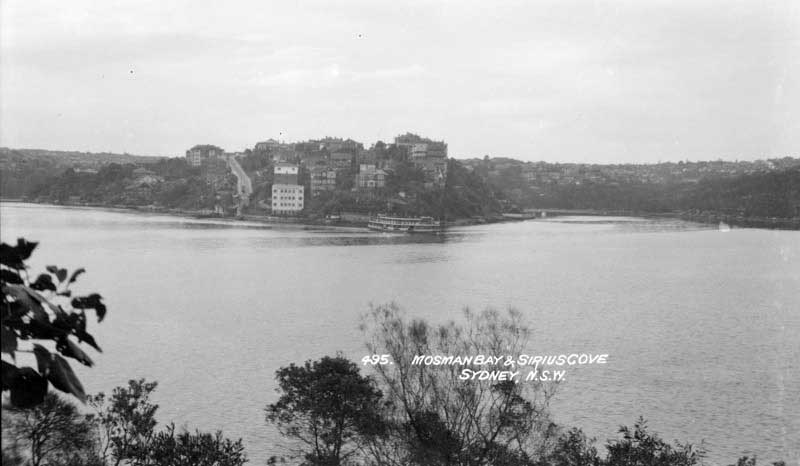
Image: NSW State Library collection. Reproduction: Peter de Waal
An 18-year-old youth, George Vincent Martin, was arraigned on a charge of having assaulted a girl under the age of 16, at Sirius Cove, on September 24. Mr Maddocks Cohen appeared for Martin, who pleaded not guilty. The Crown case was that two girls, both about 9 years of age, were playing on a pier at Elizabeth Bay, when the accused and another man, [Harry Paul Walker], approached in a rowing boat. An offer of a row on the harbor was accepted by the little playmates, and after looking at a warship the men rowed them to Sirius Cove. There all four went for a swim, and afterwards to a paddock on the boundary of Taronga Park Zoo. With the assistance of a rope ladder a fence was scaled, and it was alleged that the offence was committed in the bush on the other side. Martin admitted that the girls had gone for a row and had a swim with them, but denied having committed the offence alleged.
The jury returned a verdict of guilty. Martin was remanded for sentence.
~ ~ ~ ~ ~
The Sydney Morning Herald, Thu 11 Nov 1920 4
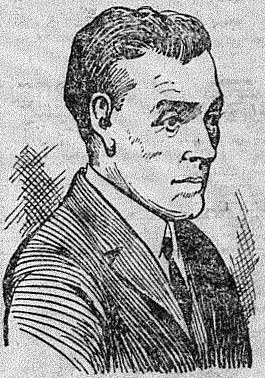
(Syd, NSW), Sun 14 Nov 1920, p. 4.
Reproduction: Peter de Waal
QUARTER SESSIONS.
No. 1 Court.
(Before Judge Cohen.)
Mr Norman Rowland, Crown prosecutor.
…
No. 2 COURT.
(Before Acting Judge Ralston.)
Mr WT Coyle, KC, Crown prosecutor.
A SERIOUS CHARGE.
George Vincent Martin, 18, was charged with having, at Sirius Cove, on September 24, assaulted a girl of the age of 9 years.
Mr Maddocks Cohen appeared for the accused, who pleaded not guilty.
The Crown prosecutor said that the accused and another youth, who was being proceeded against on a separate charge, were in a rowing boat at Elizabeth Bay on September 24. Two little girls, both about the age of nine, were playing on the jetty. Asked if they would like to go across the harbour in the boat, the two little playmates were taken to Sirius Cove. It was after the two youths and the children had been in the water that the offence took place.
Found guilty, Martin was remanded for sentence.
~ ~ ~ ~ ~
Truth, Sun 14 Nov 1920 5
SIRIUS COVE SENSATION.
———o———
TINY TOT OF TENDER YEARS
TAMPERED WITH.
———o———
Simple Child’s Shocking Story.
———o———
Remarkable Recital of an
Extraordinary Adventure.
————————
The altogether too common sight of a sweet little child of tender years standing in the witness-box at Criminal Court, reciting in simple childish language a shocking story of how she had been lured away and criminally assaulted by a scurvy scoundrel, was witnessed at Darlinghurst Quarter Sessions on Wednesday last.
the occasion, George Vincent Martin, a young man of about 19 or 20, was lined up in the dock, before Judge Ralston and a jury, on a charge of committing an indecent assault upon a child of 9 years at Sirius Cove on 24th September last.
Mr Maddocks Cohen defended the accused, who pleaded not guilty; and Mr W Coyle, KC, (instructed by Mr J Gonsalves) conducted the case for the Crown.
Before the evidence was entered upon, his Honor ordered all females present to leave the Court. In opening to the jury, the Crown Prosecutor said that the story was
AN EXTRAORDINARY ONE,
and a terrible one.
The little child, who was nine years of age, lived with her parents in Darlinghurst, and attended the Church of England Grammar School. On September 24 there was a half-holiday, and the child got her mother’s permission to go off and play with another little school mate aged eight. The two children eventually found their way down to Elizabeth Bay, and played about in the park for a while; then went on the jetty. While they were engaged in their childish games, the accused Martin and another person named Harry Paul Walker came along in a rowing boat and asked the children if they would like to go for a row. Childlike, the little girls said “Yes”, and were taken into the boat and rowed across to the opposite side of the harbor to a place which they thought was called Chinaman’s Bay. Here a landing was made and a swim was suggested by Martin, or his friend Walker. The little children were supplied with bathing suits, and the four entered the water.
AFTER THE SWIM,
a camera wos [sic] produced, and the little girls thought that their photos had been taken; but this was not so, because there was no film in the camera. However, they dressed, and the men said something about buying them chocolates and took them through the bush towards the zoo grounds. A fence was climbed with the aid of an improvised rope ladder, and then the children, who had got tired, sat down. Martin sat beside the little thing who would testify in this case, and Walker with another child who was concerned in another matter. Martin at once began to interfere with the child of nine, and eventually took her some distance away in the bush. There he removed some of her clothing and some of his own, and, according to the child's story, committed a grossly indecent assault upon her.
A little while afterwards, went on Mr Coyle, they were rejoined by Walker and the other child, and, beaching their boat and leaving the oars at a private house somewhere thereabouts, they proceeded to
MUSGROVE WHARF, MOSMAN,
crossed in the ferry and put the children in a tram and sent them home. One child was given 11⁄2d to pay her fare and the other 3d. It was about 8 pm when the child of nine reached her home, and when spoken to by her mother she told her all that had happened to her during the afternoon.
A few days later, proceeded Mr Coyle, Detective Quinn arrested Martin, and he admitted that he and Walker had picked the children up at the jetty; admitted that they had taken the children across to Sirius Cove; admitted that they all had a swim; admitted that they gave the children bathing costumes; and in fact admitted everything except the indecent assault.
“It is a terrible thing that little girls should be subjected to this kind of thing”, concluded Mr Coyle, “and an awful position for this young man to be in. At the same time, though his previous character might be good, you should leave sentiment out of the matter altogether, and if the Crown case is conclusive bring in
A VERDICT ACCORDINGLY”.
After an officer from the Department of Microbiology had given evidence regarding certain stains upon the child’s clothing.
The principal witness for the prosecution was called. She proved to be a bright, intelligent, pleasant-faced little dot, well spoken, and wonderfully self-possessed for a child so young.
Her evidence, which was given in a remarkably clear manner, was substantially what the Crown Prosecutor had indicated it would be in his opening.
After detailing the meeting on the jetty at Elizabeth Bay, and the row across the Harbor to Sirius Cove, she described how they landed and went up to a big rock some distance from the water’s edge, and undressed in the presence of the accused and the other man at their bidding. Then they donned little bathing suits which were supplied to them, and went in for a swim. After that one of the men
PRODUCED SOME NOTES
(imitation notes used by actors and called “stage notes”), and spoke of buying a 10s box of chocolates for them.
After this they walked through the bush until they came to the fence surrounding the Zoo, and one of the men made a rope latter [sic] and assisted them to climb over. Once inside the ground they sat down, and Martin sat beside her and began interfering with her clothing. Presently he got up and took her away about 40 or 50 yards into the bush, removed part of her clothing and his own, and committed an offence. While she was in a semi- nude state he picked up a camera and she thought took a photograph of her. Then he got her to replace her clothing and they went back to Walker and her little friend.
In conclusion the child described how the two men took them back to town via the Mosman ferry, put them in a tram at the Quay and sent them home.
Mr Cohen: When you were on the wharf at Elizabeth Bay did you wave to the men in the boat?—No. What were you doing on the wharf?—
PLAYING SUBMARINES.
At Sirius Cove did the men go up behind a rock and put their bathing suits on?—Yes.
How far away were you and your little friend?—About half a yard.
Who undressed first, you two girls or the men?—We all undressed together.
Did you undress in front of them?—We turned our backs on them.
Don’t you think you should have gone away?—Yes.
Why didn’t you?—We were frightened they would leave us.
There was a flutter and much whispering in court when the other little child was called as a witness. She was a sweetly pretty child of eight, with rosy cheeks, beautiful big, dark eyes, and clear velvety-looking skin. She wore a white dress, a pretty little white hat that suited her to perfection, and a becoming red coat completed the picture. Standing
IN THE WITNESS-BOX,
under the glare of the electric light, she looked more like a beautiful big wax doll than anything else.
She proved to be every bit as intelligent as the other child, and her story, told in repply [sic] to questions by the Crown Prosecutor, was marked by striking clearness and simplicity. She corroborated the other child with regard to all that happened up till the time that they parted in the Zoo grounds.
There, she said, Martin took “Curly” away into the bush.
“Who is ‘Curly’ ”? asked Mr Coyle.
“That’s ‘Curly’”, replied the child, indicating the other little girl. “She’s my mate”.
Under cross-examination by Mr Cohen, the child said that she knew it was a very wrong thing to undress in front of the men; but the man made them undress.
How did they make you undress?—They told us to.
Told you to, but they didn’t make you?—No.
Evidence of the arrest was given by Detective Sergeant Quinn.
THE DEFENCE.
[George Vincent] Martin, who is the son of an auctioneer and resides with his parents at Hopetoun-street, Paddington, went into the witness box and positively denied that he had committed an indecent assault upon the child. He admitted that he and Walker picked the children up in the boat and rowed them across to Chinaman’s Bay, and that they went swimming there; but he contradicted the statement that the children saw them undress. They went behind a rock to get into their costumes, and the children then said that they wanted to have a swim. Accordingly they gave them costumes and the children donned them and joined them in the water. After they had dressed again, one of the children saw some stage notes poking out of his pocket, and she took hold of it and asked him to buy her a 15s box of chocolates. Eventually, at the request of one of the children, they
WALKED THROUGH THE BUSH
to the Zoo and scaled the fece [sic] with the aid of a sort of rope ladder. As there did not seem to be anyone about they decided to go home, and after Walker had indulged in a bit of physical culture exercise and shadow sparring, and the children had rested, they went back to the boat. The water was too choppy to risk a row across the harbor back to Elizabeth Bay, so they took the children back to the Quay via the Mosman ferry and set them on their way in the tram.
Mr Coyle: Have you any little sisters of your own?
Martin: Yes.
Do you think it a fair thing for strange men to take little children on a trip such as this without the knowledge of their parents?—We did not see any harm in it.
Martin, replying to other questions, said that he and Walker found the boat in the harbor some time before, and took possession of it and pained it red. Since then they had used it. For some weeks past he had been at home nursing his mother, who had had a nervous breakdown.
Mr Coyle (holding up two tiny bathing costumes): Whose costumes are these?
Martin: They belong to Walker.
Do you usually carry little babies’ costumes of this size about with you?—I don’t know how they came to be
IN THE BAG.
I suppose you haven’t used them on other occasions?—No.
H’m! So it isn’t part of your outfit. Doesn’t it strike you as extraordinary that Walker should carry these small costumes about with him?—Yes it is funny.
You admit that everything the little girls have said is true, except their allegations about the assault?—Yes.
So the only part of their evidence they have imagined is the indecent assault?—Yes.
You don’t complain that they have exaggerated?—Well, they said I took their photographs. I deny that, because there was no film in the camera.
But you pretended to?—Yes.
And the story they told about the rope ladder is true?—Yes.
Why did you get over the fence?—Because the children asked us.
You don’t suggest that you two fellows—one 19 and the other 24—were obeying the will of these tiny children, do you?—They asked us to do it, and we did it.
You hadn’t much money?—No.
But you had
PLENTY OF THIS FLASH STUFF—
stage money?—Yes.
After taking these little girls all that way you sent them back home late at night—one with 11⁄2d and the other with 3d?—Yes. My friend gave one of the girls 3d, and I gave this girl 11⁄2d.
Really?—Yes. We paid their fares over from Mosman.
Go on! How generous. Did you really?—Yes.
You didn’t ask them to pay for you two?—No.
Harry Paul Walker, against whom a similar charge is pending, was called as a witness. He described himself as an actor, and gave his address as 46 Wentworth-street, Randwick.
His evidence was mainly corroborative of that given by Martin, and he declared that when they reached the Zoo they all remained together. Martin did not go off into the bush with one of the children.
He concluded by saying, “We treated them as if they were our sisters”. Mr Coyle: You are an actor?—Yes.
Where did you act last?—At the Opera House.
Did you think it
A FAIR THING
to take these little girls away from home?—It was at their suggestion.
What did you have this stage money for—for the purpose of deceiving little girls?—No.
Questioned by Mr Coyle as to why they took the children to the Zoo at that late hour, Walker said that the children, particularly the elder girl, persisted in saying that they wanted to go there.
So you suggest she was the leading spirit in his expedition?—(Loudly) Yes. She was the ringleader! (Laughter.)
This closed the case for the defence.
After hearing addresses and the summing up, the jury brought in a verdict of guilty and Martin was remanded for sentence.
The Sydney Morning Herald, Mon 15 Nov 1920 6
LAW NOTICES.
———
Monday, November 15.
———
…
QUARTER SESSIONS.
No. 1 Court.—Maximilian Meyers, false pretences; John Bede Hamilton, assault and robbery; William Cook, larceny; Richard Augustus Kelly, misconduct.
No 2 Court.—Harry Paul Walker, indecent assault; Thomas Edwin Houlahan, indecent assault; George Kellow, embezzlement.
~ ~ ~ ~ ~
The Daily Telegraph, Tue 16 Nov 1920 7
CRIMINAL.
————
…
(Before Acting-Judge Ralston.)
Mr Coyle, KC, prosecuted at No. 2 Quarter Sessions.
…
Harry Paul Walker (24), who was defended by Mr Maddocks Cohen, pleaded not guilty to a charge of having assaulted a girl about nine years of age at Sirius Cove on September 24. The jury was locked up for the night.
~ ~ ~ ~ ~
The Sydney Morning Herald, Tue 16 Nov 1920 8
QUARTER SESSIONS.
No. 1 COURT.
(Before Judge Cohen.)
Mr Norman Rowland, Crown Prosecutor.
…
No. 2 COURT.
(Before Acting Judge Ralston.)
Mr WT Coyle, KC, Crown Prosecutor.
SERIOUS CHARGE.
Harry Paul Walker (24), for whom Mr Maddocks Cohen appeared, pleaded not guilty to having assaulted a little girl nine years of age at Sirius Cove on September 24.
The Crown Prosecutor stated that the particulars of the case were the same as those in the charge against George Vincent Martin (19) a companion of the accused, who last week in the same court was found guilty and remanded for sentence. The two young men, who saw two little girls on the jetty at Elizabeth Bay, invited them to go across the harbour in a rowing boat. This was early in the afternoon. The children were taken to Sirius Cove in the boat and the alleged assault took place after they had been bathing with the accused and Martin. It was 8 o’clock in the evening when the little playmates returned to their homes at Darlinghurst. The boat was left by the accused and his companion near Taronga Park.
The jury, being unable to agree, was locked up for the night.
~ ~ ~ ~ ~
The Daily Telegraph, Wed 17 Nov 1920 9
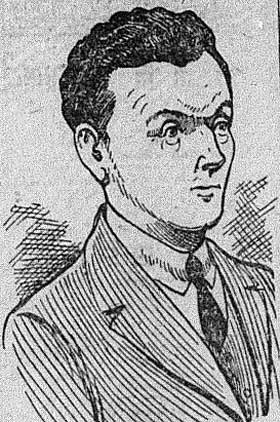
NSW), Sun 14 Nov 1920, p. 4.
Reproduction: Peter de Waal
CRIMINAL.
————
…
(Before Acting-Judge Ralston.)
…
In the case of Harry Paul Walker, charged with having assaulted a girl about nine years of age at Sirius Cove on September 24, the jury, who had been locked up for the night, stated that they were unable to agree, and were discharged. Walker was bound over to appear for trial at the next sittings of the Quarter Sessions, or such time and place as the Attorney-General may appoint.
…
George Vincent Martin (19), who had been convicted of assaulting a little girl, nine years of age, at Sirius Cove, on September 24, was sentenced to three years’ penal servitude.
~ ~ ~ ~ ~
The Sydney Morning Herald, Wed 17 Nov 1920 10
QUARTER SESSIONS.
No. 1 COURT.
(Before Judge Cohen.)
Mr Normand Rowland, Crown Prosecutor.
…
No. 2 Court.
(Before Acting Judge Ralston.)
Mr WT Coyle, KC, Crown Prosecutor.
…
NO VERDICT.
After being locked up all night, the jury not being able to agree in the case of Harry Paul Walker, 24, who was charged with assaulting a little girl, 9 years of age, at Sirius Cove, on September 24, were discharged.
The accused, who had been defended by Mr Maddocks Cohen, was bound over on bail to appear for trial at the next sittings of the Quarter Sessions, or such time and place as the Attorney-General may appoint.
YOUTH SENTENCED.
George Vincent Martin, 19, who last week was found guilty of assaulting a little girl, 9 years of age, at Sirius Cove, on September 24, was sentenced to three years’ penal servitude.
In the case for the Crown, it was stated that the convicted man, and Harry Paul Walker, who was his companion, took two little girls from the Elizabeth Bay jetty in a rowing boat across the harbour to Sirius Cove early in the afternoon of September 24. The little playmates did not return to their homes in Darlinghurst until 8 o’clock in the evening. The assault was alleged to have taken place at Sirius Cove.
His Honor, in passing sentence on Martin, said that, were it not that the public feeling was against the revival of flogging, he would have ordered a whipping as part of the punishment in this case. The maximum penalty was five years’ penal servitude.
In reply to Mr Maddocks Cohen, who appeared for the prisoner, his Honor said he could hold out no promise that the sentence would be shortened after a certain period had been served.
~ ~ ~ ~ ~
Truth, Sun 21 Nov 1920 11
SIRIUS COVE SENSATION.
———◦———
LITTLE GIRLS LURED AWAY.
———◦———
Judge Ralston on Assaults on Children—Serious Crimes
Calling for Stern Punishment—Three Years for
Youthful Yahoo—Jury Fails to Agree
in Actor’s Case
————————
The final scene in the Sirius Cove drama, one phase of which was dealt with in last week’s issue, was enacted at the Darlinghurst Sessions on Monday last, when a thin, pasty-faced young man, named Harry Paul Walker, who described himself as an actor; with emphasis on the “taw”, was placed on trial before Judge Ralston and a jury, on a charge of having indecently assaulted a sweetly pretty little girl of 8 years.
The trial was practically a repetition of that held last week, when Walker’s friend, George Martin, was found guilty of indecently assaulting a child of 8 years.
Walker, who pleaded not guilty, was defended by Mr Maddocks Cohen; and Mr Coyle, KC, conducted the case for the Crown.
The case the Crown sought to prove, as stated to the jury by the Crown Prosecutor, was that on September 24, while two little girls, one of whom was the prosecutrix in the present case,
WERE PLAYING CHILDISH GAMES
on the wharf at Elizabeth Bay. Walker and his mate, George Martin, rowed along in a boat and asked them to go for a row. The little girls consented and were taken across the harbor to a place near the Zoo, which they knew as Chinaman’s, or Dirty, Bay. There the two men undressed to go in for a swim, and by a strange coincidence produced from a bag two little costumes of a size suitable for very young children.
Mr Cohen: We say they will fit a man.
Mr Coyle (holding up two little costumes before the jury): I would like any one of the jurymen to try and get into either of them! (Smiles.)
Proceeding to limn the facts without further interruption, Mr Coyle said that these costumes were produced, the little girls were told to undress, and they donned the bathing suits and went into the water. While in there the child who was the principal witness in this matter, was indecently interfered with by Walker. When they left the water their
PHOTOGRAPHS WERE TAKEN
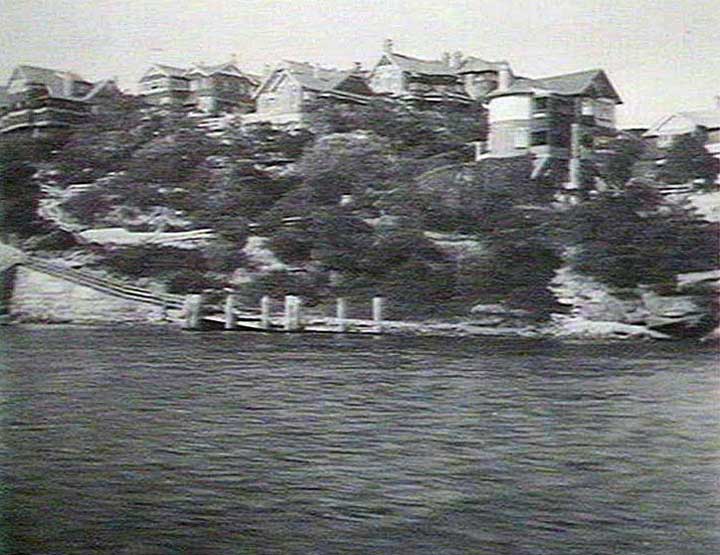
Image: NSW State Library collection. Reproduction: Peter de Waal
by the men, or at all events the children thought they were photographed. Having dressed in the presence of the men, the children, tempted by a promise of a ten-shilling box of chocolates, accompanied the two men through the bush to the Zoo grounds. There, with the assistance of an improvised rope ladder, the children were put over a rather high fence, and told to sit on the ground. Walker sat beside one of them, while Martin went off into the bush with the other one. Immediately they had disappeared from view Walker removed some of the child’s clothing and committed an assault of a grossly indecent nature. Some time elapsed, and they were rejoined by Martin and the other child. Abandoning the boat on account of the choppy nature of the water, the men walked round to Musgrave-street wharf, Mosman, with the children, took them over to Circular Quay, put them on a tram and then left them to find their way to their respective homes at Darlinghurst as best they could. A few days later when Walker was arrested he denied having anything to do with the boat or the little girls either; but later on
HE ADMITTED EVERYTHING THEY ALLEGED
took place, with the single exception of the indecent assaults.
“The suggestion, therefore”, concluded Mr Coyle, “is that the children imagined all the wretched detail which is the cause of this man being in the dock today. When you hear their stories and find them absolutely accurate in everything else, it will be for you to decided whether you are justified in coming to the conclusion that children so young could have imagined all this other dreadful business.”
The evidence of the two little children—pretty, intelligent little girls—was then taken. Their stories were almost exactly the same as those they told at Martin’s trial, the only difference being that the prosecutrix in this case furnished full details of the alleged assault committed upon her.
————
THE DEFENCE.
————
Walker, in his defence, positively denied that any indecent assault had been committed upon the child by him. He agreed with the story told by the children about the excursion in the rowing boat, the swim at Chinaman’s Bay, and the trip through the bush; but he declared that the four of them never separated while they were in the Zoo Grounds. He denied that the children were photographed while in a nude state, and smiled away the suggestion that he had committed certain acts of indecency before committing the assault.
Mr Coyle: You gave evidence last week for your friend George?
Walker: Yes.
Mr Coyle (meaningly): And you haven’t seen George since?
Mr Cohen shot up like a rocket and indignantly protested against what he termed the unfairness of the suggestion.
“There is only one inference to be drawn by the jury”, added Mr Cohen, “and that is that George is now in gaol. It is grossly unfair for the Crown Prosecutor to bring out that fact”.
Mr Coyle (to the witness): The other day you said
THE TALLER GIRL
of the two was the ringleader of the whole adventure?
Walker: I meant that she was more forward than the other one.
What was your object in going through the bush?—The children wanted to go to the Zoo.
Then why didn’t you go in the proper way instead of scaling a high fence?—I didn’t think we would get in at that time.
Further questioned, Walker said that grease paint used by actors could be removed by any sort of grease. He denied, however, that he was carrying vaseline with him on this day. The last engagement he had was at the Opera House, when he played the part of a bookmaker.
“And you were flinging thousands of pounds of this stuff about”, said Mr Coyle, holding up a big bundle of “stage notes” (notes resembling £1, £5, and £10 notes).
Walker smiled.
Mr Coyle then asked another question, and followed it up with, “I only want to get at the truth”.
“I know the truth”, replied Walker, thumping himself on the chest
IN TRUE ACTOR FASHION,
“and there is someone up above who knows the truth. You’ll get it from me”.
“I don’t know much about that”, retorted Mr Coyle.
George Martin, who was convicted of tampering with the other little child, was called, and repeated the story he related when he was on trial last week.
Mr Coyle: You gave exactly the same evidence last week?
Martin: Yes.
After hearing addresses and the summing up, the jury retired; but failing to agree, were locked up for the night.
On Tuesday morning, when they returned to the court the foreman announced that there was no possibility of an agreement being arrived at, and the jury was discharged.
Walker was then bound over in the sum of £100 to come up to trial at the next Court of Quarter Sessions.
Martin, who, as already indicated, was found
GUILTY OF INDECENT ASSAULT
on one of the girls a little over a week ago, was then brought up for sentence.
Mr Maddocks Cohen, in the course of an appeal for leniency, directed his Honor’s attention to the punishment that would be inflicted on Martin’s parents.
His Honor, in passing sentence, referred to this statement, and said that the little girl whose character might be blasted for the rest of her life had also to be considered as well as the feelings of her parents and relatives.
“I will preserve an absolutely judicial attitude in the matter, and will express no opinion of the case, because there is now another case of a similar kind pending against another man”, went on his Honor.
“These assaults upon young children, who do not realise the gravity and importance of what is happening to them, are becoming very frequent. It is hard to ascertain how widespread the practice is, as in many instances the assaults are not reported because of the desire to avoid publicity. Many offenders are never brought before the courts for this reason. If we want to keep this community wholesome and decent we
MUST PROTECT SMALL CHILDREN
against men of the type of the prisoner. In this case the damage to the little girl’s character may be irreparable. Fortunately no physical injury was done to her.
“In former days assaults of this nature, when accompanied by threats or violence, were regarded so seriously by the courts that portion of the sentence had to be carried out in irons. Even at the present time, under the laws of our country, a judge has the power to order a whipping; but the feeling of the community is against this, as it is considered to be punishment of a degrading nature, and it is not now inflicted. However, as those case is a very serious one, it must be dealt with severely.
“Under Sec 97 of the Crimes Act”, concluded his Honor, “the maximum penalty is five years’ penal servitude, and the minimum three years’ penal servitude.. Under the punitive provisions of the Act, however, I could pass a lesser sentence if I saw any redeeming features; but I can see none”.
Martin was then sentenced to three years penal servitude.
An application for leave to petition was refused.
~ ~ ~ ~ ~
The Sydney Morning Herald, Sat 19 Feb 1921 12
LAW NOTICES.
———
Monday, February 21.
———
…
QUARTER SESSIONS.
No. 1 Court.—Edward Andrew Campbell, indecent assault; Richard Roehr, embezzlement; Mary Anne Piper, maliciously wounding.
No. 2 Court.—Harry Paul Walker, indecent assault; Francis Barclay, indecent assault.
~ ~ ~ ~ ~
The Daily Telegraph, Tue 22 Feb 1921 13
CRIMINAL.
————
(Before Judge Backhouse.)
…
(Before Acting-Judge Mocatta.)
In No. 2 Court, Quarter Sessions (Mr WT Coyle, KC, prosecuting), Harry Paul Walker (24) was convicted of a charge of indecent assault at Sirius Cove on September 24 last. Prisoner, for whom Mr Maddocks Cohen appeared, was remanded for sentence.
~ ~ ~ ~ ~
The Sydney Morning Herald, Tue 22 Feb 1921 14
QUARTER SESSIONS.
(Before Judge Backhouse.)
Mr N de H Rowland, Crown Prosecutor.
…
(Before Acting Judge Mocatta.)
Mr WT Coyle, KC, Crown Prosecutor.
SERIOUS CHARGE.
Harry Paul Walker, 24, for whom Mr Maddocks Cohen appeared, was charged with having, at Sirius Cove, on September 24, assaulted a little girl under nine years of age.
In the case for the Crown it was stated that the accused, who described himself as an actor, and another young man named Martin, took the principal witness and a school girl companion in a boat from the wharf at Elizabeth Bay to Sirius Cove, where the alleged assault was committed.
The jury, who were out of court less than five minutes, found the accused guilty, and he was remanded for sentence.
When Walker was tried in November last, before Acting Judge Ralston, the jury, not being able to agree, were discharged.
~ ~ ~ ~ ~
The Daily Telegraph, Wed 23 Feb 1921 15
CRIMINAL.
————
(Before Judge Backhouse.)
…
(Before Acting-Judge Mocatta.)
In sentencing Harry Paul Walker (who had been convicted on the previous day of an assault at Sirius Cove on September 24 last) to three years’ penal servitude, his Honor described the offence as an outrageous criminal act. “I have tried to suppress my feelings as a man and a father, so that I might be able to mete out to you what is fair and right for what you have done,” added his Honor, addressing prisoner. “How a person with any sense of manhood—a human being—could set about polluting little children whom the instincts of a decent man would prompt him to protect, I do not know.
~ ~ ~ ~ ~
The Sydney Morning Herald, Wed 23 Feb 1921 16
QUARTER SESSIONS.
(Before Judge Backhouse.)
Mr N de H Rowland, Crown Prosecutor.
…
(Before-Acting Judge Mocatta.)
Mr WT Coyle, KC, Crown Prosecutor.
SENTENCES.
Harry Paul Walker, 24, who had been found guilty of assaulting a little girl under the age of nine years, at Sirius Cove, on September 24, was sentenced to three years’ penal servitude. His Honor said that Walker had been convicted of an outrageous criminal act. It was hard to understand how a person with any sense of manhood could behave in this way towards little children whom it was the instinct of every decent man to protect.
~ ~ ~ ~ ~
The Daily Telegraph, Sat 21 May 1921 17
CRIMINAL.
————
(Before Mr Justice Pring, Mr Justice Gordon,
and Mr Justice Wade.)
An appeal was made to their Honors, sitting as a Court of Criminal Appeal, on behalf of Harry Paul Walker, from his conviction before Acting-Judge Mocatta at the Sydney Quarter Sessions in February last, on a charge of indecent assault. Walker, who received a sentence of three years’ penal servitude, appealed on a number of grounds. Their Honors saw nothing to warrant them in interfering with the conviction or sentence. Mr Redshaw (instructed by Mr RD Meagher) appeared for the appellant, and Mr Crawford for the Crown.
~ ~ ~ ~ ~
The Sydney Morning Herald, Sat 21 May 1921 18
COURT OF CRIMINAL APPEAL.
(Before Mr Justice Pring, Mr Justice Gordon,
and Mr Justice Wade.)
…
REX v. WALKER.
This was an appeal by Harry Paul Walker, who was convicted of an assault upon a girl under age, at Sydney Quarter Sessions, before Acting Judge Mocatta, in February last, and sentenced to three years’ penal servitude. Several grounds were argued in support of the appeal, which, however, was dismissed. Mr Redshaw (instructed by Mr RD Meagher) appeared for the appellant.
~ ~ ~ ~ ~
Harry Paul Walker, Gaol photo sheet 19
![SRNSW: NRS2467, [3/6105], State Penitentiary photographic description book, 9 Oct 1920-14 May 1921, No. 17701, p. 253.](../../images/trials/1920-Walker-6105-gaol-photo-17701-Harry-Paul-Walker.jpg "SRNSW: NRS2467, [3/6105], State Penitentiary photographic description book, 9 Oct 1920-14 May 1921, No. 17701, p. 253.") |
Gaol Photo Sheet - Transcribed Details
No. 17701
Date when Portrait was taken: 23-2-1921
Name: Harry Paul Walker
|
Native place: Pymble Year of birth: 28-11-1896 Arrived Ship: Trade or occupation Religion: C of E Education, degree of: R & W Height: 5' 7½" Weight On committal: 119 Colour of hair: Dark brown Colour of eyes: Blue |
Marks or special features: Operation scar for appendicitis on right side of abdomen. |
|
(No. of previous Portrait ... ) CONVICTIONS |
|||||
|
Where and When |
Offence. |
Sentence |
|||
|
Paddington PC Sydney Q.S Court of Criminal Appeal |
11 21 20 |
1 2 5 |
1921 1921 1921 |
Embezzlement Indecent assault on a girl |
Rising of the Court. 3 years P.S. Appealed 26-2-1921. |
~ ~ ~ ~ ~
George Vincent Martin, Gaol photo sheet 20
![SRNSW: NRS2467, [3/6105], State Penitentiary photographic description book, 9 Oct 1920-14 May 1921, No. 17531, p. 82.](../../images/trials/1920-Walker-6105-gaol-photo-17531-George-Vincent-Martin.jpg "SRNSW: NRS2467, [3/6105], State Penitentiary photographic description book, 9 Oct 1920-14 May 1921, No. 17531, p. 82.") |
Gaol Photo Sheet - Transcribed Details
No. 17531
Date when Portrait was taken: 11-11-1920
Name: George Vincent Martin
|
Native place: Sydney Year of birth: 7-12-1901 Arrived Ship: Trade or occupation Religion: R C Education, degree of: R & W Height: 5' 4⅜" Weight On committal: 118 Colour of hair: Brown Colour of eyes: Grey |
Marks or special features: Nil |
|
(No. of previous Portrait ... ) CONVICTIONS |
|||||
|
Where and When |
Offence. |
Sentence |
|||
|
Sydney Q.S |
10 |
11 |
1920 |
Indecent assault on a girl under the age of 16 years |
3 years P.S. |
Harry Paul Walker, 1923 - Indecent assault
The Daily Telegraph, Thu 17 Apr 1924 21
CRIMINAL.
————
(Before Judge Scholes.)
…
(Before Judge Beeby.)
Mr Coyle, KC, Crown Prosecutor.
…
INDECENT ASSAULT.
Harry Paul Walker was charged with having indecently assaulted a boy, [John Allen Munday], twelve years of age, at Taylor Bay, North Sydney, on November 2, 1923. After visiting the locality the jury found the accused guilty, and he was remanded for sentence.
~ ~ ~ ~ ~
The Sydney Morning Herald, Thu 17 Apr 1924 22
QUARTER SESSIONS.
No. 1 COURT.
(Before Judge Scholes.)
Crown Prosecutor, Mr LJ McKean.
…
No. 2 COURT.
(Before Judge Beeby.)
Crown Prosecutor, Mr WT Coyle, KC.
ASSAULT.
Harry Paul Walker was convicted of assaulting a male person at North Sydney on November 2 and remanded for sentence.
Prisoner was defended by Mr WM Niland.
~ ~ ~ ~ ~
Truth, Sun 20 Apr 1924 23
PUDDIFOOT PERVERT PROWLS
ABOUT THE HARBOR
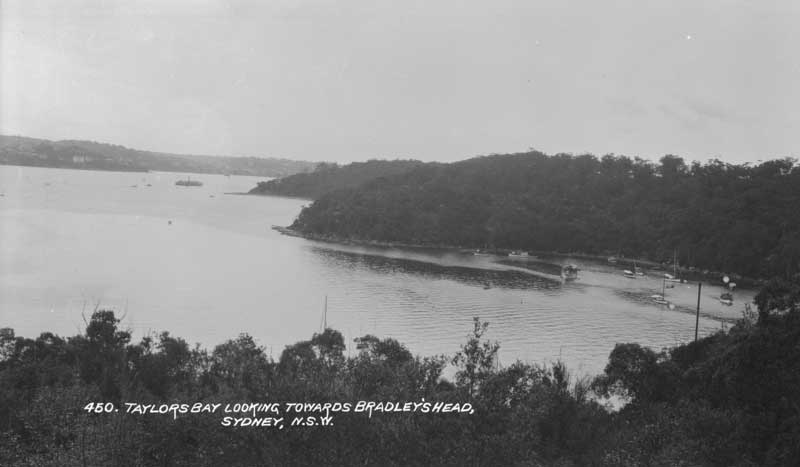
Image: NSW State Library collection. Reproduction: Peter de Waal.
Harry [Paul] Walker, Randwick Actor, Convicted of Horrible Crime Against 12 year-old Boy—Revolting Conduct In Bushes at Taylor Bay—Walker Previously Convicted on Grave Charge Against Small Girl at Sirius Cove But Released on Licence
————
SORDID STORY OF THREE BOYS IN A BOAT
ANOTHER apostle of the infamous Puddifoot, a prowler whose speciality is indecently tampering with little children, of either sex, has been overtaken by a well-deserved Nemesis.
HARRY PAUL WALKER, a young man of Randwick, an ex-actor, was found guilty at the Quarter Sessions on Wednesday of taking three little boys across the harbor in a boat and there exhibiting a most revolting form of degeneracy.
IT was not his first offence of this sort—though the jury that tried him did not know that they were dealing with an already convicted pervert.
HE has served three years’ gaol for doing the same thing to a little girl in 1920, at Sirius Cove, and since then he was scathingly condemned by the City Coroner when he held an inquiry into the drowning of an eight-year-old boy, Alan Jessep, at Anzac Bay.
WALKER acted in the dock as if he had never dreamed of anyone doing the nauseating things that two little boys witnesses accused him of, but the jury saw through his antics.
The story of the boy concerned most, and one of the two companions he had with him, was hideous one.
When Walker had pleaded not guilty, and the jury had been empanelled, the Crown Prosecutor, Mr Coyle, opened his case stressing the horrible nature of the allegation.
Walker was defended by Mr Niland.
AN ACTOR!
He attempted to assist in his own defence by indulging in a few well-meant theatricals, which he had learned when he was connected with “the stage.” The jury did not know about his past or his connection with the “profession.”
Peering eagerly through his sunken eyes, with his head resting on his arms, he occasionally stopped to raise his open hand aghast at the allegation which a witness made against him.
It was unthinkable!
His simulations of horror might hive weighed a little with some jurymen—for they did not know that they were dealing with a sex monster.
| HARRY PAUL WALKER, sentenced at the Darlinghurst Quarter Sessions for an assault on a little boy. Walker is a depraved degenerate, and a menace to children of either sex. His history is revolting, and he is quite qualified to be ranked as an apostle of the infamous Puddifoot. |
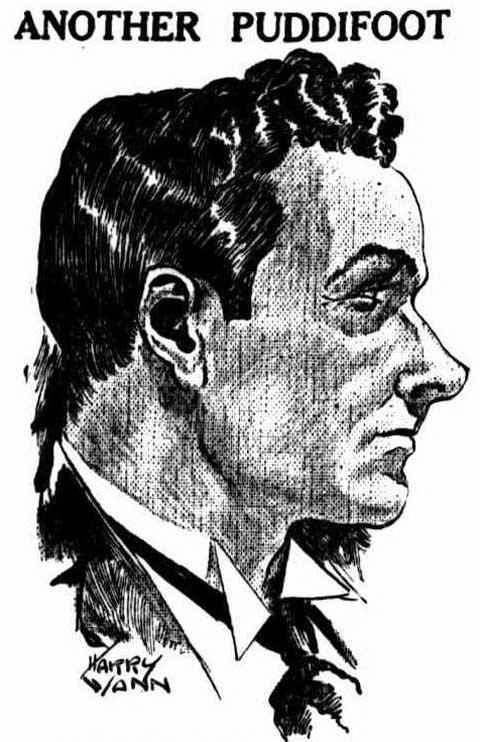
(Syd, NSW), Sun 20 Apr 1924, p. 10.
Reproduction: Peter de Waal
The charge against Walker, explained Mr Coyle, was that he indecently assaulted a twelve-year-old boy at a bay near Taylor Bay, on the north side of Sydney Harbor, on November 2.
The allegations were that on that day Walker rowed into Anzac Bay, between Rushcutter and Double Bays, about midday. He had three little boys in the boat with him and they all landed on the shore. The little fellows were left there in favor of a load consisting of the boy who had been assaulted and two of his companions—all Darlinghurst lads.
Their ages were eight, ten and twelve. It was the eldest who had the shocking experience with Walker.
NOT SPORTY BOYS.
Walker rowed them away, telling the other three boys that he was coming back for them, but, to the new crew in his boat, he remarked, “I’m not coming back. Those boys have no sport in them.”
They went across the harbor and there they bathed, and afterwards he bought some lemonade and biscuits. Some cigarettes were also bought.
They adjourned to the bushes where the offence occurred.
The arrest, and its outcome, was the result of a telephone message sent to the Double Bay police station, and acted on by Sergeant Denis McDonald who got into touch with Sergeant Shakespeare of the Water Police. They went for a cruise down the harbor in a launch and soon espied the boys and Walker in their retreat near Taylor Bay.
The whole party went back to Double Bay, and later a charge was laid against Walker at the Paddington Police Station.
As a matter of fact, Walker was first taken to the Morgue to see the body of one of the first three little boys who had made up his boat party, and whom he had deserted on finding some lads a little older with, perhaps, a little “more sport in them.”
That little chap had been drowned while trying to scale a wall to get back to his home.
This was not disclosed at Wednesday’s trial.
Before calling any witnesses the Prosecutor laid stress on the horrible thought that it was not safe for children to play about on the beaches without being picked up by men of that kind.
LAD’S STORY
The twelve-year-old boy who was the chief figure in the case gave his evidence clearly and confidently, after taking the oath.
He said that he and his two companions went down to Anzac Bay for a swim about 10 o’clock on the morning of November 2. About midday he saw Walker row in with three other boys and all bathed together.
They asked Walker to give them a row, and he did so, telling them that he did not intent to come back for the others, though he had promised them he would.
He related their bathe on the other side of the harbor and of the consumption of lemonade and biscuits. He then told of the four of them going into the bush, wether Walker showed himself to be a pervert of shocking depravity.
He also told of how his companions went away, leaving him with Walker.
Mr Niland cross-examined the fair-headed little chap vigorously, and he admitted that on the day of November 2, after they had been taken to Double Bay police station in the police launch, he did not say anything about certain allegations which he had just made in the witness box.
None of the other boys had mentioned them, nor did either himself or the one companion who gave evidence at the Children’s Court make a revolting allegation which had now been made.
He said he was frightened to say so at first, though the police had questioned him all about it.
“TELLING LIES.”
He admitted that he was naked as they were rowing across the harbor in the boat, but said that Walker had told him it did not matter about putting on his clothes.
One of the other lads, the ten-year-old corroborated the story with marked consistence.
Then Sergeant McDonald, of Double Bay, told only some of what he knew about Walker and his doings that day.
He said that when Walker was told at Double Bay that the boys made some allegations concerning his conduct, he replied, “Nothing of the sort! They’re telling lies.”
Walker did not elect to give his version of affairs on oath.
WALKER’S PLEA.
“Gentlemen of the jury,” he said, beginning like a lawyer of long experience. “At the time of this alleged offence I was working at Manly on the previous day, Friday, and as the carpenters had not finished their work, so that we could go on plastering, I decided to spend the day rowing on the harbor.
“I hired a boat for three shillings an hour at Elizabeth By, and rowed around to Rushcutter Bay, where I met three boys, how called out to be given a row. I took no notice of them but they called out again, and I thought that I might as well, so I took them to Anzac Bay. One of the boys wanted to go home, and I directed them the way through a building on to the main road.
“The other three then wanted a row and kept at me. I took them into the boat, and the eldest began to row but as he made little headway, I took the oars and rowed right across to the other side.
“On the way I told —– (the eldest) that he had better get dressed a bit, as Manly ferries were passing, and the people could see him. He said it did not matter.
“After the bathe at Taylor Bay I gave the boys two shillings and told them to get me a bottle of lemonade and some biscuits, and they got some cigarettes, I smoked one.
“—– (the eldest), got in the boat and the others ran around the foreshores. I was picking sarsaparilla leaves to take home and make a tonic, as I believe it is good in summer weather. After a while I suggested that we had better return, and they said, ‘Oh, no. this is too good.’
COULD BE SEEN.
“When the police launch came and took us back the boys were taken into a partitioned part in the front of the launch and were asked questions while I was at the back.
“Eventually one of the police said, ‘If you can’t charge him with anything else, charge him with stealing the boat.’ I replied that I had hired the boat, and they said that it was all right, as they would get something at the police station.
“As a matter of fact, over in that bay there is a road passing right along, and people and vehicles on it, while there are houses up the hill, and even under a tree anyone could be seen,” he added, concluding with the remark that at the utmost he may have flicked the boy with his towel.
Mr Niland addressed the jury on the precociousness of the boys and dilated on their appetite for cigarettes.
The jury retired before lunch and returned after lunch to say that they would like to see the scene of the adventures described by the boys. Accordingly a visit was arranged.
GUILTY.
Thy pottered about the bay, and goy back to the Court late in the afternoon. At twenty minutes past five the bells rang through the corridors—a signal that the jury had agreed.
They filed in, and on being questioned the foreman said: “Guilty.”
“Can I ask the jury a question?” said Walker, who decided not to “faint” this time, as he had done once before.
“No,” answered Judge Beeby. “I’ll ask the gentlemen of the jury to wait until they hear the record of the accused.”
The Gaol Recorder then took the oath and exposed Walker’s past infamy. To the jury it was a revelation.
Walker was remanded for sentence. He remained fairly clam as he left the Court and walked across to the police station cells, handcuffed.
In the Recorder’s books it is noted that Harry Paul Walker, of Wentworth-street, Randwick, was:
(1) Sentenced at Paddington for embezzlement.
(2) Given three years’ gaol for assaulting indecently a little girl of eight years of age.
(3) Was condemned by the City Coroner as being worthy of dire punishment for leaving at Anzac Bay, on that November 2, a little boy, who was drowned trying to get back to the neighbourhood from where this pervert had taken him.
In November of 1920 Walker was tried at Quarter Sessions on the charge of indecently assaulting a little girl, but the jury disagreed, and he came up. for a second trial on February 21, 1921, when he was convicted and given three years.
The story of this crime was particularly horrible. It was known as the “Sirius Cove” case, and again involved a row-boat and a trip across the harbor.
The victim of his hideous degeneracy was bright little mite of eight, good-looking and mentally alert. She and another little girl were playing a game at Elizabeth Bay when Walker arrived and rested on his oars, issuing an invitation to them to come for a ride.
Not dreaming, in their childish innocence, that they were dealing with a human monster, and not a man, they got into the boat and were taken over to Sirius Cove, where Walker, and a companion who was with him, ordered the little mites to undress.
HORRORS AT ZOO.
Like a conjurer of old, Walker produced two wee bathing suits for them.
They had a swim, and then the two men produced some “stage money” (Walker was playing the part of bookmaker in a theatrical production in Sydney at the time) and promised the kiddies that they would take them to the Zoo and give them some chocs.
They did get to the Zoo—over the barbed fence. Inside, in the thick bushes, Walker went with one little mite and his companion vanished with another.
What happened to the little girl with Walker is too shocking and repulsive to be printed. He dealt with her in an outrageous manner.
Later, the youngsters were taken over to the Quay on a ferry, and were put on a Darlinghurst tram with the princely sum of twopence. They got no chocolates. Their visit to the Zoo was a memory that will haunt the little unfortunates for a lifetime.
When that jury had found Walker guilty, he practised some more of his theatricals, and, neatly, carefully, and without any bumps, “fainted” in the dock.
The Judge at the trial said that it was hard for him to think calmly. How anyone could degrade himself to pollute the innocence of little girls passed his comprehension. He awarded three years.
In August last Walker was released on license and ordered to report himself fortnightly to the police. He was out less than three months when he was caught at this harbor-trip stunt again. And he was caught then only because a woman had phoned the police about him.
CORONER’S CONDEMNATION.
After the inquest, Mr Jamieson, city coroner, said that a heavy burden rested on Walker’s shoulders in connection with the death of little Allan Jessep, one of the original three boys he had in his boat, and whom he left stranded.
“After viewing the place,” continued the Coroner, “it is a marvel to me that only one boy was drowned. I cannot conceive that any person in their proper senses, with any regard for the lives their way from there.
“I don’t know what can be done with the matter, but a man who takes children out for a row in a boat and leaves them under conditions such as these were left, should be punished.
“There is no law for me to inflict some punishment on him, but there ought to be.”
His adventures and proclivities provide a startling warning to parents to watch the perigrinations [sic] of their little ones in lands where strange men, with perverted instincts wander abroad seeking whom they may corrupt.
~ ~ ~ ~ ~
The Advertiser, Wed 23 Apr 1924 24
INDECENT ASSAULT.
———
FIVE YEARS' IMPRISONMENT
AWARDED.
Sydney, April 23.
Harry Paul Walker, a young man, who was found guilty of indecent assault at Taylor Bay, was sentenced by Judge Beeby, at the Darlinghurst sessions to-day, to five years’ imprisonment. His Honor said it was unfortunate that there was no appropriate institution yo which the prisoner could be sent. He was a man who was not fit to be at large.
~ ~ ~ ~ ~
The Daily Telegraph, Wed 23 Apr 1924 25
THE COURTS
———◦———
CRIMINAL.
————
(Before Judge Scholes.)
Mr EF McDonald, Crown Prosecutor.
…
(Before Judge Beeby.)
Mr WT Coyle, KC, Crown Prosecutor.
…
ASSAULT ON BOY
Harry Paul Walker (27), laborer, convicted at a former sitting of indecent assault upon a boy at Taylor Bay, North Sydney, on November 2, 1923, was sentenced to five years’ imprisonment.
His Honor said that the prisoner was of a type of man not fit to be at large. The offence was committed while the prisoner was out on license in respect of a conviction of an assault on another child. It was to be regretted that there was no proper institution to which the prisoner could be consigned.
~ ~ ~ ~ ~
The Sydney Morning Herald, Wed 23 Apr 1924 26
QUARTER SESSIONS.
No. 1 COURT.
(Before Judge Scholes.)
Crown Prosecutor, Mr EF McDonald.
…
No. 2 COURT.
(Before Judge Beeby.)
Crown Prosecutor, Mr WT Coyle, KC.
ASSAULT.
Harry Paul Walker, a young man, who was convicted last week of assaulting a boy at Taylor Bay on November 2, was sentenced to five years’ imprisonment with hard labour. His Honor said that it was unfortunate that there was not an appropriate institute to which the prisoner could be sent. He was a menace, and not fit to be at large.
~ ~ ~ ~ ~
The Daily Telegraph, Wed 4 Jun 1924 27
CRIMINAL APPEAL
————
(Before Sir William Cullen, CJ, Mr
Justice Gordon, and Mr Justice James.)
…
NOT TOO SEVERE.
Harry Paul Walker appealed from his conviction, before Judge Beeby, at the Sydney Quarter Sessions, in April last, on a charge of indecent assault. Walker, who was sentenced to five years’ hard labor, based his appeal on the grounds that the trial was defective, by reason of the absence of warning to the jury against the danger of convicting on the uncorroborated evidence of young children, and it was also contended that a particular witness for the Crown—a boy—must be regarded as an accomplice, or one whose conduct might have warranted the jury in treating him as an accomplice. The Chief Justice, in giving judgment, said he was clear that the boy in question could not in any sense be regarded as an accomplice. The facts before the Court showed that the man had been previously convicted of what the judge described as “a particularly revolting assault on a young girl.” For that offence he received a sentence of three years. He had been released on license, and it was while out on license that the present offence took place. He thought the judge was amply warranted in imposing the highest penalty he could under the section, which he did by awarding imprisonment for five years, but the Crimes Act did not permit of the period of five years under the head of imprisonment for five years’ hard labor. That term would be permissible as penal servitude. The Court had rectified such an error. The only question for them was whether, in rectifying it, the Court should reduce the period of five years. He emphatically declared, in view of the frequency of offences against the criminal laws of the State in the matter of sexual offences, that the Court ought not to interfere with the sentence passed in this case. It was perfectly clear the appeal must be dismissed and the sentence would be altered to a sentence of five years’ penal servitude. Mr Rooney (instructed by Mr WM Niland) appeared for the appellant, and Mr Weigall represented the Crown.
~ ~ ~ ~ ~
The Sydney Morning Herald, Wed 4 Jun 1924 28
COURT OF CRIMINAL APPEAL.
(Before Sir Wm Cullen, CJ, Mr Justice
Gordon, and Mr Justice James.)
…
REX v. WALKER.
The appellant in this case, Henry Paul Walker, was convicted at Sydney Quarter Sessions in April last on a charge of indecent assault, and sentenced by Judge Beeby to five years’ hard labour. The grounds taken on appeal were that the jury were not warned against accepting the uncorroborated evidence of young children; also that one of the principal Crown witnesses, a boy, must be regarded as an accomplice, or one whose conduct would have warranted the jury in treating him as an accomplice. Mr Rooney (instructed by Mr WM Niland) appeared for the appellant. The appeal was dismissed, the sentence being rectified to penal servitude instead of hard labour.
~ ~ ~ ~ ~
Harry Paul Walker, Gaol photo sheet 29
![SRNSW: NRS2467, [3/6111], State Penitentiary photographic description book, 14 Jan 1924-5 Jun 1924, No. 20073, p. 212.](../../images/trials/1920-Walker-6111-gaol-photo-20073.jpg "SRNSW: NRS2467, [3/6111], State Penitentiary photographic description book, 14 Jan 1924-5 Jun 1924, No. 20073, p. 212.") |
Gaol Photo Sheet - Transcribed Details
No. 20073
Date when Portrait was taken: 17-4-1924
Name: Harry Paul Walker
|
Native place: Pymble Year of birth: 28-11-1896 Arrived Ship: Trade or occupation Religion: C of E Education, degree of: R & W Height: 5' 7⅝" Weight On committal: 126 Colour of hair: Dark brown Colour of eyes: Blue |
Marks or special features: Operation scars on both sides of abdomen. |
|
(No. of previous Portrait .. 17701) CONVICTIONS |
|||||
|
Where and When |
Offence. |
Sentence |
|||
|
Sydney Q.S |
16 3 |
4 6 |
1924 1924 |
Indecent assault on a male person Leave to appeal refused. |
5 years HL |
|
And 2 previous convictions for which see Photo No. as above |
|||||
~ ~ ~ ~ ~
Below is Walker’s gaol discharge photo
Harry Paul Walker, Gaol photo sheet 30
![SRNSW: NRS2397, [3/6015], Parramatta Gaol photographic description book, 1929-1930, No. 1633, p. 6, R5138.](../../images/trials/1920-Walker-6015-gaol-photo-1633.jpg "SRNSW: NRS2397, [3/6015], Parramatta Gaol photographic description book, 1929-1930, No. 1633, p. 6, R5138.") |
Gaol Photo Sheet - Transcribed Details
No. 1633
Parramatta
Date when Portrait was taken: 18-5-1928
Name: Harry Paul Walker
|
Native place: Pymble Year of birth: 28-11-1895 Arrived Ship: Trade or occupation Religion: C of E Education, degree of: R & W Height: 5' 7½" Weight On committal: 119 lbs Colour of hair: Brown Colour of eyes: Blue
|
Marks or special features: Operation scar for appendicitis on right side of abdomen. |
|
(No. of previous Portrait .. 17701, 20073) CONVICTIONS |
|||||
|
Where and When |
Offence. |
Sentence |
|||
|
Sydney Q.S Paddington Sydney Q.S Sydney Q.S... |
11 20 16 |
1 2 4 |
1921 1921 1924 |
Embezzlement Indecent assault on a girl Indecent assault on a male person |
Rising of Court 3 years P.S. 5 years H.L. |
1 The Sydney Morning Herald, Fri 1 Oct 1920, p. 6.
2 The Sydney Morning Herald, Wed 10 Nov 1920, p. 10. Emphasis added.
3 The Daily Telegraph, Thu 11 Nov 1920, p. 8.
4 The Sydney Morning Herald, Thu 11 Nov 1920, p. 5.
5 Truth, (Syd, NSW), Sun 14 Nov 1920, p. 6. Emphasis in original and added.
6 The Sydney Morning Herald, Mon 15 Nov 1920, p. 7. Emphasis added.
7 The Daily Telegraph, Tue 16 Nov 1920, p. 7.
8 The Sydney Morning Herald, Tue 16 Nov 1920, p. 6.
9 The Daily Telegraph, Wed 17 Nov 1920, p. 7.
10 The Sydney Morning Herald, Wed 17 Nov 1920, p. 6.
11 Truth, (Syd, NSW), Sun 21 Nov 1920, p. 11. Emphasis in original and added.
12 The Sydney Morning Herald, Sat 19 Feb 1921, p. 9. Emphasis added.
13 The Daily Telegraph, Tue 22 Feb 1921, p. 8.
14 The Sydney Morning Herald, Tue 22 Feb 1921, p. 6.
15 The Daily Telegraph, Wed 23 Feb 1921, p. 7.
16 The Sydney Morning Herald, Wed 23 Feb 1921, p. 9.
17 The Daily Telegraph, Sat 21 May 1921, p. 7.
18 The Sydney Morning Herald, Sat 21 May 1921, p. 9.
19 SRNSW: NRS2467, [3/6105], State Penitentiary photographic description book, 9 Oct 1920-14 May 1921, No. 17701, p. 253.
20 SRNSW: NRS2467, [3/6105], State Penitentiary photographic description book, 9 Oct 1920-14 May 1921, No. 17531, p. 82.
21 The Daily Telegraph, Thu 17 Apr 1924, p. 3.
22 The Sydney Morning Herald, Thu 17 Apr 1924, p. 7.
23 Truth, (Syd, NSW), Sun 20 Apr 1924, p. 10. Emphasis in original and added.
24 The Advertiser, Wed 23 Apr 1924, p. 12.
25 The Daily Telegraph, Wed 23 Apr 1924, p. 12.
26 The Sydney Morning Herald, Wed 23 Apr 1924, p. 10.
27 The Daily Telegraph, Wed 4 Jun 1924, p. 5.
28 The Sydney Morning Herald, Wed 4 Jun 1924, p. 10.
29 SRNSW: NRS2467, [3/6111], State Penitentiary photographic description book, 14 Jan 1924-5 Jun 1924, No. 20073, p. 212.
30 SRNSW: NRS2397, [3/6015], Parramatta Gaol photographic description book, 1929-1930, No. 1633, p. 6, R5138.