The Sydney Morning Herald, Sat 4 Feb 1922 1
LAW NOTICES.
———◦———
Monday, February 6.
———
…
QUARTER SESSIONS.
Joseph Kelly, stealing in a dwelling and receiving; Harold Blackford, indecent assault; James Ireland and Frederick Levett, horse stealing and larceny; Henry Brown, breaking and entering and stealing.
~ ~ ~ ~ ~
The Sydney Morning Herald, Mon 6 Feb 1922 2
LAW NOTICES.
———◦———
Monday, February 6.
———
…
QUARTER SESSIONS.
Joseph Kelly, stealing in a dwelling and receiving; Harold Blackford, indecent assault; James Ireland and Frederick Levett, horse stealing and larceny; Henry Brown, breaking and entering and stealing.
~ ~ ~ ~ ~
The Sydney Morning Herald, Sat 11 Feb 1922 3
LAW NOTICES.
———◦———
Monday, February 13.
———
…
QUARTER SESSIONS.
Harold Blackford, indecent assault; Sidney Thomas Galloway, stealing; John Dorrington and James Dillon, breaking and entering and stealing; Henry Clayton, breaking and entering and stealing.
~ ~ ~ ~ ~
The Sun, Mon 13 Feb 1922 4
ACQUITTED
At the Darlinghurst Sessions to-day Harold Blackford, aged 23, was acquitted on a charge of having assaulted a boy at La Perouse.
~ ~ ~ ~ ~
The Sydney Morning Herald, Mon 13 Feb 1922 5
LAW NOTICES.
———◦———
Monday, February 13.
———
…
QUARTER SESSIONS.
Harold Blackford, indecent assault; Sidney Thomas Galloway, stealing; John Dorrington and James Dillon, breaking and entering and stealing; Henry Clayton, breaking and entering and stealing.
~ ~ ~ ~ ~
The Daily Telegraph, Tue 14 Feb 1922 6
CRIMINAL.
———
(Before Judge Scholes.)
…
Harold Blackford, [22], was arraigned upon a charge of assaulting a boy, [Ronald Hamilton]. He pleaded not guilty, and was defended by Mr W Parker. The jury returned a verdict of not guilty.
~ ~ ~ ~ ~
The Sydney Morning Herald, Tue 14 Feb 1922 7
QUARTER SESSIONS.
(Before Judge Scholes.)
Mr N de H Rowland, Crown Prosecutor.
ACQUITTED.
Harold Blackford was charged with indecent assault at La Perouse. Mr Parker appeared for the defence. The jury returned a verdict of not guilty.
~ ~ ~ ~ ~
Truth, Sun 19 Feb 1922 8
UGLY CHARGES.
———◦———
CAPERS AT A CARNIVAL.
————
SAILOR SNAPS SHARP SENTENCE.
————
“RAZZLE-DAZZLE” AND “HOUP-LA”.
————
“HAVE YOU SEEN MY SISTER WITH THE RED HAT?”
————
The idyllic waterside refuge of La Perouse figured as the locale of one of two criminal cases decided by Judge Scholes and juries at the criminal sittings of the Quarter Sessions held during the week just ended. In both instances the criminal charges alleged the commission of an indecent assault by one male person upon another. Both were odiously ugly cases. In one case the Crown failed to convince the jury of the truth of the allegations advanced against the accused, and the jury recorded an acquittal. In the second case the Crown succeeded, and Judge Scholes sentenced the convicted man to 12 months’ imprisonment with hard labor in Goulburn Gaol.
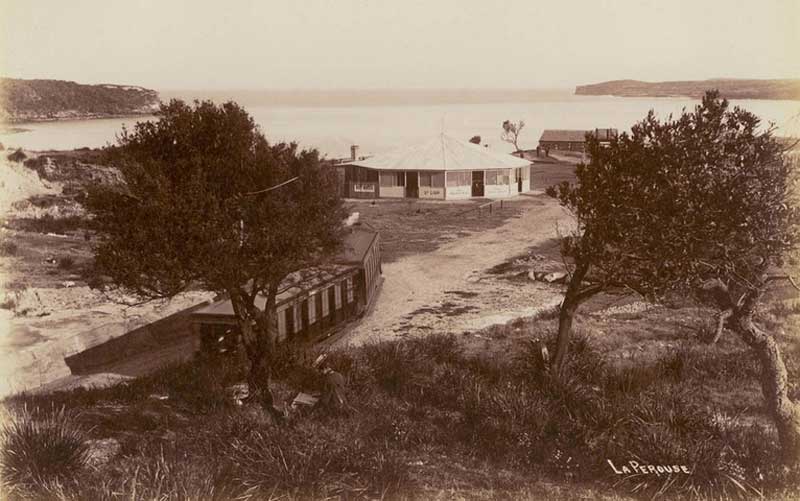
State Library collection. Reproduction: Peter de Waal
AN ACQUITTAL.
The indictment presented against Harold Blackford (23) at the Quarter Sessions last Monday charged him with having committed an indecent assault upon a youth, during the course of an outing to La Perouse organised by the Boy Scouts, the date of the alleged offence being New Year’s Eve, December 31st last.
The Crown Prosecutor was Mr N de H Rowland, and the accused was defended by Mr Parker (from the office of Mr ER Abigail). Accused pleaded not guilty.
The Crown case set out that accused and three young lads, all members of the same league of Boy Scouts, proceeded to La Perouse. There they built a cubby house, and in that abode accused was in the habit of beguiling his comrades with dissertations upon a mouth-organ. It was alleged that in this cubby house certain indecent conduct occurred between accused and certain of the boys. This the accused strenuously denied, despite the evidence given by the boys, asserting that the only incident that might have given ground to the charge he was now faced with, was when his shirt became disarranged while he was discoursing on the mouth-organ, and he had to re-fix that garment within his breeches.
The jury eventually returned a verdict of not guilty, and accused was discharged.
—————
CARNIVAL CAPERS.
————
HIDEOUS HYDE PARK HAPPENING.
————
SAILORMAN SHARPLY SENTENCED.
————
Before Judge Scholes and a jury of twelve, at the Quarter Sessions, last Tuesday, Joseph White, a sailorman with substantial service to his credit in the Royal Navy, to which he had added four years’ meritorious service with the AIF, was convicted of having indecently assaulted a boy named John Croft. The offence was alleged to have been committed at Hyde Park on the evening of January 21 during the currency of a carnival in that park.
Mr N de H Rowland was the Crown Prosecutor, and accused was defended by Mr C Moseley.
AFTER THE RAZZLE-DAZZLE.
The Crown Prosecutor stated that accused was charged with having committed an indecent assault upon a male person, a boy of 13 years of age. Indecent offences between males, whether the second party consented or not, were prohibited by law. In this case accused, having first induced the boy to go on a machine known as the razzle-dazzle, further induced the lad to lie down on a grass plot near by. There the indecency allegedly occurred between them. Another boy appeared on the scene, and remarked aloud, “Here they are”. Thereupon accused and his boy companion arose and went to get away. But the second lad had informed a constable of what he had seen, and consequently accused and his comrade were promptly taken into custody.
John Croft, a diminutive lad of 13, with an impediment in his speech, stated that he was a schoolboy. On the night of Saturday January 21, he went to the carnival at Hyde Park. There he saw accused at about 8 o’clock. Witness asked accused if he had seen his (witness’s) sister, but accused said he had not. The words actually used were. “Have you seen my sister with a red hat?” Then witness and accused went on the razzle-dazzle, accused paying. Next they both moved on to a grass plot. The youngster then described certain happenings, the commission of which constituted the basis of the criminal charge against accused. While the indecent behaviour was in course of perpetration, a boy came along and called out, “Here they are.” Then a constable came. Accused went to walk away, but the constable called him back, and he came back. Then accused was arrested.
Mr Moseley: You didn’t know this man before?
Witness: No.
Did you ask anybody else about your sister that night?—No.
Now, didn’t you ask accused for sixpence to go on the “razzle-dazzle”?—No.
How did you get from the “razzle-dazzle” to that grass plot?—We walked there.
In the lower court, you said defendant grabbed hold of you. Is that true?—He didn’t have hold of me at all.
Why did you say so? Why have you altered your story now? Is it not because you have heard Billy Young’s story?—Yes.
You followed him down to the grass plot to get more money from him?—I never asked him for any money.
While you were telling the policeman what had happened, did accused try to speak?—Yes.
And what did the policeman say?—He said, “Hold your tongue”!
William Alexander Young, a neatly-attired lad of 15 years, told what he had seen on the grass plot that carnival night. He saw accused and the boy Croft together on the grass plot. The two of them moved about from one dark patch to another. It was at a spot about 50 yards from
“THE TEMPLE OF MYSTERY”
that he saw them behaving indecently. He sent his young brother for a constable. When the constable arrived the clothing of both accused and the boy Croft was disarranged.
Mr Moseley: You didn’t have these people under observation?
Witness: No.
When the constable called accused back, the latter came back?—Yes.
And when he wanted to make an explanation, the constable told him to hold his tongue?—Yes.
Constable Don Hughes, of No. 1 Police Station, stated that from information that had reached him, he approached accused and the boy Croft on the grass on the night of January 21. When they saw witness they both rose and accused went to walk off. But when called back by witness, White came back. The boy Croft then detailed to witness certain indecent conduct that White had been guilty of. Croft told witness that White had invited him to have a “razzle-dazzle”, and that they had a couple of turns at the “houpla”. White paid and gave Croft the sixpence change. When White was charged at the police station he said, “I’ll plead not guilty”. Accused appeared to be perfectly sober.
This constituted the Crown case.
SAILORMAN’S STORY.
Mr Moseley put accused in the witness-box to give evidence on his own behalf.
Accused [Joseph White] said that he had had four years’ service abroad with the AIF, and had been returned to Australia after receiving injuries to the head. His only defence was a direct denial to the story told by the boys. The boy Croft followed him on to the grass, whither accused had adjourned for a certain purpose. Croft asked accused for a shilling. Accused did not know that Croft was near until the latter sat down beside him on the grass plot. He had served for 25 years in the British Navy, and had been discharged with a good character. This was before he joined the AIF.
To the Crown Prosecutor: He heard a boy cry out, “Here they are!” So far as he knew young Croft’s clothing was not disarranged. If Croft’s clothing was disarranged the boy must have disarranged it himself. The youngster might have been in his company for about 10 minutes altogether. He had never seen the boy before. He was not a married man, having spent most of his life at sea.
Mr Moseley in his address for the defence, pointed out the discrepancies in Croft’s evidence as to how he came to be on the grass with accused, and also to other discrepancies in his evidence relative to the alleged indecent happenings.
The Crown Prosecutor pointed out that there were two separate stories before the jury. Which did they believe? The boy Croft had not varied his main story as to the happenings on the grass.
A juryman desired to know what had induced the lad Young to take such an interest in the doings of accused and the boy Croft.
Judge Scholes laconically explained, “Boys will be boys”.
The jury eventually returned a verdict of guilty against White, and Judge Scholes imposed upon prisoner a sentence of 12 months’ imprisonment, with hard labor, in Goulburn Gaol.
1 The Sydney Morning Herald, Sat 4 Feb 1922, p. 9. Emphasis added.
2 The Sydney Morning Herald, Mon 6 Feb 1922, p. 5. Emphasis added.
3 The Sydney Morning Herald, Sat 11 Feb 1922, p. 9. Emphasis added.
4 The Sun, (Sydney, NSW), Mon 13 Feb 1922, p. 7.
5 The Sydney Morning Herald, Mon 13 Feb 1922, p. 7. Emphasis added.
6 The Daily Telegraph, Tue 14 Feb 1922, p. 9.
7 The Sydney Morning Herald, Tue 14 Feb 1922, p. 6.
8 Truth, (Syd, NSW), Sun 19 Feb 1922, p. 10. Emphasis added.