Tattersall v. Tattersall, 1912 – Divorce
Below also see: Tattersall v. Tattersall, 1915 – Divorce,
Herbert Tattersall, 1929 – Indecent assault
Evening News, Wed 6 Mar 1912 1
LIFE OF MISERY.
———◦———
WIFE’S AWFUL EXPERIENCES.
————
HUSBAND THREATENED HER
LIFE.
————
Drunkenness and cruelty were the grounds upon which Grace Madeline Tattersall, formerly Dewhurst, sought in the Divorce Court before Mr Justice Gordon, a dissolution of her marriage with Herbert Tattersall.
Mr Boyce (instructed by JAI Perry, Dent, and Company) appeared for the petitioner, but there was no appearance on behalf of the defendant.
Dr Victor Ethelbert Ludlow said he knew the petitioner, whose family attendant he had been for years. He attended her between 1920 and 1912. She was suffering from insomnia, mental prostration, and an erratic heart. He prescribed ordinary sedatives. One time her heart was so bad that he thought it might develop into an organic disease. In October, 1911, she had, in addition too these symptoms, severe haemorrhage, which caused witness extreme anxiety. He came to the conclusion that it was due to the worry. Prior to 1909, she was a very healthy woman. Mrs Tattersall had complained to him, and he told her that worry must be removed, as it was undermining her health. She told him the worry of her husband’s carrying on had caused the symptoms.
Grace Madeline Tattersall, the petitioner, said she was married by the rites of the Unitarian Church on April 4, 1905. 2 Her husband, who was a tailor, came from England. He said he liked the climate of Australia, and did not propose to go back.
After she was married she went to live in a house provided by her mother, and resided in other places subsequently. In January, 1907, she was living in Edward-street Woollahra, and subsequently in Bondi-road. Her husband never made a home for her. He was employed by Gowing Brothers in 1907, and while living in Edward-street he was drinking, and had to be brought home twice. During the two years she lived in Bondi-road he got worse.
He came home between 8 pm and 8.30 pm, and was always muddled, and complaining because she and her mother did not wait for him. He would not eat his tea, but would throw it across the table, and then go to the hotel, and get drunk. When he came home he would stagger about the room, and try five or six times to light the candle.
Mr Boyce: When did he leave Gowing Brothers?—In January, 1911.
Who paid the rent of the house?—My mother.
Did your husband give you any money?—Yes; he gave me £2 14s a week. But he used to come and ask me for it back, and if I did not give it to him he threatened to murder me.
Witness: continuing, said she had received letters from her husband after he left her. One of these was addressed “Mrs Brown.”
His Honor: Who is Mrs Brown?
Witness: I am.
Mr Boyce: They were known as Mr and Mrs Brown.
The witness stated that during all her married life she was known as Mrs Brown.
His Honor: What name were you married under?—Tattersall.
During the time they lived in Edward-street, said Mrs Tattersall, her husband threatened to cut his own throat, and he called her foul names.
“He was insolent when he was sober,” explained the witness, “but I did not mind that.”
In July, 1908, he came home very much under the influence of drink one afternoon. She said she would get him a cup of tea, and he said, “if you do, I will scald you.” He subsequently became quiet, and she went to him again with an offer of tea. He again threatened to scald her, and finally locked the door and said, “There’s going to be tragedy here to-night.”
“He caught me by the throat,” said Mrs Tattersall, “and my sister intervened, and said ‘Don’t do anything to her.’ My husband then said, ‘I’m going to get my boots on; I’m going to get some rum. Give me some money.’ I had only 2s, and when he left the room I locked the door, and passed the money through the fanlight to him. He said, ‘That’s no good to me; I want half-a-sovereign.’ I told him I did not have it, and he threw the weight through the fanlight, where I had been standing, and said, ‘I hope it will kill you.’ I refused to open the door, and he said he would get the hatchet, and break it in.”
Witness added that she escaped from the room by the window, and took refuge on the roof.
Before her child was born, continued the petitioner, he told her that he had a very strong objections [sic] to her having a child, and got his razor, and drew the back of it across her throat. Tattersall said married life was no good to him, and that he wanted to live a bachelor’s life, and would go away. On one occasion he threatened to bash out the child’s brains.
Her husband, in March, 1910, had smashed up crockery, and his brother came to the house and asked what was the reason for his behaviour. Her husband saw there was none, adding, “Grace is the best in the world.” His brother then said, “It is you and me for it,” and gave him a hiding. Mr Tattersall next morning said if ever his brother came to the house again, he would do for him, and would get a revolver to do for them all.
“The Kensington mystery will be nothing to it,” he said. “I’m going to paint Bondi red.”
Mrs Tattersall said that she was terrified of her husband in these moments. “His eyes,” she explained, were starting out of his head like balls of fire.”
On another occasion, he howled like a native dog. Her mother paid the rent, and the servant, and some of the food.
Relating further experiences of her husband’s behaviour, Mrs Tattersall said on one occasion he gave her five minutes to say her prayers, saying, “I’ll male no mistake this time. I’m going to do for you and the child.” The police had to come to the house , and one time, when he had gone to get an axe, a policeman came. Her husband calmed down, and put the axe away. She was 10st in weight when she was married, and was now 7st 7lb.
Alice Gowan, a domestic servant, gave evidence corroborative of Tattersall’s behaviour to his wife.
Constable Stokes, of Waverley, who had been called to the house, described Tattersall as a quarrelsome man, who was given to indulge in liquor. He had seen him drunk 10 times during the first 12 months he knew him.
Susan Woodford Dewhurst, mother of the petitioner, said that Mr and Mrs Tattersall had lived with them ever since their marriage. Tattersall was continually under the influence of liquor, and treated his wife cruelly.
Mr Boyce: Tell me all about it.
Witness: I told you about it yesterday, didn’t I? (Laughter.)
His Honor: But I want you to tell me about it.
Witness: He took her by the throat, and, oh! He ill-treated her in many ways. One day he smashed up everything in the dining-room; but he locked us all out before he did it. He wanted me to make over my property to him by deed of gift, and because I declined he was very unpleasant to me.
Witness said respondent’s brother gave him a thrashing because of his behaviour to petitioner.
Louisa Clubb, sister of the petitioner, said she had seen the respondent under the influence of liquor in 1907 and in 1908. She lived in Coogee, and used to visit her mother’s place twice a week. After her sister’s child was born she overheard Tattersall say that he would bash out the child’s brains and his wife’s too.
Mr Boyce: Are there any other incidents?—Oh, yes; dozens of them.
Mr Boyce: Well, tell us some of them?—Well, many I could tell you I did not actually see, although I know they happened.
His Honor: In what state was your sister’s health?—In a terrible state.
Was there any other cause?—None. It was caused through his ill-treatment.
After argument.
His Honor said he would have too be satisfied that there was habitual cruelty prior to February, 1908.
“I am quite satisfied” said his Honor, that at a later period there was habitual cruelty. There is sufficient evidence for the granting of a judicial separation, but not to satisfy me as to granting a divorce. If I am not satisfied that the cruelty has extended over three years, no matter how much I think the petitioner has been wronged, I cannot grant a divorce. There must be three years’ habitual drunkenness and habitual cruelty. It has to begin and then becomes a habit. This has been laid down. The legislature has provided that certain things must be complied with, and I cannot depart from that. I will consider the evidence.
Judgment was reserved.
~ ~ ~ ~ ~
The Sun, Wed 6 Mar 1912 3
THREATS OF MURDER.
———◦———
WIFE’S SORDID STORY.
————
Husband Howled Like A Dingo.
————
A sordid story was told in the Divorce Court this morning in the petition for divorce brought by Grace Madeline Tattersall against Herbert Tattersall on the grounds of habitual drunkenness and cruelty.
The petitioner was represented by Mr Boyce (instructed by Messrs Perry, Dent and Co).
The parties were married according to the rites of the New Unitarian Church on April 4, 1905, the wife’s then being Dewhurst. Tattersall was tailor, and, according to the evidence of the petitioner, two years after their marriage he developed drunken habits. He had frequently to be taken home. He never provided her with a home, and had lived with her mother. Sometimes Tattersall would give her money, but he would get it back again by threatening to do her violence. The money for rent and food was supplied by her mother. He threatened murder and suicide, and used most fearful language. Once he her to lock the door, saying that there that there was going to be a tragedy; he was going to kill her. He grabbed her by the throat, but her sister came in and prevented any violence. Another time. When she was unable to give him money, he picked up a three-pound weight and, throwing it at her, said, “Take that, I hope it will kill you.” When his child was born he was drunk and cruel, and at a subsequent date he threatened to kill both her and the child. In March, 1910, he became so violent t5hat the police were called in, and on another occasion she sent for Tattersall’s brother, who found that the respondent had no cause for cruelty, and thrashed him soundly. The police were called in again in July, 1910, because Tattersall had threatened murder. He had said to her, “There has been a Kensington tragedy, and there will be a Bondi tragedy.” During one scene he drew the back of a razor cross her throat, and in another she had to climb on to the roof in the rain to escape him. His drinking was responsible for him getting delirium tremens, during which he howled like a dingo. The treatment she received affected her health, and her weight fell from 10st, to 7st 7lb.
Dr Ludlow gave evidence that Mrs Tattersall was between 1909 and 1912 suffering from nervous prostration, insomnia, and an irritable heart, apparently caused by extreme worry.
Other evidence was given in support of the petitioner’s story, and his Honor reserved his decision.
~ ~ ~ ~ ~
The Sydney Morning Herald, Thu 7 Mar 1912 4
DIVORCE COURT.
(Before Mr Justice Gordon.)
Tattersall v. Tattersall
Mr Boyce, instructed by Messrs Perry, Dent, and Co, appeared for the petitioner, Grace Madeline Tattersall, formerly Dewhurst, who sought a dissolution of her marriage with Herbert Tattersall, on the grounds of habitual drunkenness and cruelty. The parties were married at Sydney on April 4, 1905, according to the rites of the new Unitarian Church.
The petitioner said that respondent was often very drunk, and on occasions had to be brought home. He would come home drunk and late for his tea, and then would go out again and get more drink. He had never provided her with a home, but lived with her mother, and although he used to give her money he mostly got it back from her under threats of violence. Petitioner’s mother used to provide the money for rent and food. Respondent had threatened to cut his own throat, generally frightened her, had threatened to murder witness, used fearful language, and was always insolent. His conduct was so bad that in March, 1910, the police had to come in. Petitioner also sent for respondent’s brother, who, finding that respondent had no cause for his cruelty, gave him a sound thrashing. The police had to come again July, 1910, on account of the respondent’s violence and threats to murder her and her child. 5 She described numerous other scenes which occurred between them in which threats were made to kill her with axes and other heavy implements. Her health naturally suffered and she had to receive medical attention.
Dr V[ictor] E[thelbert] Ludlow stated that he had attended the petitioner on many occasions between 1909 and 1912, and found her to be suffering from nervous prostration, insomnia, and an irritable heart, all apparently caused by extreme worry. Petitioner was a healthy woman when he first attended her at the birth of her child.
Evidence in corroboration of the petitioner was given by Alice Gowan (a domestic). Mrs Dewhurst, and Alice Clubb (mother and sister respectively of the petitioner). Constable Stoke also deposed to being called to petitioner’s house and seeing respondent under the influence of drink.
His Honor said that to give the relief asked for he must be satisfied that there had been habitual cruelty and drunkenness for three years. So far as the evidence went there only appeared to be two instances of cruelty in 1907, and they did not constitute habitual cruelty. He was satisfied that petitioner had been subjected to great cruelty since, but he could not on that ground grant a divorce, though it might be sufficient for a decree of judicial separation.
His Honor reserved his decision.
~ ~ ~ ~ ~
Truth, Sun 10 Mar 1912 6
TATTERSALL THE TOUGH
———◦———
WHACKS AND WALLOPS HIS WIFE
———◦———
He Threatens to Surpass the Kensington Tragedy
and Paint Bondi Red.
———◦———
“HE DREW A RAZOR ACROSS MY THROAT,” SAYS MRS TATT
———◦———
And Howled Like a Dingo at Night”—Wife
Flees to the Divorce Court.
————————
A story of almost inhuman and diabolical cruelty was told to Judge Gordon in the Divorce Court on Wednesday during the hearing of the case in which Grace Madeline Tattersall (formerly Dewhurst) petitioned for divorce from her husband, Herbert Tattersall, on the ground of habitual drunkenness and cruelty.
Mr Boyce (instructed by JAI Perry, Dent, and Co.) Appeared for the petitioner; there was no defence to the suit.
Dr Victor E Ludlow, practising at Waverley, said that he had been the family physician for the petitioner for some years. He attended her between 1909 and 1912, when she was suffering from insomnia, nervous prostration, and a weak heart. He prescribed for her, and her condition occasioned him grave anxiety, and at time he thought that the heart trouble would turn into a valvular or chronic complaint. In October, 1911, he found that she was suffering from hemorrhage, [sic] and this caused him great anxiety. He examined her to determine the cause, and found that there was no organic trouble. He came to the conclusion, therefore, that this condition or things was caused by worry and excitement. He ordered her very strong treatment. Prior to 1909 she was a normal, healthy woman, and suffered from nothing but ordinary minor complaints, such as dyspepsia, &c he found no trace of physical ill-treatment, but she told him of her husband’s conduct, and he told her that she must not be caused to worry, as it was
UNDERMINING HER HEALTH.
The petitioner said that she was married on April 4, 1905, by Dr Zillman. After the marriage she and her husband lived at various places in and around Sydney, and eventually they settled down in a home provided by her mother in Edward-street, Woollahra. Afterwards they lived in Bondi-road. While at the former place her husband was always in a muddled condition, brought about by excessive drinking. He was employed at Gowing Brothers at the time, and regularly got drunk on Wednesday afternoon (when he was off) and Sunday. He had to be brought home twice. They lived at Bondi-road for two years, and here his habits got worse. When he got home at night he was always in a drunken, muddled state. After tea he would go out again down to the nearest hotel, and stay there drinking until nearly midnight. He never got home for his tea until about 8 o’clock, and because she and her mother did not wait for him, he would kick up a row and throw the food about the table. When he returned from the hotel he would be that muddled that he would not know what he was doing, and in the morning when she woke up, she would find his clothes all over the place, the
CHAIRS KNOCKED OVER,
and, generally speaking, the whole room in a disgraceful state. He would stumble up the stairs and fall over. He would make five or six attempts to light the candle before he succeeded, and while he was endeavouring to do so he would fall over, drop the matches, and tumble over again. That sort of thing happened three or four times a week. When he came home from work he used to tell her frankly that he was going down to the hotel to get blind drunk, and he always very thoroughly carried out his threat. He used to give her £2 14s a week, but he generally got most of it back from her, for he used to borrow it until it was nearly all gone. If she did not give it to him he would threaten to murder her. He went away from her, and she received a number of letters from him. He addressed her as Mrs Brown. She and her husband had been known as Mr and Mrs Brown, although they were married in their proper name. One letter was written when he was drunk, and was almost unintelligible, and wound up, “Yours, Nothing.” When they were in Edward-street he used to come in drunk on Sunday morning and rush about the place, smashing things up. One day he did this, and then he took every stich of clothes off and ran about the house naked. They managed to get him into bad, and subsequently he wanted to know why they undressed him! He behaved in a very offensive manner, and said that everybody in the house was a — —. He said that he was going to
CUT HIS OWN THROAT,
and that terrified the petitioner. Then they made arrangements to go for a trip to the Mountains, and the respondent behaved in such a dreadful way that he made the petitioner ill, and she had to go to bed. The trip, of course, was cancelled. He asked her for money, and she had none to give him. He said that he would murder her where she stood. He went on like that several times, and made her very frightened. He threatened to cut her head off and throw it out into the street, and used filthy expressions towards her. When he was not drunk he was very insolent, but she did not mind that so much. It was when he was rough, and threatened her, that she got terrified. Then there was trouble about the dog. It was vicious brute, and she told him to get rid of it, or else it would bite somebody. He merely replied that it was a pity it did not bite her. She did not mind rows of that sort, which she would call “quiet rows.” In July, 1908, he came home one Wednesday afternoon very much under the influence of drink. She told him to go upstairs, and that she would bring him some tea. He replied that he would throw it over her and scaled her if she did. After a while she managed to get him upstairs, and he went to sleep. “I thought that he was going to be quiet for the rest of the night,” continued petitioner, “and so my sister, who was with me on this occasion, said that she would stay for the night, as it was pouring rain. She came into my bedroom, and we got undressed. I put on my night wrapper, and then my husband called me. I went into his room, and put arms around his neck, and asked him if he would have a cup of tea. He said that he would throw it over me and scald me if I got it, and added, ‘Look, I am going to do for you tonight. There is
GOING TO BE A TRAGEDY.’
I fled from the room, and went to my sister. He came into the room and grabbed my by the neck. My sister told him not to hurt me. He said, ‘I’ll kill you now. I am going to get my boots on and get some rum. Give me some money.’ He let me go, and went out. We locked the door, and he called out to be let in. We would not let him in because we were terrified. He again asked me for money, for he wanted to go to the hotel, and I replied that I only had two shillings. I stood on a chair, and handed it over through the fanlight to him. He said that that was no good, as he wanted half a sovereign. I told him that I did not have it, and he picked up a piece of iron which we had to keep the door open with, and shot it through the fanlight. He said, “Take that, and I hope it will kill you.” I managed to step out of the road, and the weight smashed the fanlight, and made a bug dent in the floor where it hit. He asked me to open the door agin, and I said that I wouldn’t, as I was too frightened. He said, ‘Well, then, I will go and get the hatchet.’ He went away, and I got out through the window on to the roof. It was pouring rain at the time. The roof was very wet and slippery, but I managed to keep my hold and not fall. My mother was down in the street, and she told me not to jump. I stayed there for some time, and then knocked at the window of the house next door. I could not make them hear for a while, but I kept knocking, and eventually they heard me, and let me through the window. My mother ran for the police, but she could find any. Next day I told him that I would have to leave him, as I could not put up with his treatment. He said that he would
BECOME A TEETOTALLER.
That night he came home muddled, although he was not drunk. The next night he was very drunk, and went on exactly the same as before. He took me by the throat and threatened to kill me. I screamed, and he let me go. That was in 1908, and I really could not remember the number of times he took me by the throat—so often was it.”
What was the next date upon which he was cruel to you?—The following week. He said that married life was no —– good to him, and he wanted to lead a bachelor’s life again. His boorish habits continued, and three or four times a week he would throw his food about the table and generally upset things at the meals.
What happened in 1909?—Yes, I told him that I was going to have a child, and he told me that I had better take some drugs and get rid of it. I refused, and he got me by the neck, got a razor, and drew the back of it across my neck. He said, as he did so: “You’ll die; that will be the best thing for you. I don’t want any —– children.”
From that time until the child was born, what happened?—He was always frightening me. He used to pounce out at me and frighten me fearfully. He was trying to terrify me, and in that way procure a certain event. He used to get me by the throat and terrify me beyond words. He would say, “You will have no —– kid.”
And during this time his drinking habits were getting worse?—Very much worse. He used to make me so sick that I would go to bed at 7 o’clock, and he would go down to the hotel and drink there until he could hardly walk. Then he would come in and bang the door, throw his things about, and make the room in a dreadful mess. He would
DRAG ME OUT OF BED
by the hair of the head, and knock me about.
After the child was born, what did he do?—Well, that was in December, 1909. When I was ill in bed he was always saying that I should be up. I was too ill to get up, but he didn’t care. There was a terrible row one day, and he said that he would drag me out of bed and bash the child’s brains out. I asked him for a drink and he would not get me one. I fell back fainting, and my sister got me a drink. In January the child was christened, and I arranged him to come to St Mathias’s Church to see it. He said that he would wait outside. Well, when it was all over, I came out and he was not there. When I got home I told him that everything went all right , and flew off in a terrible rage, and said, “Anyone would think that you were a Jesus. I don’t want any Jesus in this house. I’ll bash the kid’s brains out. You needn’t rush about, for I can bash it’s brains out, and yours too, for that matter, just as well here as anywhere else.”
In March what happened?—My husband came home one Wednesday afternoon terrible drunk. He asked me if I had been into town about some business I had to do. I told him that I had not, for it was
RAINING TOO MUCH.
He asked me where my mother was, and I told him that she was in the kitchen. He said savagely, “Answer me properly; you are not a —– Jesus.” I told him that I had answered him properly. I was terrified, and rushed to get the baby, and ran out of his way. He said that he would murder him where I stood. I got out into the street and my mother followed me. It was a bad day and raining heavily, and the child was very scantily clad. He slammed the door, and when I went back it was closed. I could hear a terrible smashing going on inside, and when I got in afterwards I found that that he had simply wrecked the dining room and pulled everything off the table. The butter and sugar was in a puddle on the floor, and everything else was smashed and mixed up. I brought Constable Morrow in, and he said that he could not do anything because he did not have a warrant. I rang up my husband’s brother, and he came out as soon as he could. I showed him what he had done, and took him upstairs to his brother, who was lying on the bed quite quiet. He said to him, “What provocation did you have for this?” My husband replied, “None in the world. Grace is the best in the world.” Then his brother said, “Very well, then, it is you or me for it.” They then had a terrible fight and closed with each other. I was terrified, but my brother-in-law got the better of him, for he was sober. He gave him
A TERRIBLE HIDING.
Next morning my husband said that if I brought his brother out again he would do for him as well as me and the baby. He said that he would get a revolver, and added, “The Kensington mystery will be nothing to the Bondi tragedy, I will paint Bondi red.”
At the time he had cut himself?—Yes, he cut his finger on the broken crockery. He went upstairs and pulled all the clothes off me, and threw them across the room. He was splashing blood all over the place, and threw the baby’s cradle against the wall. After that he was continually threatening me, and said that there would be a tragedy, and that he would certainly do for me, and make no mistake about it this time. He said that he would not be satisfied until he had done for both of us, as he had enough to doo to keep himself. His eyes used to be like balls of blood when he was in a state like that, and they used to stare out of his head.
And what was the next thing?—On Eight Hour Day. He went down too the beach and kept going up to the hotel and drinking. Then he used to go back and lie in the sand. He came home drunk and a policeman, who knew the state he was in, followed him, because he knew that something was bound to happen. He asked for his dinner, as I was
GIVING THE CHILD A DRINK
I said that my mother would get the dinner. He would not have that, however, and wanted me to get it. My father was there and he said something. My husband turned on him (he is not a very strong old man) and, flaring up, asked him what the hell he meant by interfering. Oh! he was terrible. He grabbed me by the neck and said he would murder me where I stood. He tried to twist my throat, and my people rushed out for Constable Morrow, and told him to come. The constable came, and told my husband that he had better go away, and stay away until he was properly sober. Well, he did go away, and stayed away for a fortnight. He sent me very plausible letters, and, believing him, I told him that it was just as well for him to return if he would be better to me. He returned, but was no better towards me. He was alright for a while, of course, and then there was more trouble. He went off at me for opening a circular, which came addressed to him, and said that there would be another tragedy, as he was determined to
DO FOR ME AND THE BABY.
I brought a policeman in and he quietened down. He always did get quiet when there was a man in the house. When he was gone he grabbed me by the neck and dragged the child out of my arms. I thought that he was going to bash the child’s brains out. In the same month he came to me at 6 o’clock in the morning and asked me to dress and go down to Manly with him. I eventually dressed, and he said to me, “Look here, I am going to murder you and there will be no mistake this time. I will give you five minutes to say your prayers.” He picked up a chair and went to smash me down with it, but I shoved him away. He said, “Oh, this chair is no —– good to me. I will go downstairs and get the hatchet.” He went downstairs and I called a constable. The officer came, and when my husband saw him he went back into the yard and put the axe down. He tried to pass it all off when he saw the policeman. He always did quieten down when there was a man in the house.
The petitioner continued to relate her tale of woe, and said that on one occasion he came terrible drunk [home] and terrified them all. He said, there as been a Kensington tragedy, but it will be nothing to the tragegy I am going to commit. I am full of this me and am going to do for myself after I have done for you all here.” He was frightfully drunk at the time. A constable was brought in, and the respondent said that he had done nothing, and denied threatening her. He used some horrible remarks to the constable, and that night he had the DT’s, and all night he
HOWLED LIKE A NATIVE DOG.
He always howled like a dingo when he was very drunk. On one occasion he got 12 rum flasks and threw them out of the window, just missing her head. Petitioner, when she was married, was strong and healthy, and weighed 10 stone. Now she weighed 7st 7lbs.
Constable Stokes, stationed at Waverley, said that the respondent was very much addicted to drink. He used to see Tattersall and two mates, on sundays, with flaks of liquor, and drinking until they were helplessly drunk. In consequence of the state of terror in the house witness frequently kept in the locality of the house, for the protection of the woman. Respondent was, apparently a very ill-tempered man, full of bluff, bombastics, and bouncing.
Alice Gowan, a domestic in the employ of the petitioner, at 129 Bondi-road, supported the story told by the petitioner. When Tattersall had the DT’s he howled all night like a dingo, and in the morning he danced the chairs round the table and threw things about. He frequently said that there would be a tragedy in the house much worse than the Kensington tragedy. Mrs Tattersall
ALWAYS TREMBLED
when she heard her husband coming.
Susan Dewhurst, mother of the petitioner said that she provided the home, rent, and servant’s wages, and most of the food, for her daughter and her husband. The man was a habitual drunkard, and became a physical wreck through it. He wanted witness to make over everything she had to petitioner, and she refused. Because of that he was always very nasty with her. She said that he wanted her to make a deed of gift so that when she “pegged out” his wife would have everything. He threatened to
CUT HER HEART AND LIVER
out, and, one day, when he cut his finger, he wrecked the dining room. The man was unbearable and was ceaselessly cruel to his wife. He used to set the dogs to fight to annoy his wife. “He told his wife,” said witness, “that she could not have a child as she was a barren joey. Oh, he was a bad wretch!” He said that he would make witness keep him all his life and that he would fire her out of the house, and knock her down.
This concluded the evidence.
His Honor reserved judgment, intimating that he was satisfied that there had been habitual cruelty. He, however, wanted to see whether the statutory three years conditions had been fulfilled.
~ ~ ~ ~ ~
The Sydney Morning Herald, Thu 21 Mar 1912 7
DIVORCE COURT.
(Before Mr Justice Gordon.)
Tattersall v. Tattersall
Grace Madeline Tattersall (formerly Dewhurst), petitioned for a divorce from Herbert Tattersall, on the grounds of habitual drunkenness, cruelty, and neglecting to support the petitioner. The parties were married at Sydney in April, 1905, according to the rites of the New Unitarian Church. Mr Boyce (instructed by JAI Perry, Dent and Co), for the petitioners. Respondent did not appear. His Honor reserved his decision.
~ ~ ~ ~ ~
The Sydney Morning Herald, Wed 10 Jul 1912 8
DIVORCE COURT.
(Before Mr Justice Gordon.)
…
Tattersall v. Tattersall
His Honor said that this was a suit brought by the wife, Grace Madeline Tattersall, against Herbert Tattersall. The parties were married on July 4, 1905. The question for his decision was whether the petitioner had proved to his satisfaction that the respondent during three years and upwards had been an habitual drunkard, and had habitually been guilty of cruelty towards her. He was of opinion that she had not, and the petition must, therefore, be dismissed.
Tattersall v. Tattersall, 1915
Tattersall v. Tattersall divorce papers 1915 9
1a
In the Supreme Court of NSW
Matrimonial Causes Jurisdiction }
No. 499 of AD 1915.
|
TATTERSALL v. TATTERSALL |
PETITION |
PM SANDERS.
48 Elizabeth Street,
SYDNEY.
1b
In the Supreme Court of NSW
Matrimonial Causes Jurisdiction
No. 499 of 1915
To the Honourable Alexander Gordon Esquire Judge of the Matrimonial Causes Court.
In re GRACE MADELINE TATTERSALL formerly Grace Madeline Dewhurst of Number 135 Bondi Road Bondi near Sydney in the State of New South Wales
and
HERBERT TATTERSALL of Sydney in the State of New South Wales Clothier Her husband.
The twenty eighth day of July in the year of Our Lord one thousand nine hundred and fifteen
THE PETITION of GRACE MADELINE TATTERSALL
sheweth:–
1. That your Petitioner was on the fourth day of April one thousand nine hundred and five lawfully married to Herbert Tattersall at Sydney in the State of New South Wales according to the rites of the New Unitarian Church.
2. That your Petitioner was born on the Darling River in the State of New South Wales and is at the present time and has been for three years and upwards domiciled in New South Wales THAT you Petitioner’s husband was born in Manchester England and is at the present time and has been for three years and upwards domiciled in New South Wales.
3. That your petitioner and her said husband have had issue of their said marriage one child to wit Ena Lorrell Tattersall aged five years and six months.
4. That your petitioner’s husband has without just cause or excuse wilfully deserted you Petitioner and without any such cause or excuse left your petitioner continuously so deserted during three years and upwards.
YOUR PETITIONER THEREFORE HUMBLY PRAYS:–
1. That your Honor will be please to decree that the marriage of your Petitioner with her said husband be dissolved.
2. That your Petitioner may be given the sole and permanent custody of Ena Lorrell Tattersall the issue of the said marriage.
3. That your Petitioner’s husband may be ordered to pay your Petitioner’s costs of and incidental to this suit.
4. And that you Petitioner may have such further or other relief in the premises as to your Honor may seem meet.
[Signed] Grace Madeline Tattersall
Petitioner.
Note:– This Petition is filed by Percy Martineau Sanders of 48 Elizabeth Street Sydney Solicitor for Grace Madeline Tattersall of Number 135 Bondi Road Bondi near Sydney in the said State the abovenamed
2a
In the Supreme Court of NSW
Matrimonial Causes Jurisdiction
No. 499/15.
|
TATTERSALL v. TATTERSALL |
AFFIDAVIT |
Affidavit of Grace Madeline Tattersall.
Sworn on the 28th day of July one thousand nine hundred and fifteen.
PM SANDERS,
Solicitor,
48 Elizabeth Street,
SYDNEY
2b
In the Supreme Court of NSW
Matrimonial Causes Jurisdiction }
No. -----
In re GRACE MADELINE TATTERSALL
Petitioner
-and-
HERBERT TATTERSALL
Respondent.
On this Twenty eighth day of July in the year one thousand nine hundred and fifteen GRACE MADELINE TATTERSALL of Number 135 Bondi Road Bondi near Sydney in the State of New South Wales Married Woman being duly sworn makes oath and says as follows:–
1. I am the abovementioned petitioner.
2. On the fourth day of April in the year one thousand nine hundred and five I was lawfully married to Herbert Tattersall the abovenamed respondent at Sydney in the State of New South Wales according to the rites of the New Unitarian Church.
3. I was born on the Darling River in the State of New South Wales and I am at the present time and I have been for three years and upwards domiciled in New South Wales. The said respondent was born in Manchester England and he is at the time of the institution of this suit and he has been for three years and upwards prior to the institution of this suit domiciled in New South Wales.
4. There has been issue of the said marriage, one child to wit, Ena Lorrell Tattersall aged five years and six months.
5. The said respondent has without just cause or excuse
[Signed] Grace Madeline Tattersall
[Signature illegible]
Commissioner for affidavits.
~ ~ ~ ~ ~
Wilfully deserted me and without any such cause or excuse left me continuously so deserted during three years and upwards.
6. There has been no connivance nor collusion past or present direct or indirect between me and the said respondent or between me and any other person liable to be made a party to the petition herein.
[Signed] Grace Madeline Tattersall
SWORN by the deponent on the day first abovementioned at Sydney before me this Twenty eighth day of July one thousand nine hundred and fifteen
[Signature illegible]
A Commissioner for Affidavits.
3a
In the Supreme Court of NSW
Matrimonial Causes Jurisdiction.
No. 499 of 1915
|
TATTERSALL v. TATTERSALL |
AFFIDAVIT OF SEARCH |
DEPONENT:— JOHN WILKINSON CAMPER.
SWORN the 29th day of May AD 1916
PM SANDERS,
Solicitor,
48 Elizabeth St,
SYDNEY.
3b
In the Supreme Court of NSW
Matrimonial Causes Jurisdiction }
No. 499 of 1915
BETWEEN
GRACE MADELINE TATTERSALL
Petitioner
and
HERBERT TATTERSALL
Respondent
On the twenty ninth day of May in the year one thousand nine hundred and sixteen JOHN WILKINSON CAMPER of 112 Mitchell Road Alexandria near Sydney in the State of New South Wales Law Clerk being duly sworn makes oath and says as follows:–
1. The time for entering an appearance on behalf of the Respondent has expired.
2. I have this day searched in the proper office of this Honourable Court and find that no appearance by or on behalf of the abovenamed respondent has been entered herein.
[Signed] John W Camper
SWORN by the Deponent on the day first above mentioned at Sydney before me.
[Signature illegible]
A Justice of the Peace for the State of New South Wales
~ ~ ~ ~ ~
GEORGE V., by the Grace of God King of the United Kingdom of Great Britain and Ireland and of the British Dominions beyond the Seas, Defender of the Faith, Emperor of India.
To the within named respondent HERBERT TATTERSALL
WHEREAS GRACE MADELINE TATTERSALL claiming to have been lawfully married to you the within named respondent has filed her petition in the Matrimonial Causes Jurisdiction of our said Court praying that her said marriage may be dissolved wherein the said Grace Madeline Tattersall alleges that you have been guilty of desertion NOW THIS IS TO COMMAND YOU that within fourteen days after the service hereof on you inclusive of the day of such service you cause an appearance to be entered for you in our said Court to the within petition AND TAKE NOTICE that in default of your so doing our said Court will proceed to hear the said charged proved in due course of law and to pronounce sentence therein your absence notwithstanding AND TAKE FURTHER NOTICE that for the purpose aforesaid you are to attend in person or by your Solicitor at the Registry Supreme Court House King Street Sydney and there enter an appearance in a book provided for that purpose without which you will not be allowed to address the Court either in person or by Counsel of Solicitor at any stage of the proceedings in the case.
WITNESS the Honourable Alexander Gordon Judge in the Matrimonial Causes Jurisdiction of the Supreme Court of New South Wales at Sydney the - - - - - day of - - - - - in the year of our Lord one thousand nine hundred and fifteen and in the sixth year of our reign.
For the Registrar,
Chief Clerk.
4a
In the Supreme Court of NSW
Matrimonial Causes Jurisdiction.
No. 499 of 1915.
|
TATTERSALL v. TATTERSALL |
AFFIDAVIT OF SEARCH |
DEPONENT:— JOHN WILKINSON CAMPER.
SWORN the 29th day of May 1916.
PM SANDERS,
Solicitor for Petitioner,
48 Elizabeth Street,
SYDNEY.
4b
In the Supreme Court of NSW
Matrimonial Causes Jurisdiction }
No. 499 of 1915
GRACE MADELINE TATTERSALL
Petitioner
-and-
HERBERT TATTERSALL
Respondent
On the twenty ninth day of May in the year one thousand nine hundred and sixteen JOHN WILKINSON CAMPER of 112 Mitchell Road Alexandria Sydney in the State o New South Wales Law Clerk being duly sworn makes oath and says as follows:–
1. On Saturday the eleventh day of September last past I duly served the abovenamed respondent with a true copy of the petition herein having been duly certified as correct in the office of the Registrar of this Honourable Court by F - - - - - C - - - - - Bayles Chief Clerk in Divorce and sealed on each page with the impress seal of this Honourable Court and having a citation duly endorsed thereon addressed to the said Herbert Tattersall and commanding him within fourteen days after service thereof inclusive of the day of such service to cause an appearance to be entered for him in the said Court which citation was signed for the Registrar by the said F - - - - - C - - - - - Bayles Chief Clerk in Divorce by handing the said copy Petition to the said Herbert Tattersall personally at the corner of Dowling and Oxford Streets Sydney.
2. I knew the said Herbert Tattersall for some considerable time before the day of service of the Petition herein and the said Grace Madeline Tattersall had also pointed him out to me as her husband.
3. I said to the said Herbert Tattersall “I believe you are Mr Tattersall the husband of Grace Madeline Tattersall” He said “You know I am” I said I have to serve you with the Petition in Divorce He took the said Petition and put it in his pocket saying “all right.”
[Signed] John W Camper
[Signature illegible]
A Justice of the Peace for New South Wales.
~ ~ ~ ~ ~
4. The said copy petition had also endorsed upon it and at the foot thereof the address of the Petitioner’s Solicitor as follows:– “Note:– This petition is filed by PERCY MARTINEAU SANDERS of 48 Elizabeth Street Sydney Solicitor for GRACE MADELINE TATTERSALL of Number 135 Bondi Road Bondi near Sydney in the State aforesaid the abovenamed petitioner.”
[Signed] John W Camper
SWORN by the Deponent on the day first above mentioned
at Sydney before me.
[Signature illegible]
A Justice of the Peace for the State of
New South Wales.
5a
In the Supreme Court of NSW
Matrimonial Causes Jurisdiction.
No. 499 of 1915.
|
TATTERSALL v. TATTERSALL |
Draft Issues |
PM SANDERS,
Solicitor for Petitioner,
48 Elizabeth Street,
SYDNEY.
5b
In the Supreme Court of NSW
Matrimonial Causes Jurisdiction }
No. 499 of 1915
GRACE MADELINE TATTERSALL
-against-
HERBERT TATTERSALL
QUESTIONS FOR THE JUDGE.
1. Whether GRACE MADELINE TATTERSALL the Petitioner was married to Herbert Tattersall the Respondent on the 4th of April 1905?
2. Whether the Respondent has without just cause or excuse wilfully deserted the Petitioner and without any such cause or excuse left her continuously so deserted during three years and upwards?
Registrar
Issues to be tried at Sydney
at the present sittings
[Initialled] HW
6.6.1916
Settled or altered [Signed] HD Wood
Deputy Registrar
6.6.1916.
6a
In the Supreme Court of NSW
Matrimonial Causes Jurisdiction.
No. 499 of 1915.
|
TATTERSALL v. TATTERSALL |
Precepe |
PM Sanders
6b
In the Supreme Court of NSW
Matrimonial Causes Jurisdiction }
No. 499 of 1915
Between Grace Madeline Tattersall
Petitioner
&
Herbert Tattersall
Respondent
Enter this cause for Trial at the present sittings.
Dated this fourteenth day of June 1916.
[Signed] PM Sanders
Solicitor
for Petitioner
48 Elizabeth Street
7a
Supreme Court of NSW
Matrimonial Causes Jurisdiction
No. 499 of 1915
|
TATTERSALL v. TATTERSALL |
Issues |
Cor Henry J.
8th September 1916
Domicile and issues proved
PM Sanders
Solicitor
48 Elizabeth Street
7b
Supreme Court of NSW
Matrimonial Causes Jurisdiction }
No. 499 of 1915
Grace Madeline Tattersall
-against-
Herbert Tattersall
Questions for the Judge
1. Whether Grace Madeline Tattersall the Petitioner was married to Herbert Tattersall the Respondent on the 4th of April 1905?
2. Whether the Respondent has without just cause or excuse wilfully deserted the Petitioner and without any such cause or excuse left her continuously so deserted during three years and upwards?
[Signature illegible]
Registrar.
8
In the Supreme Court of NSW
Matrimonial Causes Jurisdiction. }
No. 499 of 1915
BETWEEN
GRACE MADELINE TATTERSALL
PETITIONER
-and-
HERBERT TATTERSALL
RESPONDENT.
The eighth day of September in the year of our Lord one thousand nine hundred and sixteen. This cause coming on to be heard this day and the issues to be tried before the Honourable John Mulgrave Harvey exercising the jurisdiction of the Judge of the Matrimonial Causes Jurisdiction of the said Supreme Court. WHEREUPON AND UPON READING the petition and issues filed herein the affidavit of John Wilkinson Camper sworn on the twenty ninth day of May one thousand nine hundred and sixteen of the service of the petition and citation on the above named respondent the affidavit of the said John Wilkinson Camper sworn on the twenty ninth day of May one thousand nine hundred and sixteen of search and no appearance by or on behalf of the above named respondent and both filed herein AND UPON HEARING the oral evidence of the said petitioner and of Susan Woodford Dewhurst called on behalf of the petitioner. AND UPON HEARING what was alleged by Mr JM Sanders of Counsel for the petitioner and no one appearing on behalf of the respondent it having been proved to the satisfaction of this Court that the respondent was at the time of the institution of the suit domiciled in New South Wales His Honor found the first and second issues in favour of the petitioner, that is to say:–
(1) Whether Grace Madeline Tattersall the Petitioner was married to Herbert Tattersall the Respondent on the fourth day of April in the year one thousand nine hundred and five?
(2) Whether the Respondent has without just cause or excuse wilfully deserted the Petitioner and without any such cause or excuse left her continuously so deserted during three years and upwards?
Wherefore this Court doth order and decree that the Marriage of the Petitioner Grace Madeline Tattersall with the Respondent Herbert Tattersall be dissolved unless within six months from the date of the service of a copy of this decree upon the Crown Solicitor any person shall show why this decree should not be made absolute or the Crown Solicitor shall under the direction of the Attorney General by leave of this Court intervene or unless it should otherwise appear that this decree should not be made absolute. And this COURT DOTH FURTHER ORDER that the petitioner having custody of the child Ena Lorrell Tattersall the issue of the said marriage. AND THIS COURT DOTH FURTHER ORDER that the petitioner’s costs of and incidental to this suit be taxed by the proper officer of this Court and tat the respondent do pay into Court the said costs as so taxed within fourteen days after service of a copy of the Certificate of Taxation and that such costs be paid out to the petitioner or to PERCY MARTINEAU SANDERS her Solicitor after this decree shall have been made absolute.
By the Court,
[Signed] Arthur G Saddington
Deputy Registrar.
9
In the Supreme Court of NSW
Matrimonial Causes Jurisdiction. }
No. 499 of 1915
|
TATTERSALL v. TATTERSALL |
DECREE NISI |
TAKE NOTICE that if you marry again before this decree shall have been made absolute you will be guilty of bigamy.
Section 28 of the Matrimonial Causes Act 1899 provides that the respective parties to a suit for dissolution of marriage may marry again as is marriage had been dissolved by death where but not before:–
(a) The time limited for appealing against a decree absolute had expired and no appeal has been presented; or
(b) Any such appeal is dismissed; or
(c) In the result of any appeal the marriage is declared to be dissolved.
[Signed] Arthur G Saddington
Deputy Registrar.
To the within names Petitioner and Respondent.
PM SANDERS.
Solicitor,
112 King Street,
SYDNEY.
10a
In the Supreme Court of NSW
Matrimonial Causes Jurisdiction.
No. 499 of 1915.
|
TATTERSALL v. TATTERSALL |
DECREE NISI |
Deponent John Wilkinson Camper
Sworn the 7 day of July 1917.
PM SANDERS
King Chambers
112 King Street,
SYDNEY.
10b
In the Supreme Court of NSW
Matrimonial Causes Jurisdiction. }
No. 499 of 1915.
BETWEEN
GRACE MADELINE TATERSALL
Petitioner
-and-
HERBERT TATTERSALL
Respondent.
On this seventh day of July in the year One thousand nine hundred and seventeen John Wilkinson Camper of 112 Mitchell Road Alexandria near Sydney Clerk to PERCY MARTINEAU SANDERS Solicitor being duly sworn makes oath and says as follows:–
1. On Tuesday the twenty eighth day of September one thousand nine hundred and sixteen I duly served the Crown Solicitor with a true copy of the Decree Nisi pronounced herein by delivering the same to a Clerk in his Office at Macquarie Street Sydney aforesaid and at the same time I produced to the said Clerk and shewed to the said Clerk the original Decree Nisi for dissolution of marriage and which is hereunto annexed marked “A”.
SWORN by the deponent on the day first above mentioned
at Sydney before me.
[Signed] John W Camper
[Signed] Patrick Brassil.
A Justice of the Peace for the State of New South Wales.
11a
In the Supreme Court of NSW
Matrimonial Causes Jurisdiction.
No. 499 of 1915.
|
TATTERSALL v. TATTERSALL |
REQUEST. |
PM SANDERS
King Chambers
112 King Street,
SYDNEY.
11b
In the Supreme Court of NSW
Matrimonial Causes Jurisdiction. }
No. 499 of 1915.
GRACE MADELINE TATTERSALL
Petitioner.
--and--
HERBERT TATTERSALL
Respondent.
I hereby request that the Decree Nisi made herein be made absolute.
[Signed] Grace Madeline Tattersall
Petitioner.
12a
In the Supreme Court of NSW
Matrimonial Causes Jurisdiction.
No. 499 of 1915
|
TATTERSALL v. TATTERSALL |
Certificate of |
Cor Gordon J 30-7-1917
Decree Absolute with custody of child
PM SANDERS
12b
In the Supreme Court of NSW
Matrimonial Causes Jurisdiction. }
No. 499 of 1915
BETWEEN
Grace Madeline Tattersall
Petitioner,
and
Herbert Tattersall
Respondent.
In pursuance of the 22nd Section of the “Matrimonial Causes Act, 1899,” and on the request in writing my the Petitioner, I hereby submit the name of this suit to the Court for confimation [sic] of the Decree Nisi herein, and I hereby certify that no matter in opposition to the final Decree herein is now pending.
Dated this 28th day of July 1917.
[Signed] Arthur G Saddington
Deputy Registrar.
13a
In the Supreme Court of NSW
Matrimonial Causes Jurisdiction
No. 499 of 1915
|
TATTERSALL v. TATTERSALL |
|
DECREE ABSOLUTE
PM SANDERS
Solicitor
King Chambers
112 King Street, Sydney
13b
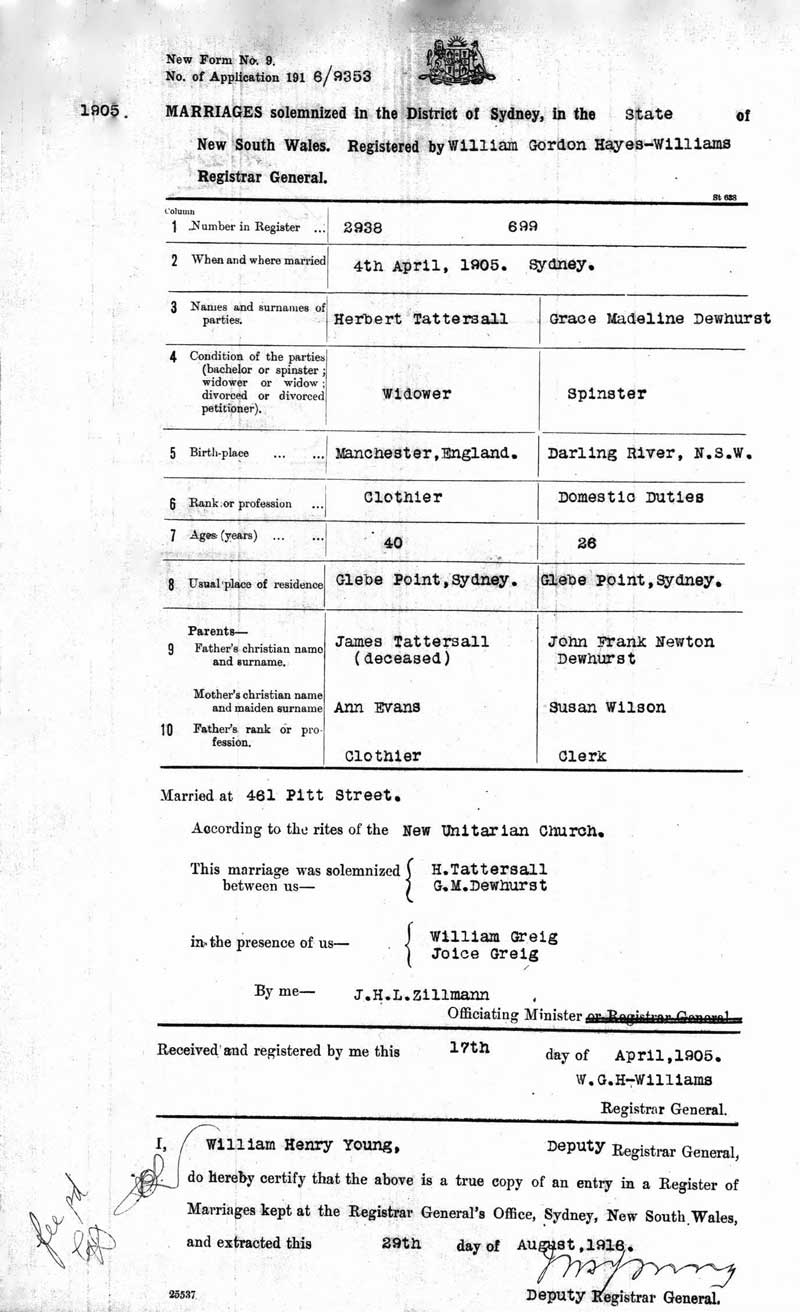
marriage certificate. Photo: Peter de Waal
In the Supreme Court of NSW
Matrimonial Causes Jurisdiction }
No. 499 of 1915
BETWEEN
Grace Madeline Tattersall
Petitioner
and
Herbert Tattersall
Respondent
Monday the thirtieth day of July in th year of our Lord One thousand nine hundred and seventeen.
Upon reading the Decree Nisi made herein on the eighth day of September One thousand nine hundred and sixteen the request in writing of the abovenamed Petitioner that such Decree Nisi should be made absolute and the Affidavit of John Wilkinson Camper sworn on the seventh day of July One thousand nine hundred and seventeen and filed herein as to service of a copy of the said Decree Nisi on the Crown Solicitor And upon reading the Certificate of the Registrar of the Honourable Court filed herein Certifying that no matter in opposition to the final decree is now pending herein. This Court now Order and Gives That the Decree Nisi aforesaid be and the same is hereby made absolute. The marriage of the abovementioned Grace Madeline Tattersall the Petitioner herein with the abovenamed Herbert Tattersall the Respondent herein be and the same is hereby dissolved And it is further ordered and Decreed that the Respondent do pay all the costs of and incidental to the making of this Decree absolute
By the Court
[Signed] Arthur G Saddington
Deputy Registrar
~ ~ ~ ~ ~
Divorce court transcript Fri 8 Sep 1916 10
167
In the Supreme Court
of NSW in Divorce }
Coram: GORDON J.
Wednesday, 6th March,1912.
TATTERSALL V TATTERSALL.
|
PETITIONER: |
Grace Madeline Tattersall. |
|
RESPONDENT: |
Herbert Tattersall. |
|
MR BOYCE |
appeared for the petitioner. |
|
ISSUES: |
1 (as amended) marriage, 4th April 1905. 2 whether the respondent during three years and upwards has been an habitual drunkard, and has habitually left the petitioner without the means of support. 3 whether the respondent during three years and upwards has been an habitual drunkard and has habitually been guilty of cruelty towards the petitioner. |
|
PETITION: |
25th September, 1911. |
|
SERVICE |
Personal affidavit of Mr A McGuffie, dated 17th October 1911. Affidavit of Mr A McGuffie, dated 17th October 1911, of search and no appearance. |
168
(Mr Boyce stated he was proceeding on the third issue).
VICTOR ETHELBERT LUDLOW,
sworn, examined on behalf of petitioner, deposed:
TO MR BOYCE: My name is Victor Ethelbert Ludlow, I am a duly qualified medical practitioner, practising on the Old South Head Road, Waverley. I know petitioner, I have been her family attendant for a number of years. I attended her between 1907 and 1909; in December 1909 I attended her confinement. I attended her in January and March 1910; August, September, October, and November, 1911; and February 12, 1912.
After her confinement I found she was suffering from complete nervous prostration, insomnia, and an irritable heart.
TO HIS HONOR: She was then living at Bondi Road, at respondent’s house.
TO MR BOYCE: I prescribed ordinary sedative medicines. At one time the heart was so bad I thought it was going to develop into a valvular disease, an organic disease. The disease was not in any way anything to do with the childbirth.
VE Ludlow x
169
in October 1911, in addition to those symptoms she had a severe haemorrhage which caused me great anxiety; after the ordinary examination I could trace no womb trouble so I came to the conclusion it must have been caused by the worry, still nervous breakdown. I treated her for that, I kept her in bed for some time and ordered some very strong treatment; I thought it was a dangerous illness, I was very anxious about it. During 1910 and 1911 she was completely prostrated, and had insomnia, and an irritable heart; the irritable heart is brought on by worry. Prior to 1909 she was a very healthy woman.
TO HIS HONOR: When I attended her in the confinement in December 1909 she was a very healthy woman. I had attended her before that for two or three years, she was a very healthy woman, I had attended her for ordinary illnesses, I considered her a healthy woman. I noticed the nervous trouble in March 1910, that became worse, and was very bad in 1911. While passing through the house I saw a gentleman in the room, I did not speak to him; I think I saw him twice when passing through, going upstairs to the bedroom. I never had any conversation with him with reference to the state of the patient’s health. Mrs Brown paid me, that
VE Ludlow x
170
is petitioner’s mother. I asked petitioner what was causing the trouble; apart from what she told me, I did not see anything; she made complaints to me, I told her the worry would have to be removed, it was completely undermining her health. I never saw any signs of physical ill-treatment; I personally saw no ill-treatment of any sort. She frequently told me, when I attended her, that it was the way respondent was carrying on that caused her symptoms.
(Witness retired)
PETITIONER,
sworn, examined by Mr Boyce, deposed:
My name is Grace Madeline Tattersall, I am the wife of Herbert Tattersall. My maiden name was Grace Madeline Dewhurst. We were married on the 4th April, 1905, at Dr Zillman’s private residence in Sydney, according to the rites of the new Unitarian Church.
(Copy Certificate of Marriage put in and marked Exhibit A)
(Order made, amending the date of the marriage as alleged in issue 1, from 4th July 1905 to 4th April 1905, and dispensing with service on respondent of amended petition).
VE Ludlow ret
Petitioner x
171
There is one child of the marriage, Ena Lorell, born on the 17th December, 1909.
Respondent told me he was born at Manchester, England; I think he said he was out here five years before the marriage, he was a tailor. At the time of marriage he said he like Australia, he would not go back again, the climate here agreed with him best. After marriage he lived with me here, he was served here personally; after the filing of the petition he came to my house and threatened me, I had no conversation with him; the first time he came was in July 1911, the second was on the 14th October 1911; he was there again on the 23rd February and the 26th February 1912.
TO HIS HONOR: Since marriage he never spoke of going back to England; he was not a master tailor, he was in employment.
TO MR BOYCE: After marriage we lived in a house supplied by my mother; we lived in various places about Sydney until 1907. In January 1907 we were living in Edward Street, Woollahra, we remained there until October 1907. We then moved to 137 Bondi Road, Bondi, we remained there until September 1909, then we moved to 129A Bondi Road, Bondi;
Petitioner x
172
I’m still living there, that is my mother’s house. Respondent never made a home for me. At Edward Street, he was always in a muddled condition when he came home at night.
TO HIS HONOR: He was working for Gowing Brothers then.
TO MR BOYCE: He had every Wednesday afternoon off, he would get drunk then and on Saturday morning. I should say he got drunk about twice a week at Edward Street. He had to be brought home twice. The police were not called in at Edward Street.
At 137 Bondi Road he got considerably worse, he was always in a drunken muddled state when he came home, which was about 8 or half past 8 at night; our tea hour was half past six for seven, he would complain because we had not waited for him.
TO HIS HONOR: He was working for Gowing Brothers at that time.
TO MR BOYCE: He was drunk mostly on Wednesday afternoon and Sunday. After he came home he would go out, and would return about eleven or twelve at night. In the morning his head was on one side of the room, and chairs would be on the other side
Petitioner x
173
of the room tumbled over, he would stumble coming upstairs, he would make about six attempts to light his candle before he succeeded; that would occur about three or four times a week. The police came in here in July 1908.
I parted from respondent on the 15th February 1911, he left the house; that was at 129 Bondi Road. He was always in the same muddled state, he would not converse with you. After he had his tea he said he was going down to the hotel to get blind drunk.
TO HIS HONOR: He left Gowing Brothers in January 1911.
TO MR BOYCE: I spoke to one of the managers of Gowing Brothers, I only went there once, that was in January or February 1911 before he lost his position.
We kept a servant at Bondi Road, my mother provided the money. Respondent gave me £2-14-0 a week, but he used to keep coming to me for it and if I would not give it to him he would threaten to murder me. My mother paid the rent. I provided some of the food, mother provided some of it.
(Looks at document) That is respondent’s handwriting.
Petitioner x
174
That is the first communication I got from him after he left.
TO HIS HONOR: I do not know where he was when that was written, I got it by post.
(Letter from respondent to petitioner dated 14th August, 1911 put in and marked Exhibit B.)
TO MR BOYCE: (Looks at document) This is the next letter I got.
(Letter from respondent to petitioner, dated 10 September 1911, put in and marked Exhibit C.)
I did not answer that letter, I did not answer any of them. I got two other letters after that, both were received by me during December.
(Two letters from respondent to petitioner, one dated 26 September 1911, and one dated, put in and marked Exhibit D.)
TO HIS HONOR: All our married life we were known as Mr and Mrs Brown; we were married under the name of Tattersall.
TO MR BOYCE: While living in Edward Street, respondent came home one Sunday morning, he divested himself of all his clothes and
Petitioner x
175
rushed about the place, we were managed to get him to bed, then he said I had undressed him. He said we were nothing but a lot of B— B—’s in the house, words to that effect; I cannot remember exactly I was so frightened. He said he was going to cut his own throat.
TO HIS HONOR: He was very drunk, he had had to be helped home. After I got him into bed I brought him in a cup of tea; he then asked me what I had undressed him for. That was at dinner time on a Sunday morning.
TO MR BOYCE: While at Edward Street, respondent and I were going for a trip to the mountains; he went on in such an abusive manner that it made me ill and I had to go to bed; he asked me for money, I had given him his money; he asked me for ten shillings, I had not got it to give him, he said he would murder me where I stood; I ran down into the yard, my mother came after me; then he went to work, we did not go to the mountains. A couple of times he went on like that, the second time I was not quite so frightened, but he was always under the influence. He called me a b----- b----; he said he was going to cut my head off and throw it out in the middle of the road. When
Petitioner x
176
he was sober he was insolent, I did not mind that so long as he did not threaten to kill me.
At 137 Bondi Road, in the early part of 1908, I wanted to get rid of a dog respondent had that was vicious, it used to run out in street and I said it would bite people; he said it was a pity it would not bite me. He said he was going to leave the place, he went upstairs and packed his portmanteau; he came back in the evening and unpacked it and said he did not think he would go that time. Whenever we had words he would say he was going. There were lots of rows like that, what I call quiet rows that was not so frightened about.
In July 1908 he came home on Wednesday afternoon very much under the influence of drink. I said “Go upstairs and I will bring you a cup of tea.” He said “If you bring me a cup of tea I will scald you with it, you b----- b----.” He stayed downstairs, after a while I managed to get him upstairs, he went to sleep. My sister came to see us, it was pouring with rain, she said she would stay the night. We went upstairs to my room, we were getting undressed; I put on my night wrapper, respondent called me; I put my arms round him and asked
Petitioner x
177
him if he would have a cup of tea; he said again if I brought any tea he would throw it over me and scald me. He said, “Lock the door, I am going to do for you, there is going to be a tragedy here to-night.” I ran back to where my sister was, he came in, made a grab at me and fell, then he caught me by the throat. He said, “I will go and get my boots on, I’m going down to get some rum.” When he went out to get his boots we locked the door. He said, “Let me in”. I said, “No, I’m too frightened of you.” He said, “Give me some money, I want to go down to the hotel.” I only had two shillings, I stood on a chair and put it through the fanlight. He said, “That is no good to me, I want ten shillings.” He threw his three pound weight through the fanlight and said, “Take that, I hope it will kill you.” It broke the fanlight, and made a big dent in the floor. He said, “Will you open the door now?” I said, “No, I am too frightened.” He said, “I will go down for the hatchet.” While he was away my sister helped me through the window on to the roof and shut the window down. The roof was wet and slippery, I managed to crawl along to the end of it. I stayed there some time, I knocked at the window of the next house, they let me in, I went down to the street;
Petitioner x
178
it was pouring with rain at the time, my mother and my sister were in the street, there were no police there. Next day I said I would have to leave him, I could not possibly put up with that. I said, “I cannot get up, I will have to stay in bed.” He said he was going to be a teetotaller. That night he came home muddled, but he was not what you would call drunk. The next night he was very drunk, he went on exactly in the same manner, he would take me by the throat, I would scream, and my mother would come up.
In 1908 I could not tell the number of times he took me by the throat, it was so often. I was in bed for a week after the incident on the roof. The police came that night, someone sent them; I told them I thought he was quiet then, I did not tell anyone about it because I wanted to shield him. The next week respondent said married life was not b----- good to him, he wanted to live a bachelor’s life, he did not care about staying where I was, and he thought he would go. From then up to the end of 1908 he was very abusive, and then next day he would say he had not said anything to me. He would throw
Petitioner x
179
everything I put on the table at me, throw his soup plate at me, he would do that about four times a week.
In the beginning of 1909, when I told him I was going to have a child, he said I had better take some very strong drug or go and be operated on; I refused. He got me by the neck and got his razor and drew it across my throat; he said, “You will die, that is the best thing for you, I do not want any children.” I was fearfully frightened. From then, until the child was born, he was always jumping up to frighten me because he said it would bring on a certain event. He used to catch me by the throat; he said he was not going to father any b----- kid. I used to be so sick at that time that I used to go to bed about seven o’clock; he used to go down to the hotel, he would come home very drunk, he would throw his hat on one side of the room, throw the chairs about the room and bang the door. He was so very abusive that I would not have him in my room, he used to drag me out of bed by the hair, that was about five months before the child was born.
TO HIS HONOR: I ceased to occupy the same room with him about a year before that. I was in such a dreadful state of health that I went and saw Dr Ludlow.
Petitioner x
180
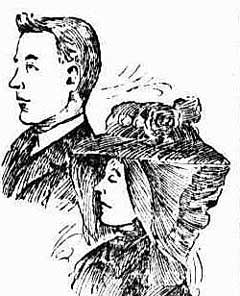
Image: Truth, (Syd, NSW), Sun 10 Mar
1912, p. 6. Reproduction: Peter de Waal
TO MR BOYCE: While I was in bed after the child was born, respondent was always saying I should get up, I had no right to be there. The day after it was born he said he had a good mind to drag me out of bed, and he would dash the child’s brain out. I asked him for a glass of water, he said he would not give me one; I fell back fainting, my sister came up and found me.
Six weeks after the child was born I had it Christened. Respondent said he would be waiting outside Saint Matthias’ Church for me, when I got there he was not there; I had to go by myself. When I got home I was telling them about the Christening; he said, “Anyone would think you were a b----- Jesus, I do not want any b---- - Jesuses here, I will dash the child’s brain out.” I went to the cot to get the child. Respondent said, “I can just as well bash your brains or the child’s brains out downstairs as well as up, so you need not run.” I said, “I’m not able to run”; I sat down on the top of the stairs.
In March the same thing went on, the police came in; Constable Morrow came in; Constable Ford came in and stayed with me until respondent’s brother came. Respondent came in on a Wednesday afternoon, it was pouring with rain;
Petitioner x
181
he asked me why I had not been out to see about some business in town, I said I was not able to go. He asked me where my mother was, I said she was in the kitchen. He said, “Answer me properly, you are not a b----- Jesus.” I said, “I am answering you properly, Ma is in the kitchen.” I was frightened, I got the baby out of the cot and went towards the street; he followed me, he picked up a chair and said, “I will murder you where you stand.” I went out into the street, my mother followed me, he came after me, then he ran back and slammed the door. The child was scantily clad, it was cold and raining. We went back to the door, it was closed, we heard a crash; when we went in we found the dining room had been wrecked, he had broken everything that had been on the table, butter, sugar, cups and saucers, and everything, were on the floor. I brought Constable Morrow in and let him see them. Constable Morrow stayed with me, then Constable Ford came; I went and rang up respondent’s brother, the brother came out as soon as he could, I showed him what respondent had done. He went upstairs, respondent was lying on the bed; he asked respondent what provocation he had for doing what he had done downstairs; respondent said, “None whatever, Grace
Petitioner x
182
is the best in the world.” The brother said, “Very well, it is you or me for it”; they closed, and the brother gave him a hiding. Next morning respondent said if I brought his brother out again he would do for the brother too he was going to buy a revolver; he said the Kensington murder would be nothing to it, he was going to paint Bondi red. At that time he had counterfeit himself with the broken crockery, and when he went upstairs he pulled the clothes off the bed and spattered the blood about the wall. I showed Constable Morrow the state of the room.
The next time the police came in was in July 1910, it was a strange policeman from Waverley, I do not know his name. Respondent was inside threatening to break and smash everything, he said there was going to be a tragedy there, he would not be satisfied until he had done for me and the baby, he was not going to keep any more, he had quite enough to do to keep me. I was so frightened I went out in the street, his eyes were like coming out of his head, they were like balls of blood. I called the policeman, he said he could not do anything; respondent was quiet then.
Constable Morrow came again on 8 hour day because
Petitioner x
183
of the way respondent was going on. Respondent came home at 9 o’clock very drunk, I was giving the baby a drink; he said, “Get me my dinner.” I said, “It is 8 o’clock, it will take some time to get dinner ready, I thought you were just going to have a light tea.” My mother started to get the tea, I was sitting down giving the baby a drink. He said, “I do not want her to get it, I want you to get it.” I said, “I cannot, I am giving the baby a drink, she is getting it, what is the difference?” He went and sat down for a while. My father was there; respondent said, “What are you making such a fuss about, what b----- right have you got here?” I said, “I will go and see if I can find a policeman.” When I went towards the door respondent caught me by the back of the neck, he said he was going to murder me where I stood and the b----- baby. He caught me by the throat, my mother and father rushed forward; Constable Morrow came in and told him he had better to go away and stay away until he was sober. Respondent went upstairs and packed his things, he went away that night and stayed away a fortnight. When he came back he had not a penny. He wrote me all the sorts of plausible letters while he was away and I believed them. I told him
Petitioner x
184
he had better come back if he was going to behave himself. After that he did not do anything serious, except that he pulled me out of bed a couple of times, until January 1911.
In January 1911 a letter came for him, it was open, it was a circular. When he came home I told him there was a letter for him; he said, “What did you open it for?” I said, “It was only a circular.” He said, “You have no b---- - business to open my letters, there’s going to be a tragedy here to-night, you are not going to escape me this time.” I ran out and found Constable Morrow, when he came in respondent quietened down. Respondent caught me by the back of the neck that time and shook me, he dragged the baby out of my arms.
In the same month (January 1911) he woke me up at 6 o’clock in the morning and asked me would I go down to Manly with him, I said I could not, I felt very ill. He said he would drag me out of bed. I said, “You need not do that, I will get out; what do you want me to do?” He said, “I want you to come down to Manly.” I said, “I cannot go, you go and get dressed and we will see afterwards.” He came back dressed, he said, “Look here, I’m going to break everything in this b----- room, you may as well say
Petitioner x
185
your prayers, I will give you five minutes to say your prayers.” He picked up a chair and went to hit me, I shoved him hard. He said, “This is no b----- good to me, I will go down and get the axe.” I locked the door, I looked through the window and saw Constable Stokes, I motioned to him, he cam in. As soon as respondent came up with the axe in his hand and saw Constable Stokes was there, he went back and put it down. He came up and said, “There is a b----- policeman down there, I will not do you any harm, let me in.” I opened the door and let him in, then he went down and spoke to Constable Stokes.
On the 10th February I had a servant named Alice Gowan. Respondent was out of work at that time, he came home and said he was desperate, he could not get anything to do, everyone had blackguarded him all over the town; he locked the door and said, “Now I am going to do for you and the b----- baby where you are, there is no more about it, there has been a Kensington tragedy, and there is going to be a Bondi tragedy, I do not value my own life and I’m going to do for the whole lot of you.” I was frightened, I went out and brought Constable Morrow in; respondent said he had not said anything, he denied what he
Petitioner x
186
had said. The girl was present, she said, “You know very well you said you would.” I brought respondent’s brother out again, the brother said he thought respondent had better go away out of that and he would pay for his board somewhere. He went on the 15th February; on the night before he had the DTs very badly, and made me ill through the noise he made, he howled like a native dog. He got twelve rum flasks and threw them through the window; we were down in the yard, he nearly hit me with one.
TO HIS HONOR: Respondent’s brother took him away on the 15th February.
TO MR BOYCE: When I was married I weighed 10 stone, I weigh 7 stone 7 pounds now.
TO HIS HONOR: The doctor attended me for the first time about 1907, for nerve trouble over the eye; he said I must have had some worry, I did not tell the doctor then.
TO MR BOYCE: In 1910 I was under the doctor.
On the 14th October 1911 respondent came to the door and nearly banged the door in.
TO HIS HONOR: I did not live with respondent after the 15th February 1911
Petitioner x
187
TO MR BOYCE: Respondent came to the house in July 1911, he banged at the door, he was fearfully drunk; we did not let him in. He came again in October, he was fearfully drunk; he kept calling out that if he got in he would do for the lot of us. We did not let him in; I went to bed the next week, and the doctor attended me.
Constable Morrow is in Bondi.
The photograph marked Annexure A attached to the affidavit of A McGuffie of the 17th October, 1911, is a photograph of respondent.
(Witness retired)
EDWARD STOKES,
sworn, examined on behalf of petitioner, deposed:
TO MR BOYCE: My name is Edward Stokes, I am a First Class Constable stationed at Waverley. I know petitioner and respondent, I know they used to live at 131 Bondi Road.
TO HIS HONOR: I knew them about two years.
Petitioner ret
E Stokes x
188
TO MR BOYCE: I have known respondent to be addicted to drink, I have seen him on several occasions when he has been under the influence. I have seen him on several occasions down at the Bondi tram terminus on Sunday morning with two others like himself who were fond of drink. I have seen them there with flasks of spirits, the three of them more or less under the influence. I have seen him on weekdays occasionally.
TO HIS HONOR: I was stationed at Waverley before he came out. It must be eighteen months ago that I first noticed him. The first twelve months I knew him I saw him drink about ten times, that would be mostly on Sunday; on other occasions I saw him about 10 o’clock at night, he would be pretty well under the influence.
TO MR BOYCE: I have gone to the house on several occasions in consequence of what petitioner told me. On one occasion she called me in; she was at an upstairs window; I went into the shop down below, in consequence of what her mother told me, I remained there about a quarter of an hour. Respondent came in, he walked up and down, he started at me; he said “Are you here on duty?” I said, “Yes.”
E Stokes x
189
he said, “How long are you going to stay here?” I said, “I could not tell you.” He went back to the dining room after that; then I had another conversation with Mrs Dewhurst, and I went out on the footpath. Respondent was very excited, and I believe he had drink.
TO HIS HONOR: That was in January 1911.
TO MR BOYCE: In consequence of what I was told, I have kept a close eye on the place on several occasions. Petitioner seemed very frightened; respondent seemed to be on the bluff, very dominant and aggressive. I would take him to be a very bad-tempered man, erratic. Constable Morrow is on night duty now.
(Witness retired)
ALICE GOWAN,
sworn, examined on behalf of petitioner, deposed:
TO MR BOYCE: My name is Alice Gowan, I am a domestic in the employment of petitioner at 129 Bondi Road; I went there on the 11th of January, 1911, I am still there. I remember the day
E Stokes ret
A Gowan x
190
respondent left the house, it was the 15th February 1911. On the 11th January respondent had the DTs, he was very boisterous, he was howling like a native dog all night. In the morning when he got up he looked very vicious, he danced the chairs around the table when he came downstairs; Mrs Dewhurst and myself were there, petitioner was upstairs.
TO HIS HONOR: Anyone upstairs could hear the noise.
TO MR BOYCE: On the 10th February he came home very drunk, he was abusing petitioner; he said there was going to be a tragedy there that night worse than the Kensington mystery, he would paint Bondi red.
TO HIS HONOR: He said he was going to do for the lot of us before the night was out.
TO MR BOYCE: He also threatened to do for petitioner and the baby, he said he would murder them.
TO HIS HONOR: Constable Morrow was called in on the 10th February.
TO MR BOYCE: No-one else came. I know respondent’s brother, I do not remember if he came.
A Gowan x
191
Constable Stokes was called in to the shop some time in January.
TO HIS HONOR: It was about a week or a fortnight after I went there.
TO MR BOYCE: Respondent came home very drunk, he asked petitioner if she would go to Manly; she said she had too much to do, she had the baby to attend to and she would not go. He went down the yard, got the hatchet, and came up and said he would smash her and the home up. Constable Stokes came into the shop, respondent heard the constable and went and put the hatchet down in the yard.
TO HIS HONOR: I saw respondent with the axe, he went down the yard and brought it up inside; when he heard Constable Stokes he took it back again.
TO MR BOYCE: He did not bring it in in front of the constable, he put it down as soon as he heard him.
After respondent went away from the house, he came back again some time in February; I saw him at the door trying to get in, petitioner was inside; he was under the influence of drink, he was trying to unlock the door. Between February and October 1911 he was there several times
A Gowan x
192
walking up and down outside and trying to get in; he looked to be under the influence of drink, and very wild.
TO HIS HONOR: On the 14th October he came to the house trying to get in, petitioner would not let him in.
On one occasion in January 1911 respondent caught petitioner by the neck and threatened to choke her if she did not give him money, he wanted to go to the hotel and get drink; that is the only time I saw him put his hand on her.
TO HIS HONOR: She was terribly frightened of him, she used to tremble if he came near her. After the 14th February she was in bed a week, Dr Ludlow attended her.
(Witness retired)
Image: Truth, (Syd, NSW), Sun 10 Mar
1912, p. 6. Reproduction: Peter de Waal
SUSAN WOODFORD DEWHURST,
sworn, examined on behalf of petitioner, deposed:
TO MR BOYCE: My name is Susan Woodford Dewhurst, I am petitioner’s mother; I have resided with petitioner and respondent during their married life; I have found the home, the rent, and most of the food; I paid the servant.
A Gowan ret
SW Dewhurst x
193
while in Edward Street respondent was intoxicated, he was not drinking so very much then but still he was drinking a lot. I never noticed how often he got drunk; he is very fond of drink, he is always under the influence of drink. I could not say how many times he was drunk during that year, it was very often indeed.
During the next two years he got worse. There is a letter here in which he says he has become a hopeless wreck through drink; I agree with that. As far as I can remember, I never saw him sober at night; we were afraid of him. In 1909 and 1910 he got worse.
The year before respondent came to Bondi Road he was very unkind to petitioner, I do not remember any particular incident. His general conduct was very bad, he was discontented, dissatisfied, saying it was nothing but bed and work.
TO HIS HONOR: stripped himself of all his clothes on Sunday, then he called me and asked me who had done it; he said petitioner had done it. I said, “She never did anything of the kind, a man brought you here intoxicated and put you on the bed and you made use of the most abusive language and told me to give the man money.”
SW Dewhurst x
194
TO MR BOYCE: While in Edward Street he would say he would go away, and for two pins he would wring her neck.
In 1908, in Bondi Road, he asked me to take over everything I had to petitioner; I said I would not. He said he would employ a solicitor to make me. I said, “You cannot do it.” After that he was very nasty and disagreeable to me.
Just before the American Fleet arrived he attacked petitioner with a hatchet, he said he would kill her with it if she let him in; he was very much intoxicated, and very abusive to her and to me. He went to bed, he woke up and called her, he threw a piece of iron through the fanlight; he called her first and said she was to lock the door and to give him the key and she would see what he would do to her. It was a wet, cold, windy night. I tried to persuade him not to do it, then I went into the street; I next saw petitioner on the roof, she got through the window.
TO HIS HONOR: She was just getting ready for bed when this happened; she came down to me in the street.
TO MR BOYCE: Then we went back to the house; I made him a cup of
SW Dewhurst x
195
tea and put a pinch of soda in it, that seemed to sober him.
He smashed everything in the dining room after locking us outside; that was in March, about two years ago. Everything was laid for the tea, he had us locked outside; he asked me were we coming in to have tea at the usual time; I said “Yes.” He said, “You come inside and shake hands with me.” I said, “No, thank you.” He chased the girl, he said he would cut her heart and liver out; he was very drunk. When I got inside everything was pulled down and broken to pieces upstairs and down, the bed was pulled to pieces, the basinet was upside down, and blood over the wall where he had cut his fingers. He had pulled everything off the dining table, jam, butter, and everything; I left them on the floor till the constable came. Respondent’s brother came and gave him a thrashing.
The day the baby was born he was very cruel to petitioner, he made a noise, he was drunk. Before the baby was born he was very cruel.
TO HIS HONOR: I heard him saying he did not want a child; before that he said she could not get a child, she was a “barren joey”.
SW Dewhurst x
196
TO MR BOYCE: I know Constable Ford, I remember him coming in the time respondent broke the things.
I know Constable Morrow, he was there on Eight Hour Day. Respondent came home at 8 o’clock, the girl was out; he asked me for his dinner. I said, “I could not give you any dinner but I will get you something to eat.” I prepared him something quickly, he went upstairs, he came down again and said he would not eat it because petitioner had not prepared it. Petitioner came down; I heard him saying to her “I will knock you down and kill you and the b----- baby where you stand.” I called Constable Morrow in, I said respondent was drunk; he said “He has had too much to drink but he can stand, he has had a lot because he has been down at the beach all day.” The constable persuaded him to go away, he went away and he was away a fortnight. After respondent came back he was pretty decent for a week, then he launched out again, knocking the furniture about and abusing petitioner.
A circular came, I heard him abusing petitioner over it, he said very nasty things, he was intoxicated.
Constable Morrow came in altogether about three or four times.
SW Dewhurst x
197
I remember the Christening of the baby; he came to me and told me he would fire me out of the place; he said he would kill petitioner, she was telling him about the Christening; he said, “She must think she is a b----- Jesus.”
I remember when Constable Stokes came, it was in the morning. Respondent said he was going to smash everything and make a wreck of petitioner’s room; he came up out of the yard with a hatchet in his hand, he could see Stokes talking to me; he put the hatchet down when he saw Stokes and came forward in a very mild manner and spoke to him.
When petitioner married respondent she was in perfect health, she weighed about 10 stones; I noticed she was ill soon after marriage.
TO HIS HONOR: In December 1909, when the child was born, she was in a bad state; a month before the child was born she was weak generally.
TO MR BOYCE: She has been in a delicate state of health ever since they have been married.
I have no memory of any dates because I never put
SW Dewhurst x
198
them down.
TO HIS HONOR: The first time after marriage that petitioner was attended by a medical man was in Brisbane Street; only Dr Ludlow has attended her, that was in Brisbane Street, a long time before the child was born.
(Witness retired.)
LOUISA CLUBB,
sworn, examined on behalf of petitioner, deposed:
TO MR BOYCE: My name is Louisa Clubb, I am the wife of Charles Clubb, and sister of petitioner’s; at present I am staying with my mother.
TO HIS HONOR: I was married before petitioner.
TO MR BOYCE: I remember when we were living in Brisbane Street, I think that was in 1907.
TO HIS HONOR: In 1907 they were living in Brisbane Street, and in Edward Street; they were only a short while in Brisbane Street.
SW Dewhurst ret
L Clubb x
199
TO MR BOYCE: At that time I was living at Coogee, I did not see much of them in that year. I would not say respondent was very drunk in that year, I saw him under the influence of liquor on several occasions, he was not so very bad then.
During 1908 I saw him very bad indeed, I saw him a very great number of times. I used to go over to my mother’s place twice a week and sometimes three times.
I remember one particular incident; respondent was home when I got there, I saw him when he came to petitioner’s room, she persuaded him to go to his room, he was in a frightful condition of intoxication.
TO HIS HONOR: That was about July 1908.
TO MR BOYCE: We got him out of the room and locked the door. He came and demanded money, he said he was going to get terribly drunk; that was said through the door, we were locked inside. Petitioner threw in two shillings through the fanlight; he wanted us to open the door, we said we would not, he said he would go down and get the hatchet and open the door. While he was away petitioner got out of the window on to the roof, it was raining.
L Clubb x
200
TO HIS HONOR: Petitioner was frightened of him.
TO MR BOYCE: Respondent threw a weight of some sort through the fanlight, the fanlight was broken.
I can remember a date in 1911, I can remember one in 1910, I cannot remember dates prior to that. On several occasions when I was there, they had to lock themselves in before respondent came home at night; that extended over a period of two or three years.
TO HIS HONOR: I have heard respondent speak to petitioner about the child, but not before it was born.
TO MR BOYCE: I have heard respondent say he would bash the child’s brains out and bash her brains out where she stood; that was while the child was very young.
I remember after the Christening petitioner said something about the service; respondent said he did not want to know anything about the service, he said something about the baby, I heard him move forward, then I heard her crying. I heard him say something but I could not tell what it was.
I remember one afternoon when he came home from
L Clubb x
201
business, he brought home a bottle of schnapps; when I went to bed he called me in and asked me to give him some, he said, “I am very ill”. I said, “You had better have a hospital nurse, because we cannot nurse anyone here.” After tea he was shouting and yelling in two or three different voices, that was when petitioner was in bed with the baby.
TO HIS HONOR: Petitioner’s health was in a terrible state; I am sure there was no other cause except the worry.
(Witness retired)
(Decision reserved)
L Clubb ret
~ ~ ~ ~ ~
The Sydney Morning Herald, Sat 9 Sep 1916 11
DIVORCE COURT.
(Before Mr Justice Gordon.)
…
(Before Mr Justice Harvey.)
Tattersall v. Tattersall
Grace Madeline Tattersall (formerly Dewhurst) sought divorce from Herbert Tattersall, on the ground of desertion. The parties were married at Sydney in April, 1905. Mr JM Sanders, instructed by Mr PM Sanders, appeared for the petitioner. A decree nisi was granted.
~ ~ ~ ~ ~
The Sydney Morning Herald, Tue 31 Jul 1917 12
DIVORCE COURT.
(Before Mr Justice Gordon.)
His Honor pronounced absolute the decrees in the following suits:—
…
Grace Madeline Tattersall v Herbert Tattersall,
Herbert Tattersall, 1929
Goulburn Evening Penny Post, Fri 14 Jun 1929 13
SORDID STORY
——✦——
Assaults on Boys
———
THREE YEARS’ PENAL SERVITUDE
———
Disgusting behaviour against schoolboys at Canberra, was the allegation made by the Crown at the Goulburn Quarter Sessions [before Justice Coyle] this morning, when Herbert Tattersall was charged with having committed an indecent assault on a male person at Canberra on May 2 and May 14.
Image: NAA 3560, 5684. Reproduction: Peter de Waal
It was alleged by Captain PV Storkey, VC, who appeared for the Crown, that Tattersall, who lived at the Capitol Hill Mess 14 at Canberra, was in the habit of inviting schoolboys to his hut where he committed the assault, afterwards giving them money for allowing him to do so.
Mr NA Jenkyns, instructed by HWY Deane of Queanbeyan, appeared for Tattersall.
The boy [Clifford McDonald] mentioned in the charge, who is 12 years of age, told the court of his visits to Tattersall’s hut on May 2 and May 14. On both occasions he was with another boy. Tattersall was dressed in his pyjamas and beckoned the boys over, ultimately behaving indecently towards them. He afterwards gave them sixpence each. On May 14, they again visited Tattersall’s hut and were both assaulted by Tattersall, who again gave them further money.
Asked by Mr Jenkyns how it was that he was sure as to the date of the first assault, the boy said he remembered it because May 2 was written on the blackboard at school. He had not told his mother or father about Tattersall’s behaviour until he was asked about it.
Cross examined by Mr Jenkyns, the other boy, who gave similar evidence regarding Tattersall’s behaviour, said he had suggested to boys at the school that they might get their names in “Beckett’s Budget”. 15 It was suggested that they might do so by implicating Tattersall in a charge of assault.
Sergeant Shepherd told of his interview with Tattersall at the Capitol Hill Mess. When questioned regarding the charges, Tattersall made no reply. The boy mentioned in the charge was brought in and said Tattersall was the man who had committed the offence.
Asked by Mr Jenkyns how May 2 was arrived at as the date of the first offence, Sergeant Shepherd said the boys had told him it was 10 or 12 days previous to the second assault.
ACCUSED’S STATEMENT
In a statement from the dock, [Herbert] Tattersall made a denial of the charge. He admitted that the boys frequently went to his room, where they used to romp about and “made themselves a general nuisance around the place.”
He worked at night and the boys prevented him from sleeping. They used to go there before school, and in order to get rid of them, he used to give them money.
Nothing indecent was ever done, and the first time any suggestion of indecency was made was when Sergeant Shepherd came to the mess and questioned him.
In his address to the jury, Mr Jenkyns said certain newspapers published in Sydney were responsible for more than half the charges which were levelled at innocent men.
Mr Jenkyns told the jury that they could not consider seriously the evidence as put forward by these two boys, one of whom admitted that he had talked with other boys about getting his name into “Beckett’s Budget”.
Commenting on Mr Jenkyns’ suggestion, Judge Coyle said, if this was the case and the boys had deliberately made a charge against Tattersall to get their names into a paper in connection with an affair with disgusting details such as these, their crime would be far worse than the one of which Tattersall was charged. Having seen the witnesses in the box it was for the jury to decide whether that had been their motive.
The jury retired at 1.15 to consider its verdict.
TATTERSALL SENTENCED
After lunch the jury brought in a verdict of guilty, and Tattersall was sentenced to three years’ penal servitude.
In appealing for clemency, Tattersall promised that in the event of him being sent to gaol he would return to society on his discharge, and would not again descend into the gutter.
Judge Coyle reminded Tattersall that by his dreadful act he had deprived the boys of their chance in society. Accused had been guilty of a dreadful crime, and he would be failing in his duty if he did not sentence him to three years’ penal servitude.
~ ~ ~ ~ ~
The Sun, Sat 15 Jun 1929 16
THREE YEARS FOR INDECENCY
Goulburn Friday.—At the Quarter Sessions yesterday Herbert Tattersall was sentenced by Judge Coyle to three years’ penal servitude for indecently assaulting a 12-year-old boy at Canberra.
~ ~ ~ ~ ~
The Sydney Morning Herald, Wed 19 Jun 1929 17
QUARTER SESSIONS.
…
Goulburn, Tuesday.
At the Goulburn Quarter Sessions Henry Wallace, charged with a serious offence against a girl under the age of 16 years, was acquitted by the jury. In his address to the jury Judge Coyle said that the facts that had been testified to in this case “must leave Britons by no means proud of the conditions in which some of our race live.”
Herbert Tattersall, charged with serious offences against two school-boys, at Canberra, was convicted, and sentenced to imprisonment for three years.
~ ~ ~ ~ ~
Herbert Tattersall, Gaol photo sheet 18
![SRNSW: NRS2327, [3/5992], Maitland Gaol Photograph description sheets, 1875-1930, No. 2118, p. 91, R5132.](../../images/trials/1929-Tattersall-5992-gaol-photo-2118.jpg "SRNSW: NRS2327, [3/5992], Maitland Gaol Photograph description sheets, 1875-1930, No. 2118, p. 91, R5132.") |
Gaol Photo Sheet - Transcribed Details
No. 2118
Maitland
Date when Portrait was taken: 11-9-1929
Name: Herbert Tattersall
|
Native place: England Year of birth: 13-1-1886 Arrived Ship: ------ Trade or occupation Religion: C of E Education, degree of: R&W Height: 5' 4" Weight On committal: 142 Colour of hair: Fair Colour of eyes: Blue |
Marks or special features: |
|
(No. of previous Portrait ... ) CONVICTIONS |
|||||
| Where and When | Offence. | Sentence | |||
|
Queanbeyan PC Goulburn Q.S |
28 14 |
5 6 |
1929 1929 |
Stealing Indecent assault on a male person |
£2.3.6. or 21 days H.L. 3 years P.S. |
1 Evening News, (Sydney, NSW), Wed 6 Mar 1912, p. 7. Emphasis added.
2 NSW BDM, registration number: 2938/1905.
3 The Sun, (Sydney, NSW), Wed 6 Mar 1912, p. 8. Emphasis added.
4 The Sydney Morning Herald, Thu 7 Mar 1912, p. 6. Emphasis added.
5 Ena Lorrell Tattersall Browne. NSW BDM, registration number: 10151/1910.
6 Truth, (Syd, NSW), Sun 10 Mar 1912, p. 6. Emphasis in original and added.
7 The Sydney Morning Herald, Thu 21 Mar 1912, p. 5.
8 The Sydney Morning Herald, Wed 10 Jul 1912, p. 7.
9 SRNSW: NRS13495, [13/12853], Divorce and matrimonial cause case papers, No. 499, 1915.
10 SRNSW: NRS2713, [6/2737], Transcripts of evidence of the various courts, royal commissions, boards of inquiry, 1916, pp. 167-201.
11 The Sydney Morning Herald, Sat 9 Sep 1916, p. 9.
12 The Sydney Morning Herald, Tue 31 Jul 1917, p. 4.
13 Goulburn Evening Penny Post, Fri 14 Jun 1929, p. 6. Emphasis in original and added.
14 Capital Hill Mess, now the site of Parliament House, was in 1928 the site of a workers’ camp.
15 Beckett’s Budget (1927-30) continued by Australian Budget were similar to the Truth newspaper.
16 The Sun, (Sydney, NSW), Sat 15 Jun 1929, p. 7.
17 The Sydney Morning Herald, Wed 19 Jun 1929, p. 16. Emphasis added.
18 SRNSW: NRS2327, [3/5992], Maitland Gaol Photograph description sheets, 1875-1930, No. 2118, p. 91, R5132.