Aubrey Sydney Maddocks, 1889
Below also see: Aubrey Sydney Maddocks, 1891,
Aubrey Sydney Maddocks, 1898,
Aubrey Sydney Maddocks, 1905-1910,
Sydney Aubrey Maddocks, 1913,
Sydney Aubrey Maddocks, 1915,
Sydney Aubrey Maddocks, 1921,
Sydney Aubrey Maddocks, 1930,
Sydney Aubrey Maddocks, 1937 – Sodomy
Michael John Gibson, 1948
Government Gazette of the State of NSW, Fri 22 Feb 1889 1
IN BANKRUPTCY
(Notice under Section 11 of the Bankruptcy Act, 1887.)
(899)
In the Supreme Court of New South Wales.
IN BANKRUPTCY.
Re Aubrey S Maddocks.
NOTICE is hereby given that a Sequestration Order has this day been made against the abovenamed Aubrey S Maddocks, of Moore Park Road, clerk.—Dated at Sydney, this 18th day of February, a.d, 1889.
ARTHUR HENRY,
Registrar in Bankruptcy.
3s. 6d.
1750
~ ~ ~ ~ ~
Government Gazette of the State of NSW, Fri 1 Mar 1889 2
IN BANKRUPTCY
(899)
In the Supreme Court of New South Wales.
IN BANKRUPTCY.
Re Aubrey S Maddocks, of Moore Park Road, Sydney, clerk in the Treasury.
NOTICE is hereby given that the Single Meeting of creditors in the above matter will be held at the Court, Chancery-square, Sydney, on the 13th day of March, 1889, at 11 am, or as soon after as the course of business will permit. To entitle a creditor to vote thereat, his proof must be lodged with the Registrar in Bankruptcy, not later than the 9th day of March, 1889,
ARTHUR HENRY
Registrar in Bankruptcy.
Official Asignee—Lancelot Threlkeld Lloyd.
1985
6s.
Aubrey Sydney Maddocks, 1891
The Daily Telegraph, Wed 4 Nov 1891 3
LAW.
———◦———
SUPREME COURT.
Tuesday, November 3.
IN BANCO.—(Before the Chief Justice, Mr Justice Innes and Mr Justice Manning.)
…
IN PROBATE.— (Before Mr Justice Stephen.)
BUCKLEY v. MADDOCKS.
Mr Ferguson appeared for the plaintiff, Ellen Buckley, and Mr Mann for the defendant, John Alfred Maddocks. This matter was the hearing of a dispute in the will of the late Robert Maddocks. It appeared that the testator died on July 26 last, at which time he was living in lodgings at the house of Mrs Buckley, the plaintiff. The will bequeathed everything the testator died possessed of to Mrs Buckley, and the defendant, a brother of deceased and his next of kin, disputed the will on the ground that deceased was continually under the influence of drink immediately prior to making the will and was frequently in bed all day, a copious supply of spirits being constantly kept at his bedside; that he was not in a fit state to make a will and did not understand the provisions of the will. Probate had been applied for and on a caveat lodged by defendant had been refused.
The plaintiff, Ellen Buckley, deposed that deceased gave her instructions to have the will prepared about July 15, when he was very ill. The will was prepared by Mr Newell. She brought it home and deceased signed it in the presence of two witnesses after reading it through. Deceased was frequently the worse for liquor, but was not habitually drunk. She had heard him say that he was a brandy drinker years before. The doctor attending deceased, Dr Rutledge, had told her to send for deceased’s relatives, but she had not done so because he did not want to have them sent for, as he said his nephew would only fleece him.
Aubrey Sydney Maddocks, nephew of testator, deposed that the deceased lived with him for a period of 14 years, during which period the deceased was addicted to drink, consuming as much as three bottles of brandy between Saturday afternoon and Monday morning. While at Mrs Buckley’s deceased, when seen by witness, was generally in bed and in an intoxicated condition. There was always spirits on a chair by the bedside. Deceased complained of having been robbed of a ring at Mrs Buckley’s, and also said Mrs Buckley had promised he should marry her daughter, aud mentioned a widow woman who wanted to marry him.
Thomas Jones stated that when visiting the deceased at Mrs Buckley’s house she had asked him to persuade deceased to make his will in her favor, as it was a shame for the nephew, who never came near him, to have all the money.
The case was not concluded when the Court rose at 4 pm, and stands as part heard being adjourned until noon to-day.
~ ~ ~ ~ ~
The Daily Telegraph, Thu 5 Nov 1891 4
LAW.
———◦———
SUPREME COURT.
IN BANCO.—(Before the Chief Justice, Mr Justice Innes and Mr Justice Manning.)
Wednesday, November 4.
…
IN PROBATE.— (Before Mr Justice Stephen.)
BUCKLEY v. MADDOCKS.
Mr Ferguson appeared for the plaintiff, Ellen Buckley, and Mr Mann for the defendant, John Alfred Maddocks. This matter which stood as part heard, was a dispute with regard to the will of the late Robert Maddocks. The will bequeathed the deceased’s property to Mrs Buckley, with whom he was lodging at the time of his death, and the defendant, a brother of deceased and his next of kin, disputed the will on the grounds that deceased was continually under the influence of drink immediately prior to making the will, and was frequently in bed all day, a copious supply of spirits being constantly kept at his bedside; that he was not in a fit state to make a will, and did not understand the provisions of the will. Probate had been appIied for, and on a caveat lodged by defendant had been refused.
Further evidence having been taken, the counsel for the plaintiff addressed the Court, but the counsel for the defence had not concluded his remarks when the court rose at 4 pm until 2 pm to-day.
~ ~ ~ ~ ~
The Daily Telegraph, Fri 6 Nov 1891 5
LAW.
———◦———
SUPREME COURT.
Thursday, November 5.
IN BANCO.—(Before the Chief Justice, Mr Justice Innes and Mr Justice Manning.)
…
IN ECCLESIASTICAL JURISDICTION.— (Before Mr Justice Stephen.)
Probates.
…
BUCKLEY v. MADDOCKS. (PART HEARD).
Mr Ferguson for Plaintiff, Ellen Buckley; Mr Mann for defendant, John Alfred Maddocks.
This was a case in which the will of the late Robert Maddocks was disputed. The facts of the case have already been fully stated.
Council having concluded their addresses, his Honor reserved judgment.
~ ~ ~ ~ ~
Evening News, Mon 16 Nov 1891 6
A PROBATE SUIT.
————
His Honor Mr Justice Stephen on Saturday delivered his reserved judgment in the probate suit of Ellen Buckley v. John Allen Maddocks. The facts as set out in the statement of claim were that on July 26 of the present year Robert Cattle Maddocks, of Paddington, died, leaving to the plaintiff, with whom he had lodged, all his real and personal estate. Plaintiff subsequently gave notice of her intention, as sole executrix of the will, to apply for probate, but the defendant lodged a caveat against the application. The defendant, a brother of the testator, stated that at the death of the latter’s wife he (the testator) went to live in lodgings. He had resided with the plaintiff, and towards the end of his life defendant had been informed that he (the testator) frequently remained in bed incapable of rational conversation, and with a full supply of drink at his bedside. Defendant contended that at the time of making the alleged will the testator was not of sound and disposing mind, and further that the document had been obtained by the undue influence of plaintiff and others with her. He, therefore, asked that the application for probate should be dismissed, with costs. After reviewing all the circumstances connected with the evidence, and considering the authorities bearing upon the matter, his Honor came to the conclusion that, notwithstanding some conflicting evidence by the plaintiff’s witnesses, the decision would have to be in favor of the plaintiff, and he decreed accordingly, the defendant’s costs to be paid out of the estate.
Aubrey Sydney Maddocks, 1898
Evening News, Thu 22 Sep 1898 7
NEWCASTLE NEEDS.
————
…
Aubrey Sydney Maddocks was committed for trial at the Water Police Court to-day by Mr Addison, SM, on a charge of wilfully and corruptly making and subscribing a false declaration before J Gregg, a justice of the peace, of the colony of New South Wales.
~ ~ ~ ~ ~
The Sydney Morning Herald, Fri 23 Sep 1898 8
POLICE COURTS.
———◦———
…
Alleged False Declaration.—At the Water Police Court yesterday, before Mr GWF Addison, SM, Aubrey S Maddocks, a pensioner, was charged with having given and subscribed to a false declaration with regard to a certain sum of money alleged to be payable to him on presentation of a voucher.
Geo H Smith deposed that accused obtained from him on loan the sum of £6-8s-7d, for which he agreed to pay £1 as interest. Prosecutor was afterwards given a voucher by the accused, who stated he was entitled to a pension of £7-8s-7d per month.
Smith presented the voucher at the Treasury but was informed that the pension had been assigned, and on examination it was found to be mortgaged for some length of time. The accused was committed for trial.
~ ~ ~ ~ ~
The Sydney Morning Herald, Fri 7 Oct 1898 9
LAW NOTICES.
…
SYDNEY QUARTER SESSIONS.—Friday,
Patrick Butler, William Warren, William Slattery, and Luke Hayes, common assault; George King, burglary, Aubrey Sydney Maddocks, false pretences.
~ ~ ~ ~ ~
The Australian Star, Tue 11 Oct 1898 10
A MORTGAGED PENSION.
———◦———
An Ex-Civil Servant Sentenced.
————
Aubrey Sydney Maddocks, who yesterday pleaded guilty to a charge of obtaining a sum of money from George Henry Smith by falsely declaring that there was no encumbrance whatever upon a pension due to him from the Treasury, was brought up at the Quarter Sessions this morning for sentence, before Judge Coffey.
His Honor: said that taking into consideration all the circumstances of the case, the snallness of the amount, and his previous good character, he would sentence him to six months’ hard labour.
Mr Bourke, who appeared for the accused, asked that he be given the benefit of the First Offenders Act.
His Honor: I cannot, seeing that he made a false declaration. He might have been charged with that.
Mr Bourke: said that the accused had been advised that his pension could not be transferred to anyone, and therefore that being so there was actually no lien on the pension at all.
His Honor: If that is so he is not guilty, and should be acquitted. Why, then, did he plead guilty?
Mr Bourke: That would hardly have been an honest defence, I thought.
His Honor: said he would allow Mr Bourke to see the prisoner, and if he could put any further facts before him to show that the accused had been misled he would allow him to make a further application.
…
PLEADED GUILTY.
———◦———
Aubrey Sydney Maddocks, a retrenched civil servant, pleaded guilty at the Quarter Sessions to-day to a charge of having on February 8, 1898, falsely pretended to George Henry Smith that there was no charge or encumbrance of any kind upon the monthly instalment of a pension due to him on March 2 at the Colonial Treasury, and by that means obtained a sum of £6-8s-7d.
Mr Bourke, who appeared on behalf of the accused, asked—in view of evidence given as to his character, his 16 years’ public service, and his straitened circumstances—that he be brought under the provisions of the First Offenders Act. His Honor said he would look at the depositions, and remanded the accused till to-morrow morning for sentence.
~ ~ ~ ~ ~
Evening News, Tue 11 Oct 1898 11
A MORTGAGED PENSION.
————
AN EX-CIVIL SERVANT
Sentenced.
————
Aubrey Sydney Maddocks, who pleaded guilty at the Darlinghurst Sessions yesterday to a charge of having, in February last, obtained the sum of £6-8s-7d from George Henry Smith by falsely pretending that the monthly payments in connection with a pension to which he was entitled from the Treasury was unencumbered, was brought up for sentence to-day. His Honor, stated that under all the circumstances he would pass a lenient sentence, and ordered the accused to be imprisoned with hard labor for six months.
Accused’s counsel asked for the suspension of the sentence under the First Offenders Act. He said that accused had been advised that his pension could not be transferred, so that in reality it was not mortgaged when he obtained the money from Smith.
His Honor: If that was so he should have pleaded not guilty.
Mr Bourke: We thought that hardly an honest defence to set up.
His Honor said he would not alter the sentence at present, but he would allow Mr Bourke to consult his client, and if any fresh facts were ascertained he could bring them under his notice at a future time.
~ ~ ~ ~ ~
The Sydney Morning Herald, Tue 11 Oct 1898 12
METROPOLITAN QUARTER
SESSIONS.
(Before Judge Coffey.)
Mr WL Merewether was Crown Prosecutor.
…
PLEAS OF GUILTY.
Aubrey Sydney Maddocks, a pensioner, formerly employed in the Treasury, pleaded guilty to having on February 8 obtained £6-8s-7d, the property of Emma Powell, from George Henry Smith, by false pretences with intent to defraud.
Mr Bourke appeared for the prisoner, and asked his Honor to extend to Maddocks the provisions of the First Offenders Act. His Honor promised to read the depositions.
~ ~ ~ ~ ~
Western Grazier, Wed 12 Oct 1898 13
TELEGRAPHIC NEWS
———◦———
…
An Ex-Civil Servant in Trouble.
————
Sydney, Tuesday.
Aubrey Sydney Maddocks, an ex-Civil Servant, has been sentenced to six months hard labor for making a false declaration.
Aubrey Sydney Maddocks, 1905-1910
Government Gazette of the State of NSW, Fri 12 May 1905 14
In the Supreme Court of New South Wales.
IN BANKRUPTCY.
NOTICE is hereby given that the Single Meeting of creditors in the following matter will be held at the Court, Citizens’ Chambers, Moore-street, Sydney, on the 24th day of May, 1905, at 11 am, or as soon after as the course of business will permit. To entitle a creditor to vote thereat, his proof must be lodged with the Registrar in Bankruptcy not later than the 20th day of May, 1905.
Re Aubrey Sydney Maddocks (No. 16,524), of Windsor Cottage, View-Street, Woollahra.
ARTHUR HENRY,
Registrar in Bankruptcy.
Official Assignee—William Harrington Palmer.
3634
6s.
~ ~ ~ ~ ~
Government Gazette of the State of NSW, Wed 1 Dec 1909 15
PROMOTIONS.
…
Chief Secretary’s Department.
HIS Excellency the Governor, with the advice of the Executive Council, and upon the recommendation of the Public Service Board, has approved of the promotions of the undermentioned officers of the Chief Secretary’s Department, in consequence of the retirement of Mr CI Callachor:—
Messrs H Deering, HW Johnson, RC Scott, SB Bailey, FK Lomas, WP Browne, and AS Maddocks.
WH WOOD.
~ ~ ~ ~ ~
Government Gazette of the State of NSW, Wed 16 Feb 1910 16
PROMOTIONS.
Chief Secretary’s Department.
HIS Excellency the Governor, with the advice of the Executive Council, and upon the recommendation of the Public Service Board, has approved, in pursuance of the provisions of section 49 of the “Public Service Act, 1902,” of the promotions of the undermentioned officers in the Chief Secretary’s Department, consequent on the resignation of Mr HA Herborn, Clerk, Chief Secretary’s Department:—
Mr SB Bailey, Mr HJ Peir, Mr AS Maddocks, and Mr SL Anderson.
…
WH WOOD.
Sydney Aubrey Maddocks, 1913
Government Gazette of the State of NSW, Wed 23 Apr 1913 17
CHANGE OF NAME.
I, SYDNEY AUBREY MADDOCKS, of the Chief Secretary’s Office, Sydney, public servant, hereby notify for general information that whereas my birth is registered in the name of Aubrey Sydney Maddocks, and whereas I am more generally known in the name of Sydney Aubrey Maddocks, I now elect to be known in future solely by the latter name.
S A MADDOCKS.
Sydney, 21st April, 1913.
3797
4s.
Sydney Aubrey Maddocks, 1915
The Sydney Morning Herald, Sat 25 Dec 1915 18
MARRIAGES.
…
MADDOCKS—CAMPBELL.—December 1, 1915, at St Paul’s Church, Rothbury, by the Rev Canon Withey, Sydney Aubrey Maddocks, of Manly, to Hilda Evelyn, daughter of GA Campbell, of Rothbury.
Sydney Aubrey Maddocks, 1921
The Sydney Morning Herald, Thu 10 Feb 1921 19
POLICE SECRETARY.
———◦———
MR MADDOCKS APPOINTED.
———
The appointment of Mr SA Maddocks to the secretaryship of the Police Department in succession to Mr McCall, retired, has been confirmed by the Executive Council. Mr Maddocks, who during Mr DR McCall’s term of office was assistant secretary, studied law, and afterwards joined the Public Service, in which he has filled many important posts, including that of secretary of the Aborigines’ Protection Board, clerk to the Executive Council, and secretary to the Lord Howe Island Board of Control. For a number of years he was connected with the Chief Secretary’s Department.
Sydney Aubrey Maddocks, 1930
Government Gazette of the State of NSW, Fri 11 Jul 1930 20
(6997)
Local Government Department,
11th July, 1930.
HIS Excellency the Governor, with the Advice of the Executive Council, has approved of the appointment of Mr Sydney Aubrey Maddocks, LLB, as Commissioner of Road Transport,—commencing on the 1st July, 1930.
MICHAEL F BRUXNER,
Minister for Local Government.
Sydney Aubrey Maddocks, 1937 21
Auckland Star (Auckland, NZ), Mon 24 Aug 1936 22
STOWAWAY ON MARIPOSA.
————
TO BE RETURNED TO SYDNEY
Arrested on Saturday morning when the Mariposa arrived from Sydney, Mikiel John Adam Petersen, [see below: Newcastle Morning Herald and Miners’ Advocate, Fri 9 Apr 1937, p. 12] aged 18, appeared in the Police Court this morning, charged with stowing away on the ship at Sydney on August 19, and further with landing in New Zealand without a permit.
He pleaded guilty to the first charge. In reference to the second charge, Petersen said he never had time to obtain a permit. “I suppose I’m guilty,” he added.
The Collector of Customs, Mr J McIntosh, who prosecuted on the second charge, said Petersen had no money or ticket. Mr McIntosh asked that Petersen should be sent back to Sydney by the next steamer, which would leave in a fortnight’s time. He did not ask for a penalty.
Mr Wyvern Wilson, SM, convicted Petersen without fine on the first charge, and ordered that he be detained in prison until his removal from New Zealand. Petersen was convicted and discharged for landing in New Zealand without a permit.
~ ~ ~ ~ ~
Evening Post (Wellington, NZ), Mon 24 Aug 1936 23
STOWAWAY FROM SYDNEY
(By Telegraph.—Press Association.)
Auckland, This Day.
Arrested on Saturday, on the arrival of the Mariposa from Sydney, Mikiel John Adam Petersen, aged 18, was charged in the Police Court today with stowing away at Sydney, and also with landing in New Zealand without a permit. Mr Wyvern Wilson, SM, convicted the accused without a fine, and ordered his detention in prison until his removal from New Zealand.
~ ~ ~ ~ ~
The Muswellbrook Chronicle, Tue 2 Mar 1937 24
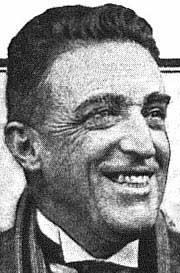
Truth, (Syd, NSW), Sun 18 Apr 1937,
p. 1. Reproduction: Peter de Waal
COMMISSIONER FOR ROAD
TRANSPORT SUSPENDED
———◦———
ACTION BY SPECIAL MEETING OF EXECUTIVE
COUNCIL.
POLICE COURT CHARGE AGAINST SA MADDOCKS.
Sydney, Tuesday.
The Commissioner for Road Transport, Mr SA Maddocks, was to-day suspended from duty by the Executive Council. The Chief Traffic Manager, Mr CN Neale, was appointed to act as Commissioner until further notice.
The Minister for Transport (Mr Bruxner) discussed the position last night with the Premier (Mr Stevens) and a special meeting of the Executive Council was convened for to-day, presided over by the Lieutenant-Governor (Sir Phillip Street).
————————
At the Central Police Court later, Sydney Aubrey Maddocks (56) was charged with having at North Sydney on March 1 indecently assaulted Michael John Robertson [sic].
Sergeant Magnay, police prosecutor, applied for an adjournment until 16th March. He said substantial bail had been fixed and the police would be satisfied with that.
The Magistrate then remanded the defendant on bail of £400.
~ ~ ~ ~ ~
NSW Executive Council Minute, Tue 2 Mar 1937 25
EXECUTIVE COUNCIL MEETING.
At Government House.
SPECIAL – Tuesday, the 2nd March, 1937.
|
Present: |
His Excellency the Lieutenant-Governor, presiding. |
The Lieutenat [sic] Governor Laid Before Council Minute Papers by the Hon Minister for Transport, Recommending,
Suspension of Mr Sydney Aubrey Maddocks from his position of Commissioner for Road Transport and Tramways, and the appointment of Mr Charles Norman Neale as his Deputy.
Council then adjourned.
[Signed] LA Roble
Clerk of the Council.
Council met a short time later and confirmed the above minute.
Council then adjourned.
[Signed] LA Roble
Clerk of the Council.
~ ~ ~ ~ ~
The Daily Telegraph, Wed 3 Mar 1937 26
(Syd, NSW), Sun 15 Aug 1937, p. 1.
Reproduction: Peter de Waal
TRAFFIC
CHIEF
SUSPENDED
————
SPECIAL MEETING
OF EXECUTIVE
The Commissioner for Road Transport (Mr SA Maddocks) was suspended from duty yesterday.
Mr CN Neale was appointed Acting-Commissioner.
This action was taken at a special meeting of the Executive Council.
Mr Neale is Chief Traffic Manager.
The meeting, at which the Lieutenant-Governor (Sir Philp Street) presided, followed discussions between the Premier (Mr Stevens), the Minister for Transport (Mr Bruxner), and the Attorney-General (Mr Manning).
Mr Maddocks has been a public servant since 1901.
Formerly, he was secretary to the Police Department.
He was sent abroad by the Government to study transport and traffic problems.
On his return, he submitted a report on his investigations.
————
INDECENT ASSAULT
CHARGE
————
BAIL FIXED AT £500
Sydney Aubrey Maddocks, 56, civil servant, was charged at Central Police Court yesterday with having, on March 1, indecently assaulted Michael John Peterson at North Sydney.
Mr Moffitt, for Maddocks, raised no objection to a remand until March 16, sought by the police.
Sergeant Magney [sic] said Maddocks had found substantial bail the previous night, and the police would like that bail maintained.
Mr Reed, SM: What was the amount?
Sergeant Magney: £500.
Mr Reed: I will fix the same bail. The case is adjourned until March 16.
~ ~ ~ ~ ~
The Sydney Morning Herald, Wed 3 Mar 1937 27
MR SA MADDOCKS.
———◦———
SUSPENDED FROM OFFICE.
————
TRANSPORT COMMISSIONER.
———
The Premier (Mr Stevens) announced yesterday that at a meeting of the Executive Council it had been decided to suspend from duty the Commissioner for Road and Transport (Mr SA Maddocks).
Mr Stevens added that during the period of suspension the Chief Traffic Manager (Mr CN Neale) would take over the duties of the Commissioner.
————
CHARGE OF ASSAULT.
——
At the Central Police Court yesterday, Sydney Aubrey Maddocks, 56, Public servant, was charged with having indecently assaulted Michael John Peterson at North Sydney on March 1.
On the application of the police prosecutor (Sergeant Magnay), the case was adjourned until March 16.
Mr Moffitt (instructed by Osborne M Allen), who appeared for the defendant, consented to the adjournment.
The police prosecutor asked that substantial bail should be imposed, and Mr Reed, SM, fixed bail at £500.
~ ~ ~ ~ ~
Truth, Sun 7 Mar 1937 28
DRAMATIC SUSPENSION
Mr Maddocks
———◦———
GOVERNMENT TAKES
ACTION
———
INDECENCY IS
CHARGED
The Commissioner for Road Transport, Sydney Aubrey Maddocks, was suspended from his office on Tuesday morning after he had appeared at the Central Police Court on a serious charge.
It is understood that on the previous night the Commissioner of Police, the Premier, the Attorney-General, and the Minister for Transport had held a conference at the Criminal Investigation Department.
At about 2 o’clock in the morning, Maddocks was taken into the charge room at the lock-up where he stood in the dock. The formal charge was read over to him.
Then his finger-prints were taken. Bail was fixed at £500. A well-known city barrister provided the bail, and Maddocks was permitted to leave.
Maddocks, who is 56 years of age, has had a splendidly successful career in the public service, which he joined in 1901. His first big appointment came when he became secretary to the Police Department, one of the most confidential and onerous offices in the State.
In this position Maddocks’ ability was widely recognised, and it is only a few years ago that it was suggested that he should be appointed as Commissioner of police. He had had no actual police experience. The Secretaryship of Police is a Public Service position. But the knowledge he had gained of police work would have overcome this difficulty, it was suggested.
It was in 1932 that he was appointed as Commissioner of Road Transport. A special Act of Parliament was passed to give him his appointment, and there was some astonishment when he received the princely salary of £2500.
Maddocks has been virtually the dictator of Sydney’s traffic, and he has made additions to the law by the now common practice of laying regulations upon the table of Parliament. They then become law and are as binding and as insurmountable as if they had been actually passed by Parliament.
One of Maddocks’ latest proposals was an increase in the number of taxicab licenses.
Maddocks has had two tours abroad. Only last year he returned from a journey around the world, in which he examined traffic problems. He has submitted a report to the Government of his impressions and opinions.
On Tuesday morning—following the unusual happenings at the CIB on the previous night—a meeting of the Executive Council was called. The Lieutenant-Governor (Sir Philip Street) presided, and after a brief sitting it was announced that the Executive Council had decided to suspend Maddocks. The Chief Traffic Manager (Mr CN Neale) automatically took over the post.
The powers given by statue in relation to the Commissioner enable the Executive Council to suspend him, but the Transport Act stipulates that within 7 days of opening of the next Session of Parliament the Minister for Transport must lay on the table of the House a full statement of the grounds of suspension.
Thereupon Parliament and the Government can act in whichever way they may choose.
COURT PROCEEDINGS
When the name of Sydney Aubrey Maddocks was called at the Central Police Court on Tuesday, Maddocks rose from where he had been seated with Detective-sergeant Thompson and Detective Gordon.
He walked across the court room and stood beside the dock.
The charge that on March 1 he had indecently assaulted a male person named Michael John Peterson, at North Sydney, was then read over to him.
The Police Prosecutor (Sergeant Magnay) immediately asked for a fortnight’s remand to March 16.
Mr Moffitt (instructed by Osborne M Allen) raised no objection to this course.
Sergeant Magnay said that the accused man had found substantial bail on the previous night and the police would like the same bail to be imposed by the court.
Mr Reed, SM: What was the amount?
Sergeant Magnay: Bail was fixed at £500.
Mr Reed: Very well, I will fix the same bail. The case was adjourned until March 16.
~ ~ ~ ~ ~
The Bulletin, Wed 10 Mar 1937 29
POLITICAL POINTS
…
The NSW Government has suspended its Road Transport Commissioner, who has to answer a police prosecution. It may have a legal right to suspend him, but he cannot be dismissed except by resolution of both Houses.
~ ~ ~ ~ ~
Truth, Sun 14 Mar 1937 30
MADDOCKS AND HIS
SUSPENSION
———◦———
QUESTION OF POWER OF THE
GOVERNMENT
A Knotty legal problem may arise from the recent suspension from office of Mr Sydney Aubrey Maddocks, the Commissioner for Transport.
It may be a question whether the Government had the power to suspend Mr Maddocks in the manner it did.
(Syd, NSW), Sun 11 Apr 1937,
p. 21. Reproduction: Peter de Waal
Mr WJ Curtis, KC, with him Mr WH Moffitt (instructed by Osborne M Allen) have been retained on behalf of Mr Maddocks.
Under the Transport Act Mr Maddocks was appointed to control tramways and road transport for a period of seven years. His salary was fixed at the high figure of £2,500 and there was power to grant him additional fees and allowances.
His powers, authority, duties and functions were very wide and amounted, in fact, to a dictatorship of road transport.
An important legal aspect is created by section 9 of the Act which preserves the rights of the Commissioner under various Acts of Parliament and also preserves his superannuation fund and pension rights upon his ceasing to hold office … “otherwise than for misbehavior or incompetence.”
Except when removed from office for “misbehavior or incompetence,” the Transport Commissioner, whoever he might be, is entitled to receive “any payment, pension or gratuity as if he were an officer within the meaning of the Act under which the fund or account to which his contribution have been made is administered.”
Section 11 of the Transport Act declares that the Commissioner for Transport can be suspended from his office by the Governor for misbehavior for incompetence but the section insists that within seven days, if Parliament is in session; or, if Parliament is not in session, within seven days of the commencement of the new session, the Minister must lay before Parliament a “full statement of the grounds of suspension.”
~ ~ ~ ~ ~
Barrier Miner, Tue 16 Mar 1937 31
MADDOCKS FOR TRIAL
——————
INDECENT ASSAULT
ALLEGED
————
POLICE STORY OF
RAID ON CAR
Sydney, Tuesday.
SYDNEY Aubrey Maddocks (56), former Commissioner for Road Transport, was committed for trial at the Central Police Court to-day on a charge of having at North Sydney on March 1 indecently assaulted McKiel [sic] John Adams. The police stated that Adams, a houseboy now unemployed, had given his age as 18.
The court was crowded, and many prominent citizens, including members of Parliament, were present when the case was called on before Mr Stevenson, SM.
Detective-Sergeant Wharton Thompson, of the CIB, said that about 6.30 pm on March 1, he was in a motor car with Detective Gordon in George-street, near Market-street.
Witness said he saw defendant and a youth named Adams walk across the intersection of Market and George streets towards York-street. Gordon and witness followed in a car, and witness saw Maddocks and the boy walk into York-street and get into a car, the number of which was noted. It was parked in York-street near Queen Victoria buildings.
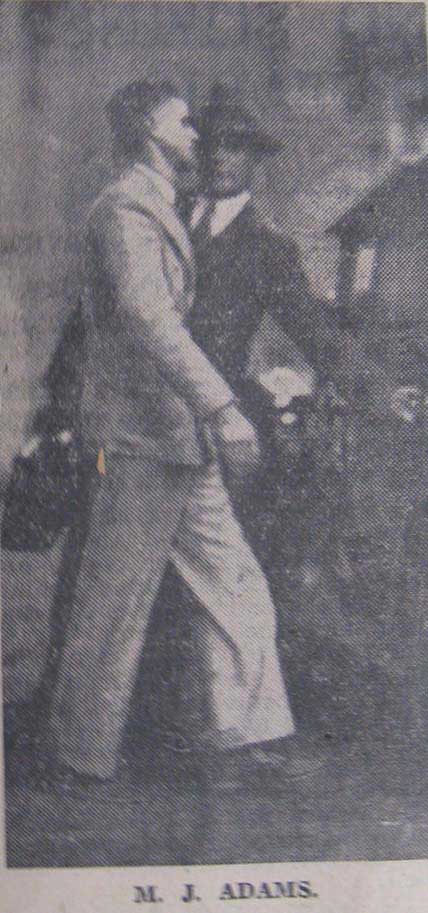
Telegraph, Sat 10 Apr 1937, p.1.
Reproduction: Peter de Waal
After a minute or two, said witness, Maddocks drove towards Druitt-street, where the car was lost sight of in the traffic.
Gordon and witness then joined Detectives Eddie and Summers, and all drove to Warraroon-road, Lane Cove.
“We all alighted from the car and made a search of the bush in the vicinity,” said witness.
“On a bush track off the road I saw the sedan car with the lights out and almost obscured by the scrub. A little later I gave the other officers certain instructions and we walked to a bend in the bush tracks and then all ran to the car.
“HAVING A FEW DRINKS”
“I went to the nearside rear door, opened it, and flashed my torch inside.”
Witness then detailed what he saw. He said to Maddocks, “What are you doing here?”
“We were having a few drinks,” Maddocks is alleged to have replied.
Witness added that when he reminded Maddocks of what he had seen, Maddocks replied: “Thompson, this means the end of everything. Can’t something be done. I have been drinking all the afternoon.”
“I said: No. Get dressed,” said Detective Thompson. “You are going to the Commissioner of Police. We have had complaints about you.”
While Maddocks was dressing, said Thompson, he (witness) made a thorough examination of the inside of the car, and saw that the front seat had been removed and placed on the floor at the back of the car. In an attache case he found two bottles of beer.
~ ~ ~ ~ ~
Register of Criminal Cases Tried At Sydney Quarter Sessions 32
|
Case No. |
Name of Accused. |
Offence. |
Date of committal. |
Court of committal. |
|||||
|
275 |
Sydney Aubrey Maddocks |
1) Attempt to commit Buggery |
16-3-1937 |
Central Police |
|||||
|
Court to which Committed. |
Date of Trial. |
Verdict. |
Sentence. |
Witnesses. |
Chairman. |
||||
|
Sydney Quarter Sessions |
April 8th |
Guilty to both counts |
To be imprisoned with hard labour for a period of eighteen months on each count concurrent |
Sgt Thompson |
[Acting Judge] Hill |
||||
~ ~ ~ ~ ~
Newcastle Morning Herald and Miners’ Advocate, Wed 17 Mar 1937 33
FOR TRIAL
———◦———
PADDOCKS COMMITTED
———
CHARGE OF ASSAULT
———
YOUTH DECLINES TO GIVE
DETAILS
———
Sydney, Tuesday.
The Central Police Court was filled today when Sydney Aubrey Maddocks, 56, public servant, was committed for trial on a charge of having indecently assaulted Mikiel John Adams, at North Sydney, on March 1.
When the case began, many prominent citizens, including public servants, members of Parliament, and clergymen were seated in the public section.
It was stated by the police that the youth had given his age as 18 years.
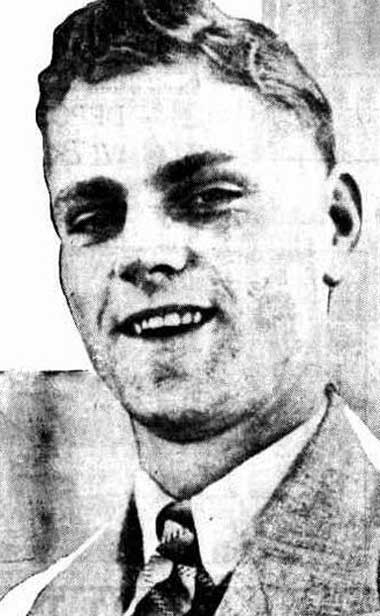
Image: Truth, (Syd, NSW), Sun 4 Apr
1937, p. 19. Reproduction: Peter de Waal
Detective-Sergeant Thompson told how he discovered Maddocks and the youth in a car at Lane Cove. He said he told Maddocks that the police had received complaints about him. Maddocks, he alleged, said that something might be done about the matter, since he had been drinking all the afternoon, and that the only reason they were at the spot was because they had been having a drinks together.
After corroborative evidence had been given by Detective Gordon, Mikiel Adams, who said he sometimes assumed the name of Peterson, entered the witness-box. He said he arranged a meeting with Maddocks, and that he had purchased beer and had dinner with Maddocks in the city.
When asked to give details of what had happened after they had arrived at Lane Cove, Adams declined to answer. He said, however, that while in the car he and Maddocks drank two bottles of beer.
Mr Curtis, KC, who appeared with Mr Moffitt for Maddocks, said that in view of the fact that the witness claimed statutory privilege, he would reserve his cross-examination.
Maddocks, who pleaded “Not guilty,” reserved his defence. Bail was fixed at £500.
~ ~ ~ ~ ~
Northern Star, Wed 17 Mar 1937 34
MADDOCKS FOR TRIAL
————
POLICE STATEMENT
Sydney, Tuesday.
The Central Police Court was uncomfortably filled by the public to-day, when Sydney Aubrey Maddocks (56), public servant, was committed for trial on a charge of indecently assaulting Mikiel John Adams at North Sydney on March 1. It was stated by the police that the boy had given his age as 18 years.
Detective-Sergeant Thompson gave evidence of surprising Maddocks and the youth in a car at Lane Cock, and after detailing what he saw, said he told Maddocks that the police had received complaints about him.
After corroborative evidence had been given by Detective Gordon Main, the police witness, Mikiel Adams, who said he sometimes assumed the name of Peterson, entered the witness box. He gave evidence of arranging a meeting with Maddocks and stated that he purchased beer and had dinner with Maddocks in the city. When asked to give the details of what happened after they arrived at Lane Cove witness declined to answer. He would say however, that while they were in the car he (Maddocks) consumed two bottles of beer.
Mr Curtis, KC, who appeared with Mr Moffitt for Maddocks, stated that in view of the fact that witness claimed a statutory privilege, he would reserve his cross-examination.
Maddocks, who pleaded not guilty, reserved his defence. Bail was fixed at £500.
~ ~ ~ ~ ~
The Sydney Morning Herald, Wed 17 Mar 1937 35
SA MADDOCKS.
———◦———
SUSPENDED TRANSPORT
COMMISSIONER.
———
COMMITTED FOR TRIAL.
———
At the Central Police Court yesterday, Sydney Aubrey Maddocks, 56, Commissioner for Transport (temporarily suspended), was committed for trial on a charge of having, on March 1, indecently assaulted Mikiel Jon Adams, at North Sydney.
Evidence for the prosecution stated that the defendant had been found with Adams in a car at Lane Cove.
Police stated that Adams had told them he would be 18 on March 9.
At the conclusion of evidence, Maddocks said: I am not guilty, your Worship, and I reserve my defence.
Mr Stevenson, SM, committed Maddocks for trial at the Quarter Sessions on bail of £500.
Mr AW Barry (from the State Crown Law Office) appeared for the prosecution; Mr Curtis, KC, and Mr McButt (instructed by Osborne M Allen) for Maddocks.
~ ~ ~ ~ ~
Truth, Sun 21 Mar 1937 36
MADDOCKS FOR TRIAL
POLICE TELL OF HAPPENINGS
IN MOTOR CAR IN BUSH
———◦———
YOUTH’S STORY OF DINNER AND DRINKS IN CITY
FOLLOWED BY RAID
AN overcrowded courtroom at the Central Police Court on Tuesday morning heard preliminary evidence in the charge brought by the police against the Chief Transport Commissioner, Mr Sydney Aubrey Maddocks, of having allegedly committed an indecent assault upon a youth. Detectives swore that on the evening of March 1 last they had had the Chief Transport Commissioner (who has been suspended from office), and the youth under surveillance, and had followed them to the bushlands at Northwood, where a posse of detectives converged upon a darkened car which Maddocks and his companion occupied. There was a stir in the court when the boy, known as Peterson, said that his correct name was Mikel John Adams. Mr Maddocks sat on the form outside the dock. He was smartly dressed, but appeared to be distressed as the evidence was given. “I am not guilty!” he said, in a firm voice, at the conclusion of the hearing, when Mr Stevenson, SM, committed him to stand his trial at the Quarter Sessions commencing on April 1 next.
Mr AW BARRY conducted the case for the Crown, Mr WJ Curtis, KC, with him Mr WH Moffitt (instructed by Osborne M Allen) appeared for the defence.
In the public gallery there was only one woman.
Detective-sergeant Wharton Thompson, chief of the Drug Bureau of the Criminal Investigation Department was the first witness.
Thompson said … “At about 6.30 pm on the 1st of March 1937, I was in a police motor car with Detective Gordon in George-street, near Market-street. I saw the defendant and a youth named Peterson walk across the intersection of Market and George streets, towards York-street.
“Detective Gordon and I followed in the car and I saw them walk into York-street and get into a sedan motor car Number 218,380, parked in York-street, near the Queen Victoria Building.
“After a minute or two the defendant drove the car towards Druitt-street, where I lost sight of the car in the traffic. Gordon and I then joined Detectives Eddie and Summers, and we drove to Warraroona-road, Lane Cove.
“We alighted from the car and made a search of the bush in the vicinity. In a bush track off the roadway I saw a sedan car being almost obscured by scrub.
RAN TO CAR
“A little later I gave the other officers certain instructions, and we walked along the bush track to a point on the track.
“We all then ran to the car. I went to the near-side rear door, opened it, and flashed a torch inside.”
Witness said he saw the defendant and the youth both naked in the car.
Continuing, Thompson said: “The defendant sat up facing me, and I recognised him I said to him, “Mr Maddocks, what are you doing here in this condition?”
“He said, ‘We were having a few drinks’.”
Thompson said that Maddocks then said: “Mr Thompson, this means the end of everything. Couldn’t something be done. I have been drinking all day.” (Witness quickly) “Drinking all the afternoon, I should say.”
Mr Barry: That is what he said … “Drinking all the afternoon”?—Yes.
Continuing: “I said, ‘Now get dressed, I am going to take you to the Commissioner of Police. We have had complaints about you’.”
Continuing, Thompson said: “Whilst the defendant was dressing I made a thorough examination inside the car. I saw that the front seat had been removed, and placed on the floor at the back of the car. The suit-case produced—or rather, the attache case produced—was under the seat, bringing it about level with the back seat.
In the attache case were two bottles of beer.
Certain other articles were found in the car and tendered as evidence.
DID NOT SPEAK
“We then took the defendant to Police Headquarters at the corner of Phillip and Hunter streets, where he remained until 2 am, when I conveyed him to the Central Police Station and charged him with the present charge,” said Thompson.
“When charged he did not speak.”
Mr Curtis, KC: What time did you take up your position in the car with your brother officer?—It was about 20 minutes to 6.
What time did you leave police headquarters?—A few minutes prior to that. I take it you mean the Detective Office?
Yes. Did you drive straight from the Detective Office to George-street?—Yes.
And were you in the same position right up till 6.30?—Yes.
How long does it take to drive to where you found the car?—I timed that with the speedometer. It is approximately 6 miles from Sydney, and if you drove straight there, it would take about a quarter-of-an-hour.
He told you that he had been drinking all the afternoon. You know from your inquiries that he had been drinking at dinner?—Yes.
And that he had been drinking in the car?—Yes.
May I put it to you fairly that, apart from anything he said he had been doing (and you now know that he had been drinking in the afternoon and in the car) his condition was such that you could see that he had been drinking?—Yes.
Detective-sergeant Thompson (explaining) I would add, you Worship, that when I said that it would take a quarter of an hour to drive there, I meant it you drove straight there. That is, without stopping anywhere else, as we did.
Mr Barry: It is a difficult place to find?
Witness: Very difficult.
And since the occurrence you have had plans made and photographs taken of the locality?—Yes.
Do you produce that plan and the photographs?—Yes. There are 5 photographs and a plan. One of the photographs shows a police car in, approximately, the position of defendant’s car. The plan is certainly a rough sketch showing Warraroona-road, and showing the bush track. It does not show where the car was.
“HAVING A FEW DRINKS”
Mr Barry: It is a rough sketch, not drawn to scale?—That is so.
Mr Curtis : I think that the photographs are sufficient. The plan has observations on it.
Mr Barry: I merely wanted it to be marked for identification, that is all.
Mr Curtis: Very well, I will not object.
Mr Barry: I want to tender the suitcase and other exhibits.
The second witness was Detective [John] Gordon, the second member of the Drug Squad. His evidence exactly corroborated Detective-sergeant Thompson in respect of the observations of the meeting of the defendant and the youth Peterson on the late afternoon of March 1, and then up to the point where the police lost sight of the sedan number 218,380.
Then the drive to Warraroona-road. And then … “About 15 yards from the sedan car we all ran to it. I went too the offside rear door and opened it and flashed the torch inside.
“I went to the other side of the car with Detective-sergeant Thompson. I heard Detective-sergeant Thompson say to him, ‘What are you doing here, Maddocks?’
“The defendant said, ‘Just having a few drinks.’
Witness said he heard Maddocks say; “This will mean the end of everything. Cant’ something be done?”
“Detective-sergeant Thompson said to him, “No. We have had complaints about you, and we are going to take you to the Commissioner of Police.”
AND ATTACHE CASE
“Later I saw the examination of the car made by Detective-sergeant Thompson. The seat was lifted back over the front and underneath was the attache case.
“I later drove the defendant and the youth in defendant’s car to Police Headquarters and later, the following morning about 2 o’clock, to the Central Police Station, where the defendant was charged with the present charge. He made no reply.
Mr Curtis: I think you inadvertently omitted a small part of the conversation. I think the accused said, ‘I have been drinking all the afternoon’?—Yes, I think he did say that.
Do you know the age of Peterson?—The age he has given us is that he was 18 years of age on the 9th of March last.
How long was it from the time the police arrived that the torch was put on the car?—Approximately 10 minutes.
Can you tell us how long the defendant’s car was there before the police car arrived?—I could not say. It would not be more than 20 minutes.
Mr Barry: If your Worship pleases, I have two mor constables, whose evidence is corroborative, but in view of the evidence of the other witnesses I would merely like their names to appear on the depositions. I do not propose to call them. There names are Constables Eddie and Summers.
The magistrate: Very well.
Mr Barry: Call John Adams!
Adams then entered the witness stand. He is tall and well dressed.
Mr Barry: What is your correct name?—The name I have given, Mikel John Adams.
Your occupation?—A houseboy. I am unemployed at present.
You have at times taken the name of Peterson? (Witness nodded his head).
Do you know the defendant, Mr Maddocks?—Yes.
The magistrate: I do not know when you mean to caution this witness.
Mr Barry (inquiringly), at this stage your Worship?
The magistrate: Well, either now or later, on.
Mr Barry: I have no objection.
The magistrate (turning to the witness): You are not obliged to answer any question which in your opinion might tend to incriminate you in this or in any other charge. Do you understand that?—Yes, your Worship.
If you are in any doubt, you can appeal to me and I will give you a ruling—Thank you.
Mr Barry: Do you know the defendant, Maddocks?—Yes.
How long have you known him?—About six months.
Do you know when you first met him?—About the third or fourth week in September.
I want you to take your mind back to the 1st of March. Did you meet the defendant?—Yes.
How did you come to meet him?—By appointment.
By appointment?—I made the appointment with him.
How did you come to make the appointment?—I made it on the telephone. I rang him.
At what number?—At his office number, of course.
You met him where?—At the corner of Market and George streets at about 5.30.
HE HAD FISH
Was anything said when you met him?—Only the usual formalities. I said I had come into town to give him some photographs and I told him I had them with me.
What did he say?—He just asked me where they were.
Anything further said?—Oh I mentioned that he had not his car. He said he had not his own car, but he had got one.
What were his words?—He said, “You rang me at such short notice I never had a car. I got one since.”
Did you give him the photographs?—Not then.
What then?—I walked down Market-street towards Robert’s Hotel.
As you were walking down, did he say anything to you?—He asked me if I would like a drink.
What did you say?—Yes.
Then?—I asked him to have a drink with me. But either he did not want a drink or did not fancy one. I went in alone after he had given me some money. I suggested I should get one bottle.
He gave you some money, did he?—Yes.
How much?—Four shillings.
Did you go into the hotel?—I went in.
Did you have a drink?—No.
Did you buy anything?—I bought one bottle of Guinness’ Stout.
And you came out and met the defendant?—Yes, and we went to the fish-shop next door in Pitt-street for dinner.
Did you open the bottle?—I forgot to get it opened at the hotel. I got a cork-screw off the girl in the fish-shop to get it opened. We had dinner. I had oysters.
What did Maddocks have?—(Haughtily): I think you can ask him that question.
If you know what he had, I would like you to tell me. If you don’t know, you need not answer.—Oh, I think he had fish.
Did you have anything to drink?—Yes, the bottle of stout. The waitress opened it. I mean the girl in the shop.
How long did you remain at dinner?—We remained until we had had the first bottle of stout, and then I went and got another.
IN BACK OF CAR
Did you drink that?—Yes.
Where?—In the same shop.
Who opened it?—The same person. The same girl.
How long did you remain altogether?—Approximately, a half to three-quarters of an hour.
What did you do when you left the fish-shop?—Walked towards Clarence-street with Mr Maddocks. We went to Clarence or York street, I am not sure of the streets about there, and I got into the car with the defendant.
Did you remain long in the car?—(Abruptly): Long enough to start it.
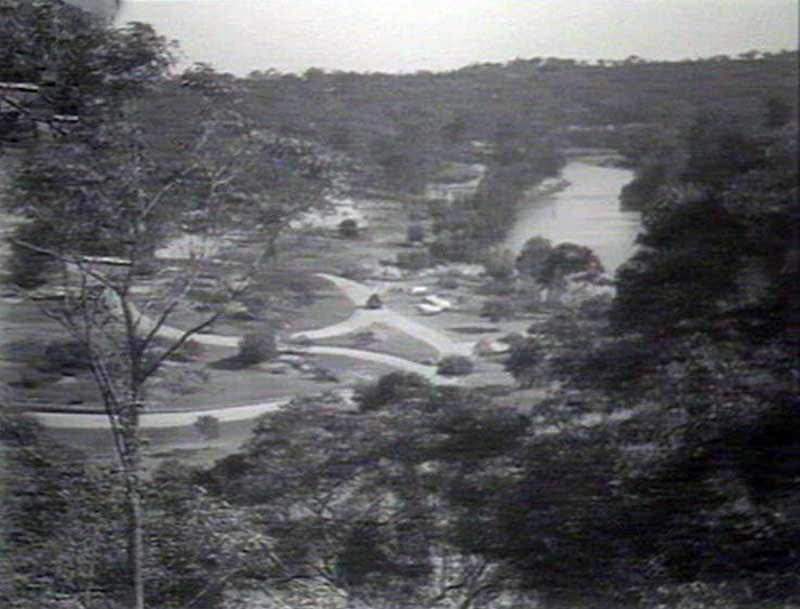
collection. Reproduction: Peter de Waal
You drove away with the defendant?—You’re correct.
Who drove the car?—Why, he did. I can’t drive.
Where did you drive to?—Over Sydney Harbor Bridge.
Where to?—I don’t know what locality. I believe it was Northwood. It is either Northwood, or Lane Cove.
What happened when you got to this place?—I decline to answer that question.
Do you know Detective-sergeant Thompson and Detective Gordon?—Yes.
Did you see them that night at the place where the car pulled up?—I did. I did not see them WHEN the car pulled up. I saw them later in the evening.
How long had you been there when you saw Detective-sergeant Thompson?—Approximately, twenty-five minutes.
Had you been out of the car?—Yes.
And where were you when Detective-sergeant Thompson arrived at the car?—In the back of the car.
Was anyone there with you?—Who stopped the car? He must have. He was there with me.
Who was there?—The defendant.
Will you tell his Worship how you were dressed when Detective-sergeant Thompson arrived?—Would I? I will. I was not dressed, as matter of fact.
Will you tell his Worship how Mr Maddocks was dressed?—(Looking at Mr Maddocks): HE will do that.
Mr Barry: Eh, what was that?
Adams: Maddocks will tell you himself. He was in the same state of dress as I was.
Mr Barry: What position were you in in the car when Detective-sergeant Thompson arrived?
Adams: I also decline to answer that.
Well, do you remember anything that was said when Detective-sergeant Thompson arrived?—Er—we were rather dazed at first. Then I got rather furious, and then defendant said something to Sergeant Thompson.
What subsequently happened to you and defendant?—We were taken to headquarters, where I spent the most uncomfortable six hours and was then transferred to the CIB.
When you were at Northwood, did you have anything to drink?—Yes, a bottle of beer each.
Who purchased that?—I cannot say, definitely, who purchased it. It was in the defendant’s possession. It came out of his suit-case.
GAVE HIM PHOTOS
I was asking you about some photographs. Did you give defendant the photographs you had brought?—Yes.
Where?—At dinner. I gave him two at dinner and one when we were riding over to Lane Cove.
At this stage of the proceedings, when the Deposition Clerk was reading witness’s depositions over to him, he exclaimed, “You have left out something. Where you say, “He had not got his car and then said he had obtained one,” you have left that out. What he said was, that “he had got a car in the meantime.”
Mr Curtis: In view of the fact that the witness takes the protection of the Statute, I do not propose to ask him any questions at this stage. I reserve my cross-examination till another occasion.
This concluded the evidence, and Mr Barry asked permission for Adams, or Peterson, to be allowed to leave the precincts of the court immediately.
This request was granted, and Peterson, in company with Detective-inspector Wickham, was hurried through the side corridor of the court to the Detective Office, where he remained for some time before leaving.
Sydney Aubrey Maddocks was thereupon asked to stand and was formally charged … “That at North Sydney, on March 1, he indecently assaulted a male person, Mikel Jon Adams.”
In firm tones Mr Maddocks said: “I am not guilty. I reserve my defence.”
Mr Stevenson then committed the defendant to take his trial at the next sittings of the Sydney Quarter Sessions on April 1, or such other date as the Attorney-General might determine.
Bail was renewed in the sum of £500.
~ ~ ~ ~ ~
Quarter Sessions court transcript Thu 8 Apr 1937 37
In the Court of Quarter Sessions
Holden At Darlinghurst }
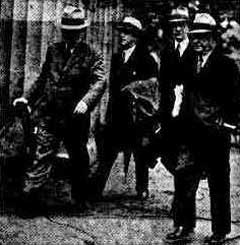
Curtis, KC. Image: The Newcastle Sun, (NSW),
Fri 9 Apr 1937, p. 5. Reproduction: Peter de Waal
BEFORE HIS HONOR ACTING JUDGE HILL
and a Jury of Twelve.
Thursday, 8th April, 1937.
————
REX v. SYDNEY AUBREY MADDOCKS.
|
Charges: |
For that he on the 1st March 1937 at Lane Cove in the State of New South Wales did attempt to commit with Mikiel John Adams the abominable crime of buggery. Further that he on the day in this year and at the place last aforesaid did indecently assault the said Mikiel John Adams, a male person. |
|
Pleas: |
On the first count NOT GUILTY. On the second count NOT GUILTY. |
Mr McKEAN, KC, appeared as Crown Prosecutor
Mr CURTIS, KC with Mr MOFFITT, appeared for the Accused.
——————
(At 12.15 pm the Crown Prosecutor opened to the Jury.)
Mikiel John Adams,
Sworn, examined, deposed:
Crown Prosecutor: Q. What is your name?
A. Mikeal John Adams.
Q. Sometimes you go by the name of Peterson, is that so?
A. That is correct.
Q. And you know the accused?
A. Yes.
Crown Prosecutor: I do not know whether Your Honor at this stage would warn the witness in the ordinary way.
His Honor: Q. You realise you are not compelled to answer any question that you consider on the evidence may appear to have a tendency to incriminate you in any criminal offence. Do you realise that?
A. Yes.
Q. If those circumstances arise, you have a right to refuse to answer any question which may tend to incriminate you in a criminal offence?
A. Thank you, Your Honor.
Crown Prosecutor: Q. How long have you known the accused?
A. Approximately 6 months.
Q. When did you first meet him?
A. I can’t be sure of the date. It was some time in August or September, I think. I can’t answer that
[Page] 1 MJ Adams X. [Examined]
~ ~ ~ ~ ~
definitely.
Q. On the 1st March do you remember meeting him?
A. Yes.
Q. About what time?
A. 5.30.
Q. Had you spoken to him earlier in the day?
A. Yes.
Q. Face to face?
A. No, by telephone.
Q. Where did you telephone from?
A. Liverpool.
Q. Did you speak to the accused yourself?
A. Yes.
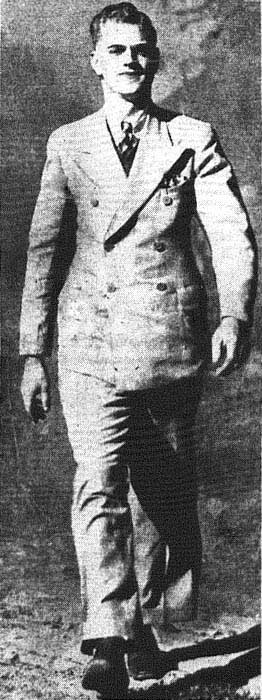
(Syd, NSW), Sun 18 Apr 1937, p. 1.
Reproduction: Peter de Waal
Q. You knew his voice on the phone?
A. I did.
Q. What did you say to him?
A. I always —
Q. Never mind that; what did you say to him; that was the question?
A. I asked if it was him, first, and when I made positively sure that it was him, I said I was coming into town.
Q. Anything further?
A. He asked me what I was coming into town for, and I said I had some photographs of his, which I had to return to Mr Maddocks. I had promised to do so before I rung him up to tell him that I was coming into town to give him his photographs.
Q. What did he say to that?
A. He said that he would meet me, and I said if you will I would go to dinner with him, and he said that he would be honoured or pleased to go to dinner, but he hadn’t a car at the time. He would come over in the boat from Manly and hadn’t his own car, but he would get one out.
Q. Anything further?
A. Just where I was to meet him.
Q. What was said about that?
A. The meeting place was made to be —
His Honor: Q. Try and give his words?
A. He asked me to meet him at Gowing’s corner on the corner of Market and George Streets. He said that he didn’t think he would be there quite on time, as he had to take his son to buy him a cricket bat, but he would be as near to six as possible, and to be there a little earlier.
Crown Prosecutor: Q. And the meeting time was what?
A. 5.30 to 6.
Q. What time did you arrive?
A. 5.30.
Q. Was he there?
A. As I walked towards the corner, he walked towards me.
Q. That was in George St?
A. Market St. I came up Pitt St, and I turned round Robert’s Hotel, and walked up Market St to Gowing’s corner, and he walked from Gowing’s corner down Market St and met me just past the State Theatre.
Q. On the eastern side?
A. Yes.
[Page] 2 MJ Adams X. [Examined]
~ ~ ~ ~ ~
Q. Where did you go from there?
A. We walked from there down toward Robert’s Hotel, and he asked me if I would like a drink. I said Yes, and I asked him would he come in for one too, but he didn’t want to go in for a drink for some reason. It was the first time he refused to go into an hotel —
His Honor: Don’t go into that.
Crown Prosecutor: Q. Confine yourself to what was said?
A. So he gave me 4/-. I suggested that he have a bottle if he didn’t like coming in. So he gave me the money to buy a bottle of Guiness’s stout.
Q. How much did he give you?
A. 4/-.
Q. Did you have a drink?
A. No, I didn’t.
Q. What did you do with the 4/-?
A. I bought the bottle of Guiness’s stout.
Q. And came out?
A. Yes.
Q. Did you rejoin him?
A. No. It had been arranged between us when I went into the hotel that we were going to have dinner next door to Robert’s Hotel, and he was already seated when I walked in with the bottle of stout.
Q. That is some fish place, is it?
A. Yes.
Q. Did you have a meal there?
A. Yes.
Q. What about the bottle of stout?
A. Neither of us had a bottle opener. We called a girl, and she cam and offered to open it for us. I suggested that we have another bottle with the change, and she brought another bottle.
Q. Of Guiness’ stout?
A. Yes.
Q. And you consumed it?
A. Yes, after it had been opened for us.
Q. What time would this be about now?
A. It would be about 6 by the time we finally got in for dinner. It would be well after 6 when we left.
His Honor: Q. Who consumed the stout?
A. We consumed it equally.
Crown Prosecutor: Q. How many glasses did you each have?
A. I can’t tell you how many glasses are in a bottle. I think there are four, or is it three?
Q. What kind of glasses were they; were they something like that one? (Showing tumbler)
A. Yes.
Q. About that size?
A. Yes.
[Page] 3 MJ Adams X. [Examined]
~ ~ ~ ~ ~
Q. About four each?
A. Yes, I should imagine there would be four in a bottle.
Q. You left this restaurant about what time?
A. I am afraid I wasn’t watching the time; I couldn’t state.
Q. About what time?
A. 6.30.
Q. Where did you go from there?
A. He told me that he had got a car and had parked it in York St or Clarence St. I don’t know the streets in Sydney very well. We went down towards the car.
Q. Where was the car parked?
A. The best way I can explain it is that there was a demonstration on in the electrical windows of a washing machine a long time ago. Well, you go straight through there and it was opposite in Clarence St.
Q. You know Market St?
A. Yes.
Q. After leaving the fish shop did you go across George St again?
A. Yes.
Q. In Market St?
A. Yes.
Q. And turned round the first street on the lefthand side?
A. That’s correct.
Q. Going towards the Town Hall?
A. No, we went straight up Market St, and then turned into Clarence St.
Q. To your left?
A. Yes.
Q. And the car was parked where?
A. Half way down the street.
Q. You know where the Town Hall is, don’t you?
A. Yes.
Q. Half way down Clarence St?
A. Yes.
Q. When you got to the car you got in?
A. Yes.
Q. Who was driving?
A. I never drive. I can’t drive.
Q. Who was driving?
A. There was only one other person to drive.
Q. Will you answer the question please?
A. Mr Maddocks.
Q. At that time did he show any signs of drunkenness?
A. Well no, not further than a bit of a bleary face.
Q. Where did he drive the car to?
A. He turned it round and drove down over the Harbour Bridge. I can’t say what street we went down.
Q. I suppose he drove down George St and up York St and over the Harbour Bridge?
A. Yes.
Q. When you got to the toll did he pay anything?
A. No.
Q. What did he do?
A. You have me tricked for a minute, because I can’t remember.
[Page] 4 MJ Adams X. [Examined]
~ ~ ~ ~ ~
Q. If you don’t remember, say so?
A, He didn’t pay, I am almost sure. He tooted his horn.
Q. Did he say anything?
A. No.
Q. Where did you go to?
A. Through North Sydney, and to a locality known, I believe, as Lane Cove.
Q. Have you ever been there before?
A. Yes.
Q. You got to a place at Lane Cove. Would you know it again by a photo?
A. Yes.
Mr Curtis: I have told my friend that I am not raising any objection to the proof of the photograph. He can tender them and show them to the witnesses, if he likes.
Crown Prosecutor: Q. What time was it when you got to this particular place?
A. It must have been after 7.
Q. On 1st March?
A. Yes.
Q. What was the state of the light?
A. What do you mean on the cars?
Q. No, the natural light. It was just edging off day, before it gets dark.
Q. Dusk?
A. Yes.
Q. When you left Clarence St, Sydney, where [sic] the lights of the car switched on?
A. No, I don’t think so.
Q. What about the tail light?
A. I can’t remember about that — yes, it must have been on, because I turned it off.
Q. If you don’t know, say so?
A. It was on.
Q. Who put them on?
A. The defendant.
Q. When you got to this place at Lane Cove — the place is covered with scrub, isn’t it?
A. Yes.
Q. Was anything done with the lights?
A. They were turned off.
Q. Who turned them off?
A. The defendant.
Q. Which lights?
A. Both.
His Honor: What do you mean by both—
Crown Prosecutor: Q. Both the headlights and the tail light.
A. Yes.
Q. Just look at that photo. Do you recognise that place at all?
A. Yes.
Q. Can you show there where the car was?
A. No. The car would be concealed from here. It would go through there, and down a little bit. You might just see the back of the car from there, but you wouldn’t see the whole car.
Q. Round this bend here?
A. Yes.
[Page] 5 MJ Adams X. [Examined]
~ ~ ~ ~ ~
(Photgraph [sic] m.f.1 1)
Q. Do you see where that car is there?
A. Yes.
Q. Do you recognise that place?
A. Yes.
Q. What about that?
A. Coming down here, that is where you would be on the road again.
Q. Does that car convey anything to you at all?
A. It conveys that sometimes our car was that far down, but not always.
Q. Do you see that car there? (Showing another photograph)
A. Yes. That could be seen from the road.
Q. Does that convey anything to you at all?
A. No.
Crown Prosecutor: I will not bother with this witness as far as the photographs are concerned.
Q. You got to this particular place, and you say the accused turned both the headlights and the tail light off?
A. Yes.
Q. What did he do after that?
A. Suggested that we have a drink.
Q. Tell us what was said?
A. He had informed me later in the evening that he had four bottles of beer, and he asked me would I like a bottle.
Q. He told you what?
A. He told me that he had collected four bottles earlier in the day, and asked me if I would like at bottle. I said yes, and he opened the case and took two out, one each.
Q. How many bottles were in the car?
A. Four.
Q. Dinner ale, were they?
A. Yes.
Q. You had a bottle each?
A. Yes.
Q. How did you drink it. Out of the bottle or a glass?
A. Out of the bottle.
His Honor: Q. Did you drink the whole of the bottle?
A. Yes.
Q. Both bottles, one each?
A. Yes.
Crown Prosecutor: Q. What happened after that?
A. We both proceeded to get undressed.
Q. Where were you sitting at the time when you proceeded to get undressed?
A. In the back of the car.
Q. Where was the accused sitting?
A. He was out of the car.
Q. Did you get undressed?
A. Yes.
Q. Wholly?
A. No.
Q. What was left on?
A. My singlet.
[Page] 6 MJ Adams X. [Examined]
~ ~ ~ ~ ~
Q. Did you get undressed in the car itself?
A. Yes.
Q. Did he get undressed?
A. Yes, out of the car.
Q. Wholly?
A. Yes.
Q. What happened after that?
A. The front seat was moved to the back of the car.
His Honor: Q. Who moved the seat?
A. Both of us.
Crown Prosecutor: Q. How was it placed?
A. With a suitcase underneath it, to bring it to the level of the back seat.
Q. How was it placed, diagonally or at right angles to the back seat?
A. I am afraid —
Q. There is the back on the front seat and the back seat?
A. It was placed in one long line.
Q. From corner to corner?
A. Yes, one end near each door.
Q. Each rear door?
A. Yes.
Q. And the suitcase was where?
A. Underneath the front seat that had been put in the back, just in the middle of it, in the middle of the front seat that had been put in the back to raise the back seat.
His Honor: Q. Underneath the front seat to raise it up to the level of the back?
A. Yes.
Crown Prosecutor: Q. The front seat was removed to the back seat, and placed from corner to corner or door to door?
A. Yes.
Q. The suitcase was place underneath the door?
A. Underneath the front seat.
Q. That would be on the nearside rear door?
A. Yes.
Q. The lefthand door; is that it?
A. Yes, because I still don’t understand what you mean.
His Honor: Q. Well don’t answer, unless you do.
Crown Prosecutor: Q. Say what you did with the seat?
A. The back seat was where it always is, and the suitcase was on the floor, and then the front seat was put over the back on top of the suit case.
Q. You know the offside and the near side, the righthand side and the lefthand side of a car?
A. Yes.
Q. One end of the front seat was on the righthand side of the car, and the other end was on the lefthand side of the car?
A. Yes.
Q. And the suitcase was underneath the front seat on the lefthand side of the car?
A. No, it was underneath in the middle.
[Page] 7 MJ Adams X. [Examined
~ ~ ~ ~ ~
Q. Very well. What happened after that?
A. We just —
Q. Tell us what happened, if you please, if anything?
A. Is this one of the questions I can refuse to answer, Your Honor?
His Honor: Yes, I think you are justified in refusing to answer that question.
Crown Prosecutor: Q. Can you tell us what happened after that, or do you decline to answer?
A. Wait a moment, We both proceeded to cuddle up and make whoopee as the saying is.
Q. Say what was done in plain language?
A. I decline to answer that question.
Q. You remember the police arriving don’t you?
A. Yes.
Q. Did anything take place between the time you got into the back seat and the time the police arrived?
A. Exactly what do you mean by anything?
Q. Exactly what I am asking you? —
His Honor: Q. You are being asked — did anything take place, and you have still got the protection I told you about earlier. You can claim that protection if you wish, or you can waive it if you wish. It is entirely for you. You are asked now if anything took place between the time when the seat was placed in the car and when the police arrived?
A. Yes. I got undressed and laid on my stomach in the back seat, and the defendant was on top of me.
Crown Prosecutor: Q. What was done?
A. There wasn’t time for anything to be done; the Police arrived.
Q. How long after that took place, that you lay on your stomach and the accused got on top of you — how long was it between that and the arrival of the police?
A. Three or four minutes.
Weekly, Wed 6 Jan 1954, p. 15.
Reproduction: Peter de Waal
Q. When the accused was on top of you, as you said, was he still undressed?
A. Yes.
Q. And you?
A. Yes.
Q. With the exception of your singlet?
A. Yes.
Q. You spoke about there being four bottles of beer in the car, and you each had one. Was there anything else in the car?
A. Any liquor?
Q. No, anything else at all?
A. No, just the suitcase that the beer was in, and the two jars of vaseline there on the table.
Q. Where did the vaseline come from?
A. One jar was already in the
[Page] 8 MJ Adams X. [Examined]
~ ~ ~ ~ ~
suitcase, and passing through North Sydney the defendant told me that it was nearly empty, and would I mind running over for another bottle. He gave me 6d, and I went over to Washington & Soul’s in North Sydney, and bought another bottle at his request.
Q. Which bottle did you buy?
A. The full one there.
Q. And are these the two bottles of beer?
A. I suppose so.
(Two pots of Vaseline tendered and marked Ex A)
(Two bottles of beer tendered and marked Ex B)
Q. He told you that one pot was rather empty, and asked you to get the other pot. Where did he pull the car up?
A. Right opposite the chemist’s shop. I think there is a post office opposite.
Q. Where was that?
A. In North Sydney, Washington & Soul’s.
Q. Before you lay on the seat on your stomach, as you say, was any use made of the vaselline?
A. Yes, the defendant used the empty jar.
His Honor: Q. Tell us exactly what was done?
A. He placed it on certain parts of himself.
Q. What parts?
A. The parts known as private parts.
Crown Prosecutor: Q. Was any vaseline used on you?
A. No.
Q. Not at all?
A. No.
Q. After you got to this particular place in the scrub, you said the lights were turned out?
A. Yes.
Q. Were they turned on at all between that time and the arrival of the police?
A. I can’t answer that question, I am sorry, I can’t remember.
Q. You remember the police arriving don’t you?
A. Yes.
Q. Do you remember a torch being flashed inside the car?
A. Yes.
Q. Exactly what were you doing then, or what was your position then when the torch was flashed inside the car?
A. The same position as I have just described. I was on the back seat, and —
CROSS EXAMINATION.
Mr Curtis: You remember, of course, giving evidence in the Police Court?
A. Yes.
Q. And you remember also being warned by the Magistrate that you need not answer anything that would inciminate [sic] you?
A. Yes.
Q. Do you remember taking advantage of that warning?
A. Certainly.
Q. And you know, of course, what the warning meant, and that you
[Page] 9 MJ Adams X. [Examined]
~ ~ ~ ~ ~
could decline to answer?
A. Yes.
Q. And you know that to-day?
A. I think so.
Q. You know it to-day?
A. Yes.
Q. You know it just as forcibly when you were in the Police Court?
A. Yes.
Q. In the Police Court, after saying that you drove over to either Northwood or Lane Cove, you were asked the question “What happened after that?” and you said “I decline to answer that question.”?
A. Yes.
Q. And you never gave any evidence in the Police Court relating either to the moving of the seats?
A. I wasn’t asked anything about it.
Q. You declined to answer questions on what took place afterwards?
A. Yes.
Q. Now listen, Adams or Peterson. You listen to my questions. You didn’t say anything in the Police Court about vaseline?
A. No.
Q. You didn’t say anything in the Police Court about the moving of the seats?
A. No.
Q. You didn’t say anything in the Police Court about what you described as making whoopee?
A. No.
Q. You didn’t say anything in the Police Court about you lying on your stomach.
A. No.
Q. And you didn’t say anything about cuddling?
A. No.
Q. And you didn’t say anything about the accused undressing himself?
A. No.
Q. None of that?
A. No.
Q. Has anybody interviewed you since the last case?
A. What do you mean by interviewed?
Q. Well, spoken to you about your evidence?
A. No.
Q. So that what you have given to-day you volunteered of your own freewill?
A. Yes.
Q. Knowing the section, and knowing the benefit to which you are entitled?
A. Yes.
Q. Of course, you realise the nature of that evidence as regards the accused?
A. Yes.
Q. In other words, you realised that on your story you are prepared to tell everything that there is against him, but won’t say anything if there is anything against yourself; isn’t that the position?
A. No.
[Page] 10 MJ Adams XX. [Cross examined]
~ ~ ~ ~ ~
Q. First of all, as regards when you met the accused, will you fix the month definitely?
A. I’m afraid I can’t do that.
Q. How old are you?
A. 18. I am in my nineteenth year.
Q. You appear to travel or use two houses?
A. Yes.
Q. Is there any special time when you use one in preference to the other?
A. No.
Q. Is there any reason why you got two?
A. Yes.
Q. What is the reason?
A. One is because I was known at school under one name because my mother had re-married, and one because I didn’t like it after a while, and chose to go under my auntie’s.
Q. Which name do you go under now.
A. Peterson.
Q. How do you spell your front name?
A. I spell them different in each case.
Q. Then you’re using the name of Adams, how do you spell that?
A. M-i-k-i-e-l J-o-h-n.
Q. When you are using the name of Peterson who [sic] do you spell that?
A. M-i-k-i-e-l J-o-n.
Q. Where were you born?
A. I couldn’t say.
Q. You don’t know?
A. No.
Q. Have you never heard?
A. No.
Q. Do you remember that when you met the accused you met him by accident at the Spit when he was with his children?
A. With one of his children.
Q. Did you have a lad with you?
A. Yes, I had my step-brother with me.
Q. Whose name, you said, was Peter?
A. Yes.
Q. How old was the lad, the son of the accused, that was there that day?
A. He could have been anything between 11, 12 or 13.
Q. Did you ascertain, after some conversation started, that he had bought a dinghy for his boy, and made a present of it for his birthday?
A. No.
Q. You don’t remember that?
A. No.
Q. Do you remember going out in the dinghy?
A. I remember going out in the dinghy.
Q. Do you remember a big storm coming up?
A. I do.
Q. Do you remember the boat had to be left there and an arrangement was made to come back for it?
A. Yes.
Q. And you were invited to bring your brother with you on the
[Page] 11 MJ Adams XX. [Cross examined]
~ ~ ~ ~ ~
occasion of the return for the boat?
A. No.
Q. Were you invited?
A. No.
Q. Did you come back the next time?
A. No.
Q. Do you swear that you didn’t come back on the second occasion?
A. I didn’t come back when the boat was taken home.
Q. Did you come back on another occasion to the Spit?
A. I came back on an occasion when I was called for by the car that I was working for, and taken out.
Q. Do you remember some photographs being taken?
A. Yes.
Q. They were photographs that you showed to your employer?
A. Some of them.
Q. Some of those photographs were taken when the accused was present, and some of them were taken by his boy?
A. No, his son never took any of the photos.
Q. Did you take some?
A. Yes, I took one or two, and Mr Maddocks took the rest.
Q. Some of those would show you two together, I mean, in one another’s company?
A. No.
Q. You were taken together in a picture?
A. No.
Q. Never?
A. Never.
Q. Will you swear that you didn’t have in your possession photographs that would prove that you knew Mr Maddocks sufficiently to be taken in a photograph with him?
A. May I give an explanation?
Q. Answer the question first?
A. No.
His Honor: I think that is rather a difficult question, in the circumstances.
Witness: Only he or I could have taken the photograph, as we couldn’t be in the same photograph together.
Mr Curtis: Q. Do you mean that you weren’t present when others were present?
A. When others were present but not able to take them.
Q. When others were present and photographed?
A. Yes.
Q. Were you photographed with him in some of the pictures?
A. No.
Q. Never?
A. Never.
Q. Will you look at this photograph, and tell me whether you are right or wrong when you say you weren’t photographed together? (Photograph shown to witness)
A. This boy is not me.
Q. Let me have a look at that photograph. Do you say that you had no photograph at any time in which you were taken with Mr Maddocks,
[Page] 12 MJ Adams XX. [Cross examined]
~ ~ ~ ~ ~
the accused. Now just think?
A. Not to my knowledge.
Q. You do admit, do you not, that the appointment was made to return him certain photographs on 1st March?
A. Yes.
Q. And you do admit that he had asked for those photographs back?
A. I had promised them; he never asked for them.
Q. Well, you had promised them back?
A. Yes.
Q. Will you admit that you had in your possession at that time a cigarette lighter with his monogram on?
A. That he had given me, yes.
Q. But you had it in your possession?
A. Yes.
Q. You say he gave it to you?
A. Yes.
Q. Did you also have an official letter in your possession belonging to him?
A. No.
Q. Will you swear that you didn’t steal from him a letter sent to him as head of the Department? —
His Honor: Q. You are entitled to the same privilege.
A. I would need to be.
Mr Curtis: Q. Will you decline to answer?
A. No. I will certainly say that it wasn’t stolen from him. It was picked up in the bottom of the car.
Q. When did you pick that up?
A. Weeks and weeks back.
Q. You took it intending to return it to him?
A. Yes.
Q. But you didn’t return it?
A. Yes, but he wasn’t in a sober enough mood to return it.
Q. Had you ever passed yourself off as his son?
A. Yes, at his request.
Q. You say yes, at his request?
A. Yes.
Q. You knew the position that he held?
A. Not until 3 or 4 weeks after I had known him.
Q. A responsible position in this community?
A. I suppose it is responsible.
Q. Have you ever been associated with criminals?
A. Never.
Q. Did you ever stow away in a boat?
A. Yes.
Q. Were you sentenced for it?
A. No, remanded.
Q. When was that?
A. Last year.
Luncheon adjournment.
[Page] 13 MJ Adams XX. [Cross examined]
~ ~ ~ ~ ~
at 2 pm.
Mr Curtis: Q. Before the court rose I was asking you about certain photographs. How many actual photographs did you have in your possession in which either you or Mr Maddocks was photographed, about?
A. Either 6 or 7.
Q. How many did you return to him on 1st March?
A. The three he wanted.
Q. Will you look at these three photographs, and tell me did you hand these to the Police? (Photographs shown to witness.)
A. No, none of them.
Q. You may take it from me that these have been handed to me by the Crown Prosecutor, you see?
A. Yes, I see. I didn’t hand them to the Police.
Q. Have you seen these photographs before?
A. Yes.
Q. Do you know where they were obtained?
A. Obtained by me, or obtained by the Police?
Q. Did you ever have these in your possession?
A. Yes.
Q. When did you have them in your possession?
A. At various times during the past four months,–three months.
Q. When you say various times, you didn’t return and get them back?
A. No. I left Sydney for a long time, and I left them at a house where I had been working.
Q. By the by, when did you leave Sydney?
A. The Monday after Boxing Day I think it was.
Q. Where did you go to?
A. I started walking to Melbourne.
Q. How long were you away from Sydney?
A. I have been out of Sydney ever since; I have been living out of Sydney.
Q. Until when?
A. Until about 18th March – no the 18th February.
Q. So, I may take it you were away from Sydney from Boxing Day to 18th February?
A. Yes.
Q. What were you doing?
A. Working.
Q. Where?
A. At a lady’s place in Moss Vale.
Q. What was the name of the lady?
A. Do I have to give the name, Your Honor?
His Honor: Yes
Mr Curtis: Q. What was the name?
A. Mrs Hall.
[Page] 14 MJ Adams XX. [Cross examined]
~ ~ ~ ~ ~
Q. You see these photographs. When did you get these in your possession first?
A. About two weeks after they were taken.
Q. When was that?
A. Sometime in December.
His Honor: Q. In December of what year?
A. 1936.
Mr Curtis: Q. Will you look at this? (Photographs shown to witness) Weren’t the original photographs much smaller than those?
A. Yes.
His Honor: Do you mean the originals that he had?
Witness: Some of those photographs are different in size, anyway.
Mr Curtis: Q. Were the originals that you had smaller than those?
A. I couldn’t say.
Q. You said some of them were? —
His Honor: He said some of them were smaller than others.
Mr Curtis: Q. Stand them up?
A. There is a difference in that photo (indicating).
Q. Did you have any photograph enlarged?
A. No.
Q. Do you swear that?
A. Yes.
Q. Where did you get those photographs from wen you had them in your possession?
A. They were on the bottom of the car also, that I picked up at the time.
Q. They were on the bottom of the car where you found the official letter?
A. I didn’t find; I picked it up.
Q. Those photographs show the accused in bathing costume with boys?
A. Yes.
Q. Do you know that one of them is his own son?
A. Yes; I also know that two aren’t.
Q. Isn’t that why you kept them?
A. No, it isn’t.
Q. Didn’t you want to get evidence from photographs so that you could prove that this man was photographed with boys?
A. No, there was no such thing in my mind.
Q. Will you swear that you didn’t have those enlarged yourself?
A. I will.
Q. Did you get anybody to enlarge them?
A. No.
Q. Did you ever know they were enlarged?
A. No.
Q. You understand what I am talking about?
A. Yes.
Q. Did you have smaller copies of these photographs in your possession. Now just think?
A. Yes, I had the originals
Q. What size were they?
A. I couldn’t swear to the size of any
[Page] 15 MJ Adams XX. [Cross examined]
~ ~ ~ ~ ~
photograph.
Q. How much smaller than these?
A. I couldn’t say whether they were smaller or larger.
Q. I don’t know whether you want me to call you Peterson or Adams, which is the one you prefer?
A. Peterson.
Q. Well, Peterson, will you deny that the photographs that you have of the accused photographed with boys were smaller than these?
A. Will I deny that?
Q. Yes.
A. No.
Q. You won’t?
A. No.
Q. Don’t you know they were a third less than these in size?
A. No.
Q. What do you mean by saying these weren’t the originals?
A. Because the originals were much clearer than these.
Q. Who had the originals?
A. I had the originals.
Q. Did you find those on the floor of the car?
A. Those were the originals. Those were not the photographs that I picked up on the floor of the car. I picked up the originals.
Q. Do you know where the police got these from?
A. No.
Q. What became of the small ones that you pickled up on the floor of the car?
A. I left them behind at my last job in Sydney.
Q. Do you know whether these are the original negative prints; do you know what I mean by that?
A. No. Do you mean the black prints —
Q. Do you know what a negative is?
A. Yes, that is the black part of the photo.
Q. When you print it is the same size, and it becomes positive?
A. Yes, those are not the negatives.
Q. Those are not printed from the negatives?
A. No, I don’t think they could be.
Q. You said they were not?
A. Well, they were not then.
Q. Are they enlargements?
A. I couldn’t say.
Q. Have a look at them. What do you think they are?
A. Possibly they are enlargements.
Q. Never mind possibly. You know what I am suggesting, don’t you?
A. No.
Q. I am suggesting that you had these enlarged to have proof that the Commissioner for Transport was going about with boys?
A. And I deny it left and right.
[Page] 16 MJ Adams XX. [Cross examined]
~ ~ ~ ~ ~
Q. Now do you deny what you said before, that you think they are enlargements?
A. They are enlargements.
Q. You are satisfied?
A. Yes.
Q. Have you the originals of all those of the smaller size?
A. I had all these in their original size.
Q. Smaller?
A. Yes.
Q. Who had them enlarged. Come on, out with the truth?
A. How do I know? I didn’t enlarge them.
Q. But you had these in your possession?
A. Not those.
Q. But you had them in your possession?
A. Never those photographs. I have never seen those photographs until you showed them to me.
His Honor: Q. Did you cause enlargements of the photographs that you term original to be made?
A. No, I left the photographs in town. I neve made any arrangements to enlarge the photographs.
Mr Curtis: Q. What has become of the smaller ones?
A. Three of them have been returned to Mr Maddocks.
Q. Three of these?
A. Yes, and the others have been burned.
Q. How many did you return to Mr Maddocks?
A. Three.
Q. So I may take it that the three that you returned to Mr Maddocks were three smaller?
A. Yes, originals.
(Five photographs tendered and marked Ex C)
Q. Before the jury look at them — it looks like this, that three of the photographs that you returned to the accused are three that are shown in that group; not one was returned to him in which you were photographed with him?
A. Because I wasn’t photographed with him.
Q. Not one shows you in any picture with him?
A. No.
(Photographs shown to Jury.)
Q. Those were the pictures you say the accused was asking for?
A. Three of them were.
Q. While the Jury are looking at those, do you honestly swear that this man was pressing you to return three photographs, whichever they are, which are three out of that six?
A. Yes.
Q. Do you know on how many his own son appears?
A. Either three or four.
Q. May I take it that the pictures that he wanted returned, and made an appointment to have them returned, —
A. I made the appointment to return them.
[Page] 17 MJ Adams XX. [Cross examined]
~ ~ ~ ~ ~
Q. And which he demanded, you said before?
A. Yes.
Q. Were the pictures which contain a photograph of his own son?
A. The ones that he wanted were.... a very good one of me, a very good one of himself with his own son, and another one that he asked of himself or his son.
Q. You have told me that you found this official letter on the floor of his car?
A. Exactly.
Q. Did you find a letter on the same day as the photographs?
A. Yes.
Q. I am putting to you — didn’t you steal the wallet with all these things in? —
His Honor: X. You have the same protection.
Witness: No.
Mr Curtis: Q. When did you last have the small photographs?
A. They were handed to me by a friend of mine on the 1st March, and I haven’t ....
Q. By a friend of yours?
A. Yes.
Q. Which friend?
A. I decline to answer that question.
Q. Then I ask His Honor to compel you to answer, unless it incriminates you?
A. It won’t incriminate me.
His Honor: I am afraid you will have to answer then.
Witness: The photographs were brought to me by Det Thompson, and I was asked to identify them.
Mr Curtis: Q. How long before that was it that the photographs that you had returned had last been in your possession?
A. On about the 25th December.
Q. What did you do with them then?
A. I left them in a kitchen draw [sic] at the house of AM Bundock, 12 Henrietta St, where I was working.
Q. And you haven’t seen them then since the police returned them to you?
A. No. I left some clothes at Mr Bundock’s, and I asked him to bring them into town.
Q. Is that Mr Firebrace?
A. Yes.
Q. You happened to find these photographs on the floor of the car?
A. Yes.
Q. When did you find the official letter?
A. At the same time as I found the photographs.
Q. In December?
A. Yes.
Q. You mentioned that you wanted to return the official letter.
[Page] 18 MJ Adams XX. [Cross examined]
~ ~ ~ ~ ~
Do you remember saying that?
A. No. I asked him if he wanted it, and he said it wasn’t very important.
Q. Did you have it with you on the 1st March?
A. The letter had been burnt weeks and weeks before.
Q. It had?
A. I clear out my pockets and throw all the rubbish away once a week.
Q. When did you last have this official letter?
A. I can’t tell you.
Q. Well I want you to?
A. Well, I can’t remember back as far as that on a certain date that I cleared out my pockets.
Q. But you wanted to give it back to him?
A. I asked him the next night whether he wanted them back and he said no.
Q. I thought you swore this morning that he was too drunk to hand it back?
A. He was the night.
Q. He was too drunk to hand it back to him?
A. Well, not too drunk.
Q. But you swore that he was too drunk to hand it back to him?
A. Well, yes.
Q. Don’t say “well, yes.” We want the truth?
A. Yes.
Q. When was that?
A. Some time in December.
Q. Have you got more photographs of yourself?
A. Of whom?
Q. Of yourself and him?
A. No.
Q. You said he gave you this lighter with his monogram on?
A. Yes.
Q. Didn’t he tel you he wanted it back because it was given to him by his own child?
A. He did say that a couple of weeks after.
Q. That he wanted it back?
A. Yes.
Q. Did you ever return it?
A. I promised to give it to him back, but I have only seen my auntie once in three months, and it was at my auntie’s house.
Q. Didn’t you keep that so that if there was any – I want to use a neutral term – any proceedings in which this man might be involved, you could say “He gave me his own cigarette lighter?”
A. No.
Q. Do you mean to say you couldn’t get it from your aunt?
A. I suppose I could, but I wasn’t going to bother.
Q. You are on your oath before His Honor and these 12 men. You wouldn’t go to that bother, is that what you swore?
A. No.
Q. You said that?
A. Possibly I said it, but you misunderstood me. It would have cost me £1 to come all the way back from where I was working to get it, and I haven’t got £1.
[Page] 19 MJ Adams XX. [Cross examined]
~ ~ ~ ~ ~
Q. But you were in Sydney on 1st March?
A. Yes.
Q. And you could have returned it?
A. Yes, but I wasn’t at my auntie’s house on that day.
Q. Where does your auntie live?
A. Mosman.
Q. How long were you in Sydney prior to 1st March?
A. I was in for one day – no two days.
Q. How long does it take to get to Mosman and back?
A. Twenty minutes.
Q. That is not a great bother is it?
A. No.
Q. Before I leave the photographs; you returned three. You say you returned some at dinner and some later?
A. Yes.
Q. How many did you give him at dinner?
A. Two.
Q. And you say one in Lane Cove?
A. The other I didn’t know whether to part with it or not. The other was of the boy with him, and my curiosity was roused as to who it was.
Q. You had another one with a boy, and your curiosity was roused as to who it was?
A. Wouldn’t your curiosity be roused to? [sic]
Q. Don’t ask me; I have a different profession?
A. That’s not my profession either.
His Honor: Q. Don’t be flippant. Just answer the questions.
Mr Curtis: Q. You were curious, because it contained a picture of him and another boy?
A. Yes.
Q. Didn’t you want that as some evidence with which to implicate him?
A. No.
Q. What do you mean by curious?
A. Well, I thought I had first place in his affections.
Q. What date was this?
A. 1st March.
Q. On 1st March you had arranged for him to be caught, hadn’t you?
A. No.
Q. Do you swear that?
A. I do.
Q. You swear that you had not arranged for him to be caught with you on 1st March?
A. Not up to the time of ringing to give him the photographs.
Q. I said on 1st March before you went out with him did you arrange for him to be caught with you? Yes or no?
A. Yes.
Q. We will come to this trap?
A. No trap.
Q. I am not saying a word against the Police in this, I am saying it against you?
A. Thank you.
[Page] 20 MJ Adams XX. [Cross examined]
~ ~ ~ ~ ~
His Honor: Don’t be flippant, witness.
Mr Curtis: Q. Don’t thank me before I am finished. You answer my question, and please don’t be impertinent. This boy Peter, going back to the episode at the Spit, was he your half brother?
A. Yes.
Q. Was he living with you?
A. No was staying with us for the weekend.
Q. What do you mean by “us”?
A. My auntie and myself.
Q. Did you and Peter play with his son — I don’t say “play” but joined up with them. Do you remember there was a machine game in the shop and you were all playing it together?
A. That’s correct.
Q. And you were all on friendly terms?
A. Yes, quite.
Q. That was the first occasion that you met the accused?
A. Yes.
Q. How long afterwards did you meet him?
A. Next morning 10 o’clock — 9 o’clock.
Q. Did you tell him that you were born in England but your father was a Norwegian?
A. That’s correct.
Q. And that you had come to Australia with either your mother or your aunt?
A. Both of them.
Q. Did you show him some knife wounds in your leg?
A. I have only got one.
His Honor: You weren’t asked that. You were asked did you show him any knife wounds in your leg?
A. One.
Q. Did you tell him that was the result of an affray in your mother’s house?
A. I don’t see what that has to do with this case.
Q. I am going to suggest this, and His Honor can take it from me that I would not unless I had instructions —
His Honor: Yes, I think you should answer.
Mr Curtis: Q. I am going to put it to you that you told him a story which made him sympathetic towards you, and now you have turned against him?
A. The story was told to him weeks afterwards.
Q. How long after you met him?
A. Three or four weeks after I met him.
Q. Did you tell him that the wound in your leg was the result of an affray in your mother’s house?
A. It was.
His Honor: Q. No, did you tell him that?
A. Yes.
Mr Curtis: Q. Did you say you were living with your aunt, who was conducting a business as an astrologer in Mosman?
A. That’s correct.
Q. Did you say also that you had various jobs from time to time,
[Page] 21 MJ Adams XX. [Cross examined]
~ ~ ~ ~ ~
but had lost them and gone to other jobs?
A. I didn’t say I lost them.
Q. I am not putting it effectively. Just changed from place to place?
A. Yes.
His Honor: Q. You told the accused that?
A. Yes.
Mr Curtis: Q. That you had worked at various clubs?
A. No, I don’t think that, I have only worked at one club.
Q. Without going into details, did you tell him certain unpleasant things as to why you couldn’t live at your aunt’s. If you answer yes, I won’t go into details?
A. No.
Q. You didn’t?
A. No.
Q. Well, certain reasons why you couldn’t live at your aunt’s?
A. I do live at my aunt’s.
His Honor: Q. You are asked as to conversations with the accused as to whether you said it or not, not whether it is true or not?
A. Well, yes.
Mr Curtis: Q. It is?
A. Will you ask the question again please.
(Shorthand writer reads the evidence.)
His Honor: Q. Did you tell the accused there were reasons why you couldn’t live at your aunt’s place, whether you explained those reasons or not?
A. No.
Mr Curtis: Q. Did you tell him that you were helping to educate your step-brother Peter – you can see I am reading from a certain document?
A. I can.
Q. I am not saying what it is, but conclusions may be formed. Did tell him that you were helping to educate your young step-brother Peter our of your small earnings?
A. No.
Q. Were you helping him?
A. I gave my brother every assistance that I possibly could.
Q. Did you say also that you envied Mr Maddocks’ son for having such good surroundings and wished you were as well off?
A. No, I never did.
Q. Nothing of that sort?
A. No.
Q. Did you urge Mr Maddocks to help you as best he could, or try and find a job for you?
A. No.
Q. Have you never done that?
A. Never. I have asked him once, but he said it was impossible. I never asked him again.
Q. When was that?
A. I think it was on February 19th.
[Page] 22 MJ Adams XX. [Cross examined]
~ ~ ~ ~ ~
Q. You are very precise, aren’t you?
A. Because I was only in there for two days, and I didn’t ask him the first day.
His Honor: Q. In town for two days running?
A. Yes.
Mr Curtis: Q. You went to a position at Mrs Bundock’s at Double Bay, didn’t you?
A. That’s correct.
Q. When did you go there?
A. The Monday after the Sunday I met Mr Maddocks.
Q. And you used to speak to him on the phone from time to time?
A. When he rang me, I did.
Q. Did you tell him that you had certain photographs which he had had developed?
A. Did I tell him, I had?
Q. Yes?
A. Yes.
Q. Did you say then “I am sorry I have retained these things, but I will give them back to you?”
A. I did.
Q. What did you mean by saying you had retained them?
A. I meant to say I was sorry I had forgotten to take them out the night before to give to him.
Q. I used the expression definitely. Did you say to him, “I am sorry I have retained them, and I will give them back” —
A. Retained is not the word I used.
Q. You can alter it, but you said yes distinctly. You know what retained means, don’t you?
A. Yes.
Q. And you said you —
(Shorthand writer reads the evidence “Did you say then ....... A. I did.”)
Witness: I thought you meant give them back to me.
Mr Curtis: Q. You misunderstood me?
A. Yes.
Q. Did he not mention a cigarette lighter?
A. No.
Q. When did he demand that back?
A. About a week after he had given it to me.
Q. When did he give it to you?
A. Some time in December.
Q. So, sometime in December he asked back his cigarette lighter?
A. Yes.
Q. And you have never returned it?
A. No.
Q. Did you go up to Bowral. Where was this place you mentioned?
A. Moss Vale.
Q. When did you go there?
A. The Wednesday after Boxing Day.
Q. By the by, what name had you been going under then?
A. Peterson.
[Page] 23 MJ Adams XX. [Cross examined]
~ ~ ~ ~ ~
Q. What name had you been employed under?
A. Adams.
Q. So when you go from the city to the country you change from Adams to Peterson?
A. No, not necessarily; I don’t always when I am going to the country.
Q. Did you ask this lady?
A. Which lady?
Q. Mrs Hall, Sutton Road, Moss Vale?
A. That’s correct.
Q. To wire to Maddocks at the Blackheath Hotel as regards a reference for character?
A. Yes.
Q. You knew he was staying at the hotel?
A. I did.
Q. You know that he replied “Insufficient knowledge of the person mentioned”?
A. Yes, because his wife got the telegram, he had to deny it.
Q. I didn’t ask you that. You weren’t there. —
Mr Cutris [sic]: I ask that to be struck out of the notes.
His Honor: That should be struck out of the notes, and Gentlemen, don’t take any notice or give any consideration to that answer at all.
Mr Curtis: Q. I am suggesting you only met him in November. I am suggesting that in December, or a month after, when he is trying to get his lighter back, and his photographs back, and you say you are sorry you retained them, that you used his name for a reference to get a job at Bowral, and he wired back “Insufficient knowledge”?
A. I didn’t know; I wasn’t told.
Q. I thought you said a moment ago you knew the reply?
A. —
(Shorthand writer reads — “You know that he replied........had to deny it.”)
Q. “Yes” is the answer?
A. “No” was the answer.
Mr Curtis: he is entitled to make an explanation; did he say yes in answer to my first question, and qualify it because his wife was there.
His Honor: That has been struck out.
Mr Curtis: Q. Was the first word “yes.” Did you hear that. Did you say “yes,” or did you mean “no”?
A. I meant “no”.
Q. Do you often do that in the box?
A. I am not very often in the box.
Q. You meant to say “no” when you said “yes”?
A. Yes.
Q. You know, at any rate you told me that when she had wired to Mr Maddocks for a reference ---
A. After she had done it.
[Page] 23a MJ Adams XX. [Cross examined]
~ ~ ~ ~ ~
Q. Do you mean to say that you didn’t ask what reply you got?
A. I didn’t ask it.
Q. Do you swear that?
A. I do.
Q. Do you mean to say that you were never told the content of that document at any time by this lady?
A. The lady never showed me that at any time.
Q. You will admit this — you must have given her an address?
A. What address?
Q. Where Mr Maddocks was?
A. Yes.
Q. Therefore, you must have known where he was?
A. She asked me where he was at present.
Q. You must have known she was wiring?
A. No I must not; she could have telephoned.
[Page] 23b
~ ~ ~ ~ ~
Mr Curtis: Q. You knew she was going to communicate with Mr Maddocks?
Witness: May I make an explanation, Your Honor.
Mr Curtis: I do not know what the explanation is but if it is relevant on the question of having communicated — I will not have anything volunteered.
His Honor: (To witness) You understand you are not to give anything that is volunteered. You can answer the question.
Q. Did you know Mrs Hawe [sic–Hall] was going to communicated [sic] with the accused in respect to you?
A. Not until she had done it and then she told me she had done it. I do not know she telephoned.
Mr Curtis: Q. She told you she sent a telegram?
A. After she sent it.
Q. Why did you say a moment ago she had not sent a telegram or telephoned?
A. I said I did not know she telephoned.
Q. You knew at that time Mr Maddocks and his family, his wife and children were staying with him at Blackheath?
A. That is correct.
Q. While he was there did you telephone him from Sydney saying that you were in serious trouble and you must see him at once?
A. Did Mrs Hawe?
Q. While he was at Blackheath, did you ring him at Blackheath, I do not care where from?
A. May I give an explanation again?
His Honor: No, anser the question.
Witness: Yes.
Mr Curtis: Q. At that time were you in Bowral or Sydney?
A. I was in Sydney.
Q. Did you ask him to meet you a Leura?
A. No, he suggested I meet him at Leura.
Q. Come up by the afternoon train?
A. That is correct.
Q. Did you tell him you were in serious trouble?
A. No, I was not in.
Q. I am not asking you if you were, I am asking you did you tell him that?
A. No.
Q. Did you arrive with another man?
A. Yes.
Q. Where did that other man come from?
A. He was a visitor from New Zealand. I took him up.
Q. A visitor from New Zealand. Did you meet him in gaol?
A. I did.
Q. As far as your convictions are concerned I am not going to be unfair. You were only convicted for being a stowaway, I know?
A. That is
[Page] 24 MJ Adams XX. [Cross examined]
~ ~ ~ ~ ~
correct.
Q. I only want fairness on both sides and if you are fair to me I will be fair in your favour?
A. I see.
Q. You met him in gaol?
A. That is correct.
Q. In regard to New Zealand, did you tell your employer?
A. Which one?
Q. Mrs Bunbodk [sic], that the photograph that you had were taken on a ship by Mr Maddocks coming from New Zealand?
A. Anyone looking at the photographs can see.
Q. Did you tell Mrs Bundock that?
A. No.
Mr Curtis: Q. You have never quarrelled with Mrs Bundock or Mr Bundock?
A. No, I have not quarrelled with them.
Q. Did you ever tell Mr Bundock that the photographs you had were taken my Mr Maddocks on a trip from New Zealand?
A. No.
Q. Did you ever tell them that he had taken you to New Zealand?
A. No.
Q. Nothing like that at all?
A. No. I told them I had been to New Zealand.
Q. That is not what I am asking you. How long had you know [sic] this gentleman that you met in gaol in New Zealand?
A. I was only in gaol 11 days and I met him while I was there in the 11 days.
Q. Were you introduced to him?
A. No, he happened to bring round the food.
Q. You knew he was a criminal?
A. I did not know what he was in for.
Q. He was not a boarder or resident?
A. No, not quite.
Q. You knew he was in for something?
A. Yes.
Q. How long before you came up to Leura had you met him in the city?
A. He came here on either the Mariposa or the Monterey on Boxing Day.
Q. Did he know your address?
A. —
His Honor: That is not an answer as to when you met him but when he arrived.
Mr Curtis: Q. You came on Boxing Day?
A. Yes.
Q. What day was it you came to Leura with the man?
A. The following Thursday I think.
Q. What day did the boat arrive, generally on Mondays?
A. No. Saturday this time.
Q. It was the following Thursday you came with him?
A. Yes.
Q. Did you know he was coming over on that boat?
A. When I saw —
Q. Answer my question?
A. No.
[Page] 25 MJ Adams XX. [Cross examined]
~ ~ ~ ~ ~
Q. Did you go to the boat to meet him?
A. No.
Q. Did he get in touch with you?
A. Yes.
Q. How did he know your address?
A. I gave him open house in New Zealand.
Q. I do not know what sort of mansion you had established after your 11 days. Where did you keep open house?
A. I invited him to come and stay at my aunt’s place if he came here, until he got himself settled.
Q. You invited him knowing he was a criminal?
A. Because a man is a criminal once it doesn’t make him twice, you have to give him a chance somewhere.
Q. I know that, I will concede it. Knowing he was a criminal you said.
A. No, I said I didn’t know what he was in for.
Q. You knew he was a criminal. On some charge or other he had been convicted.
A. I did not know what he had been convicted on.
Q. You knew he had been convicted of some offence?
A. I did not even know what he was convicted for.
Q. Did you bother to find out?
A. I do not ask questions.
Q. You are going to answer this one?
A. Yes, go on.
Q. Do you swear you did not ask him or out what he was in for?
A. Yes, I still don’t know what he was in gaol for.
Q. And you do not care?
A. Well he was still human to me.
Q. And you asked him to come and stay with your auntie when he arrived in Sydney?
A. Stay with me.
Q. Stay with you at auntie’s?
A. Yes.
Q. You were keeping open house at auntie’s?
A. The house is as much mine to do with as anybody else.
Q. What were you working at at this time when he arrived?
A. I was working at Bundock’s. It happened to be my day off when he arrived, by a marvellous coincidence which I do not suppose you will believe.
Q. Do not ask me what I believe or what I do not. By a marvellous coincidence what happened?
A. I was staying in at my auntie’s place, he came up by taxi the next morning early off the boat.
Q. He arrived at auntie’s by this marvellous coincidence. How often did you see him between then and the Thursday?
A. I took them and showed them part of Sydney.
Q. Showed them?
A. There were two of them.
[Page] 26 MJ Adams XX. [Cross examined]
~ ~ ~ ~ ~
Q. Were they both criminals?
A. Yes, there was a second and a third one that was not.
Q. Only two out of the three were criminals?
A. Not a bad average.
His Honor: Do not be flippant, answer the questions properly.
Mr Curtis: Q. Keeping open house when you entertained them did you entertain them such a place as the 50-50?
A. I took them to the 50-50. I had been told I could get in there.
Q. You were a regular visitor?
A. No, I was not.
Q. Do not get annoyed with me because it is wasted?
A. Ditto.
Q. You took them to the 50-50. Two of them were criminals, only 60% being criminals.
A. 66 and 2/3rds.
Q. That is very smart, very accurate, only two thirds, 66 and 2/3rds. You are quick at figures. We will say two of the three were criminals. Did you know what the other lad had been in for?
A. He had not been in for anything.
His Honor: Q. Not the one you referred to originally but the second one that had been in gaol over there, did you know what he had been in gaol for?
A. No.
Mr Curtis: Q. Did you give him open house in New Zealand?
A. I did.
Q. Were you keeping an open hotel or restaurant?
A. I never given him an open house in New Zealand.
Q. Did you know them inside?
A. I knew them both in gaol.
Q. Was it a miraculous circumstance he arrived at Auntie’s?
A. Yes, because I had given them both the address, both of them got out the same day.
Q. The third one did not come?
A. No, the third one did not come the same day, he stayed in town.
Q. Were the two going to stay in auntie’s?
A. They came to the house they were not going to stay at auntie’s, they were going to eat there and stay in town.
Q. They knew you had been in gaol for at least 11 days?
A. I suppose so. I was working......
Q. I suppose auntie did not know that?
A. Yes, she did.
Q. How did you get back from New Zealand?
A. I came back on the Monterey.
Q. Workd [sic] your passage?
A. No.
Q. How?
A. I was just escorted back, well given a free ride back, I
[Page] 27 MJ Adams XX. [Cross examined]
~ ~ ~ ~ ~
do not know how you would explain it otherwise. I was an Australian subject and I could not stay in New Zealand.
Q. Were you deported?
A. Yes, I suppose that is the word I want.
Q. You swear you did not know the word?
A. I did not use the word deported.
Q. I used it and you said “Yes, I suppose that is the word I want”?
A. I said —
Q. You said you were escorted back, given a free ride?
A. Yes.
Q. How long had you been in Sydney before the two-thirds arrived?
A. I got back —
His Honor: Q. Mr Curtis means the two men?
A. I understand, it penetrates all right. I got here on September 4th and they arrived on Boxing Day.
Mr Curtis: Q. Did you hear from anyone on the Monday?
A. No.
Q. I think you told us you invited them to stay at Your auntie’s?
A. That is correct.
Q. Did you show them all the sights of the city?
A. I did.
Q. Were they both strangers here?
A. They were both Australian born but had been out of the State some years.
Q. How many years?
A. I couldn’t say. I did not ask them.
Q. You did not ask them, you were not curious?
A. No.
Q. They did stay at auntie’s?
A. They did not.
Q. Where did they stay?
A. In town.
Q. Where?
A. Do I have to give the name of the place they stayed at, isn’t it rather —
His Honor: How does this evidence become material?
Witness: That is exactly what I want to know?
His Honor: What is this cross-examination directed to?
Mr Curtis: If you will pardon me you will see in a moment.
His Honor: You will have to answer it.
Witness: In a boarding house somewhere near the Quay, I just do not remember where.
Mr Curtis: Q. Were you staying there at all?
A. I stayed there two nights.
Q. You arrived at Leura on the afternoon with one of them.
A. Yes.
Q. Did you tell Mr Maddocks that the one who was with you was a New
[Page] 28 MJ Adams XX. [Cross examined]
~ ~ ~ ~ ~
Zealand criminal?
A. When he asked me I did.
Q. I suppose you told this man you were taking him to meet Mr Maddocks?
A. I did not.
Q. What?
A. I did not. I did not even know he was going to come. For the last 10 minutes before the train went I did not know he was going to go up.
Q. Did you take him for company?
A. I took him to show him the Mountains.
Q. I put it to you you went up there to try and get money out of this man.
A. Not exactly the object of it, and that is where you are entirely wrong. I am getting sharper every minute with your teaching.
Q. You said you told him he was a New Zealand criminal?
A. I said I told who?
Q. You told Mr Maddocks?
A. I told Mr Maddocks when he said —
Q. You told him he was New Zealand criminal?
A. On his request asking who he was.
Q. Did he said he didn’t like the look of the man?
A. He didn’t like the look of anybody who was with me.
Q. Did he say that or not?
A. Yes, but I do not know whether he asked exactly in those terms.
Q. Did you say he was a man you were unable to get away from?
A. No.
Q. Did you tell him on this occasion at Leura about stowing away on an American boat?
A. I told who?
Q. Mr Maddocks?
A. Yes.
Q. It was while in New Zealand you did get to know several New Zealand criminals?
A. No.
Q. Did you say this, they held something over you and unless you got £10 you would be in serious trouble?
A. That is a lie.
Q. I am asking the question?
A. No.
Q. Did you say this “I have been knocking about with this man”?
A. I told him I had been, no.
Q. Nothing like that?
A. No.
Q. You had been —
A. Not knocking about.
Q. Showing them the sights?
A. That is better still.
Q. Did you say you could not escape from them?
A. No.
Q. Nothing like that?
A. No.
Q. Did you say that you had an entry to the 50-50 club and other
[Page] 29 MJ Adams XX. [Cross examined]
~ ~ ~ ~ ~
places?
A. I have.
Q. Did you tell Mr Maddocks that?
A. No.
Q. Did he tell you he would not give you the £10?
A. The question of £10 was never raised.
Q. Did he advise you to go into the country and get away from those criminals?
A. No.
Q. Nothing like that?
A. No.
Q. Just think, did he not give you advice to go into the country and get away from those criminals? —
His Honor: Q. Did he give you any advice to get away from those men he knew you were with?
A. He told me I would be better without their company.
Mr Curtis: Q. I will take that answer. By the by, did you take those people out to Mr Bundock’s place, these two men, and the third?
A. I took them as far as the gate in a taxi.
Q. Did you tell Mr Bundock they were men who were wealthy touring the world?
A. I did not.
Q. Nothing like that?
A. No.
Q. Did you say who they were?
A. No, I am not in the habit of discussing my friends with my employers.
His Honor: Q. Did you say that?
A. No.
Mr Curtis: Q. You took them out just to the gate?
A. I took my friends as far as the gate.
Q. Why didn’t you take them past the gate?
A. Because I happened to be going into the house.
Q. Why not take them in?
A. The house was not mine.
Q. Is that your answer?
A. Yes, that is the answer.
Q. And you did not tell Mr Bundock they were wealthy people touring the world?
A. I did not geven [sic] tell him I had been with them.
Q. Did you tell Mr Bundock that you were going to Moss Vale to a position?
A. No.
Q. How long before you left him did you go to Moss Vale?
A. About three days I think.
Q. Did you tell him you were going there to avoid criminal associates?
A. I never discussed it because I never thought I was leaving the Bundocks. I left under a misapprehension.
[Page] 30 MJ Adams XX. [Cross examined]
~ ~ ~ ~ ~
Q. I did not ask you that. Did you tell him that?
A. No.
Q. Did you tell him that you were going under the name of Peterson?
A. No.
Q. What name were you known to this person as?
A. Peterson.
Q. What name were you convicted under?
A. Peterson.
Q. In New Zealand?
A. Yes.
Q. About ten days prior to the 1st March did you telephone the accused?
A. No, it would be more than 10 days.
Q. Let me refresh your memory. More than 10 days?
A. Yes.
Q. Did you tell him that you were on your way to Sydney on a cream lorry?
A. Yes.
Q. Was that true?
A. No.
Q. It was not?
A. No.
Q. Do not sing it please. You did not tell him that?
A. I did tell him.
Q. It was not true?
A. No.
Q. You were coming to Sydney then?
A. I was coming.
Q. Did you come then?
A. Wait a minute, did I tell him on the 1st March?
Q. No, 10 days before that?
A. No, I never ever even told him that I was coming down on a cream lorry.
His Honor: There is some misunderstanding.
Witness: It was the 1st March I was coming to town.
His Honor: Q Mr Curtis asked you did you ring up the accused 10 days before the 1st March and you said “No, I think it was some days before that, about 14 days before.” Then you are asked did you have this conversation with the accused on the telephone on that occasion?
A. No, I am sorry.
Mr Curtis: Q. Why did you tell him you were coming to down [sic] on a cream lorry?
A. On the 1st March.
Q. When you were in Sydney?
A. When I was on the way to Sydney.
Q. I thought you were in Sydney on the day before?
A. The day before the 1st March, I never said I was in Sydney.
Q. When did you arrive in Sydney?
A. On the 1st March.
Q. What time did you arrive?
A. —
Witness: (To His Honor) He is getting mixed with the 1st March and the 18th and 19th February.
His Honor: Q. You said you rang up from Liverpool?
A. That is correct.
[Page] 31 MJ Adams XX. [Cross examined]
~ ~ ~ ~ ~
Mr Curtis: Q. What time did you arrive in Sydney?
A. Quarter past 4.
Q. Did you get the police?
A. Yes. As a matter of fact I came down with the police.
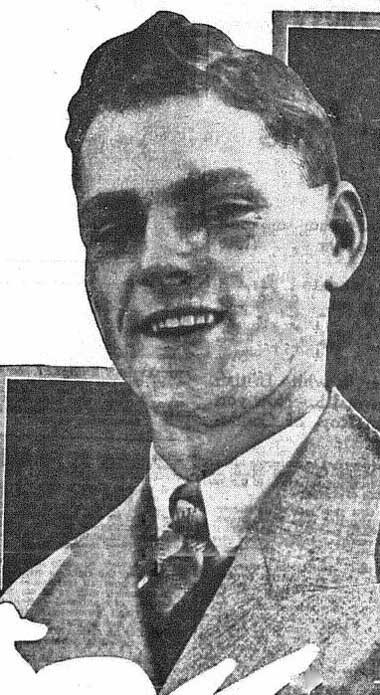
(Syd, NSW), Sun 11 Apr 1937, p. 1.
Reproduction: Peter de Waal
Q. You came down with the police?
A. Yes.
Q. Where did you go to?
A. Just came into town and was dropped in town.
Q. Where at?
A. Either in Clarence Street or York Street.
Q. What time?
A. A quarter past 4 exactly.
Q. Did you go to this spot with them?
A. Yes.
Q. The spot where this man was found with you?
A. Yes.
His Honor: You mean prior to that?
Mr Curtis: Q. What time did you go out there?
A. We went out before a quarter past, we went out right to the place and came back again.
Q. In other words the police knew what place to go to?
A. Yes.
Q. And the police knew what time you were going to meet him?
A. Yes.
Q. And you told them where they had been?
A. Exactly.
Q. And you have never been charged with anything?
A. No.
RE EXAMINATION.
Crown Prosecutor: Q. Has there been any treat promise or inducement —
Mr Curtis: I am not suggesting it.
Crown Prosecutor: Q. I must put it formally. Has there been any threat promise or inducement held out to you my anybody?
A. No, none whatsoever.
Mr Curtis: Q. You have never been told you will be prosecuted?
A. No.
Q. You gave evidence in this case?
A. Yes.
Q. You have never been told that by anyone at all?
A. No.
Crown Prosecutor: Q. You see those five photographs. Do you appear in any of them at all?
A. Yes, I appear in two or three of them.
Q. Which ones do you appear in? (Photos handed to witness)
A. I am the middle person in this one (indicates), I am the end person in this one (indicates) and I am the middle person in that photograph (indicates) and I am the only person in that photograph.
His Honor: Not in the other one at all?
A. No.
Crown Prosecutor: You appear in the middle one in a group of three standing up in single file?
A. That is correct.
Q. You appear at the end one standing back to back?
A. That is correct.
[Page] 32 MJ Adams XX. [Cross examined]
~ ~ ~ ~ ~
Q. And you appear in the middle one sitting down?
A. That is correct.
Q. And you appear in this one standing alone?
A. That is correct.
Q. Do you know the names of the other boys at all?
A. Yes, one is his son and one was his son’s best boy friend, Arnold.
Q. And in this case you do not appear in that at all?
A. No.
Crown Prosecutor: The one he does not appear in is a photo of the accused and two small boys in front of him. The other four he appears in.
Q. In any of those five photos did they contain the three which you say you had promised to return to the accused?
A. Two of them.
Q. Which two?
A. The one I am sitting down and the one of the accused.
Q. The one of you sitting down on the log in the centre?
A. That is correct.
Q. And the other one —
A. Was the one where the accused is with the two boys in front of him. That is the two of them.
Q. You said your name was Peterson or Adams?
A. Yes.
Q. What name did the accused know you as?
A. Peterson.
Q. Did he call you any other names?
A. Yes, lots of them.
Q. Such as?
A. Michael, Carl, Little Norway.
Q. You say your father was a Norwegian?
A. Yes.
Q. I think you told us also that you first met the accused at The Spit?
A. That is correct.
Q. You have some trouble with a boat?
A. Yes, that is right.
Q. On that occasion did the accused give you anything at all?
A. Yes, he shouted us to afternoon tea and it started to rain and we had not prepared for the rain, my brother and I —
Q. Did he give you anything at all?
A. Yes, he gave us our tram fare home.
Q. Any other money?
A. No, he gave my brother a 1/- I believe.
Q. Was that the first time you had met him?
A. Yes.
Q. Was there any arrangement to meet again.
A. Yes, the next morning.
Q. Who made the suggestion?
A. He did.
Q. What did he say?
A. He asked me what I was doing in the morning and I said “Nothing”. He said “If you like I will call for you and take you into town.” I told him where we lived. He came the next morning at 9 o’clock.
[Page] 33 MJ Adams XX. [Cross examined]
~ ~ ~ ~ ~
Q. How did he come?
A. In a car.
Q. Where did you go?
A. I did go —
Q. Where did you go?
A. Well, how we went out and drove out right around until we came to come to some rocks on a headland overlooking the harbour, I could take you there but I do not know the name of the place but I could take you there.
Q. Did he bring you into town?
A. Yes.
His Honor: Q. After taking you to this headland overlooking the harbour?
A. We stopped there for a wee while.
Crown Prosecutor: Q. I will not bother further on that aspect. Did you come into town.
A. Yes.
Q. When was the next time you met him?
A. The next night, either the next night or the night preceding. It was either one night or perhaps the nights after; I cannot swear to this.
Mr Curtis: I object to this and I submit it has to be argued in the absence of the jury.
Crown Prosecutor: I would prefer it too.
His Honor: (To the jury) There is to be a legal argument which I do not think will interest you. If you will retire for a little while —
(at 3.10 pm the jury retired).
Mr Curtis: I submit that nothing which is asked in cross-examination which requires explaining or qualifying, this is re-examination, this extra matter trying to destroy the effect of the cross-examination. I showed there were several things, either association which could be inferred and the jury have to decide what took place on that date. The only object which can be tendered is to suggest there was familiarity going on which would result in intimacy. (Quotes more re similar offences reported in Phipson [on Evidence], latest edition, at 181). To show what happened on this particular date he cannot prove it by saying a person has taken a boy out to the pictures or given him many presents, from which inferences can be drawn. If the evidence is admissible it does rest on this probability. It is put definitely in this case in Russell on Crimes (quotes). What the jury have to do in this case, it is hard to make it clear, it does not matter what they may think of this man, or the possibility of what may have happened, they have to be satisfied these persons were absolutely as suggested and particularly
[Page] 34 MJ Adams XX. [Cross examined]
~ ~ ~ ~ ~
that this offence has been committed, it did not matter whether one was so drunk or whether the police did not come along at the time. It would be impossible to infer, to lay a foundation of association and meeting. I didn’t object although it was unfair that he called him Little Norway. It was not in reply to anything I asked and I submit you will uphold me unless it is something to explain or qualify the answers given in cross-examination, you will not allow the effect to be destroyed by inadmissible evidence.
Crown Prosecutor: So far as Little Norway is concerned —
His Honor: We need not worry about that, is was not objected to.
Crown Prosecutor: My submission is this, we are entitled to show how many times —
(At this stage Mr Curtis asks that the witness leave
the Court during argument. Witness does so by direction.)
Crown Prosecutor: I am entitled to show that we are in the habit — I do not know whether this is a fact or not — of meeting from time to time. I am not for one moment going into any details as to what took place if anything did take place, with this man. All I am asking the witness is what was the next time he met and where did they go and leave it at that, not what was said or done, up to the 1st March. Just to entirely cut away from my friend’s suggestion that this was a sudden impulse through drunkenness on the part of his client on the 1st March without any previous association at all between the two of them. If it doesn’t strictly arise out of cross-examination I ask leave to ask these questions and my friend can re-cross-examine on that point.
His Honor: It would be admissible on the ground that the cross-examination has suggested to a degree on this occasion the 1st March the boy informed the police and prepared a trap suggesting possibly that the offence did not take place and it was a trap of special nature.
Mr Curtis: To use the word trap is unfair. I am not suggesting it. My friend opened to the jury that the police picked up their trail and eventually they found them at this lonely spot.
His Honor: It was impossible for the Crown to give any other evidence than that.
Mr Curtis: You infer that, and I wanted to show they knew where to go and that is all. Subject to anything else that is said, Your Honor
[Page] 35
~ ~ ~ ~ ~
used the expression “trap” —
His Honor: It is not admissible as similar acts or tendency.
Mr Curtis: What else is it directed to?
His Honor: I could not take it that this witness led them into a trap to get this man and the suggestion may come down to a question of what happened at that time.
Mr Curtis: That is similar acts and tendency.
His Honor: Subject to anything you may say, Mr McKean, I think it would not be admissible.
Crown Prosecutor: I suggest I may ask the general question — on how many occasions did he meet the accused prior to the 1st March.
Mr Curtis: I object to that. That is directed to tendency.
His Honor: Is not that directed to a charge under tendency.
Crown Prosecutor: That shows the terms on which they were and also given colour to the story told by the witness.
His Honor: Is not that the only purpose, to get tendency and association. I think in this case it is not admissible for that purpose.
Crown Prosecutor: I think in a case like this I will not press it.
His Honor: I think I will reject the evidence.
(The jury returned at 3.15pm).
Mr Curtis: The only thing I wanted was the depositions and my friend says he will get the witness to identify the signature and he will tender it and it can be read.
(Witness recalled into court).
Crown Prosecutor: Q. You are still on your former oath. Will you look at these depositions (shown). Look at the second page, is that your signature at the end of the second page?
A. Yes.
Q. And that is the deposition of the evidence you gave at the lower Court?
A. Yes, that is so.
(Tendered and marked Exhibit D and read to Jury).
Mr Curtis: Q. I did not ask you any questions at the Police Court at all?
A. No.
(Witness retired).
SAMUEL SUMMERS,
Sworn, and examined as under:
Crown Prosecutor: Q. You are a constable of Police stationed at Police Headquarters?
A. Yes.
[Page] 36 Const Summers X. [Examined]
~ ~ ~ ~ ~
Q. Do you know the accused?
A. Yes.
Q. Do you know the last witness, the youth Adams?
A. Yes.
Q. On the 1st March last about half past six in the evening did you see the accused and the youth Adams?
A. Yes.
Q. Where?
A. They crossed the intersection of George and Market Streets, turned into York Street, entered a sedan motor car No 213-380. They got in the car for a few minutes and then the car was driven into Druitt Street, then into Clarence Street where I lost sight of it in the traffic.
Q. What were you doing, walking or what?
A. Walking.
Q. Where were you when the accused and youth got into the car?
A. On the opposite side of the street.
Q. In Clarence Street?
A. No, York Street.
Q. You say you lost sight of the car?
A. Yes, in the traffic.
Q. What happened after that?
A. I later returned to the Det Sergt Thompson and Det Gordon in the police car. We then drove to Warraroone [sic] Road, Lane Cove, where we got out of the police car and made a search of the bush in the vicinity.
Q. Is it very thick scrub there?
A. Very thick scrub. I saw a sedan motor car parked with the light out in a bush track.
Q. Where was it parked?
A. In a bush track off the Worraroone Road. All the lights were out. Det Sergt Thompson and Det Eddy went to the near side of the car.
Q. How did you go, walk?
A. Yes, we walked down through the scrub.
Q. When you got the certain instructions what did you do after you got these instructions?
A. We walked down and when about 15 yards off the car we ran towards the car. Det Sergt Thompson and Det Eddy went to the read door on the near side of the car. Det Gordon and I went to the rear door on its near side of the car. Det Gordon and I went to the rear door on the offside. Det Gordon opened the door and flashed the torch. I saw the accused lying on top of the youth, who was lying face downwards on the seats of the car. The accused was naked and the youth was naked except for a singlet. I saw the accused rise off the youth, turn over on his left side and face Det Sergt Thompson. Det Gordon left me and went to the rear side of the car where Det Sergt Thompson was and Det Eddy joined me on the offside of the car. I saw both men dress into their clothes. I notice the interior of the
[Page] 37 Const Summers X. [Examined]
~ ~ ~ ~ ~
car. The front seat had been removed and placed alongside the back seat in the rear of the car. Later —
Q. Did you see anything else?
A. On the back seat on the near side there was a bottle containing vaseline with the lid off.
Q. Did you hear any conversation at all take place?
A. No, I could not hear any conversation.
Q. I understand later you went to Police Headquarters with the accused?
A. Yes.
Q. And about 2 o’clock the next morning to the Central Police Station?
A. Yes.
CROSS EXAMINATION.
Mr Curtis: Q. What time of the day did you first know you would be required?
A. In the morning of that day.
Q. What time?
A. About 9 o’clock I should say.
Q. I am not asking what you were told but who said you would be required?
A. Det Sefgt [sic] Thompson told me.
Q. Did you know what time you would be required that evening?
A. No.
Q. Did you know where you would be required that evening?
A. No.
Q. I think that you told us you took up a position about 6.30, was that as the result of instructions, I am not asking what they were?
A. Yes.
Q. What time did you get those instructions?
A. During the afternoon.
Q. About what time?
A. I should say about 5 o’clock I think it was.
Q. Was your mate, I do not mean it in any way offensively or otherwise, was the other officer with you, was he with you when the instructions were given?
A. Yes.
Q. And you proceeded to this position in Market Street?
A. Yes.
Q. Did you know or not that Thompson and Gordon would be there?
A. Yes.
Q. Did you know where they were to pick you up?
A. No.
Q. Where did they pick you up?
A. They picked us up at the intersection end of George and Market Streets.
Q. Had you seen the car before they picked you up?
A. No.
Q. The police car?
A. Yes, the police car.
Q. Did you know where it was stationed, you knew where it was stationed, the police car?
A. Yes, I knew where it was.
Q. They knew where to pick you up?
A. No.
[Page] 38 Const Summers XX. [Cross examined]
~ ~ ~ ~ ~
Q. Approximately?
A. They had no idea where they were going to pick me up.
Q. Do you mean to say they picked you up by accident?
A. No, I returned there.
Q. How long had you been waiting before you returned to the police car?
A. I returned immediately I lost sight of the other car in Clarence Street.
Q. Do you remember whether it was a darker or light night?
A. It was not dark.
Q. How many torches were there?
A. O would say two.
Q. Are they bright torches?
A. Fairly good torches.
Q. Were they on a little time or just flashed from time to time?
A. In the car.
Q. When you got up there and afterwards?
A. It was not quite dark.
Q. What time did you get up to Lane Cove?
A. I should say somewhere bout 7 o’clock.
Q. On the first March I take it it was light, you could see?
A. It was dusk.
Q. Torches were used?
A. Torches were used in the car.
Q. You say it was still dusk, you could see.
A. Fairly light, you could see.
Q. I will take your answer. Now you went to one side of the car with whom?
A. Det Gordon.
Q. I suppose you saw Mr Maddocks when he came out of the car, did you not?
A. I saw him get out of the car.
Q. Before he dressed?
A. Yes.
Q. You were there while he dressed?
A. Yes.
Q. And you told us everything that you saw?
A. Yes.
Q. You went back with them did you not, to Phillip Street?
A. Yes.
Q. What time did you get there?
A. I should say somewhere about 8 o’clock.
Q. Did you remain there the whole time?
A. Yes.
Q. At Phillip Street until what time?
A. Until 2 am next morning.
Q. When you arrived there were you and Thompson and Gordon and the other officer all present?
A. No, I was not with Gordon and Thompson I was along with Det Eddy.
[Page] 39 Const Summers XX. [Cross examined]
~ ~ ~ ~ ~
Q. Did you remain on the building?
A. Yes.
Q. Was Chief Commissioner Mackay there when you got there or not?
A. I saw him later.
Q. It is a fact, is it not, that no charge was laid against the accused until 2 o’clock in the morning at the Central?
A. Yes.
Q. You know that?
A. Yes.
Q. It is usual is it not when a person is found if you have the evidence in the act of a crime to go and charge them straight away, that is the usual procedure.
A. I could not say that.
Q. Do you know this or not, do you know that after Mr Mackay arrived there was a cabinet meeting down there?
A. No, I did not know, I could not say that.
Q. You do not know anything about it?
A. No.
Q. You do not know about the Ministers being summoned?
A. No.
Q. What time did you get the Central where he was charged?
A. About getting on for 2 o’clock.
(Witness retired).
WILFRED STANLEY EDDY,
sworn, examined, as under:
To Crown Prosecutor: I am a constable of Police attached to Headquarters. I know the accused. I know the youth Adams. On the 1st March last about half past six in the evening I saw the accused and the youth Adams. I was standing at the corner of George and Market streets I saw them near Gowing’s corner together. I saw both walking along over towards Market Street, towards York Street. They turned into York Street and entered a motor car which was standing there No 218-380. They remained in that position for about three minutes and then the car was driven into Druitt Street, from Druitt Street into Clarence Street. I lost sight of it in the traffic. I was on foot.
Q. Where were you when they got in the car?
A. I was on the corner of Druitt Street and York Street.
Q. You lost sight of it in the traffic, what did you do then?
A. I then returned and joined Det Sergt Thompson and Gordon and was driven to Warroona Road, Lane Cove. Under instructions from Det Sergt Thompson we searched the scrub in the vicinity and I there saw a car in
[Page] 40 Const Eddy X. [Examined]
~ ~ ~ ~ ~
in the scrub. It was practically concealed by the bushes. It was dusk. There were no lights on the car at all. Det Sergt Thompson then gave us instruction and with him I went to the near side of the car and Det Sergt Thompson opened the near rear door of the car and flashed his torch inside. I saw the defendant lying on top of the youth Adams, who was lying face downwards in the rear on the seats of the car. I saw the defendant rise off the youth. The defendant was absolutely naked and the youth had on a singlet. I saw the defendant rise off the youth and slide out of the car. Det Sergt Thompson asked him why he was in such a condition, and he replied he had been having a few drinks. I then went to the other side of the car. I saw a search of the car made by Det Sergt Thompson. I noticed there was a bottle of vaseline in the rear right hand corner of the car, the lid was off the bottle.
Q. What about the front seat?
A. The front seat was in the rear of the car practically level with the back seat. I then left and went over to the police car. Later I returned to police headquarters. I was there until about 2 am the following morning when I went to the Central Police Court.
Q. Is that the only conversation you heard about having a few drinks?
A. That is all I heard.
Q. Did you notice any sign of drink on the accused at all?
A. I noticed, well, I would not say that he was drunk or any kind like that, but I did smell a little as if he had been drinking.
Q. Did you see any other drink at all in the car?
A. No, I did not see anything.
Q. Did you have a torch yourself?
A. No, I did not have a torch.
Q. How many torches were there, two?
A. Yes.
Q. Who had them?
A. `Det Sergts Thompson and Gordon.
CROSS EXAMINATION.
Mr Curtis: Q. You and the last witness were in attendance at the Police Court when the case was called out?
A. We were waiting there.
Mr Curtis: I am not attaching any significance to this that they are not called because there was a prima facie case. I am not making any comment on it.
Q. What I want to know is this, did you give your statement as you have got it now before the case was called on in the police court?
A. Yes,
[Page] 41 Const Eddy XX. [Cross examined]
~ ~ ~ ~ ~
before.
Q. I take it you realise the importance of remembering everything that you saw?
A. I do.
Q. Apparently you only saw one pot of vaseline?
A. That is all.
Q. You may take it your friend says the same. You were quite close to the accused sufficient to observe his person?
A. Yes, quite.
Q. I suppose you have told me everything you saw?
A. Yes.
Q. What time did you get there?
A. It would be about five or ten past seven.
Q. Of course you realised the possibilities of what you found might mean?
A. Repeat that again.
Q. You realised the possibility of what you saw there might mean as regards what charge might be made?
A. I did.
Q. And that would make it doubly important to notice everything in regard to what you would possibly see?
A. Yes.
Q. And you have told us everything?
A. Yes.
(Witness retired)
(The Crown Prosecutor intimated to His Honor that the next police witnesses would take some time and he suggested that they should not be called until tomorrow rather than start today and break in on their evidence. Mr Curtis concurred and the further hearing was adjourned to 10.0 am on Friday 9th April, 1937, the Jury being locked up for the night).
[Page] 42 Const Eddy retired.
~ ~ ~ ~ ~
QUARTER SESSIONS.
CORAM: HILL, A/J and a Jury of 12
REX v. SYDNEY AUBREY MADDOCKS.
Second day – Friday, 9th April, 1937.
————
MIKIEL JOHN ADAMS – recalled
Crown Prosecutor: Q. You are on your former oath. Do you appreciate that?
A. I understand.
Q. You told us your meeting, and having this meal at this fish restaurant?
A. That is correct.
Q. What did you have to eat?
A. I had a dozen oysters.
Q. And stout?
A. Yes.
Q. What did the accused have?
A. A dozen oysters and fish.
Q. And stout?
A. Yes.
Mr Curtis: Q. By the by, when you were asked by the police what Maddocks had for his dinner, you said at the Police Court that you declined to answer?
A. Exactly.
Q. Why should you decline to answer that he had an ordinary meal?
A. Why shouldn’t I decline?
Q. That is what I want to know? —
His Honor: Q. Give the reason?
A. There wasn’t any reason.
Mr Curtis: Q. Then why did you say “I decline to answer”?
A. Because I did decline to answer.
Q. Didn’t you want to raise something suspicious?
A. No, I did not.
Q. Nothing of that sort at all?
A. No, nothing of that sort at all.
Q. Were you very nervous at the table when you were having dinner?
A. No.
Q. Didn’t you upset the beer, the stout?
A. No.
Q. Is it a fact that you left your meal untouched?
A. It is a fact that I finished my oysters, but had no fish.
Q. You ordered fish?
A. Yes, and decided that I wouldn’t have it, because the oysters weren’t fresh.
(Witness retired).
JOHN GORDON,
Sworn, examined, deposed:
To Crown Prosecutor: I am a detective constable of police stationed at headquarters. On the 1st March last about half past six I was in
[Page] 43 MJ Adams retired.
Const Gordon X. [Examined]
~ ~ ~ ~ ~
a police car in George Street near Market Street with Det Sgt Thompson. I saw the accused and a youth named Adams walk across the intersection of George Street towards York Street, up Market St. I followed them in a police car – I was driving – into York Street, where I saw the accused and the youth enter a sedan motor car, No. 218-380. I passed the car, and pulled the police car up further along York Street.
Q. By the way, did this police car have the sign PD on it, or had it a private number plate?
A. A private number plate. The accused and the youth remained in the stationary car for a few minutes, and they then drove along York Street towards our car. I pulled out ahead of them, and turned into Druitt Street towards George Street. I then lost sight of the car in the traffic. A few minutes later I picked up two other police officers, Eddy and Summers, and we proceeded along Clarence Street, across the Harbour Bridge, to North Sydney. We then proceeded through Northwood to Warraroon Road, Lane Cove. The police car was then parked in Taleeban Road, Lane Cove. That is a road running at right angles to Warraroon Road. We all left the car and proceeded through the bush, and saw a sedan motor car parked in the scrub off Warraroon Road, about 30 yards off the road.
Q. Was it easily visible?
A. It was almost completely concealed, and all the lights were out. Sgt Thompson then gave the other police and me certain instructions and we proceeded to a track off Warraroon Road. When about 14 yards from the rear of the car, we all ran to the car. I went to the offside rear door, opened it and flashed a torch inside. I saw the accused there in the rear of the car lying on top of the youth Adams. I saw him rise off the youth and turn towards the other side of the car where Det Sgt Thompson was. I then went to the other side of the car —
Q. How was the accused dressed?
A. The accused was completely naked, and the youth was naked except for a singlet.
Q. You were saying he was lying on top of the youth. How was the youth lying?
A. The youth was lying face downwards on the seat.
Q. You say you went to the other side of the car?
A. I went to the
[Page] 44 Const Gordon X. [Examined]
~ ~ ~ ~ ~
other side of the car. I heard Det Sergt Thompson say to the accused “What are you doing here in this condition, Mr Maddocks?” The accused said “Just having a few drinks.” Sgt Thompson said to him “But you are naked, and you are lying on top of that youth, who is also naked.” The accused said “This will mean the end of everything, Mr Thompson. Can’t something be done?”
Q. Then Det Sergt Thompson said something. You need not tell us that, and after his reply, did the accused and the youth Adams or Peterson get dressed?
A. Yes, they got dressed. Prior to the accused being dressed I noticed some substance on his penis. I also noticed that the clothes of the accused and the youth were stacked in the front seat of the car, where the front seat usually is.
An examination of the car was made. I saw a vaseline bottle on the rear seat of the car. The lid was off. I also saw the front seat of the car in the rear compartment, almost level with the rear seat. The seat was lifted out, and I saw an attache case, which it had been resting on. There were two bottles of beer in the attache case and a full bottle of vaseline.
Q. That is the small bottle there, is it?
A. Yes. Shortly after, I drove the accused’s car to police headquarters, and the accused was taken into the office of the Commissioner of Police.
Q. I am sorry I have to ask you. You say you saw the accused lying on top of this youth who was lying face downwards. Did you then see the penis of the accused?
A. Not just then.
Q. You were the driver of the car all through the piece, were you?
A. Yes.
Q. Did the accused show any signs of drink at all?
A. He had been drinking.
Q. Would you say he was drunk?
A. No, he wasn’t drunk.
Q. Anything like it?
A. No, nothing like it. He was quite capable.
CROSS EXAMINATION:
Mr Curtis: Q. We know that the officer who was with you was Det Sergt Thompson. Please understand that in any question I am putting I am not making the slightest suggestion against any member of the police force?
A. Thank you.
Q. You generally work together, do you not?
A. Yes.
[Page] 45 Const Gordon XX. [Cross examined]
~ ~ ~ ~ ~
Q. How long have you been associated working together?
A. About 4 years.
Q. During that time practically the whole of your time you were engaged in looking after the drug traffic?
A. Yes.
Q. That is, getting in touch with people who use drugs and sell drugs?
A. Yes.
Q. Of course, on this particular afternoon you knew exactly where to take up your position in Market Street?
A. Yes.
Q. That had all been arranged with the lad?
A. Certain arrangements had been made.
Q. And you also knew where you would find the two of them that evening?
A. No.
Q. What?
A. No.
Q. Hadn’t you been out there that afternoon?
A. Yes.
Q. You say you didn’t know whether they would go there or not, but you had been shown that place in the afternoon with the boy?
A. Yes.
Q. For all you know they might have gone somewhere else?
A. Yes.
Q. But still, when you went out in the direction you, of course, went to the place that the boy had shown you?
A. Yes.
Q. What time do you say you left town?
A. About 25 to 7.
Q. Was it then light?
A. Yes.
Q. Would you have your lights on?
A. No.
Q. So I may take it there would be no necessity for the lights of the car to be on then?
A. No.
Q. Not on 1st March?
A. No.
Q. As a matter of fact, it would get dark much later?
A. It would be getting dark about 7 o’clock, dusk.
Q. At that time lights might or might not be put on?
A. My lights were on at that time.
Q. I think you told us that in your opinion the car in which the accused was would have been about 20 minutes at the spot before your car arrived, approximately?
A. Yes.
Q. I mean, ample time for an offence to be committed. Well, we will take it at 20 minutes. And I think you said that the police car was there for about ten minutes before you went up to the other car?
A. Approximately ten minutes.
Q. You know, of course that the other two officers that we have
[Page] 46 Const Gordon XX. [Cross examined]
~ ~ ~ ~ ~
heard were just as close to Maddocks as you were — they both came right up to the car, didn’t they?
A. Yes.
Q. And could see into the car, just as you saw?
A. I should imagine so.
Q. You don’t say what it was, but you say you saw something on his person?
A. Yes.
Q. I suppose you realise that that is an important factor?
A. I do.
Q. Was anything said about it at the time?
A. No.
Q. Was any attention drawn to it in any shape or form?
A. No.
Q. I suppose you realise that if it were some thing that would be material in a charge of some unnatural offence, the presence or non-presence of the vaseline was a matter that a medical man could ascertain?
A. Yes.
Q. I suppose you realised that if the accused had had his attention drawn to it, assuming he said it was not there it would have been easy to get an examination?
A. It could have been.
Q. But nothing was done and nothing was said about it?
A. No.
Q. I suppose you realise that whatever a man’s condition may have been as regards sobriety, nothing sobers a man quicker than sudden shock?
A. It would tend to sober him, yes.
Q. And whatever condition you may say he was in when he spoke to you, there is no doubt about this — you will admit that the shock of a man in his position being discovered by the police, there is no greater shock a man would get?
A. I take it he would get a shock.
Q. A terrific shock?
A. Yes.
Q. He did say this to you “I have been drinking all afternoon?”
A. Yes.
His Honor: Q. When did he say that?
A. He said that during the conversation with Det Sgt Thompson at the side of the car.
Mr Curtis: Q. That would be just having a few drinks, but Thompson said “But you are naked and lying on top of the youth”. It would be at that conversation that he said “I have been drinking all the afternoon”?
A. Yes.
Q. Of course, you know from your inquiries that apart from the afternoon, he had consumed at least a bottle of stout and a bottle of beer?
A. Yes.
Q. Would you agree with this statement, that apart from what you
[Page] 47 Const Gordon XX. [Cross examined]
~ ~ ~ ~ ~
knew about the drink he had had, or from anything that he had said, you could tell from his condition that he had been drinking?
A. I could smell liquor on him.
Q. But from his condition?
A. I think he was normal.
Q. Do you have what evidence Det Sgt Thompson gave? Would you agree with his answer to this question. I will put this question to you: “Apart from the knowledge that you knew he had drink, was his condition such that you could see he had been drinking — Yes.” Would you say that?
A. Yes, I will say that.
Crown Prosecutor: Q. On the question of drink, did he need any assistance to dress?
A. Not at all.
(Witness retired).
WHARTON THOMPSON,
Sworn, examined, deposed:
To Crown Prosecutor: I am a detective Sergeant of police stationed at headquarters and I am the officer in charge of this case. About half past six on the 1st March last I was in a police motor car with Det Gordon in George Street near Market Street.
Q. What did you see?
A. I saw the accused and a youth named Peterson cross the intersection of Market and George Streets, and walk towards York Street. We drove the police car into York Street where I saw the accused and Peterson enter a sedan motor car, No 218-380. They remained in the car for a couple of minutes and the accused then drove the car towards Druitt Street. I there lost sight of the car in the traffic. I later joined Detective Eddy and Detective Summers, and Det Eddy told me something. We all then drove to Warraroon Road, Lane Cove, where we alighted from the car and made a search of the bush. I saw a sedan car with all lights out parked about 80 yards from Warraroon Road in the bush. The car was almost obscured by the scrub. I gave the other officers certain instruction, and we went to a bush track, and when about 15 yards from the car, we ran. I went to the near side door of the sedan car, pulled it open, and flashed a torch inside. I there saw the accused, who was completely naked, lying on top of the youth Peterson, who was also naked with the exception of a singlet.
Q. How was he lying?
A. He was lying face downwards, so was the youth. He was lying on top of the youth face downwards. The
[Page] 48 Det Thompson X. [Examined]
~ ~ ~ ~ ~
defendant rolled off the youth, and sat up and faced me. I recognised him, and I noticed that his penis was greasy. His penis was not in a state of erection. I said to him “Mr Maddocks, what are you doing here in this condition” The accused said “We were having a few drinks.” I said “But you are naked and lying on top of this youth, who is also undressed.” The accused said “Mr Thompson, this means the end of everything. Can’t something be done. I have been drinking all the afternoon.” I said “No, get dressed.” “I am going to take you to the Commissioner of Police.” The accused commenced to get dressed, and I then made a thorough examination of the car. I saw that the front seat of the car had been removed and placed on the floor at the back of the car. Under that seat was an attache case, and that seat was almost level with the rear seat. I opened the attache case, and found two bottles of beer and a full bottle of vaseline. On the seat on the near side I saw another bottle containing vaseline; the lid was off it and also lying on the seat. When the accused had dressed Det Gordon drove the car, and I took the accused to Police headquarters at the rear of Phillip and Hunter Streets, where I saw the Commissioner of Police, Mr Mackay, and told him something. At about 2 am the next morning, the 2nd March, I conveyed the accused to the Central Police Station where I charged him with indecent assault on a male person. When charged he made no reply.
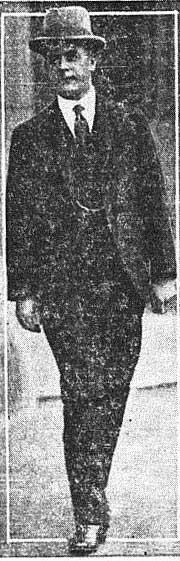
Image: Truth, (Syd, NSW), Sun 21 Mar
1937, p. 24. Reproduction: Peter de Waal
Q. Did you see the accused’s person when you opened the door of the car?
A. No.
Q. When he was lying on the boy?
A. No.
Q. This is very scrubby country, isn’t it?
A. Very.
Q. Where that car is in that photograph (shown to witness) does that show the position of the car?
A. Yes, looking from Warraroon Rd.
His Honor: Q. That is the position it was in when you went out there on the evening of the 1st March?
A. Yes. That car is a police car, which was placed there for the purpose of the photographer.
Q. And you were present?
A. Yes.
(Crown Prosecutor shows photograph to jury).
Crown Prosecutor: Q. What distance from the road would that be?
A. Through the bush track, about 30 yards.
Q. That is an identical photo, is it?
A. Yes.
[Page] 49 Det Thompson X. [Examined]
~ ~ ~ ~ ~
(Two photographs tendered and marked Exs E/1 and E/2.)
Q. What does that photograph represent (another photograph shown to witness)?
A. That shows Warraroon Road with the bush track leading from it where the car was.
Q. And around the corner there is where the car was parked?
A. Yes.
His Honor: Q. The car was on that bush track further along?
A. Yes.
(Photograph tendered and marked Ex E/3.)
Crown Prosecutor: Is there any habitation around there at all?
A. Not in that particular road.
Q. In the neighbourhood?
A. Yes, there are some houses in Taleeban Road, which is running parallel on this side of it.
Q. How far away from where the car would be?
A. It may be 200 yards.
Q. What does that photograph represent?
A. That photograph shows the bush track and the turn in the bush track, and the turn in the roadway where we commenced to run from.
His Honor: Q. Does that show the position the car was in on the evening?
A. Yes.
Q. That is another car though?
A. Yes. That is the police car placed in the same position.
Crown Prosecutor: Q. That is the turn where you commenced your run?
A. Yes.
(Photograph tendered and marked Ex E/4.)
Q. This plan (shown to witness) shows the streets, Taleeban Road running at right angles to Warraroon Road?
A. Yes.
Q. It is round the corner here where the turnoff is?
A. Yes, that is, the bush track.
Q. Is that the mark where the car was?
A. No, that does not denote the car. That is a flat rock that is just on the turn. The car was along here.
Q. Will you mark with a cross approximately where the car was?
(Witness marks the plan accordingly; plan shown to jury).
Q. How long does it take to get from York Street where the car driven by the accused was parked, to this place where the accused was found?
A. Driving straight there, about a quarter of an hour.
(Plan tendered and marked Ex F.)
Q. Did you notice the condition of the accused so far as sobriety was concerned?
A. Yes, I could see that he had been drinking.
[Page] 50 Det Thompson XX. [Cross examined]
~ ~ ~ ~ ~
Q. Was he drunk?
A. Definitely not.
Q. Did he require any assistance to dress himself?
A. None whatever.
Q. What was his speech like?
A. Clear and concise.
CROSS EXAMINATION:
Mr Curtis: Q. Assuming that even before he had the beer and stout his face was bleary, it was not bleary when he spoke to you?
A. No.
Q. I suppose you realise that sudden shock will sober a man very quickly?
A. Yes.
Q. What time did you take up your position?
A. 20 to 6.
Q. Where did you take it up?
A. In George Street near Market Street.
Q. We have heard that it was arranged that you should be there about that time?
A. Yes.
Q. What time did you leave town?
A. Do you mean to go to this spot?
Q. Yes, I think you said about 6-30?
A. At 6-30 we first saw him. It would be about ten minutes later that we commenced to drive to North Sydney.
Q. You knew, of course, that he had been drinking both stout and beer?
A. Yes.
Q. And he told you that he was drinking all the afternoon?
A. Yes.
Q. I think I put this question to you – “Apart from the knowledge that you had about these matters, you said that from his condition you could see he had been drinking”?
A. Yes.
Q. And that is a fair description of it?
A. Yes.
His Honor: Q. What was the condition that you noticed?
A. I could smell drink on him, and I didn’t notice anything very much about his drunken condition, but it was quite apparent to me that he had been drinking, by the smell of his breath and his general demeanour.
Q. You can’t indicate any particular thing in the demeanour?
A. No.
Mr Curtis: Q. What is a fair way to describe his condition, from his general demeanour?
A. Yes.
Q. As far as seeing something on his person, no mention was made of that at the time?
A. No.
Q. Nor was it discussed there at all?
A. No.
Q. No examination was made at all?
A. No.
Q. Were the two pots of vaseline in the attache case?
A. No, the small one.
Q. The small one only?
A. Yes.
[Page] 51 Det Thompson XX. [Cross examined]
~ ~ ~ ~ ~
The Sun, Thu 8 Apr 1937 38
MADDOCKS TRIAL: TWO
CHARGES PREFERRED
———◦———
YOUTH AS WITNESS
————
Tells Of Man He Met In Gaol
PUBLIC galleries were a crowded at the Quarter Sessions to-day when the trial began of Sydney Aubrey Maddocks, 56, Commissioner for Transport (temporarily suspended).
The charges were that Maddocks attempted to commit an unnatural offence with Mikiel John Adams at North Sydney on March 1. He was also charged with having indecently assaulted Adams.
Addressing the jury, the Crown Prosecutor (Mr LJ McKean, KC) said the defence would be that Maddocks was so drunk that he did not know what he was doing.
Drunkenness, however, was no defence for any crime, said Mr McKean, and the onus was upon the defendant to show that he was so drunk that he did not know what he was doing, or that what he was doing was wrong.
Mr McKean said the Crown would argue that no man who was not in his sober senses could drive a car to the particular secluded spot where Maddocks and the boy were found at Lane Cove.
Mr McKean said that when taken to the police station, Maddocks had admitted that what the police said they had seen was, in fact, true.
MEETING IN CITY
The first witness called was Mikiel John Adams, a fair youth, wearing a grey suit. He said he was sometimes known as Petersen.
Before he commenced to give evidence, Acting-Judge Hill warned him that he need not answer questions which he thought might incriminate him. Adams said he had known Maddocks for approximately six months. His evidence of meeting Maddocks by appointment in the city on March 1 and having dinner with him was on the lines of that given by him in the lower Court. He said that in a Pitt-street fish restaurant they drank about four glasses of stout each. They left the restaurant about 6.30, Maddocks stating that he had a car parked in either York or Clarence-street. At that stage, Adams stated, Maddocks showed no signs of intoxication, “apart from a bit of a bleary voice.”
Mr McKean: At the toll-gate at the Harbor Bridge, did Maddocks pay anything?
Adams: You have me a bit tricked there.
Mr McKean: Don’t answer unless you know.
Adams: I don’t think he paid anything. He just tooted the horn.
Adams continued that they drove into scrub at Lane Cove, where Maddocks turned off both the head and tail lights.
There were four bottles of beer in the car, and they drank a bottle without a glass.
POLICE ARRIVED
When Mr McKean asked what followed, witness said that he would refuse to answer. Later, however, he said, they “made whoopee, as you say.”
Mr McKean: This is no joking matter.
Adams: I never said it was.
He then explained his attitude in the car, but said there was not time for anything to happen, because the police arrived.
To Mr Curtis, KC (for Maddocks), Adams admitted that he had been warned in the lower court that he need not give evidence that might incriminate him, and that at the Central Court he had said nothing about making whoopee.
Mr Curtis: As a matter of fact, you are prepared to say anything about the accused, but won’t say anything if it is against yourself?
Adams: That is not correct.
Asked by Mr Curtis whether he had had in his possession a mono-grammed cigarette case belonging to Maddocks. Adams replied that accused had given it to him.
OFFICIAL LETTER
Mr Curtis: Did you steal from him an official letter addressed to him as the head of his department?—I certainly did not steal the letter. I picked it up from the bottom of the car and meant to return it to him. He was not sufficiently sober at the time to return it.
Mr Curtis: Have you ever passed yourself off as Maddocks’s son?— Yes, at his request.
And you know he held a responsible position?—I suppose it was responsible. I did not know his position until a few weeks after I met him.
Witness denied that he had associated with criminals, but admitted to Mr Curtis that last year he had stowed away on a boat.
Mr Curtis: Were you sentenced?—No. I was remanded.
Further cross-examined by Mr Curtis, Adams said that certain photographs, copies of which were produced in court, were picked up by him in the motor car at the same time as he found the official letter.
Mr Curtis: As a matter of fact, in one of those photographs is his own son?—I also know that two of them are not.
Mr Curtis: Oh! Is that so? Isn’t that just why you had them? If you don’t know what I mean, I suggest that you had them enlarged to have proof that the Commissioner for Transport was going about with boys?
“I deny that,” said Adams, with some heat.
Adams continued that Maddocks told him he wanted back the cigarette lighter because it was given to him by his son.
Mr Curtis: Didn’t you keep it so that if there were proceedings in which Maddocks was involved you would be able to say, “He gave me his own cigarette lighter”?—No.
“FIRST PLACE”
In another photo, there appeared Maddocks with a boy, and his curiosity was aroused as to who it was, Adams proceeded.
Mr Curtis: I see. Your curiosity was aroused.
Adams: Wouldn’t you be curious?
Mr Curtis: Don’t ask me that.
Adams denied that he wanted the photo, as evidence of incrimination. “I thought I had first place in his affections,” he said.
Mr Curtis: Had not you arranged for Maddocks to be caught with you on March 1?—Not before —–
Mr Curtis: Yes or no?
Adams: Yes.
Mr Curtis: We will come to this trap.
Adams: There w as no trap.
Mr Curtis said he would not say anything about the police, but would say it all to witness.
Adams: Thank you.
His Honor reprimanded the witness and told him not to be impertinent.
Adams admitted that he had asked Maddocks if he could find him a job, but Maddocks had said he could not. When at Moss Vale he had asked his employer to wire Maddocks at a Blackheath hotel for a reference as to character, but he did not know that the reply received from Maddocks was “Insufficient knowledge of person mentioned.”
“MET IN GAOL”
Adams said he had rung Maddocks, who was still at Blackheath, from Sydney, but he did not tell Maddocks he was in trouble. Maddocks suggested that he should meet him at Leura.
Mr Curtis: You arrived with another man, didn’t you?—Yes, a visitor from New Zealand.
Did you meet him in gaol there?—I did.
Mr Curtis: How long did you know this gentleman in New Zealand?—He happened to bring round my food. I did not know what he was in gaol for.
Adams also said that he had invited the New Zealand friend to come and stay with him at his aunt’s place.
Mr Curtis: Although you knew he was a criminal?—Does the fact that a man was a criminal once mean that he Is a criminal twice?
Mr Curtis: No, I don’t think so, but did you find out about him?—I don’t ask questions.
Mr Curtis: As a matter of fact, you did not care, did you?—He was still human to me.
Asked about the arrival of this man at his aunt’s, witness said: “I don’t know whether you will believe this or not, but by a marvellous coincidence he arrived at my aunty’s by a taxi the next day.
Mr Curtis: Was there another man, a criminal, too?—There was a third man, not a criminal.
Witness denied that he was a regular attendant at the Fifty-Fifty Club, or that he intended entertaining the visitors from New Zealand at that club.
DEPORTED
Adams said he had been escorted back from New Zealand. “I got a free ride,” he said.
Mr Curtis: You mean, you were deported?—That is the word I want.
Continuing, Adams said that he had gone to Leura with one of the New Zealanders, and he told Mr Curtis that when Maddocks asked him, he had informed him that the man was a New Zealand criminal.
Mr Curtis: I put it to you, you went to try and get money from Maddocks?—Decidedly not.
Mr Curtis: Didn’t Maddocks say he didn’t like the look of the man?— He did not like the look of anybody who was with me.
Adams denied that he told Maddocks he was unable to get away from the man, nor did he say that unless he got £10 he would be in serious trouble. He said that on March 1 he arrived in Sydney about 4.15 pm.
Mr Curtis: And then you went to the police?—I drove to Sydney with the police.
Mr Curtis: Did you go with the police to the spot where Maddocks was subsequently found with you?—Yes
Mr Curtis: The police knew where you were going, and what time you would meet Maddocks?—Yes.
Adams said the police dropped him at either Clarence-street or York-street about 4.15 pm.
Mr Curtis: No charge has been laid against you?—No.
Replying to Mr McKean, Adams said he had not been told by anybody that he would not be prosecuted if he gave evidence.
Re-examined by Mr McKean, Adams said he was known to Maddocks as Petersen, and had been called Mikiel, Carl and “Little Norway.”
Detective-Constable Samuel Summers, who gave evidence of the raid on the car, told Mr Curtis in cross- examination that he had set up a watch about 6.30, as the result of instructions given him by a superior officer during the afternoon. Maddocks was taken to headquarters at 10 pm and was charged at 2 am. After the Commissioner of Police had arrived there was a Cabinet meeting about the matter.
His Honor told the jury that it would be necessary for them to be locked up for the night, and the case was adjourned until 10 am tomorrow.
The Crown Prosecutor (Mr LJ McKean, KC appeared for the Crown, and Mr Curtis, KC, and Mr Moffit instructed by Osborne M Allen) for Maddocks.
~ ~ ~ ~ ~
Barrier Miner, Fri 9 Apr 1937 39
WEEPS AT
TRIAL
————
INNOCENT,
SAYS
MADDOCKS
Sydney, Friday.
In a plea for his liberty when his trial on two serious charges was resumed to-day, Sydney Aubrey Maddocks, former Transport Commissioner, broke down and wept, stating that he was innocent.
When the trial was resumed, Detective John Gordon, who was the driver of the police car on the night of the raid, reiterated the story of an alleged incident in the scrub at Lane Cove.
Replying to Mr Curtis, witness admitted that a man in Maddocks’ position would suffer “terrific shock” in being found in the circumstances in which he allegedly was found.
Witness said that on the afternoon of the raid he had visited the spot where the car was ultimately found. He was accompanied by Adams.
BURSTS OF WEEPING
In a speech from the dock, punctuated by several bursts of weeping, Maddocks declared his innocence.
“I stand in this unfortunate position to-day by reason of my attempt to help a young man in whom I thought there were good qualities, but who has proved utterly worthless,” he said.
“No matter what the verdict is, you cannot repair the damage that has been done to me by these vile charges. My liberty is in your hands, but God knows that I have only a few years to go, and I appeal to you to let me live my life again. I ask you to give me an opportunity of devoting what further years God may grand towards the support of my wife and the education of my children.”
The case is proceeding.
(Earlier references in Page 6.)
…
MADDOCKS ON
TRIAL
———◦———
“DEFENCE WILL BE
DRUNKENNESS”
SYDNEY, Friday,—Two charges were preferred against Sydney Aubrey Maddocks (56) at his trial at the Quarter Sessions to-day. They were: (1) The he attempted to commit an unnatural offence with Michel John Adams at North Sydney on March 1, and (2) The he indecently assaulted Adams.
The court was crowded.
The Crown Prosecutor (Mr McKean, KC) said it would be submitted by the defence that Maddocks was so drunk that he did not know what he was doing, but drunkenness was no defence for any crime.
Michel John Adams, in evidence, said he was sometimes known as Petersen. He was told by Acting Judge Hill that he need not answer questions which he thought might incriminate him.
Adams, who said he had known Maddocks about six months, told of the meeting by appointment on March 1, and of a drive after dinner to the scrub at Lane Cove, where they drank some beer.
The trial is proceeding.
~ ~ ~ ~ ~
The Daily Telegraph, Fri 9 Apr 1937 40
TRAP TO CATCH
MADDOCKS ALLEGED
————
YOUTHFUL WITNESS IN CLASHES
WITH COUNSEL
EVIDENCE that a trap had been set to catch Sydney Aubrey Maddocks was given at Quarter Sessions yesterday by a youth, Mikiel John Adams, who was the principal witness against the accused.
Maddocks, who was suspended from duty as Transport Commissioner, was charged with having committed an unnatural offence against the youth, and with indecent assault, at Lane Cove, on March 1.
He pleaded not guilty to both charges.
The youth had many verbal clashes, under cross-examination, with Mr Curtis, KC, who appeared for the accused.
“Why did you retain a picture of Maddocks taken with another boy?” he was asked by Mr Curtis.
“Well, I was naturally curious,” was the reply.
Mr Curtis: Why?
Adams: Well, wouldn’t you be under the same circumstances? I thought I was first in his affections.
PHOTOGRAPHS MENTIONED
Previous to this, Mr Curtis suggested that the witness had retained certain photographs, which were enlarged, to insinuate that Maddocks went about with boys.
Adams said that he had arranged for Maddocks to be caught with him on March 1.
He made an appointment by telephone with Maddocks, came down from Liverpool with police the same day, and directed them to the lonely spot at Lane Cove, told the police he would be there with Maddocks that night, returned to the City with the police, and subsequently met Maddocks.
At this point, Adams was told by Mr Curtis not to be impertinent, and was warned by the Judge.
Mr Curtis: As a matter of fact, you are prepared to say anything about the accused, but won’t say anything if it is against yourself?—That is not correct.
Letter Theft Denied
Adams said that he and Maddocks drove to the spot in Lane Cove, where the police were.
Mr Curtis: Did you steal from Maddocks an official letter addressed as the head of the department?—I certainly did not steal the letter. I picked it up from the bottom of the car, and meant to return it to him. He was not sufficiently sober at the time to return it.
No charge has been laid against you?—No.
Have you ever passed yourself off as Maddocks’ son?—Yes, at his request.
Deported From NZ
Adams stated that he was known under two names, Mikiel John Adams and Mikiel Jon Peterson, and he did not know where he was born.
In answer to the Crown Prosecutor’s question, “What used Maddocks call you?” he replied, “Oh, Mikel, Karl, and sometimes Little Norway.”
In further answers to Mr Curtis, Adams eventually admitted that he was deported to Australia from New Zealand.
Later he was joined in Sydney by a man he had met in jail in New Zealand. With this man he went to Leura to meet Maddocks.
Mr Curtis: I suggest you went to Leura to get money out of Maddocks.—Oh, I knew you were going to make that point. You see, I’m getting sharper every minute. Oh yes, much sharper.
Mr Curtis: I’m glad I’m doing some good.
Didn’t Maddocks say he didn’t like the look of the man?—He did not like the look of anybody who was with me.
CABINET MEETING
Police-Constable Samuel Summers stated, under cross-examination, that Detective-Sergeant Thompson had told him earlier in the day on March 1 that he would be required for duty that night.
He received instructions about 5 pm. The police brought Maddocks back to headquarters about 8 o’clock, and kept him there until 2 am before he was charged with the offence.
Mr Mackay, Police Commissioner, was at the office, but the constable said he did not know that, after Mr Mackay’s arrival, a Cabinet meeting was held.
Maddocks listened to the evidence with composure. Once or twice he pencilled a note for his counsel. He did not even look at the jurymen as they were being empanelled, and he made no challenges.
At the conclusion of the hearing the jury was locked up for the night. The hearing will be resumed this morning.
…
TODAY’S LAW
CASES
(Continued from Page 19)
SYDNEY QUARTER SESSIONS
…
No. 3 Court.—Sydney Aubrey Maddocks, attempted indecency and indecent assault on a male person (part heard).
~ ~ ~ ~ ~
Newcastle Morning Herald and Miners’ Advocate, Fri 9 Apr 1937 41
JURY LOCKED UP
———◦———
Maddocks Trial Begins
———
YOUTH’S EVIDENCE
———
CROWN VIEW OF POSSIBLE
DEFENCE
———
Sydney, Thursday.
Sydney Aubrey Maddocks, 56, Commissioner for Transport (temporarily suspended) appeared at the Quarter Sessions today on charges of having attempted to commit an unnatural offence with Mikiel John Adams at North Sydney on March 1, and with having indecently assaulted Adams. The jury was locked up for the night.
A large crowd had gathered to obtain seats before the case began.
In his address to the jury, the Crown Prosecutor (Mr WJ McKean, KC) said the defence would be that Maddocks was so drunk that he did not know what he was doing. This was no defence for any crime, and the onus was upon the accused to show that he was so drunk that he did not know what he was doing or that what he was doing was wrong. The Crown would argue that no man who was not in his sober senses could drive a car to the particular secluded spot where Maddocks and the boy were found at Lane Cove.
Mikiel John Adams, the first witness called, said he was sometimes known as Petersen. He was warned by Acting Judge Hill that he need not answer questions which he thought would incriminate him.
Adams said that by appointment he met Maddocks in the city on March 1, and in a Pitt-street fish restaurant they drank about four glasses of stout each. They left the restaurant about 6.30, and Maddocks showed no signs of intoxication apart from a bit of a bleary voice. They drove in Maddocks’s car the scrub at Lan Cove, where Maddocks turned off the head and tail lights. There they drank a bottle of beer.
Adams refused to disclose what followed the drinking of the beer, but said that there was not time for anything to happen as the police arrived.
PASSED AS MADDOCK’S SON.
To Mr Curtis, KC, for Maddocks. Witness said he had passed himself off as Maddocks’s son, but it was at the request Maddocks. He denied having stolen a letter belonging to Maddocks and that he associated with criminals.
Questioned about certain photographs produced in Court, Adams denied that he had them enlarged to have proof that Maddocks was going about with boys. He did not want the photographs as evidence of incrimination.
Adams denied that a trap was set to catch Maddocks.
In answer to Mr Curtis, witness declared that he asked Maddocks to get him a job, but Maddocks replied that he could not. He admitted that he had been in gaol in New Zealand, and that he had been deported. He denied taking a New Zealander with whom he had been in gaol in New Zealand to Maddocks at Leura with the intention of trying to get money from Maddocks.
Replying to further questions, he said that the police knew he was going to the spot with Maddocks, also the time. He said that no charge had been laid against him by the police.
To Mr McKean, witness said that he had not been told by anybody that he would not be prosecuted if he gave evidence.
Detectives Samuel Summers and Leslie Samuel Eddy gave evidence that they watched a car in the city and later raided it at Lane Cove.
Under cross-examination, Detective Summers could not say whether it was usual for the police to charge a man immediately he was arrested in certain circumstances. Although the police arrived back at police headquarters at 8 pm the accused was not charged until 2 am. He had seen the Police Commissioner at headquarters after they arrived. He did not know that after Mr Mackay had arrived a Cabinet meeting of a sort was held. He did not know about Ministers of the Crown being summoned.
In announcing the adjournment, Acting Judge Hill informed the jury that they would be locked up for the night.
~ ~ ~ ~ ~
The Sydney Morning Herald, Fri 9 Apr 1937 42
SA MADDOCKS ON
TRIAL.
———◦———
SERIOUS CHARGE.
———
JURY LOCKED UP FOR NIGHT.
———
Sydney Aubrey Maddocks (56), who was recently suspended by the Government from his position of Road Transport Commissioner, appeared at the Quarter Sessions yesterday for trial on a serious charge.
He pleaded not guilty to a charge of having attempted to commit, with Mikiel John Adams, on March 1, at Lane Cove, an unnatural offence, and to having indecently assaulted Mikiel John Adams.
Acting Judge Hill presided.
The Crown Prosecutor (Mr LJ McKean, KC) said that he believed that the defence would be that the accused was so drunk he did not know what he was doing. Drunkenness, however, was no defence for any crime, and the onus was upon the accused to show that he was so drunk that he did not know that what he was doing was wrong.
Evidence was given by Mikiel John Adams, aged 18, and by the police.
The case stands part heard. The jury was locked up for the night.
~ ~ ~ ~ ~
Auckland Star (Auckland, NZ), Sat 10 Apr 1937 43
OFFICIAL’S LAPSE.
GAOL TERM FOR INDECENT
ASSAULT.
————
BREAKDOWN AS DEFENCE.
————
Sydney, April 9.
A sentence of 18 months’ imprisonment was imposed to-day upon Sydney Aubrey Maddocks, aged 56, formerly Commissioner of Transport, who was convicted on a charge of having on March 1, indecently assaulted Mikiel Jon Adams, at North Sydney.
In a dramatic statement from the dock, Maddocks said that some time ago his official duties had become so wearying that he had felt he was bordering on a complete breakdown. He tried drinking heavily without getting relief. Adams, whom he had been trying to help, quietly planned his destruction. Maddocks denied that there had been any association between Adams and himself.
Adams, in evidence, admitted having been deported from New Zealand.
~ ~ ~ ~ ~
The Daily Telegraph, Sat 10 Apr 1937 44
COMMISSIONER OF
POLICE
————
MALICIOUS RUMORS
CONFOUNDED
Within the last few weeks there has been a whispering campaign against the Commissioner of Police (Mr WJ Mackay).
It has been of the most malicious type.
Following Judge Markell’s report on the first SP Betting Inquiry, the administration of the Force was attacked.
At the dates with which the inquiry was concerned, Mr Mackay was not in charge of the force, but that did not prevent a subtle link being forced to suggest that his control of the police was in question.
There have been other incidents connected with the Force, but with which the Commissioner could be in no way concerned. Nevertheless, malice forged another false link.
But the depths were plumbed during the sad case against the Commissioner for Transport.
Malice Finally
Confounder
The rumor-mongers, taking their fabrications as facts, hinted that influential political circles were concerned at the continued criticism of the Police Force. They pointed out that Mr Maddocks was once secretary of the Police Department, and had acquired a reputation as a first-class administrator and insinuated that, because of that Mr Mackay had a special interest in the devastating charge that was laid against a former colleague.
Malice could go no further.
Neither could it be more completely and finally confounded.
Not only did Mr Mackay volunteer information to the credit of the defendant covering a period of 20 years, but the defendant himself went out of his way to pay a fervent tribute to the help the Police Commissioner had given him.
“I shall never forget,” he said, “the courtesy of Mr Mackay, who personally assisted me in securing bail, and came down to the Central Court when I was charged.
Maligning A
Fearless Man
These facts should silence even the most malicious.
They are brought into the light here so that the public may know the extent to which a man who does his job fearlessly can be maligned.
And also to enable them to realise that such a man should be given the fullest confidence of the public as, happily, he enjoys that of the Government.
…
MADDOCKS SENTENCED TO
18 MONTHS’ JAIL
————
BURSTS INTO TEARS IN
EMOTIONAL APPEAL
FROM DOCK
SYDNEY AUBREY MADDOCKS, 56, Transport Commissioner (temporarily suspended), was yesterday found guilty at the Quarter Sessions on a charge of having attempted an unnatural offence on a youth, and on a charge of indecent assault.
He was sentenced to 18 months’ imprisonment on each charge, the sentences to be concurrent.
Standing in the dock with head erect Maddocks received the judge’s sentence without apparent emotion.
For the first time in his trial he appeared to be at ease with himself and resigned to his fate, as though he were glad the ordeal was finished.
Before Maddocks was sentenced, Mr [William John] Mackay, Police Commissioner, said he had known Maddocks since 1914.
He worked with him, and saw very many young men in whose welfare Maddocks had taken a deep interest.
Maddocks always tried to help those who had the ability to make an effort for themselves, and today there were many men in the public service who were trained by him.
“I never heard a breath of suspicion about Maddocks until three days before March 1”, said Mr Mackay.
“I feel he has had a hard and very grave punishment already. I feel very sorry for him.”
“PUNISHED ENOUGH” SAYS KC.
Detective-Sergeant Thompson said that, from inquiries he had made, he was led to believe that the youth Adams was “ruined before Maddocks ever saw him. The boy as definitely a pervert from the age of 12 or 14 years.”
Pleading for leniency, Mr Curtis, KC, asked the judge if he did not think that Maddocks had been punished enough.”
“What good will it do to send him to jail? He could be bound over for five years,” he said.
“Can’t you let him work for his wife and children?
“Maddocks has nothing left in his life but his liberty. Please, your Honor, give it to him.”
MADDOCKS’ PLEA IN DOCK
When Maddocks was asked if he had anything to say before the passing of sentence, he stood in the dock, clutched at the rails, and proceeded:
“This has been to me the end of everything. If you will only allow me to spend the rest of my life in the support of my wife and children, it will be a great thing to them and will harm no one.
“This lesson, coming so late in my life, will never be lost on me.”
In passing sentence, Acting-Judge Hill said that, although the Police Commissioner (Mr Mackay) and Detective-Sergeant Thompson had spoken very much in his favor, he could not overlook the fact that Maddocks had been found guilty of an offence.
“Although I realise the effect of this on your family,” said the Judge, “I cannot overlook the nature of the charge. It is an offence that deserves punishment.”
First Meeting With Adams
When the trial was resumed yesterday morning, Maddocks made an emotional statement from the dock, which lasted 70 minutes. At times he completely broke down.
“I stand in this unfortunate position,” he began, “by reason of my attempt to help a young man in whom I thought there were good qualities, but who has proved utterly worthless.
“I first met Adams in November. I am definite on the point because”—Maddocks bowed his head and hesitated—“it was in the vicinity of the birthday … of my young son.”
Here Maddocks sobbed bitterly.
“I had purchased a dinghy for my boy, and we had taken it to The Spit. Later we had lunch, and it was then I met Adams and his step-brother.
“We were all soon on good terms, and it was arranged we should go out a fortnight later.
READY TO HELP YOUTH
“Adams then took me into his confidence. He told me he was born in England, and was illegitimate.
“In general he told me he had had a hard time, and that he was envious of my son because of the bond between us. He asked me would I help him.
“At the age of 13 years, I was thrown out on to the world without friends, relatives, or money. I have gone through many a hard knock in life. I’ve been ever ready to help a lame dog along the road.
“I was prepared to assist Adams if it was reasonably in my power to do so.
“I advised him to get away from his present surroundings, and later he obtained a job at Double Bay.
“I found that he had obtained possession of some photos, a cigarette-lighter, and an official letter. I asked him to return them to me, and could not understand why he failed to do so.
PHOTOS OF SON AND BOY
“There was nothing in those photos, ordinarily, if it had not been for later developments.
“I don’t think you”—addressing the jury—“have seen all the photos. They showed myself with my boy and another and also showed Adams in some photos.
“They were just as forceful evidence as though Adams and I had been taken together.
“This was towards the end of the year. It had been a serious and most onerous period for me, crowded with the organisation of a department of 9000 employees, dealing with various schemes for reorganisation, with contentious work daily, and decisions that brought me daily into conflict with some class or other in the community.
GOVERNMENTAL CRISIS
“On top of all this came the Accident Compaign [sic], when the Government took it out of the hands of the police, and handed it over to me.
“Over and above all these came a crisis which nearly brought about consideration by the Government of the resignation of the Minister for Transport and on myself as Commissioner.
“These questions were on the point of decision when, fortunately, a way out was found.”
Continuing with great emotion, Maddocks proceeded:—
“These great difficulties were beginning to have their toll on me.
“I felt I had approached a time of life when I was no longer equal to the burden on myself. I was subject to daily criticism, and I was bordering on a complete break-down.”
“I had tried tonic, and I started drinking heavily with the object of getting some relief. The drink added to my difficulties.”
Sobbing bitterly, he continued:—
“My wife pleaded with me to stop drinking, and even suggested my retirement, but I could not afford to retire.
ADAMS “IN SERIOUS TROUBLE”
“To recruit my health, I took my wife and family to the mountains at Christmas, but was there only a few days when I received a phone call from Adams, who said he was in serious trouble.
“He met me at Leura, and was accompanied by another man, whose appearance I did not like.
“Adams told me he had been arrested as a stowaway, had met the man in a New Zealand jail, and had made the acquaintance of other criminals.
“Three of these men, he said, were in Sydney, holding something over him, and unless he could get £10 it would be serious for him. He also told me how I could get temporary relief with drugs.
“I told him I regarded his coming to Leura as blackmail, and that I ought to place the matter in the hands of the police.
“He asked me not to add to his troubles, and I gave him about 30/- to get away to the country.
TALK OF BANNED PLAY
“About the middle of February, Adams phoned me to say he had got away from the criminals, that he had a good position with a veterinary surgeon at Moss Vale, that he had joined up with the Church, and was anxious to return my property and explain to me the reason for keeping the photographs.
“I was told that Adams had said I had produced a play which the police had canned, and it was obvious to me that he was using my name to his advantage.
“On March 1 he rang me and said he would hand over property and make a full explanation. I agreed to meet him, although I was upset because we were taking over new bus routes, and there was a tremendous amount of criticism and agitation.
“I had had a good deal of drink that day, and before meeting him I had had whisky.
TOO DRINK IN CAR
“I met Adams at 20 minutes to 6 pm. We had dinner at a fish shop. He suggested we should go for a car drive in the vicinity of St Ignatius College.
“We bought drink. I told him I was not feeling well. I have a vague recollection of driving over the bridge.
“At North Sydney Adams asked me to stop, as he wanted to purchase something from a chemist’s shop.
“Finally we arrived at the spot. It was a hot night. We took off our coats, vests, and collars. I said I was so sick I would have to go home. He suggested I should get in the car and rest.
“He arranged the seats in the manner indicated by the police. I deny I assisted him in any way.
“I lay down in the car, and I have a vague recollection of his pulling off my boots. We drank two bottles of beer.
FLASH OF TORCHLIGHT
“I remember finding it a great difficulty to drink the beer because I already had had too much. I knew it would be serious if I had more.
“I completely collapsed into the car, and remember being brought back to my senses at the shock of the torch-light flash and police voices.
“I then realised for the first time that my clothes had been removed.”
Raising his voice, Maddocks went on:
“The shock of being found in this position … holding the position I did … I shall never forget.
“The shock seemed to sober me up for the time being.
“I was taken to Police Headquarters, and I sat in the office where I had been for many years.
“Colonel Bruxner arrived. He had been my greatest friend. I felt the occasion required some explanation to the Minister, but my mind refused to function normally. I don’t know now what I said. I remained at Police Headquarters until 2 am in a state of coma.
SURPRISED BY CHARGE
“When I was told of the charge I expressed surprise because no attempt had been made by me on Adams. There was no association between Adams and me in the car.
“All that now remains is the loyalty”—here Maddocks sobbed for several minutes—“and affection of my wonderful little wife and four kiddies, who are suffering with me.
“My liberty is with you. God knows, I have but a few more years to go. I appeal to you, in the evening of my life, to let me live my life again … to give me the opportunity of devoting what years Good may grant me to the support of my wife and children.”
![Sydney Aubrey Maddocks, 1937. SRNSW: NRS– [17/1521]. Photo: Peter de Waal](../../images/trials/1937-Maddocks--Gaol-photo.jpg "Sydney Aubrey Maddocks, 1937. SRNSW: NRS– [17/1521]. Photo: Peter de Waal")
NRS– [17/1521]. Photo: Peter de Waal
Many people in court wept at times during Maddocks’s statement.
Mr Curtis said that no questions of law were involved, but the issue lay on a simple determination of facts.
“Maddocks has been crucified on the alter of publicity. His name has been the subject of ribaldry,” he said.
“Yet this is not the case of a young, innocent boy who was found in the arms of a man, but a filthy pervert, who was the easiest type for criminals to use to prey on a man in a big position.
“On the evidence, this boy framed that man, and it happened on the same day that Maddocks had injured so many people by taking over the feeder buses, which meant throwing people out of employment.”
Mr Curtis also raised the defence of drunkenness.
Mr Mckean, KC (Crown Prosecutor) spoke briefly.
“Why the association between Maddocks and the boy?” he asked. “Was it not a question of ‘birds that flock together’?”
JUDGE ON “LAYING TRAP”
In his summing up, the judge said that consent to the charge of indecent assault was no defence.
“Adams may be a pervert of the worst type. He may have laid a trap. Even if you find he laid a trap, this fact is no defence unless the accused was ignorant of the conditions under which he was found,” said the judge.
The jury retired at 4.15 pm, and returned its verdict at 4.55 pm.
~ ~ ~ ~ ~
The Sydney Morning Herald, Sat 10 Apr 1937 45
SA MADDOCKS
GUILTY.
———◦———
IMPRISONMENT FOR 18 MONTHS.
————
Sydney Aubrey Maddocks, 56, civil servant, was found guilty at the Quarter Sessions yesterday of a serious offence, and was sentenced to 18 months’ imprisonment.
The accused was formerly Road Transport Commissioner, and was recently suspended from duty.
In a long statement from the dock yesterday Maddocks said he was absolutely innocent.
The jury retired at 4.15 pm and three-quarters of an hour later retuned to Court with the verdict that accused was guilty of the two counts with which he was charged.
Mr Curtis (for the accused) asked Acting Judge Hill for leniency in giving the sentence.
His Honor said that he could not overlook the fact that the accused had been found guilty of a horrible offence.
His Honor sentenced accused to 18 months’ hard labour on each count, sentences to be concurrent.
The Senior Crown Prosecutor, Mr LJ McKean, KC, (instructed by the Clerk of the Peach), appeared for the Crown; Mr WJ Curtis, KC, and Mr HW Moffitt (instructed by Mr Osborne M Allen) appeared for the defence.
~ ~ ~ ~ ~
Truth, Sun 11 Apr 1937 46
AMAZING FACTS OF MADDOCKS’ CASE
What Are These “Malicious Whispers” About Mr Mackay?
PARTISAN POLICE METHODS
———◦———
SIX HOURS’ CONFERENCE
BEFORE CHARGE WAS LAID
STRANGE Manoeuvres Are Occurring in High Places in Sydney and it Appears That the Revelations in the Maddocks Case Have Caused A Frantic Hunt for Cover and Shelter, for the Case Revealed—and Never More Clearly—that There is A System of One Law for the Rich and Another Law for the Poor.
YESTERDAY the Sydney “Daily Telegraph” distributed a flaming poster declaring: “Police Chief: Malicious Rumors Confounded.” And then in the paper itself [see above] was a mysterious article which declared “within the last few weeks there has been a whispering campaign against the Commissioner of Police, Mr WJ Mackay. It has been of the most malicious type”.
NOW, we do not know of what those mysterious malicious whispers consist. “Truth knows nothing of any rumors, but we do know certain facts. And it is with these facts that we will deal.
APART from the grave situation in the police force under the administration of Mr Mackay there are the astonishing facts of the Maddocks case, which cannot be left without examination and comment.
ON the evening of March 1 Maddocks, one of the most powerful public servants in the State, was caught and unmasked at Northwood. The detectives did not arrest him, they “escorted him” back to police headquarters. That occurred at about 8 o’clock at night.
MADDOCKS was charged at the Central Police Station.
WHILE he was at police headquarters there were some mysterious manoeuvres and interviews which are disturbing facts, not “whispers”. These circumstances savor more of the Russian secret police than the law enforcement force of a British community.
THE Commissioner of Police, the Premier (Mr Stevens), the Minister for Transport (Mr Bruxner), and the Attorney-General ((Mr Manning, KC), were summoned, and they held a high conference of State.
WHY? The public want to know what this was about why was no charge laid against Maddocks for six hours? What were the Commissioner of Police and the Ministers of the Government discussing?
THERE is also the fact that Maddocks was taken to police headquarters instead of to the Central Police Station as is the usual practice. Why was there a change of police methods? Why was Maddocks’ destination different from that of any other citizen in trouble?
AND then after this high conference, this mysterious State conference, Maddocks was taken to the Central lock-up to be charged and he WAS NOT stood in the dock. Oh no, nothing so undignified as that for this high public official, this trusted and highly-paid official who had so many powerful friends in high places.
AND then the Minister for Transport, Mr Bruxner, whose right-hand man Maddocks had been, sails away to England. He had announced that he WOULD NOT be going to England for the Coronation. The definite indisputable statement was made to the Press by the Premier that Mr Bruxner wished it to be announced the HE WOULD NOT BE GOING TO THE CORONATION. But then something happened, and Mr Bruxner changed his mind.
That singular conference at police headquarters, the unusual courtesy shown to Maddocks, and then the departure of Bruxner before the hearing of the trial of his right-hand official are all elements which are puzzling the public.
IF there are mysterious and malicious whispers abroad in the State of New South Wales it is because the public is confused and perplexed concerning the unusual happenings and the unusual elements of certain events in the community which have culminated in the Maddocks trial, and the astonishingly light sentence which the culprit received.
IS the Government going to explain to the people why that meeting was held at Police Headquarters, and why Maddocks was not charged from 8 o’clock on the night of March 1 until 2 o’clock on the morning of March 2?
AFTER hearing the evidence, the jury took three-quarters of an hour to bring in a verdict of “Guilty!” These twelve men drawn from the community summed up the evidence, came to their conclusion, and brought their verdict into the court in just three-quarters of an hour.
BUT it had taken Mr Mackay and Mr Stevens and Mr Bruxner and Mr Manning SIX HOURS before they even charged Maddocks. Why?
ALL these things are elements in a strange drama. It is unnecessary to declare that the public is distressed and disturbed. The public is frankly worried because it appears to the man-in-the-street that there is now in operation …
ONE LAW FOR THE RICH AND ANOTHER LAW FOR THE POOR
…
HIS SNIVELLING APPEAL FAILED
MADDOCKS’ STATEMENT
———◦———
“This Has Been to Me the End
of Everything”
———◦———
GAOLED FOR 18 MONTHS
A Lifetime of brilliance during which he had graduated as a barrister-at-law, had occupied the responsible position of Secretary to the New South Wales Police Department, and had been elevated to one of the most responsible and highly-paid positions in the public service, was marred last week at the Sydney Quarter Sessions when Sydney Aubrey Maddocks, 56, Transport Commissioner (under suspension), faced Acting-Judge Hill and a jury of twelve men charged with a hideous crime—an attempted offence upon an eighteen-years-old boy. A packed court listened to a shocking recital of depravity.
MADDOCKS, haggard and worried-looking, was found guilty on two charges by the jury, the first and major count being one of an attempted abominable crime, and the second and lesser being one of indecent assault upon Mikiel John Adams, or Petersen, a youth of eighteen years, at Lane Cove on March 1 last.
ADAMS, a fair and active youth, who somewhat defiantly told Mr Curtis at one stage that he thought he was first in the affections of the Transport Commissioner, was relentlessly cross-examined by Mr Curtis.
The case lasted two days and at the conclusion of the first day’s hearing the judge would not allow the jury to disperse. They were allowed to read the newspapers, but only after all reference to the Maddocks trial was carefully cut out.
Listeners saw the tragic downfall of Maddocks, they heard his convulsive sobs during a heartrending statement from the dock.
And then, after Maddocks had been found guilty, Acting-Judge Hill, in a stern and very clear voice, said: “I’ve listened to Chief Commissioner Mackay. I’ve listened to Detective-Sergeant Thompson, and I have listened to your counsel. I have considered the position of your family in this matter, but I cannot overlook the fact that you have been found guilty of a horrible offence. I fully realise the effect it must have on your family, but I can’t overlook the nature of the charge and the circumstances. You will be sentenced to eighteen months imprisonment with hard labor on each count, concurrent.”
There was no court scene. The crowd was orderly. Maddocks, with his head downcast, was removed from the dock and slowly descended the steps to await transportation to the Long Bay Penitentiary.
His counsel are considering an appeal to the Court of Criminal Appeals and Maddocks is allowed a requisite period to lodge such an appeal.
In the event of no appeal being lodged within the required period, Maddocks will be drafted to one of the country gaols where, providing his conduct is good, he will be entitled to a remission of one fourth of the sentence.
SOBBED QUIETLY
Seldom has a more moving statement been made from the dock at Darlinghurst than that delivered by Maddocks to the jury. Occupying more than an hour and a half, Maddocks paused repeatedly and quietly sobbed when he made reference to his family.
“Your Honor and gentlemen of the jury,” he said in a firm but shaken voice, “I am absolutely innocent of these charges. I want to recite to the judge the facts of the matter, but it will be exceedingly difficult for me, for you all realise that I spent last night in the long Bay Gaol without any sleep.
“I stand in this unfortunate position by reason of my attempt to help a young man in whom I thought there were some good qualities, but who, it has been proved, is utterly worthless, and who for some reason I do not know, has been quietly planning my destruction.
“I met him in November. I am certain of that because of the fact that it was in the vicinity of the birthday of my young son. (Here Maddocks sobbed for some minutes before continuing.)
“I had purchased a dinghy for the boy,” he went on, “and had taken the boy and a young friend to The Spit. Went to The Spit for light lunch, and it was there that Adams and a boy named Peter, whom Adams said was his stepbrother, were. The boys were playing at some machines in the place, and Adams and Peter joined them.
“A storm came up and it was impossible to go out. The youngsters liked Adams and Peter, the stepbrother also, and it was arranged that when we went out a fortnight later the boys would come with us. Peter, the stepbrother, did not come, but Adams did, and it was on this occasion that Adams took me into his confidence.
“He showed me knife wounds on his leg and said they were got in a affray at his mother’s home; that he was born in England; that his father was a Norwegian; and that he was illegitimate.
“He told me unpleasant things about his mother and his aunt. He told me that he had worked at clubs and that he had had a hard life. He told me he was envious of my son because of the bond between us. The only friend he had, he said, was Peter, whom he was helping to educate on his small earnings. He asked me to help him in some way.
“Adams appealed to me and his story reminded me of my own early life. At the age of thirteen years I was thrown into the world without friends or relatives to assist me, and I was ready to help a lame dog on the road of life. I was prepared to assist Adams, believing that such effort would be of use in his future life.
“I advised him to get away from his unpleasant surroundings and told him to get employment which would remove him from such surroundings.
“It was on this occasion that photos were taken, and about this time I learnt that Adams had secured a job with Mrs Bundock at Double Bay. I found out that Adams was fond of drink, and that when in drink he would talk freely about himself and about others. He informed me that he had possession of the photos, and of a cigarette lighter with my initials on it, and an official letter. I could not understand his retention of these articles, and asked him to return them. He promised he would, but did not do so.
“This was toward the end of the year and at that time it had been the most onerous period of my official career. Not only was I in charge of the organisation of the department with 9000 employees, but there were discussions with powerful organisations which controlled those men. Almost every day there was a decision that brought one in conflict with an individual or a class of individuals and on top of all this was the accident problem.
TALK OF CRISIS
“The traffic was taken out of the hands of the police and handed over to me. Over and above all came the crisis over the feeder ‘bus services. The crisis very nearly brought about the collapse of the Government and nearly resulted in the resignation of the Minister of Transport and myself as Commissioner.
“These great claims on my energy, vitality and constitution—these great difficulties were beginning to have their toll upon me. I felt that the time had come in my life when I was not equal to it all. I was the subject of a daily tirade of criticism, and I started drinking heavily.
“My wife had pleaded with me to stop drinking and even suggested my retirement from my position, but I could not afford to retire and I was compelled to keep going.
“In order to recruit my health I took my family away to the Mountains for Christmas and New Year. I had only been there a few days when I received a telephone call from Sydney from Adams saying he was in serious trouble and asking me to see him immediately. I agreed to meet him at Leura. I went to Leura and Adams was accompanied by a man whose appearance I did not like, and I refused to meet him. Adams told me he would send the man away and would see me later.
“Adams explained to me that he had endeavored to stow away on an American boat but that he had been arrested, and while serving ‘time’ in New Zealand he had made the acquaintance of New Zealand criminals who had come to Sydney and had found him out.
“Those men, he said, had been holding something over him, and unless he could get £10 his position would be serious. He told me that he could not ask his aunt because she had accepted certain favors from them and he could not appeal to his mother. Adams also told me he had been ‘knocking about’ with them and had entree to the Fifty-Fifty Club and other night clubs.
“Adams knew the condition of my health. He told me I could get relief from drugs, and asked me could he get some for me. I told him I would not take drugs and I regarded his bringing this man along as something in the nature of blackmail. I would not give him £10. In fact, I told him that it seemed to me that I ought to place the whole matter in the hands of the police.
“Adams was very upset, and asked me not to do that but to advise him instead. I told him it was obvious that he should get away from the influence of these men, but he said that he had no money, and eventually I gave him 30s to get away from them.
“I heard no more for a few days, until I got a call from Mrs Bundock while I was at Blackheath. She told me that Adams had said he was spending a few days with my family and myself.
“Some days later I received a telegram from Mrs Hall at Moss Vale asking would I certify as to the character of Petersen. I remembered that Adams had told me that Petersen was his real name or the name he was known by. I wired back as I had to do that I did not know sufficient of Petersen to give a certificate.
“I heard nothing more from Adams for some time. My holiday had not improved my health. My condition was just the same. At about the middle of February I got a telephone ring from Adams. He told me that he had taken my advice and had secured a good position with Mr Phipps, a veterinary surgeon, at Moss Vale, that he had joined the local church and was making good. He told me that he was anxious to return the property belonging to me and to rehabilitate himself in my estimation.
“He asked me would I see him when he would return my things and make an explanation, but when he did meet he did not return my things. Adams told me they were in a cottage at Maroubra. I had heard that Adams had told a pack of lies about me, including a story that I had written a play that was banned.
“Afterwards I received a letter in which my son was mentioned and it became obvious that Adams was using my name to his advantage. I was anxious not only to have my property back, but also to secure an understanding with regard to all these matters.
AGREED TO MEET HIM
“On March 1 Adams rang me up to say that he was coming to Sydney. He stated that he had obtained my property definitely and that he would make a full explanation.
“I agreed to meet him although at the time I was very much upset because at this time we were taking over the new ‘bus routes and there was a tremendous amount of criticism and agitation about this thing. I personally was in a frightfully low state of health at this period. I had had a good deal of drink the day I agreed to meet him.
“He told me that his mother had had another child and he was anxious to see her. I thought that possibly he would want to go to his mother’s or his aunt’s place. I had been drinking in the afternoon and just prior to meeting Adams I had whisky in my office. Unfortunately I had found it necessary to take this even during office hours.
MONEY FOR DRINKS
“I met Adams at twenty minutes to six o’clock in Market Street, and we went and had a meal at a fish shop in Pitt Street. During the meal Adams handed me some of the photos, not the ones you, gentlemen, saw, but smaller. They were the originals. Adams told me he would give me the remainder later, that he could not talk in the restaurant.
“I think he told me that he had booked a room at the Coffee Palace, and he said he was not going to his aunt’s. He suggested that we should go out in the car in the vicinity of St Ignatius College. He said he would buy some drink and I gave him some money.
“I was then feeling very unwell. I doubted whether I could go out at all. I doubted whether I was in a fit condition to drive the car. But, gentlemen, I have driven a car constantly in all sorts of circumstances for many years. Adams told me it would be all right when I got out.
“I have a vague recollection of going through the toll gate on the bridge without paying my fare or showing my pass. We arrived at North Sydney. Here Adams asked me to pull up at the Post Office, that he wanted to purchase something at the chemists’s. Gentlemen, I deny that I had any idea of what Adams was going to purchase at the chemist’s shop.
“Finally we arrived at the spot mentioned by the police. It was a hot night and we took off our coats, our waistcoats, and, I think, our collars. I told Adams that I felt so sick that I would have to go home. Adams replied something to the effect that I would be all right if I had a rest. He suggested that we should get in the car and have a rest. He arranged the seats. I was not in a fit condition even to help him, and I absolutely deny that I assisted him in any way. I then got into the car and have a vague recollection of pulling off my boots. Then we drank two bottles of beer. I remember having great difficulty drinking this beer, because I already had had too much and it was affecting me to a serious extent. I knew it would be serious if I had any more.
“However, for some reason or other I had more beer and felt so ill that I completely collapsed in the car.
“I remember being brought back to my senses with the shock of a light being flashed and police voices and then Detective-sergeant Thompson pulled me out of the car. I then realised for the first time that I was naked. How the remainder of my clothes came to be removed I do not know.
“The shock of being found in this condition, holding the position I did and carrying out the activities which I had been carrying out in the department, came upon me in a flash. I realised, gentlemen, the scandal which must come from such an occurrence, and I have no doubt that the words Sergeant Thompson said I used were correct. I had known Mr Thompson for a number of years, and probably the fact that it was he who was there further made me realise just what the position was.
SOBERED HIM
“This shock seemed to sober me up for the time being, and I asked Sergeant Thompson what could be done. He told me that he would have to take me to Police Headquarters, and this he did. I there saw the Police Commissioner, Mr Mackay, who told me that before he would do anything he would send for the Ministers.
“The wear and tear on my nervous system and the arduous nature of my duty left my mentality in a very low state. As I sat there where I had been an officer myself for a number of years my position was realised by myself.”
At this stage Maddocks straightened and burst out into a paroxysm of grief. “Colonel Bruxner arrived,” he said. “Colonel Bruxner had been my greatest friend. I owed all to him. He stuck to me through thick and thin, and now I realise that with his implicit trust in me I had caused this scandal.
“We had fought many a fight together and I felt that the occasion required some explanation, but my mind refused to function normally. I don’t know now if I said anything, or what it was. I sat there in this room where I had sat for many years as Secretary of the Police Department. Police came in whom I knew and who had been my friends, yet I could not bring myself to speak to them. I shall never forget the agony I experienced.
“About two o’clock in the morning Sergeant Thompson came in and told me that the conference had been concluded, and that it had been decided to charge me with indecent assault. He told me that a more serious charge had been mentioned, but that he had said I was not in a condition to attempt it. He told me that he thought there was not going to be a charge at all.
“I expressed my surprise at the charge, stating there had been no assault of any kind and that there had been no association between Adams and myself. And that, gentlemen, is a fact. I ask you to disbelieve the statements made by Adams.
“Against the evidence of four policemen and the Commissioner of Police and the evidence of an accomplice, I am forced to rely on my own recollections. Not that I suggest for one minute that any evidence has been manufactured by the police, but I suggest that when one considers the environment and what Adams had said, it must have made some impression on the minds of the police and Detective-Sergeant Thompson unwittingly made a mistake.
“I shall never forget the courtesy extended to me by the Commissioner of Police, Mr Mackay. He personally assisted me in getting bail. He personally came to the Central Police Court to look after my comfort.
“I have received a number of anonymous and threatening letters threatening me with personal danger and I cannot help feeling that there was something more than an ordinary occurrence in the mind of Adams that brought about the circumstances which are now under your notice.
“I say I am absolutely innocent of this vile charge. This case has created a scandal which will live with me through my whole life. No matter what your verdict is you cannot repair the damage that has been done to me by this scandal which had reached its goal. It has gone throughout the length and breadth of the country, through the Press, with glaring headlines and whole posters.
“Everything that was worth while has been cut from beneath my feet and all that now remains to me is the loyalty and affection of my wonderful little wife and my four kiddies who are suffering with me at the present juncture.
“My liberty is in your hands, gentlemen, but God knows that I have only a few years to go and I appeal to you to let me live my life over again. I ask you to give me the opportunity of devoting what further years God may grant me towards the support of my wife and education of my children. I want to spend the evening of my life with those who love me.
“I’M NOT GUILTY”
“I’m not guilty of these charges. I say that at the time I was absolutely drunk and in a state of physical prostration. I appeal to you in all seriousness to feel with me, to try and feel the position in which I am placed, to put yourselves in my place, and ask in the circumstances what you would have done.”
Maddocks sobbed loudly as he concluded what is regarded as one of the most sensational dock stories ever told. He stood mute and then slowly resumed his seat in a silence seldom before manifest at Darlinghurst.
Mr Curtis: That is the case for the defence, your Honor.
Mr McKean: Call Detective-Sergeant Thompson!
Thompson, tendered by the Crown in reply to the defence, denied emphatically that he had told Maddocks that he did not think a charge would be made at all.
At this stage, before addresses commenced, Mr McKean suggested that the case was one in which the jury should view the spot mentioned in the evidence. Arrangements were made for the jury to be driven out and at 2.15 Mr Curtis commenced his address to the jury on behalf of Maddocks.
His client, he said, had been crucified on the altar of publicity. He referred to Adams variously as “this lady or gentleman”; “this pervert who was impudent, cheeky and a person who boasted of his filthy profession”; “an effeminate degenerate.”
JUDGE’S VIEW
“Don’t prejudge this man, gentlemen,” asked Mr Curtis. “Think of the vile and ribald stories that have been current in Sydney carrying this man’s name and don’t allow yourselves to be swayed by anything other than the evidence you have heard.”
I suggest to you in all seriousness that the defence in this case wouldn’t appeal to anyone outside Callan Park,” said Mr McKean in the course of a brief closing address to the jury.
When summing up to the jury, Acting-Judge Hill referred to Adams and said, “You may think as Mr Curtis has said, and you probably will think that this youth is a pervert of the worst type, but you are sworn to return your verdict on the evidence and you must not be swayed by sympathy.”
The jury retied to consider their verdict at 4.13 pm. At 4.40 pm they returned to court, asking the judge for an interpretation of the major charge. They retired again at 4.45 pm and returned at 4.53 pm with a verdict of guilty on both counts.
On the suggestion of Mr Curtis, the Commissioner of Police was then called to give evidence on the question of sentence.
(Continued on Page 23.)
…
DRUNKENNESS IS NO DEFENCE
POLICE TELL OF RAID ON
CAR IN THE BUSH
(From Page 21.)
“I Have known the accused since 1914,” said Mr Mackay. “He came to the Police Department about that time as Assistant-Secretary, and I worked with him and was associated with him, and later, when he was secretary, I was chief clerk to the Metropolitan Superintendent.
“I Heard him say to-day that he always tried to help a lame dog, and I will say this, that to my knowledge he has always helped young men in the Public Service, with the result that to-day there are men in the Public Service occupying high and responsible positions who were trained by Mr Maddocks. In all these years and until this came under my notice a few days before March 1, I never had any idea of this sort of thing.”
MR CURTIS: You feel as though he has been punished enough already?—I know he has had a very grave punishment.
Detective Sergeant Thompson then told the judge that he had taken a very long statement from the youth Adams concerning the association between Maddocks and Adams over a period of six months.
“I think it my duty to say this, your Honor,” said Thompson. “It may be thought that Maddocks caused this youth’s ruin. My inquiries show that this is not so. He was ruined before Maddocks ever saw him. I have been informed by one of his relatives that he has been a pervert since he was twelve years of age.”
Mr Curtis then made a plead for leniency. He asked that Maddocks be given the opportunity of providing for his family and allowed out on a bond. Called up for sentence, Maddocks when asked had he anything to say, said, “This to me has been the end of everything. If you will allow me to spend the remainder of my life with my wife and family I will show you and this community that the lesson is not lost upon me.”
Addressing the jury when the case opened, the Crown Prosecutor (Mr LJ McKean, KC) said his defence would be that Maddocks was so drunk that he did not know what he was doing.”
Drunkenness, however, was no defence for any crime, said Mr McKean, and the onus was upon the defendant to show that he was so drunk that he did not know what he was doing, or that what he was doing was wrong.
Mr McKean said the Crown would argue that no man who was not in his sober senses could drive a car to the particular secluded spot where Maddocks and the boy were found at Lane Cove.
Mr McKean said that when taken to the police station, Maddocks had admitted that what the police said they had seen was, in fact, true.
Mikiel John Adams, a good-looking 18-year old youth, was the first witness called by the Crown. He was dressed in a close-fitting, double-breasted flannel suit of fashionable cut, and he entered the witness-box with a confident,
and almost jaunty air.
This attitude of confidence became so pronounced that he later had to be reprimanded by the Senior Crown Prosecutor (Mr McKean), and told to stand upright in the box instead of lolling forward and resting, arms akimbo, on the witness box rail.
Adams, who said that he sometimes went by the name of Peterson, declared that he had know the accused, Maddocks, for about 6 months, having met him about last September.
WAS WARNED
Mr McKean: At this stage—it may be a convenient stage—would your Honor warn the witness.
Acting-Judge Hill: Very well! (Turning to Adams): You will realise that you are not compelled to answer any question which you consider may tend to incriminate you in subsequent criminal action. You can refuse to answer any question of that nature.
Adams: Thank you.
Continuing, Adams said that on March 1 last he had telephoned Mr Maddocks from Liverpool and had told him that he (Adams) was coming to town. Mr Maddocks asked him what he was coming to town for, and he said that he was bringing certain photographs, for which Mr Maddocks had asked him.
“He said he would meet me,” said Adams. “He said that he would be honored to meet me—or pleased to meet me, something like that. He also said that he did not have his car, but that he would get a car. The appointment was for 5.30 at the corner of Market and George streets. I arrived at 5.30 and walked towards the corner and saw Mr Maddocks walking towards me.
“We walked to Roberts’ Hotel, and he asked me whether I would like a drink. I said ‘Yes.’ I asked him would he come in, and he said ‘No,’ for some reason. It was the first time he had ever refused to have a —
Mr McKean: Don’t say anything further. Just answer the questions.
Adams said that he went into the hotel and bought a bottle of Guinness’ stout with four shillings Maddocks had given him. They went into a fish shop next door to the hotel and had dinner. The waitress opened the bottle of stout which they shared and drank. Witness offered Maddocks back the change out of his four shillings, which the latter refused, saying that they would have another bottle. The second bottle was purchased, shared, and consumed.
After the meal they both went where Maddocks had a car parked, in Clarence-street, between Market and Druitt streets. Witness switched on the tail light, and they drove off.
Mr McKean: Who was driving?—I never drive.
Now, now; who was driving?—There was only one other person to drive.
Will you answer the question, please?—All right, Mr Maddocks.
BLEARY VOICE
At that time did he show any signs of drunkenness?—Only a bleary voice.
At the bridge, did he pay?—I am almost sure that he did not. We went to a locality in Lane Cove.
Have you ever been there before?—Yes, I—
Mr McKean (Hastily): No more. That will do.
What time was it when you got there?—It must have been after 7 o’clock. It was just edging on to dusk. After we arrived Mr Maddocks turned off the tail light and the headlights. He opened an attache case, which contained four bottles of beer, and we each drank a bottle. We drank out of the bottle.
What happened after that?—We both proceeded to get undressed.
What happened after that?—The front seat was moved to the back of the car by both of us. The attache case was placed underneath the front seat, raising it to the level of the back seat.
What happened?—(turning to his Honor) That is one of the questions I must refuse to answer, your Honor.
His Honor: Very well.
Mr McKean: What happened then?—(laughing) We—er palled up and made whoopee.
Mr McKean (abruptly): This is no joking matter. Please answer the question. What happened?—I think I will refuse to answer that question, too.
Do you remember the police arriving?—Yes.
Did anything take place between the time the seat was placed in the back and the arrival of the police?—There was not time.
How long was it before the police arrived?—About three or four minutes.
When the police arrived you got dressed and were taken to the central?—Yes.
Adams sais that he remembered the police arriving at the scene. He and Maddocks were then in the position he had earlier described.
When Mr Curtis, KC, rose to cross-examine Adams, the lad straightened his shoulders. He glanced round the court and then at Mr Curtis.
You had in your possession a cigarette lighter with the accused’s monogram on it?—One he had given to me.
And an official letter?—I beg your pardon.
I suggest that you stole a letter from Maddocks? Do you decline to answer that question?—I certainly do not. I had a letter which I did not steal but picked up on the floor of the car. I intended returning it to Maddocks but I considered he was not in a condition to receive it.
Have you ever passed yourself of as the accused’s son?—Yes, at his request.
Have you ever been associated with criminals?—No.
Have you ever stowed away?—Yes.
When?—About eighteen months ago.
Were you sentenced?—No, I was remanded.
Mr Curtis: At the adjournment I was asking you about certain photographs. How many photographs did you have in your possession in which either you or Mr Maddocks appeared?—About six or seven.
How many did you return to him on March 1?—Three.
Will you look at these photographs and tell me if you handed them to the police?—I did not.
But you have had them in your possession?—Yes.
When did you leave Sydney?—On the Monday following Boxing Day. I started out to walk to Melbourne. I got work at Mrs Hall’s place at Moss Vale.
When did you get these letters in your possession first?—Some time in December, a couple of weeks after they were taken.
Didn’t you want to get evidence that this man was photographing boys?—No.
And you know that one of them is his own son?—Yes.
Where did you get the photographs?—I picked them up on the bottom of the car.
Adams was then retired, and Constable Samuel Summers, of Police Headquarters, was then called. He said that he knew both Maddocks and the youth Adams. On March 1 last at 6.30 pm, he saw Maddocks and Adams cross the intersection of George and Market streets, Sydney. He followed them and saw them enter a car in Clarence-street.
The car, continued Summers, moved off and went to Druitt-street. He lost sight of it in the traffic and returned to Detective-sergeant Thompson and Detective Gordon, who were in the police car.
Summers said that with Thompson and Gordon and Constable Eddy he then drove to Lane Cove and searched the thick scrub in the vicinity of Wonora-road. He saw a sedan car with all the lights off. They then commenced to walk towards the car.
When about 15 yards from the car, said witness, they ran towards the car. Thompson and Eddy ran to the back door of the near side of the car, and he and Gordon ran towards the back door of the off side of the car. Gordon opened the door and flashed his torch.
Summers then detailed to the court the condition of Maddocks and Adams, who were told to get dressed. The front seat of the car was at that time lying alongside the back seat in the car.
Detective-sergeant Wharton Thompson, Chief of the Drug Bureau, and officer in charge of the police inquiries in connection with the charge against Maddocks, was then called.
After detailing a corroboration of the previous police evidence, Thompson said that he told Maddocks he would be taken before the Commissioner of Police. Maddocks was taken to police headquarters, where witness told Mr Mackay something.
“At 2 am the next morning,” declared Thompson, “I took Maddocks to the Central Police Station where I charged him with an indecent assault on a male person. When charged he made no reply.”
Mr McKean: Had the accused been drinking?—I could see that he had been drinking.
Mr Curtis: A fair way to describe it would be to say that from his general demeanor you could see he had been drinking?—Yes.
Will you admit that a sudden shock will sober a man quickly?—Yes.
What time did you get to police headquarters?–About 16 minutes to eight o’clock.
Ordinarily a man would be taken straight to the police station and charged?—Yes.
But you took Maddocks to Phillip-street and reported to the Commissioner of Police?—Yes.
Do you know that certain Ministers were sent for?—Yes. Colonel Bruxner arrived first.
And who else?—The Premier, Mr Manning, the Attorney-General, and Mr Clark, the Crown Solicitor came last.
A conference took place?—Yes.
How long did it last?—From 8 pm till 2 am.
And after that conference Maddocks was charged only with an indecent assault?—Yes.
William John Mackay, Commissioner of Police, told the court that he saw Maddocks at Police Headquarters at ten minutes to eight o’clock on the night of March 1 last.
Mr McKean: What happened?—I said to the accused, “This is a terrible position, Mr Maddocks. I am told that you were found by police.”
What did Maddocks say?—He said, “Yes Mr Mackay. Can’t anything be done in this matter?” I said, “It is too serious for me. I will have to get in touch with the Ministers.”
Mr Mackay said that Colonel Bruxner arrived at Police Headquarters at 8.30 pm, and, in front of Maddocks, witness said to Colonel Bruxner, “I sent for you because two of my officers have reported that they found Mr Maddocks in an embarrassing position.” Colonel Bruxner said to Mr Maddocks, “Is that true?” and Mr Maddocks replied, “It could be taken that way.”
Later, said Mr Mackay, Maddocks was taken to the Central Police Station.
Mr Curtis: Would you say that Maddocks was very distressed?—Yes, obviously.
He was nearly broken up?—He was very, very distressed. I have never seen a man more distressed..
And on this very day, March 1, the feeder bus services were taken over by the Government?—That is so.
Did you notice signs of drink?—Yes.
Mr McKean: Was he drunk?—No.
Sentence as above was then passed.
The Senior Crown Prosecutor (Mr LJ McKean, KC), was instructed by Mr LJ Utley, for the Crown, and Mr WJ Curtis, KC, with Mr HW Moffitt, was instructed by Mr GM Allen for Maddocks.
~ ~ ~ ~ ~
The Daily Telegraph, Mon 12 Apr 1937 47
CABINET ON
MADDOCKS’S
CONVICTION
Cabinet will consider the position created by the conviction of the Transport Commissioner (Mr SA Maddocks) on Friday at an early date.
The appointment was made under an Act which requires that the removal of the occupant of this position from office can be approved only by Parliament.
The bill must be presented within a fortnight of the meeting of the Legislative Assembly.
It will be some time before Parliament meets, and meanwhile Mr CN Neale will continue to act as Commissioner.
“FAR TOO BUSY”
He declined last night to say whether he would be appointed Commissioner.
“I have been far too busy lately,” he said, “to think of anything but my present work.”
Maddocks is in Long Bay Jail, pending a decision as to where he will be placed.
The practice of mixing prisoners indiscriminately has long been discarded, and each case is judged on its merit.
A person addicted to perversion is segregated—the only type of prisoner who is kept from his fellows.
It is likely that Maddocks will later be sent to a prison farm.
~ ~ ~ ~ ~
Singleton Argus, Mon 12 Apr 1937 48
SA MADDOCKS
CONVICTED
———◦———
SENTENCED TO 18 MONTHS’
IMPRISONMENT
————
Sydney Aubrey Maddocks, aged 56, former Commissioner for Transport, at the Quarter Sessions in Sydney on Friday afternoon, was sentenced to 18 months’ imprisonment on each of two charges that he attempted to commit an unnatural offence with Mikiel John Adams and that he indecently assaulted him at Lane Cove, on March 1. It was ordered that the sentences be concurrent.
On the close of the Crown case, Maddocks, in a dramatic statement from the dock, protested his innocence.
The jury retired at 4.13 pm and returned at 4.40 to seek an interpretation on a point of law. Five minutes later they filed into Court again and announced a verdict of guilty on both counts.
The atmosphere was tense as Acting Judge Hill asked the comparatively calm Maddocks if he had anything to say before sentence was passed.
Maddocks, in a low tone, asked for leniency. He said if his Honor took into consideration the pleas of Mr Curtis and allowed him to devote the remainder of his days to the welfare of his wife and children, neither his Honor nor the community would have cause for regret.
For a moment after sentence was passed Maddocks appeared to be shaken, but he walked calmly from the dock.
~ ~ ~ ~ ~
Northern Star, Tue 13 Apr 1937 49
ASK PARLIAMENT
————
DISMISSAL OF MADDOCKS
Sydney, Monday.
Unless Sydney Aubrey Maddocks, the suspended Transport Commissioner resigns, it will probably be necessary for the Government to ask Parliament to remove Maddocks from office owing to the wording of the Transport Act .
Provision is made in the Act for the post to become vacant if the Commissioner compromises with creditors, becomes bankrupt or absents himself without leave for 14 consecutive days or becomes incapable of performing his duties, but says nothing about the Commissioner becoming an inmate of a prison or being convicted of a criminal offence. The Crown law authorities are carefully examining the position.
~ ~ ~ ~ ~
The Sydney Morning Herald, Tue 13 Apr 1937 50
TRANSPORT.
———◦———
APPOINTMENT OF NEW
COMMISSIONER.
———
NO EARLY DECISION.
———
It is not expected that the State Government will consider the filling of the position of Commissioner of Transport until the return of Mr Bruxner to Sydney from a visit to London.
In the meantime the Deputy Commissioner (Mr Neale) will continue to direct the activities of the department.
A section of the Ministerial supporters feels that a board should be created to control the department, and it is likely that the Government will consider that suggestion when the matter comes before Cabinet for consideration.
Sydney Aubrey Maddocks, who was suspended from the position of Transport Commissioner before he was sentenced to 18 months’ imprisonment for a serious offence, will be sent to Goulburn Reformatory this week. After serving a substantial portion of his sentence there, he will be sent to a prison farm for the remainder.
~ ~ ~ ~ ~
The Bulletin, Wed 14 Apr 1937 51
MADDOCKS, AND SOME REFLECTIONS.
————
SA MADDOCKS, who was arrested in Sydney last month on two disgraceful charges, has been found guilty and sentenced to 18 months’ imprisonment. He was convicted mainly on the evidence of a young ruffian whom counsel for the defence described as “a blatant and filthy pervert,” but there was supporting police testimony, and the verdict was just.
Possibly in England, though the law there is no respecter for persons, dismissal and exile would have been Maddocks’s punishment—seldom are such offenders brought to trial. In parts of Europe he would not have been prosecuted at all. Australia exacts sterner standards. It is nevertheless difficult to contemplate unmoved so dreadful a finish to a long career in the public service or to reject the uneasy thought that insufficient attention is given by society to the need for the study and treatment of sexual aberrations and mental disorders, especially in the cases of elderly persons who have lived decently until their lives are tormented by vicious inclinations or blasted by sudden lapses into crime.
Maddocks was Commissioner for Road Transport and Tramways for upwards of four years. He pleaded that overwork and worry drove him to drink. He certainly had far more powers to exercise, and far more privileges too, than should have been entrusted to any non-elected person.
The terms of his commission enabled him to become the complete transport boss. He alone decided whether this or that neighbourhood should have Government tramways, trolley-buses or motor-buses or go without. He absolutely controlled (or refused) the issue of taxi licences and the terms on which motor-lorry competition with Government vehicles should be permitted, if permitted at all. He had a multitude of drivers fined for giving foot-passengers lifts, and he had motor-lorries seized on the public highway. He even made the anti-socialist pretensions of his Government ridiculous by building up a Government bus department, which now employs the best part of a thousand men, expropriating private services when the spirit moved him. And, of course, he went abroad for long periods (twice within six years, although he was not Transport Commissioner on the first occasion), and availed himself of the “authority” mentioned by the Auditor-General in his last report:—
The Commissioners administering various Government activities have been given authority … to sanction all classes of expenditure incidental to their management without seeking Ministerial or other approval. By virtue of such authority they can make or direct payments to themselves for expenditure on entertainment, travelling expenses and the like. … The check through audit is made after the expenditure has been incurred and cannot therefore prevent extravagance; moreover, it is outside the province of an auditor to question the actions of a Commissioner exercising authority or power vested in him by statute.
So there was no restraint on Maddocks, Parliamentary or official. It would have been better if he had been subjected to restraints.
One thing is certain: the public will stand no more of this Commission-control racket.
~ ~ ~ ~ ~
Newcastle Morning Herald and Miners’ Advocate, Fri 16 Apr 1937 52
SA MADDOCKS
————
TRANSFER TO GOULBURN GAOL
———
Sydney, Thursday.
The former Commissioner for Road Transport and Tramways, Sydney Aubrey Maddocks, 56, who was sentenced to 18 months’ imprisonment, at the Quarter Sessions, for a serious offence, will be transferred from Long. Bay Gaol to the Goulburn Gaol to-morrow. After serving portion of his sentence there he probably will be sent to the Tuncurry prison farm.
~ ~ ~ ~ ~
Truth, Sun 18 Apr 1937 53
SPECIAL LENIENCY FOR MADDOCKS
Unfair Discrimination In the Treatment Of Prisoners
———◦———
WHAT IS TO BE DONE ABOUT ADAMS?
———◦———
FROM GOULBURN GAOL
TO PRISON CAMP
STILL receiving an extraordinary degree of gaol courtesy and penal preference, Sydney Aubrey Maddocks was transferred from Long Bay Gaol to Goulburn Gaol last week. Offenders of the Maddocks class are customarily sent to Maitland Gaol. The procedure has been altered in the case of Maddocks. Many aspects of the Maddocks case, including the failure of the police to proceed against the other figure in the recent rial—the boy Mikiel John Adams, alias Petersen—are disturbing the public, which is puzzled at the operation of two different kinds of law enforcement methods. Right throughout the Maddocks affair there has been a strange influence at work. From the moment he was arrested with the boy Adams, alias Petersen, at Northwood, until to-day, he has been a singularly favored person. After being courteously requested to dress himself, Maddocks was taken to Police Headquarters at 8 o’clock on March 1 and held there until 2 o’clock on the morning of March 2, while Mr Mackay, the Premier, the Minister for Transport, the Attorney-General and the Crown Solicitor had a conference. It was only after this that Maddocks was actually charged.
THE jury decided in less than three-quarters of an hour what had occupied this “inner group” of the State for six hours.
Having been found guilty on both of the grave charges against him, Maddocks was only sentenced to 18 months’ imprisonment on each count. As the sentences were concurrent, they merely mean that he has been sentenced to 18 months. Allowing for ordinary remissions which every prisoner receives automatically, Maddocks will only serv e 13 months.
Last week Henry Ernest Mason, a chemist, and Stewart Morrison Cumming, a salesman, whose cases are reported elsewhere, were convicted of practices similar to the offences of Maddocks. The first-named was sentenced to four and a half years, and the latter to four years.
Both of these men are now at Long Bay Gaol in solitary confinement.
What an astonishing example of there being one law for the rich and another law for the poor.
Maddocks was sentenced to “hard labor.” But since his imprisonment he has not done a “hand’s turn.” At Goulburn Gol, where he is now, consideration is being given to finding him a suitable job.
After he has “settled down” he is to be sent to a prison camp, probably Tuncurry. The two men sentenced last week, after they have tasted their “solitary,” are to go to Maitland. Further, Maddocks is far beyond the age that men are sent to prison camps. These camps were not instituted as a kind of leniency. They were established so that young prisoners who are capable of reform could be rehabilitated into society.
An argument that is being used is that Maddocks’ health requires out-door occupation. Very well, a gang of prisoners from Maitland Gaol is at work every day in the beautiful gardens which surround the Maitland court house. Prisoners in the Maitland Gaol—by good behavor and exemplary conduct—qualify themselves for it. It not only gives them congenial work in pleasant surroundings—but—at a distance—gives them a sense of association with the outside world.
And another thing, until Maddocks came to alter the entire system of law enforcement, it was always considered that an elderly reprobate of his class should not be placed in contact with the young men being reformed in the prison camps. Previously it has always been considered that the prison camps should be preserved from any contaminating influence.
It seems incredible that a powerful man should only serve 13 months and have special privileges created for him while similar offenders get solitary confinement, imprisonment at Maitland, hard labor and strict discipline.
Now we come to the associate of Maddocks, the boy Adams or Petersen.
This individual, when he was brazenly revealing his guilt in the witness box, was asked:—
Mr McKean (Senior Crown Prosecutor): Has any threat, promise or inducement been held out to you by anybody; anybody at all?
Adams: No!
His Honor: And you were never told that you would not be prosecuted?
Adams: No!
Why was Adams not charged? Instead, young policemen were directed to keep him company. And when they complained of this distasteful duty they were told they had to be courteous and pleasant and interesting and nice to this submerged creature.
And then to cap it al Maddocks was given a sentence which means 13 months actual imprisonment.
The argument is not that Maddocks should be unfairly penalised because he was a high and trusted public servant getting a high salary. The argument is that he should be treated with equal impartiality to other culprits of his class. THERE SHOULD NOT BE TWO SETS OF LAWS; ONE FOR THE RICH AND ANOTHER FOR THE POOR.
There is another thing, too, of which the public is unaware. The demeanor and attitude of Maddocks when he was awaiting trial was quite different from his impassionate plea, his downcast mien, his injured innocence, his crocodile tears in the dock when he tried to bamboozle the jury. Yes, his attitude was quite different as he shamelessly indicated that such offences as his were common on the Continent.
The public, which gave this man his career sent him for great world tours to study transport problems. His tours were another of those expensive jaunts with which we are now accustomed to reward our high public servants and our politicians.
He was sent away ostensibly to work and to collect information which he could not secure here. What did he do? He just smashed our every trust.
No case in the last decade has more disturbed the public than the Maddocks scandal. The general public is earnestly of the opinion that the Government should step in and see that Maddocks receives the same treatment as other prisoners.
The public also demands that something be done at once about the youth Adams. He should not be allowed to remain at large.
There should be common justice for Maddocks and common justice for Adams, the associate in the disgusting affair.
THE SYSYEM OF ONE LAW FOR THE RICH AND ANOTHER LAW FOR THE POOR SHOULD BE SMASHED!
~ ~ ~ ~ ~
Government Gazette of the State of NSW, Fri 14 May 1937 54
REMOVALS.
Chief Secretary’s Department.
THE Governor-in-Council has approved of the removal from the Commission of the Peace for the State of New South Wales of the names of
Sydney Aubrey Maddocks, and
Alfred New begin Minns, 16 Maria-street, Enfield.
Frank A Chaffey.
~ ~ ~ ~ ~
Sydney Aubrey Maddocks, Gaol photo sheet 55
![SRNSW: NRS– [17/1521], State Penitentiary photographic description book, 4 Feb 1937-17 Apr 1937, No. 30248, p. –.](../../images/trials/1937-Maddocks-1521-gaol-photo-30248-Sydney-Aubrey-Maddocks.jpg "SRNSW: NRS– [17/1521], State Penitentiary photographic description book, 4 Feb 1937-17 Apr 1937, No. 30248, p. –.") |
Gaol Photo Sheet - Transcribed Details
No. 30248
Date when Portrait was taken: 10-4-1937
Name: Sydney Aubrey Maddocks
|
Native place: Sydney Year of birth: 16-2-1881 Arrived Ship: Trade or occupation Religion: C of E Education, degree of: R & W Height: 5' 8" Weight On committal: 182 Colour of hair: Dark brown Colour of eyes: Blue |
Marks or special features: Nil |
|
(No. of previous Portrait ... ) CONVICTIONS |
|||||
| Where and When | Offence. | Sentence | |||
|
Sydney Q.S |
9 |
4 |
1937 |
1) Attempt to commit buggery |
18 months H.L. on each count concurrent |
~ ~ ~ ~ ~
Truth, Sun 20 Jun 1937 56
PIMPERNEL MADDOCKS DID
NOT EVENTUATE
———◦———
Was a Witness In Case
————
NOT CALLED
They seek him here,
They seek him there;
The pressmen seek him everywhere.
Is he in Sydney?
Is he in gaol?
Or is it a fact he’s out on bail?
—Scarlet Pimpernel, revised.
QUITE a bunch of pressmen kept humming this refrain during the quite uninteresting progress of a compensation case in the Land Valuation Court last week.
OF all jurisdictions this is perhaps the most prosaic, flat, stale, and lifeless.
But the particular case before the Court concerned the acquisition of a line of buses under the provisions of the Transport Act, and it had been freely rumored that one of the witnesses subpoenaed by the claimant was none other than Sidney Aubrey Maddocks, the suspended Commissioner for Road Transport, who is one of His Majesty’s guests at the Goulburn Penitentiary, where he is undergoing a term of imprisonment for a revolting offence.
The news that the former Czar of the roads was in the city spread like wildfire, and the daily press assigned special men to the mundane job of itemising expert values of petrol and Deisel engines, king pins, shafting, shackles, and many other things that sound like music to the motor mechanic but are nothing in the lived of newspaper men.
The persistency with which these jaded journalists pursued that facts of the Compensation claim was praiseworthy to a degree. None ventured away from the Court to morning tea; none would take a risk in the afternoon.
Unhappily, however, for the story hunters Maddocks failed to materialise—as a witness.
“Truth,” pn the authority of one of the parties in the case, is able to tell its readers that Maddocks was in Sydney—“at call on short notice” was how our informant put it.
The whereabouts of the former transport chief, however, remained a complete mystery. It was first reported that he was waiting in one of the rooms in the Registrar-General’s building, where the Land Valuation Court is located. Later it was said he had been taken to pole headquarters in Phillip-street. Others interested professed to know that he had been lodged in Long Bay Gaol.
Those who probably know more about the matter declined to say anything beyond the bald admission that Maddocks was “at call” if required.
The long wait for the star witness—the man who crashed sensationally a few months ago—ended at 4 pm on Friday when the court rose and the pressmen decided to call it a day.
“With regard to a certain witness,” said Mr Spender, KC, addressing Mr Justice Roper, “I do not now think it will be necessary for him to attend.”
“Very well,” said the judge, “it will not be necessary to certify that his attendance is required.”
The well-kept secret was out.
On his brief trip to the city Maddocks had been lodged at Long Bay awaiting a brief respite that never came.
~ ~ ~ ~ ~
Truth, Sun 27 Jun 1937 57
MADDOCKS FOR PRISON FARM
———◦———
SYDNEY AUBREY MADDOCKS, suspended Commissioner for Transport, is at present at Long Bay Penitentiary.
Maddocks was brough to Long Bay from Goulburn Penitentiary more than a week ago, ostensibly to appear as a witness in a current Land Court action.
However, he was not called as a witness, and since then he has remained at Long Bay. Offenders of this class are usually sent to the Maitland Gaol, a place dreaded by prisoners because of the shocking degeneracy of most of the inmates.
It appears that Maddocks is not destined for this institution.
The rumor persists that he will eventually be transferred to the comparative comfort of a northern prison farm.
~ ~ ~ ~ ~
The Sydney Morning Herald, Fri 16 Jul 1937 58
TRANSPORT.
———◦———
MR NEALE PROBABLE
CHIEF.
———
MADDOCKS RESIGNS.
———
The State Government has no intention of appointing the Commissioner of Police (Mr MacKay) Commissioner for Road Transport and Tramways in succession to SA Maddocks, who is now serving a sentence of imprisonment in Goulburn gaol.
Members of the State Ministerial parties anticipate that the Deputy Commissioner for Road Transport and Tramways (Mr Neale) will be given the post.
It is believed that the Minister for Transport (Mr Bruxner), who is now in Europe, and other Ministers, favour the appointment of Mr Neale.
The Government intends, when Parliament meets, to submit a resolution to both Houses of Parliament declaring the position of Commissioner for Road Transport and Tramways vacant. It was stated yesterday that this action was necessary under the Act, notwithstanding that Maddocks has sent his resignation to the Government.
~ ~ ~ ~ ~
The Sydney Morning Herald, Fri 30 Jul 1937 59
SUPREME COURT.
———
FULL COURT.
(Before the Chief Justice, Sir Frederick Jordan,
Mr Justice Davidson, and Mr Justice
Bavin.)
REPORT BY PROTHONOTARY.
The Prothonotary, Mr Hazelton, tendered certificates that Sydney Aubrey Maddocks, a barrister, and Arthur Vincent Cunningham, a solicitor, had been convicted at the Quarter Sessions.
The Court granted rules returnable on August 12, calling upon Maddocks and [Arthur Vincent] Cunningham to show cause why their names should not be removed from the role.
~ ~ ~ ~ ~
NSW Parliamentary Debates, Legislative Assembly, Tue 10 Aug 1937 60
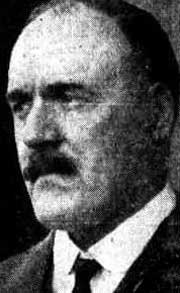
Sun 15 Aug 1937, p. 1.
Reproduction: Peter de Waal
Mr [Jack] Lang: [Opposition leader] It certainly looks as if the public revenues have been improperly used by the Treasurer. It certainly looks as if the Treasurer knew they were being improperly used and it has every appearance that the Treasurer connived at the secret and furtive repayment of the £2,000 of public money which was improperly used.
It is a longtime since the administration of any Government has been corrupted to the extent that the Stevens Government has been corrupted by its handling of the Maddocks affair. Maddocks was a public servant in the Police Department for many years. When Mr Stevens became a Minister in the Government he pretended to discover in Maddocks a man with a genius for handling transport matters. In the Bavin Government he had Maddocks appointed to a highly lucrative position and sent him on a world tour. When the Labour Government took office in 1930 it removed Maddocks from office and re-organised the transport facilities of the State into one department under Chief Commissioner [Charles Joachim] Goode. Goode was not personally known to any of the Ministers of the Labour Government, but he did have the reputation in the railway service of being the most able transport administrator in that service. When it became known that Mr Goode was engaged on draft legislation for the Government, the then Commissioner for Railways, Mr Cleary, sent a letter to the Premier. In this letter it was pointed out that some time previously at a departmental inquiry, Mr Goode had been found guilty of accepting a bribe. The Commissioner also pointed out that, as a result of the inquiry, Mr Goode had been dis-rated from the position of Chief Traffic Manager to Area Officer at Goulburn and that his salary, as a consequence, had been slightly reduced. As the Railway Commissioner apparently had not regarded Mr Goode’s offence as a very serious one, seeing that he held the responsible position of Area Commissioner, the Government decided to retain Mr Goode’s services in connection with the legislation being drafted. As Mr Cleary’s letter had not had the effect desired, the Railway Commissioner reconsidered Mr Goode’s case and dismissed him from the service altogether.
That was the second time that Mr Goode had been punished for the one offence, and had his services not been required by the Labour Government Mr Goode would still have been a trusted officer of the railway service, holding an important position. As the action of the Railway Commissioners in punishing a man twice for the same offence seemed to be an act of pure vindictiveness, the Labour Government still retained Mr Goode’s services.
When the legislation co-ordinating all the traffic activities of the State was passed by Parliament, the Labour Government appointed Mr Goode Commissioner for Transport, and when the Stevens Government took office it set up a Royal Commission inquire into this bribery allegation for which Goode had already been punished twice. The Royal Commission found much the same as the Railway Department inquiry had found, and Mr Goode was forced to resign from the Government service. When the Railway Commissioners held their inquiry into Goode and came to their decision the Bavin Government was in office, and apparently Mr Stevens, who was Minister for Railways during portion of the life of that Government, regarded Mr Goode as still being competent and honourable enough to occupy the position of Area Commissioner at Goulburn. But, when the Royal Commission returned a finding similar to that of the railway inquiry, Mr Stevens became shocked at what he described as corrupt and immoral conduct, and forced Goode out of the Railway service.
One of the chief points of the campaign conducted by the Premier in 1932 was the case of Commissioner Goode. During that campaign he went up and down the country, pointing out that Goode was immoral and corrupt, that the Labour Premier—that was I—and the Ministers who had agreed to Goode’s appointment knew of this corruption, and were themselves equally as immoral and corrupt as they said Goode was. The Premier particularly professed to be shocked at the discovery of this alleged state of affairs. “We must have a public service with clean, honourable men in it,” he said. “Return me at the head of a Government and I will purge the public life of all this corruption. I will kick out those dishonourable men and I will place in the important positions in this State men of honesty, integrity, high moral standards, men to whom the citizens of New South Wales will look up.” And the people returned the Stevens Government. Mr Stevens proceeded to clean out this alleged corruption and he forced Goode to resign his position. Goode was punished twice for the one offence.
Mr Sanders: The hon member knows there was more than one offence!
An Hon Member: He kept you in order, Teddy!
Mr Speaker: Order! It is entirely out of order for an hon member to address another hon member by his Christian name. I will thank hon members to discontinue the practice.
Mr Lang: It was done, said the Premier, so that he could appoint men of high moral standards. And what was the name of the man he put in Goode’s place? What was the name of the man of such moral character that he placed there to lift up the moral life of the community? His friend, Maddocks. And where is Maddocks to-day? In Goulburn Gaol, convicted of one of the most bestial crimes in the criminal calendar. The Premier knew Maddocks. He picked Maddocks as part of his campaign of improving the moral character of the public service. He set up Maddocks as a man whose conduct should be an example to every other member of the public service, and when I say that Maddocks was his friend I will recall to you a letter which the Premier wrote to Mr Gullett, relating to Maddocks. It reads:
The Hon HS Gullett, MP,
Minister for Trade and Customs,
Canberra.
Dear Mr Gullett,
I have received the attached letter from Mr SA Maddocks, who was, until recently, the Transport Commissioner of this State. I do not know anything about the position concerning which Mr Maddocks has written to me, but if there is a vacancy, I am quite sure his claims are worth very full consideration. I was largely responsible for his appointment as Transport Commissioner, and at my suggestion we sent him to tour the world to get the latest information. He is a man of tremendous capacity and has had a most unique training. He is an LLB of the Sydney University. I regard Mr Maddocks as an outstanding man, whose services should be utilised in the highest public sphere. If you have time to see Mr Maddocks I am quite sure you will quickly be able to size him up.
With kind regards,
Yours truly,
BSB Stevens.
Mr Solomon: What is the date of that letter? It was prior to this recent trouble!
Mr LanG: Before I have finished hon members opposite will be tested as to their professed broadness of mind, and as to whether they want to do the right thing by this State. There were cheers for the hon member for Concord when, in his speech, he referred to 1931. There is at least one person in this Chamber who does not fear to speak about 1931, and that is myself. The more hon members refer to it, the better I shall like it. But they should not squeal when I refer to things of the past. If hon members opposite want more of this sort of thing they will get it. If my statement that Maddocks was Mr Steven’s friend had not something to support it, I can imagine what hon members opposite would say. And so Maddocks was launched on his career of lifting up the moral character of the public service. Time after time the Premier and the Minister for Transport, Lt-Colonel Bruxner, came into this House and lauded Maddocks to the skies.
And then what happened? Maddocks was arrested. And how was he arrested? Just picked up by a policeman and taken to a police station and charged like an ordinary criminal? No. The Stevens Government does not treat men of high moral character like that. He was arrested by senior detectives and he was taken, not to a police station, but to the office of the Commissioner of Police. And he is not in the office of the Commissioner of Police for long before who should arrive on the scene but the Minister for Transport, Lt-Colonel Bruxner. Why the Lt-Colonel should go there the public has no explanation, but it is not long before the Minister for Transport is joined by the Minister of Justice. Something had to be done, apparently, but the job was too big for these two Ministers, so within an hour or two no less a personage than the Premier himself joining his colleagues in the office of the Commissioner of Police. Even the Premier found that he had struck a job that was too big for him, and in a short while His Majesty’s Attorney-General joins his colleagues in the office of the Commissioner of Police. And there they are from eight o’clock at night till two o’clock in the morning, the Commissioner of Police, the arresting detectives, the public servant of high moral character who had just been arrested for a bestial crime, and the Premier, the Attorney-General, the Minister of Justice, and the Minister for Transport.
The law is clear. When a man is arrested for a crime such as this he is taken to a police station and charged. But not so with a man like Maddocks. He is taken, not to a police station, but to what is virtually a meeting of Cabinet Ministers in the office of the Commissioner of Police. But the Cabinet meeting is too late. The police have been too efficient. In its first stages, at any rate, the law must take its course. At two o’clock in the morning this bright star of the public service is charged with the crime and his Ministerial friends return to their homes.
And then came a remarkable development. In the early part of the year the newspapers were very agitated as to who should represent the Government at the Coronation. It was thought that this honour would fall naturally to the Deputy-Premier, Lt-Colonel Bruxner. The newspapers announced, however, that the Minister for Transport had no intention of going to London for the occasion, and duly informed their readers of the log-rolling that was taking place for the selection of the members of the Empire Parliamentary Association of a representative to go to the Coronation. The rival candidates were Major Shand and the Minister for Social Services, Mr Hawkins. Manoeuvring went on for months, and at last reached the stage where it appeared that, while the Minister for Social Services was the elect of the Premier, Mr Stevens, Major Shand was most likely to get a majority of the votes of the members of the association.
It was at this stage that the community was shocked with the news of the arrest of Maddocks and the crime with which he was charged. It was also at this stage that the Minister for Transport, Lt-Colonel Bruxner, attended a Cabinet meeting in the office of the Commissioner of Police, and it was a few days after that Cabinet meeting that the newspapers announced that Lt-Colonel Bruxner would assist the Premier to unravel the tangle that had occurred over the Coronation representative by taking the trip himself. Although at that time there was in progress a referendum campaign involving issues in which the party led by Lt-Colonel Bruxner professed to be vitally interested, the Minister for Transport packed his bags and rushed off to Western Australia to catch a boat for London. He is still over there. Practically every other ministerial visitor who went to the Coronation has returned to Australia, but Lt-Colonel Bruxner is still tripping around Europe and it would appear that he is determined not to take boat for Australia until the Maddocks business has been disposed of by this Parliament. He is apparently disinclined to return while there is the probability of the Maddocks case being dealt with by Parliament and until a few days ago it appeared that the Government had no alternative to having the case so dealt with.
When arrested, Maddocks, in accordance with the terns of the Act under which he was appointed, was suspended from office. In the section of the Act relating to a suspended commissioner it says that a statement setting out the condition of his suspension must be tabled in Parliament within seven days of the commencement of the session. It further states that within twenty-one days of such statement being tabled the suspended commissioner shall be restored to his position unless both Houses of Parliament, by resolution, declare that he should be removed from office. The Government now hopes to avoid following this procedure. It issued a statement to the Sydney Morning Herald pointing out that there was no need for this resolution, because Maddocks had automatically forfeited his office as Commissioner for Transport. The newspaper article was written in such a way as to make it appear that Maddocks was being summarily removed and severely dealt with. But is that what is happening?
Paragraph (d) of section 12, says:
A commissioner shall be deemed to have vacated his office if he becomes incapable of performing his duties.
The Government argues that, as Maddocks is in Goulburn Gaol and will be there for some time, he is unable to perform his duties and consequently has forfeited his office. But when a man like the Premier picks up a shining start of moral rectitude, probity and honesty, he does not drop him as easily as that. By allowing Maddocks to go out this way the Premier renders a signal service to his erstwhile friend. Section 9 of the Transport Act governs the superannuation rights of commissioners appointed under the Act. Subsection (2) of section 9 lays it down very clearly that a commissioner who was a contributor to a superannuation fund, if he ceases to hold office by effluxion of time, resignation or retirement, or becoming incapable, shall be entitled to any payment, pension or gratuity as if he were an officer within the meaning of the Act. So we find that Maddocks is to be allowed to retain his full superannuation rights. What happens to a worker in Maddocks’ department if an inspector catches him reselling tram-tickets or being a few shillings light in his cash? The result is instant dismissal from the service, the loss of any claim on superannuation payments and the forfeiture of all money he has paid into the superannuation fund. That is what happens to a worker in the Transport Department, but the Commissioner, who happens to be a friend of the Premier, is to be allowed to retain his full superannuation rights, even though he is convicted of one of the most serious crimes. Why is it necessary for Cabinet to be further considering the Maddocks case? The law is simple; it is clear. It says that when Maddocks is suspended the Minister is to table a report regarding the suspension within seven sitting days of the opening of Parliament and that within a further twenty-one days, a resolution of both Houses of Parliament is to be passed dismissing him from office. Why has not that report been tabled? Why the necessity for all this shuffling on the part of the Ministry? If the procedure under the Act is followed Maddocks will be dismissed for misbehaviour, and forfeit all his superannuation rights.
It requires no weighty consideration on the part of Ministers to put the Act into operation. It is just a simple, routine matter for the Minister to attend to. If Cabinet is giving this consideration to Maddocks it can only be for one thing—to try to save him from the full consequences of his crime. Maddocks’ suspension took place months ago. The report relating to the suspension should have been prepared immediately after the man was convicted; but apparently even that has not ben done. The Premier must do it, so he might as well face up to it. We know that he is just as anxious to help Maddocks now as he was on the night of the arrest, when he held the Cabinet meeting in the Police Commissioner’s office. There was no need to hold a meeting of Ministers to decide to charge Maddocks. That decision would have been made by the arresting detectives in the ordinary way. A meeting of Ministers could have been held only to try to prevent Maddocks being sent to trial or to see that the charge levelled against him was as innocuous as possible. The Government is facing the same position to-day. If Maddocks is to be dismissed according to the Act there is no reason for any Cabinet meetings.
Mr Stevens: The hon member may be interested to know that Maddocks’ action brought him under the Crimes Act. That supersedes anything under the Transport Act. There is no need to take any action so far as this Parliament is concerned.
Mr Lang: The procedure under the Transport Act is the law of this State.
Mr Stevens: So is the Crimes Act.
Mr Lang: The Minister in the ordinary course of his duties tables the report and the resolution comes on. The Premier only requires Cabinet meetings if he is trying to save his friend from the full consequence of his crime. And that is what has been done. By appointing Maddocks’ successor without removing Maddocks from his office according to law, the Premier has paved the way for this man, now serving a prison sentence, to leave the Public Service with all the rewards and emoluments of a man who has completed an honourable career in the service of the public. In doing this the Government is guilty of conduct which outrages every sense of decency in the community and is a party to a scandal which no Government should be allowed to survive. I move:
That the Address be amended by the addition of the following words, to stand as paragraph four: We also desire to inform your Excellency that the Government does not possess the confidence of this House.
Mr Davidson (Cobar) [8.52]: I rise to support the amendment moved by the leader of the Opposition, and I do so because I am satisfied at least 90 per cent of the people of New South Wales are definitely of the opinion that the present Government, if not corrupt, has proved itself to be absolutely incompetent to carry on the affairs of this State for any further term. There has never been a Government in charge of the affairs of this State that has exhibited such incompetence and such audacity and shown so little understanding as this Government.
~ ~ ~ ~ ~
The Sydney Morning Herald, Fri 13 Aug 1937 61
SUPREME COURT.
———
FULL COURT.
(Before the Chief Justice, Sir Frederick Jordan,
the Chief Justice in Equity, Mr Justice
Long Innes, and Mr Justice Davidson).
JURISDICTION QUESTIONED.
Re Maddocks.
The Court called on for hearing a rule under which Sydney Aubrey Maddocks was to show cause why his name should not be removed from the roll of barristers. It had been reported to the Court by the Prothonotary that Maddocks had been convicted at the Quarter Sessions.
Mr Lynch, junior counsel for Maddocks, said that Maddocks would oppose the application. It was requested that the hearing should be adjourned. Maddocks, it was explained, was in Goulburn Gaol.
The Chief Justice: On what grounds do you want the adjournment?
Mr Lynch: The jurisdiction of the Court to deal with this matter is in question.
The Chief Justice: To remove the name of a person from the roll?
Mr Lynch: Yes, your Honor.
The Chief Justice: But that is covered on the authority of the Privy Council and of this Court.
Mr Lynch: Yes. I appreciate that. However, our ground is that we want to go further into the matter.
The Chief Justice: Can you suggest any matter that can be urged a fortnight hence that cannot be urged now.
Mr Lynch: From the decisions of the Privy Council, and this Court it appears that there is some question to be argued jurisdiction.
The Chief Justice: The Privy Council put it on the ground of inherent jurisdiction.
After further argument, the hearing was adjourned for a fortnight.
Mr [Clive] Teece, KC and Mr KA Ferguson (instructed by Messrs FW Walker and Son) appeared for the Bar Council of New South Wales to assist the Court; and Mr HW Moffitt and Mr JP Lynch (instructed by Mr Osborne M Allen) for the respondent barrister.
~ ~ ~ ~ ~
Truth, Sun 15 Aug 1937 62
MADDOCKS HAS NOT YET BEEN SACKED
————————————
Government Has Dodged Its Legal Responsibility
————————
SUPERANNUATION LOOPHOLE
———◦———
Premier’s Explanation In House
Cannot Be Accepted.
A MOST unsatisfactory situation has developed out of the Maddocks scandal. It now appears that unless an Act of Parliament is promulgated to sack Maddocks formally, the former Transport Dictator may get superannuation, long-service leave money, and holiday money when he comes out of Goulburn Gaol. Already Maddocks is contesting his removal from the roll of barristers, and it is certain that if the Government leaves any loophole Maddocks will take advantage of it when he comes out of gaol. Parliament appointed Maddocks and clothed him with robes of high authority. Now Parliament must sack him. Anything less than this will not satisfy the public, and the matter will be used against the Government with telling effect at the forthcoming elections. It is a very serious affair, indeed. The attitude of the premier is certainly mystifying!
Maddocks proved himself unworthy of the trust placed in him; he escaped with a particularly light sentence for his horrible crime, and his treatment when arrested cannot be waved aside with an airy gesture.
If Maddocks had been a poor and friendless man he would have been taken straight to the nearest police station and charged and locked in a cell.
A blanket would have been thrown in to him, and he would be left there until he was formally charged in open court.
But Maddocks was brought all the way from the bushlands of Northwood to the city. He was not taken to any common police station. Oh, no, he was taken to the office of the Commissioner of Police. Then he was given a comfortable chair, and urgent summonses were sent to the Premier (Mr Stevens), the Minister for Transport (Mr Bruxner), the Attorney-General (Mr Manning), and the Crown Solicitor (Mr Clarke).
They all trooped into the police headquarters, and it was not until six hours later that Maddocks was charged. And when he WAS charged, he did not suffer the indignity of being put in the charge dock like ordinary prisoners. He suffered no such humiliation.
Why did the Ministers troop down to the office of the Commissioner of Police? Why wasn’t Maddocks charged for six hours?
Now we find that on legal advice the Government has decided that Maddocks will not be dealt with by Parliament. Government legal advice in the past has been most illuminating, and we have the examples of dismissed members of the old Meat Board and the Western Lands Board suing the Government and receiving thumping verdicts. There has been divergence of opinion between Government legal advice and court decisions in the past. Is the Government afraid to put the Maddocks case and the dictatorial powers of the Road Transport Commissioner to the test in Parliament?
“Truth” believes that the public is anxious for this case to be discussed freely by members of Parliament, and that Parliament be given the opportunity to express its abhorrence of the principle of dictatorial powers conferred on high public servants. Parliament must not shirk its duty, and Parliament can force the Government to bring this burning question to issue on the floor of the House.
What Act Says
The case of Maddocks is different from the case of any “other dismissed Government employee” that is dealt with by the Superannuation Board. Maddocks held his position by special Act of Parliament, so how does he come into the same category as other Government employees?
Last week in Parliament, in moving a censure motion against the Government, Mr Lang declared that by the method of his removal from office Maddocks is enabled to retain his superannuation and other rights.
Mr Lang said a clause of the Act under which Maddocks was appointed relates to suspension from office. It says that a statement setting out the conditions of his suspension must be tables in Parliament within seven days of the commencement of the session.
It further states that within 21 days of such statement being tabled, the suspended Commissioner shall be restored to his position unless both Houses of Parliament, by resolution, declare that he should be removed from office.
“The Government now hopes to avoid following this procedure. It issued a statement to the ‘Sydney Morning Herald,’ pointing out that there was no need for this resolution because Maddocks had automatically forfeited his office.”
And then Mr Lang came to the meat of his argument. He said: “Clause 9 of the Transport Act governs the superannuation rights of the Commissioner appointed under the Act. Sub clause 2 of clause 9 lays it down very clearly that a Commissioner who was a contributor to a superannuation fund who ceases to hold office or effluxion of time, resignation or retirement, or becoming incapable, shall be entitled to any payment, pension, or gratuity as if he were an officer within the meaning of the Act.”
The Premier answered Mr Lang by reiterating that Maddocks had forfeited all his rights and he said that the president of the Superannuation Board had informed him that Maddocks’ case would be treated in exactly the same fashion as that of any other employee dismissed from the service.
Then the deputy-Leader of the Opposition (Mr Baddeley) came back with this: “What does it matter what the president of the Superannuation Board says? If, when Maddocks comes out of gaol, he takes his case to a judge, the judge will be guided by what the Transport Act says, not by what the president of the Superannuation Board says.”
And that is just the position as “Truth” sees it. Maddocks was appointed by Parliament. He must be properly dismissed by Parliament.
“TRUTH” GAVE WARNING
Countless public servants have lost their jobs—their all—through minor misdemeanors and small lapses. So it must be with Maddocks.
The Act sets out the proper way for Maddocks to be dismissed, and he must be dismissed in that way.
The Government appears to have another reason for not bringing down a proper Act of Parliament to sack him. And that is that is possibly fears a debate on the subject of these dictatorships which it has created.
The Lang bogey scared present Government members into elevating the Road Transport Commissioner, the Police Commissioner and the Auditor-General to the position of Czars. We are not greatly concerned with the Auditor-General, who is in no position to interfere with the liberty of the subject, but the position with the Transport and Police Commissioners is an entirely different proposition.
At the time the Police Regulations Bill went through Parliament “Truth” pointed out the danger of placing the Police Commissioner on a dictatorial pedestal. And much of what was predicted has come to pass. We have seen the futile attempts of the Chief Secretary to administer the police force and even the Premier has to admit that the all-powerful Police Department takes little notice of him. In the Department has grown up an attitude that the public does not matter, members of Parliament do not matter, and that police administrative officers are a law unto themselves. It is all wrong, and Parliament must rectify the position at once.
In the Transport Department we have officials overriding the findings of courts; we find officialdom ruling with a rod of iron, with no appeal from its rulings, and a ruthless and despotic bureaucracy dealing out a justice in which there is no evidence of British fairness, and an utter disregard for the public generally.
The Police Department and its method of secret inquiries has taken on itself to interpret the findings of juries, and to upset the verdicts of our law courts to suit its own ends.
We have the Transport Department confiscating buses and routes with the same ruthless methods employed in Soviet Russia, and without compensation. One case in particular came before the courts where a man, once a prosperous bus-owner, was forced to steal food for his wife and children. The judge refused to convict, and passed some caustic comment on the action of the Transport Board. That such things can happen in Australian democracy is a disgrace.
And it has been brought about by a Government that has placed public servants out of reach of the people. It has created Frankensteins that are tearing to pieces our liberties and giving us a brand of justice alien to Australia.
Maddocks must be properly sacked by Parliament, even though the consequent debate in the House on the subject of the public service dictators is unpleasant and embarrassing to the Government.
…
MADDOCKS AS
BARRISTER
On the ground that the Full Court lacks jurisdiction, it was stated by counsel last week, Sydney Aubrey Maddocks, former Transport Commissioner, intends to oppose the application made to have his name struck off the roll of barristers of the Supreme Court of NSW.
Mr JP Lynch, who with Mr HW Moffitt appeared for Maddocks, told the Chief Justice (Sir Frederick Jordan) that was in Goulburn Gaol and that it had been impossible for him to get full instructions on the matter.
Mr Lynch asked for an adjournment for a fortnight.
The application was granted.
The Full Court was moved to make a rule nisi, calling upon Maddocks to show cause why his name should not be struck off the rolls.
The Chief Justice said that because Maddocks wished to go further into the matter was no ground for adjournment.
Mr Lynch replied that on the ground of jurisdiction there was a slight question which might be pressed.
“The sentence will last beyond the time of the adjournment,” said the Chief Justice, “so there would be no attempt on the part of Maddocks to engage in practice.”
Mr Clive Teece, KC, and Mr KA Ferguson, who appeared on behalf of the Bar Association, were asked by the Chief Justice what their attitude was. Mr Teece replied that they were there to offer any assistance to the Court, but were prepared to go on.
However, to enable Mr Lynch and Mr Moffitt to communicate further with Maddocks, the matter was adjourned for a fortnight.
~ ~ ~ ~ ~
Truth, Sun 22 Aug 1937 63
MADDOCKS MUST BE
SACKED BY GOVT
———◦———
Grave Legal Doubt Must Be
Wiped Out
Maddocks, the degenerate former Commissioner for Transport, has not yet been properly sacked as required by the Act of Parliament which appointed him.
And unless Maddocks IS properly sacked by an Act of Parliament it seems that he will emerge from gaol with his superannuation money, holiday pay and service leave allowances intact. Thus, he will come out of Goulburn Gaol and collect cash.
Last week, following “Truth’s” disclosure of the additional Maddocks ‘ scandal, a Ministerial announcement was made that “if there was any legal doubt as to the position of Maddocks the Government would, if necessary, introduce special legislation to deal with the matter.”
This newspaper again tells the Government that there IS grave legal doubt and that special legislation IS necessary. If the Government does not immediately rectify the position it may be sure that the affair will be used against it at the next elections.
Mr Stevens may not be aware of it, but the fact is that the public has been gravely disturbed concerning Maddocks and the preferential treatment he received, and is still receiving.
The only way to disperse any doubts about Maddocks is to have him publicly sacked by Parliament and to allow a debate on the floor of the House. It would be an embarrassing debate, because it would allow free discussion of the whole subject of appointing dictators in the Public Service with fabulous salaries and with powers which transcend even those of the elected representatives of the people.
The Government asserts that Maddocks’ conviction means that he has been automatically sacked. It has been said that the Government has had legal advice to this effect. But the Government’s legal advice has been extremely frail in the past.
Sub-clause 2 of clause 9 of the Act which conferred dictatorial powers on Maddocks lays it down that a Commissioner who was a contributor to a superannuation fund who ceases to hold office by effluxion of time, resignation or retirement, or becoming incapable, shall be entitled to any payment, pension, or gratuity as if he were an officer within the meaning of the Act.
The public must be reassured. Maddocks must be sacked by an act of Parliament.
~ ~ ~ ~ ~
Newcastle Morning Herald and Miners’ Advocate, Fri 27 Aug 1937 64
SA MADDOCKS
————
NAME STRUCK OFF ROLL OF
BARRISTERS
Sydney, Thursday.
The name Sidney Aubrey Maddocks, former Commissioner of Transport, who is now undergoing a term of imprisonment, was to-day struck off the roll of barristers.
When the matter was before the Full Court a fortnight ago, Maddocks, through his counsel, resisted a motion to make absolute a rule nisi calling upon him to show cause why his name should not be struck off.
To-day the opposition was withdrawn, and the Full Court then ordered that Maddocks’s name be struck off the roll.
~ ~ ~ ~ ~
The Sydney Morning Herald, Fri 27 Aug 1937 65
SUPREME COURT.
———
FULL COURT.
(Before the Chief Justice, Sir Frederick Jordan,
Mr Justice Halse Rogers, and Mr Justice
Bavin.)
BARRISTER’S NAME REMOVED.
On the application of the Prothonotary the Court made absolute a rule requiring the removal from the roll of barristers of the name of Sydney Aubrey Maddocks.
The application was not resisted.
Mr Teece, KC and Mr KA Ferguson (instructed by Messrs FW Walker and Co) appeared for the Bar Council; and Mr JP Lynch (instructed by Mr Osborne M Allen) for the barrister.
~ ~ ~ ~ ~
NSW Parliamentary Debates, Legislative Assembly, Tue 28 Sep 1937 66
Lt-Colonel Bruxner (Tenterfield), Deputy-Premier and Minister for Transport (5.32): I regret that on the first occasion on which I rise in this old Chamber, on my return from abroad, I am forced to speak on a Supply Bill, not on the question of supply, but to review some of the statements made by the leader of the Opposition during my absence abroad. He has just resumed his seat after one of his characteristic attacks on other people in this House. I was surprised that the hon member was allowed by some of his own supporters to make those statements, but I am quite certain that they did not share the views expressed by him in regard to myself. What I intend to do is to place on record a reply to the hon member’s remarks during the course of the censure debate, when I was not here, and when it was suggested that I was out of this country, and staying out of it, because I was afraid to stand in this House and answer for some of my actions in the administration of my department. In other words, that I was afraid to be here and answer what he might say.
I have been in this House for eighteen years, and I put it to every hon member whether or not I have ever been afraid to answer anything that the hon member or anyone has had to say about me, about my administration, or about anything else. Time and again I have seen the hon member leave this Chamber when I have been speaking. I remember on one occasion, not so many years ago, when the hon gentleman made certain charges in regard to cases of sheep stealing at Guyra. He promised the most serious disclosures the world had ever seen. He said that he would go to Guyra and tell the people there what I had done. He went to Guyra and stood in the crowded hall. When asked to make the disclosures he had promised he said—and his words are on record in the Guyra press—“You know I have not the privilege of Parliament here, and there is a man taking down in shorthand all I say. Therefore, I cannot say what I would like to say”; and he did not say it. The answer to the hon gentleman’s speech at Guyra was that I received the best vote I had ever obtained in Guyra, and I hope the hon gentleman goes there again, because wherever he goes, and wherever he tries to throw his dirt and his filth, the man on the other side will always win.
Mr Shannon:
The Chairman: Order! I call the hon member for Phillip to order.
Lt-Colonel Bruxner: I came into the Chamber on several occasions this afternoon and listened to the leader of the Opposition, and while he was talking I did not hear one interjection from this side. I do ask that I might be given the same privilege as was extended to the hon gentleman. I hope that he will take with placidity, if he can, what I am going to say, and I do not wish to delay the Committee any longer than I need, but I want to place on record a reply to some of the misstatements—and, in fact, untruthful statements—made by him in the course of the censure debate. The hon member, in dealing with the case of the ex-Commissioner for Road Transport and Tramways, Mr Maddocks, said that I had left this country because I was afraid to stand up in this House and meet the charges that he was evidently going to level at me in connection with the case of Mr Maddocks; that it had been announced in the press that I would not go as the New South Wales representative to the Coronation; and then, since the Maddocks case occurred, I changed my mind so suddenly that I dashed off out of this country while there was in progress a referendum campaign in which my party was particularly interested, and in which I ought to be taking part, and caught the ship in Western Australia.
I am only going to deal with these three points. First of all, the hon gentleman said that I had definitely turned down the offer to represent New South Wales at the Coronation. Nobody knew better than the hon member that that was correct. If he will remember, and I ask him to remember—I hope he is prepared and is man enough, to recall, and also to agree that what I say is correct. Out there in that lobby, at the end of last year, when this House was finishing its session, the hon member came to me and said, “Is it correct that you are not going to the Coronation?” I said, “Yes, that is a correct statement.” “Well,” he said, “you ought not to have made it. If there is any man who ought to go from this country to represent this State it is you. You are the one man who nobody can throw bricks at and, so far as my fellows are concerned, they will be glad to see you go.” I said to the leader of the Opposition, “I am very grateful to you indeed, for your kindly expressions.” I have to admit that I was almost staggered by the kindliness and decency of the hon member on that occasion. I really believed he meant what he said. I then said, “I feel, to some extent, that I should go abroad, but there are very strong personal reasons why I should not.” I mentioned the reasons, but I shall not repeat them here, because the Premier has done so. They were too close and too personal to be repeated here today. The leader of the Opposition came to me voluntarily and expressed a desire that I should take the trip. He said that he and his supporters would like me to go. I took him into my confidence and told him the only reasons that prevented me from accepting the offer.
Mr O’Sullivan: Let it go at that!
Lt-Colonel Bruxner: I will not let it go at that, because I would much prefer the leader of the Opposition to remain the man he always has been to this House—that is a man whose statements one cannot trust. As I said, he came to me and I though that there was something genuine and decent behind his words.
Mr Shannon: The Deputy-Premier “fell” for him!
Lt-Colonel Bruxner: Yes, I did, and when I thanked him for what he said, he laughed. But if that is the sort of thing that will help democracy in this country, heaven help us. Later on, the leader of the Opposition said that because Mr Maddocks case was coming on, I suddenly changed my mind, left the State, and missed the Marketing Referendum in which my party, he said, was definitely interested. The Marketing Referendum was held on the 6th March, I left Sydney—not Western Australia—by train on 29th March, and I am afraid that the various speeches I made in favour of the referendum must have missed the leader of the Opposition’s attention, because hon members generally, and the press, know that I travelled over a great part of the State and took a full part in the referendum campaign. The statements of the leader of the Opposition are inaccurate. He is too ready to put anything into Hansard, as far from the truth as he likes, provided he thinks his action will hurt someone. He says I dashed off while the referendum was in progress and caught the steamer in Western Australia. The fact is that I left Sydney by train on the 29th March and boarded the vessel at Melbourne—not at Fremantle as the leader of the Opposition has said. Hon members can judge the inaccuracy of the hon member’s remarks from that statement alone. The leader of the Opposition also said that I was tripping somewhere about Europe, instead of taking my part in Parliament while the Maddocks case was being discussed. Well, I am in Parliament to-day, and the Maddocks case can be discussed here at any time—to-day if hon members like. I am prepared to discuss it here to-day. I want to place on record that never since I have been in Parliament have I been afraid to answer any charge preferred against any department of which I have been ministerial head. The leader of the Opposition said that I had no business to go to the Commissioner of Police on the night that Maddocks was arrested. He also said that neither the Premier nor the Attorney-General had any right to go to the Commissioner’s office.
Mr Shannon: Neither they had!
Lt-Colonel Bruxner: I was called up by the Commissioner of Police, and rightly so. The man who was charged was one of the senior officers of the State. He was in charge of a department, involving the convenience of many thousands of people, and a continuous service. Maddocks was arrested, but on that night he had not been convicted. The first man who ought to have been told about the offence was the ministerial head of the department, and that was I. It was essential that Maddocks should be removed from his position as head of the department at once, and that somebody should be appointed to carry on the administration the next day. In order that there should be no mistake in the legality of what was being done, in removing Maddocks from office, and appointing a successor, both the Attorney-General and I very properly discussed the matter. But the suggestion that the arrested man was in the room with us, is untruthful and too stupid for words.
Mr Shannon: Why did you use the Commissioner’s office?
Lt-Colonel Bruxner: Because the Commissioner of Police was there. He had all the information, and it was late at night. We discussed what we should do next day to place the department under an active commissioner so that it could carry on. That was the responsibility that rested with me. Maddocks was one of my senior officers, and the Commissioner of Police did the right thing by letting me know he was under arrest, and that he would be charged. Maddocks having been charged, I had to consider what I was going to do to enable the department to carry on. The leader of the Opposition, with his usual inaccuracy and untruthfulness, for which he is famous all over the world, took advantage of my absence. He said I left Sydney before the referendum took place, but the fact is that it was more than three weeks after the referendum votes were counted that I left this city. The leader of the Opposition could have made any public statement he liked, as he made in this House, before I left the State. As leader of the Opposition he could have said “I protest against Bruxner leaving the State until this man has been dealt with by Parliament.” But he said nothing. That was because he could not speak outside under Parliamentary privilege. I have now returned to the State, and if the leader of the Opposition can prove that I left the State before the referendum was held, let him do so now. If he wants to deny that in the passage outside hit Chamber he offered me his good wishes if I would accept the invitation to go abroad, let him do so. If he wants to deny that he said I was the man who ought to go, that I deserved the trip, and that I would do credit to the State abroad, let him do so now.
Mr Lang: I deny it now!
Lt-Colonel Bruxner: I leave it to hon members on both sides of the House, who know the leader of the Opposition, and who know me, to say whether they accept the leader of the Opposition’s denial, or whether they accept my statement. Let those hon members exercise their judgement regarding the leader of the Opposition’s erroneous statement that I was not in Sydney for three weeks after the referendum was held. His statement, on that occasion, should be proof enough of the manner in which he attacks the integrity and honesty of hon members without having the decency to first find out whether his statements are correct. I regret that on my first appearance in the Chamber, after my return from abroad, and after representing the State during the recent Empire celebrations in London, I should find it my duty to answer these charges. I thought that I left Sydney with the goodwill of everyone. I have met members of the Empire Parliamentary Association in Sydney, including hon members of the Opposition. They were unanimous in their request that I should go. I want hon members to remember that Maddocks was arrested on the 1st March, and charged on the 2nd. On the 10th March, I met the Committee of the Empire Parliamentary Association, which includes in its ranks members of the Opposition. The hon member for Redfern and the hon member for King were there, as well as others, and all of them made me feel that, after all, in spite of all political differences and otherwise, I was going away with their goodwill and approbation. I assured them that while I was abroad I would try to represent all side of this House worthily and to the best of my ability. That I have done. I was astounded, and, may I say, somewhat hurt—although I have been here long enough to take the knocks that come my way—to think that the leader of the Opposition, in making his attack upon the Government, should drag up this unfortunate incident, and try to make political capital out of it. The hon member has said something about democracy. If this House is to be subjected to the kind of talk we have had from him, not once, but on hundreds of occasions, and if the is going to make use of the privileges of this Parliament to cast mud and muck at men in the public life of this community, he will be doing more to imperil the democracy he prates so much about than any instrument that could be devised for the purpose. I say definitely, from my experience abroad, his conduct would not be tolerated in any other Parliament in the British Empire. The people would not stand a man of that character being in Parliament.
Mr Elliott: The people here would not stand him, and did not!
Lt-Colonel Bruxner: Yet here he is. Sitting beside the leader of the Opposition now is an hon member who is getting ready to rise to try to answer what I have said, and there are other hon members sitting opposite, none of whom believe for one moment what the leader of the Opposition tried to insinuate about me. Not one of them can point to a single time in this House when I have ever run away from a fight. They themselves know it. Not one of them would not come up to me outside and say, “I am glad to see you back.” Not one of them did not shake hands with me, if he was there at the time, and wish me farewell when I went away. Yet because the hon member for Auburn is their leader, and because, willy-nilly, they have to fall in behind him, they sit and listen in silence or with acquiescence to men being vilified and treated with the filth and dirt that comes from the leader of the Opposition. I do hope that as time does on we shall get away from that sort of thing. I do not mind how strong a debate is. I do not mind how sturdily hon members stand up for what they believe to be right. After all, that is democracy. But when they know the weakness of their case; when the leader of the Opposition has nothing but lies to put before the electors, or something that can be construed into filth, it is not debate, it is not democracy. It is, unfortunately, what we have been led to expect from the hon member. I deeply regret that for a few moments, on the occasion when the hon member spoke to me in the lobby, I thought he was a gentleman for the first time in his life. I am sorry I make the mistake. I am sorry I have found out that he is not.
(The Chairman left the chair at 5.55 pm. The Committee resumed at 7.30 pm.)
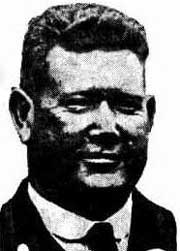
NSW), Sun 15 Aug 1937, p. 1.
Reproduction: Peter de Waal
Mr Baddeley (Cessnock) (7.32): I was rather surprised at the utterances of the Minister for Transport with respect to the statements of the leader of the Opposition, concerning the actions of the Premier while in London. As a member of the Parliamentary Empire Association, I am able to inform hon members that the assertion of the Minister for Transport that the leader of the Opposition, on behalf of the Labour members, wished him well on his visit abroad, is not strictly correct, because I myself did not vote in favour of the visit abroad being undertaken by the Minister for Transport. The man I favoured was the Minister for Lands. When Sir George Fuller was in England as Premier of this State, the hon member for Lachlan was Deputy-Premier. At one time he was the leader of the Country Party, and when he resigned the position was given to the present Minister for Transport. I contend that in respect of the visit abroad the Minister for Lands was deliberately let down my the Premier and the Deputy-Premier of this State.
I now wish to refer to what was said by the leader of the Opposition respecting SA Maddocks when the Minister for Transport was abroad. There is not doubt that the Commissioner of Police did telephone the Minister for Transport and asked him to attend at his office to ascertain what was wrong with the Commissioner for Transport. If any other departmental officer had committed an offence similar to that committed by Maddocks, I doubt very much whether the Minister would have rushed away to the office of the Commissioner of Police to ascertain what was wrong. The action of the Premier, the Minister for Transport, and the Attorney-General in attending the office of the Commissioner of Police to make a charge against Maddocks was uncalled for.
Brigadier-Gen Lloyd: The leader of the Opposition said that they went there to protect Maddocks!
Mr Baddeley: They went there first to protect him, but when they found that a serious offence had been committed by him, they endeavoured to make a suitable charge.
Brigadier-Gen Lloyd: That was fair!
Mr Baddeley: That may be so, but any other departmental officer, placed in a similar position, would have received no consideration at all. While the Commissioner for Transport was abroad, Mr Neale, his assistant, carried out the cuties of Commissioner without any fuss or bother.
Mr Ness: He was appointed to the position of Commissioner!
Me Baddeley: Of course, he was. He was Acting-Commissioner while Maddocks was abroad.
Mr LO Martin: Does not the hon member realise that Maddocks had to be suspended?
Mr Baddeley: There was no need for the Minister for Transport to spend all night at the office of the Commissioner of Police, nor was there any need for a sort of Cabinet meeting to be held to discuss the question of suspension. Surely the Minister for Transport himself could have suspended Maddocks.
Brigadier-Gen Lloyd: The hon member is making very heavy weather of the subject!
Mr Baddeley: The hon member knows perfectly well that if a tramway conductor had committed a similar offence no consideration at all would have been extended to him. The leader of the Opposition was undoubtedly justified in making his criticism, and the majority of the people outside applauded him.
Mr Monro: He lost hundreds of votes as the result of his statement!
Mr Baddeley: On the contrary, I believe that the UAP lost thousands of votes. Some members on the Government side have challenged the leader of the Opposition to repeat his remarks, but there is no need for him to do that because his speech can be read in Hansard. Mr Neil was quite capable of carrying out the duties of Commissioner, and since he has taken up that position it has been said that he had proved himself to be a better Commissioner than was Maddocks. I do not know the gentleman, but I have no doubt that he is a good officer. In all Government departments, when the Under-Secretary is absent, his duties are undertaken by his deputy, and in many instances the deputy proves himself to be a better officer than the Under-Secretary. In this case, Mr Neale was as good as, if not better than, his predecessor. I compliment him on his statement last Saturday night to the effect that the employees of the Transport Department were underpaid and that it was time the Government took action to better their wages and conditions. If he continues to adopt that attitude he will undoubtedly receive the support of the majority of the people of this State.
~ ~ ~ ~ ~
Goulburn Evening Penny Post, Fri 6 May 1938 67
MADDOCKS
RELEASED
FROM GAOL
————
Sydney Aubrey Maddocks, 56, formerly Commissioner for Transport, was released from the Goulburn Reformatory at 7 o’clock last night after serving 13 months’ imprisonment.
It was not expected that the prisoner would be released until 6.30 this morning, but the regulations provided that he could be discharged in the 24 hours preceding the normal time. By releasing him at 7 o’clock last night, the gaol authorities, intentionally or otherwise, thwarted attempts made by certain Sydney newspapers to secure an interview with the prisoner upon his release.
A representative of one metropolitan paper arrived in Goulburn early yesterday morning, and throughout yesterday maintained a watch on the Reformatory and railway station in the hope of securing an interview.
Maddocks, however, left the gaol at an unexpected hour and was whisked away in a Sydney taxi, which was waiting for him at the gates.
He was sentenced on April 9 last year to 18 months’ imprisonment, but earned full remissions by his good behaviour while an inmate. He proved himself a model prisoner.
~ ~ ~ ~ ~
Truth, Sun 8 May 1938 68
MADDOCKS OUT OF
GOULBURN GAOL
———◦———
SYDNEY AUBREY MADDOCKS, former Commissioner for Transport, was released from the Goulburn Penitentiary at 7 o’clock on Thursday night.
PADDOCKS WAS IMMEDIATELY DRIVEN OFF IN A SYDNEY PRIVATE-HIRE CAR TO AN UNKNOWN DESTINATION. HE LOOKED VERY HEALTHY AND FIT, AND SEEMED TO BE IN PARTICULARLY GOOD SPIRITS.
IN April last year he was sentenced to 18 months’ imprisonment. Thus he completed actually 13 months of the sentence, five months being remitted because of good conduct and the ordinary remissions which all prisoners are allowed automatically.
When he first went to Goulburn he was depressed and appeared to be in ill-health. His request that he should be permitted to work in the gardens was permitted and, digging and planting in the open air soon transformed his appearance.
Later, he went into the penitentiary office, where he handled the gaol accounts.
At first the other prisoners did not take kindly to his presence; but as the months wore on he became the centre of a group of friends, mostly players in the gaol orchestra.
Maddocks frequently acted as conductor. He plays the piano very well.
Some little time ago there was an upheaval in the orchestra, and there was some personal bitterness. It was rumored that Maddocks had been the cause, and that two of the players had refused to play any more while he was in the orchestra. This was denied.
Maddocks, in other leisure moments, wrote a great deal of poetry, some of it introspective and tragic.
What he will do with the poetry and some writing on which he spent a good deal of time during his 13 months in detention is unknown; but it is believed that he will endeavor to get a publisher to market his works.
He feels that he may be able to make his way upward again as a poet and novelist.
Goulburn was agog last week when it was known that Maddocks was soon to be released, and upon the arrival of excited daily newspaper reporters from Sydney, the very air quivered with gossip and rumors.
When the car arrived from Sydney the driver checked in at the local police station, and a telephone message was sent to the gaol. At the gaol, a warder made certain of the bona-fides, and thereupon the wicket gate at the main entrance swung open.
Somebody shook Maddocks warmly by the hand. He then turned, hurried to the car, briskly entered and sank back into a corner. The driver drove swiftly away.
And thus another chapter was written in a case that rocked the public service.
Michael John Gibson, 1948
The Sun, Wed 6 Oct 1948 69
DOWNFALL TRACED
TO EARLY LAPSE
A man who pleaded guilty in Quarter Sessions today to stealing in a dwelling, traced his downfall to his association with a former high Government official.
He is Michael John Gibson alias Petterson, cook.
Judge Lloyd sentenced him to 18 months. Before sentence was passed, Gibson entered the witness box and admitted a long list of previous convictions dating back to 1942, mostly for petty larceny.
Gibson said he met the then high Government official in 1936 and allowed himself to be misled.
After some months he found he was doing wrong and went to the police for aid.
He was released; the other man [Sydney Aubrey Maddocks] got 18 months.
As a result of the case, Gibson went on, his earning power was reduced to nil and his friends avoided him.
In 1941 he joined the Army, under his real name of Petterson, but was politely asked to leave.
He then joined under the name of Gibson, and served with the AIF in the Middle East and New Guinea.
~ ~ ~ ~ ~
Truth, Sun 10 Oct 1948 70
MADDOCKS CASE
ECHO IN COURT
————
Out of the past, at Darlinghurst Sessions this week, came an echo of the celebrated Aubrey Maddocks case of 1936, maddocks, then NSW Commissioner for Transport, was gaoled for 18 months for an unnatural offence.
On Wednesday, Michael John Gibson (30), cook, also known as Petterson, [aka Mikiel John Adams; Michael John Peterson], blamed his association with Maddocks for six years of almost continuous crime.
Petterson, who is at present serving a nine months’ gaol term for stealing, pleaded guilty to stealing a radio set, dressing gown, shirt and attache case from a room at a Phillip St residential on September 19.
Petterson told the judge that since the Maddocks case, his earning value was reduced, his home life was ruined.
He said he was kicked about for two or three years, became a hobo of sorts, and when he got a job, people got to know of the case because his face was “pretty familiar” and dismissed him after two or three weeks.
He joined the Army in his own name, he said, but after a few weeks was politely asked to leave, so he enlisted again in the name of Gibson, by which he had been known ever since.
After serving in New Guinea, he said, he was discharged on medical grounds, and after an 18 months’ sentence was reduced to stealing to get clothes.
“I am standing here today clothed by courtesy of the Salvation Army,” said Petterson.
“When I come put of gaol I have exactly what I stand up in. The result is all these cases of stealing to get clothes to get a job.
“Down this long list of convictions, there is not one occasion when I have been given a chance to get back on the right footing, and not one bond has ever been offered to me,” said Petterson.
Judge Lloyd sentenced him to 18 months’ imprisonment, to run concurrently with his present sentence.
Mr RR Kidston (Crown Prosecutor) Petterson in person.
1 Government Gazette of the State of NSW, (Sydney, NSW), Fri 22 Feb 1889, p. 1450.
2 Government Gazette of the State of NSW, (Sydney, NSW), Fri 1 Mar 1889, p. 1642.
3 The Daily Telegraph, (Sydney, NSW), Wed 4 Nov 1891, p. 3. Emphasis added.
4 The Daily Telegraph, (Sydney, NSW), Thu 5 Nov 1891, p. 3.
5 The Daily Telegraph, (Sydney, NSW), Fri 6 Nov 1891, p. 3.
6 Evening News, (Sydney, NSW), Mon 16 Nov 1891, p. 6.
7 Evening News, (Sydney, NSW), Thu 22 Sep 1898 p. 3.
8 The Sydney Morning Herald, (NSW), Fri 23 Sep 1898, p. 3. Emphasis added.
9 The Sydney Morning Herald, (NSW), Fri 7 Oct 1898, p. 7. Emphasis added.
10 The Australian Star, (Sydney, NSW), Tue 11 Oct 1898, pp. 5, 6. Emphasis added.
11 Evening News, (Sydney, NSW), Tue 11 Oct 1898 p. 4. Emphasis added.
12 The Sydney Morning Herald, (NSW), Tue 11 Oct 1898, p. 3.
13 Western Grazier, (Wilcannia, NSW), Wed 12 Oct 1898, p. 2.
14 Government Gazette of the State of NSW, (Sydney, NSW), Fri 12 May 1905, p. 3225.
15 Government Gazette of the State of NSW, (Sydney, NSW), Wed 1 Dec 1909, p. 6526. Emphasis added.
16 Government Gazette of the State of NSW, (Sydney, NSW), Wed 16 Feb 1910, p.1076. Emphasis added.
17 Government Gazette of the State of NSW, (Sydney, NSW), Fri 23 Apr 1913, p. 2499.
18 The Sydney Morning Herald, Sat 25 Dec 1925, p. 8.
19 The Sydney Morning Herald, Thu 10 Feb 1921, p. 9.
20 Government Gazette of the State of NSW, (Sydney, NSW), Fri 11 Jul 1930, p. 2759.
21 “Sydney Aubrey Maddocks (1881-1963), public servant, was born on 16 February 1881 at Surry Hills, Sydney, third child of Aubrey Sydney Maddocks, a native-born public servant, and his first wife Emily, née Dalley, who came from England. Educated at Fort Street Model School until the age of 14, Sydney worked in ‘commercial life’ before he joined the Colonial Secretary’s Department on 20 May 1901. He rose quickly to correspondence clerk (1914) and chief clerk (1916) in the office of inspector-general of police. At St Paul’s Anglican Church, Rothbury, on 1 December 1915 he married Hilda Evelyn Campbell; they were to have a son and thee daughters.
While secretary (from 1920) of the police department, Maddocks was appointed investigating officer (1928) for the Metropolitan Transport Services. He visited capitals and New Zealand to inspect their public transport system, and studied law at the University of Sydney (LL.B, 1930). On 4 June 1930 he was admitted to the Bar. He worked closely with Colonel Michael Bruxner, the minister for local government, in preparing a bill based on their conviction that transport should be ‘a public utility, not a source of private profit’. Maddocks was soon attacked by business interest for favouring an expanded public tramway system over private buses, but had strong political support from Bruxner. Between April and September 1929 Maddocks visited Europe and North America. His Report on Transport and Traffic Control Abroad was published in 1930. Under the Transport Act (1930), he was appointed commissioner of road transport, with control of the tramways and extensive powers to regulate the private bus system. His office was abolished in March 1932.
Following the Lang government’s fall, Bruxner became minister for transport and, with Maddocks’s help, drafted the Transport (Division of Functions) Act (1932) which created three departments headed by powerful commissioners. On 30 December 1932 Maddocks was gazetted commissioner for road transport and tramways, on a salary of £2500 per annum. One year later he claimed to have turned disastrous losses on the tramways into a profit, while investing in new rolling stock, reducing fares and retrenching debt. He had a lined but handsome face, thick dark hair, and the broad smile and dapper dress of a bon viveur. Fond of golf, tennis and surfing, he lived in Bower Street, Manly; he was also a talented violinist and producer of amateur theatricals.
Maddocks was a powerful figure surrounded by public controversy and private tensions. Early in 1937 he became involved in a dispute with elements of the police department over control of a road safety campaign at a time when he was also implementing changes to bus routes and services which threatened job losses. On the day the changes came into effect (1 March 1937) Maddocks was arrested in his car in secluded bushland at Northwood with an 18-year-old, unemployed houseboy named Mikiel John Adams, alias ‘Peterson’. Both men were naked. Maddocks was charged with indecent assault and ‘attempting to commit an unnatural offence’. He was suspended from the public service by the governor and later disbarred.
Although he denied the charges, Maddocks was convicted at the Sydney Quarter Sessions on 8 April 1937 and sentenced to eighteen months imprisonment. Adams, who hade made a prior arrangement with police to lay the trap, was not indicted. Maddocks’s defence counsel WJ Curtis described Adams as ‘an effeminate degenerate’ who had stolen personal items from Maddocks as part of a plan to blackmail him.
Onlookers in the public gallery wept as Maddocks sobbed frequently during his speech from the dock, in which he attributed his behaviour to stress, overwork and heavy drinking. In Sydney the case was a cause célèbre. …
After his release in May 1937, Maddocks eventually formed a partnership with his son in a shop at Manly. He died on 31 October 1963 at his home and was cremated; his wife and children survived him.”
Source: Michael Flynn, Australian Dictionary of Biography, vol 15, MUP, 2000.
22 Auckland Star (Auckland, NZ), Mon 24 Aug 1936, p. 8.
23 Evening Post (Wellington, NZ), Mon 24 Aug 1936, p. 10.
24 The Muswellbrook Chronicle, (NSW), Tue 2 Mar 1937, p. 2. Emphasis in original text.
25 SRNSW: NRS4232, 2 March 1939 [AK 471], Executive Council, Minute books, 2 Mar 1939, p. 119.
26 The Daily Telegraph, Wed 3 Mar 1937, p. 7. Emphasis in original and added.
27 The Sydney Morning Herald, Wed 3 Mar 1937, p. 16.
28 Truth, (Syd, NSW), Sun 7 Mar 1937, p. 23. Emphasis in original and added.
29 The Bulletin, (Sydney, NSW), Wed 10 Mar 1937, p. 16.
30 Truth, (Syd, NSW), Sun 14 Mar 1937, p. 17. Emphasis in original and added.
31 Barrier Miner, Tue 16 Mar 1937, p. 3. Emphasis added and in original text.
32 SRNSW: NRS847, [10/38419], Register of criminal cases tried at Sydney Quarter Sessions 1937, case number 275, p. 225.
33 Newcastle Morning Herald and Miners’ Advocate, Wed 17 Mar 1937, p. 9. Emphasis added.
34 Northern Star (Lismore, NSW), Wed 17 Mar 1937, p. 9. Emphasis added.
35 The Sydney Morning Herald, Wed 17 Mar 1937, p. 15.
36 Truth, (Syd, NSW), Sun 21 Mar 1937, p. 24. Emphasis in original and added.
37 SRNSW: NRS2713, [6/1919], Transcripts of evidence of the various courts, royal commissions, boards of inquiry, 1937, pp. 1-51. Emphasis added.
38 The Sun, (Sydney, NSW), Thu 8 Apr 1937, p. 21. Emphasis in original and added.
39 Barrier Miner, Fri 9 Apr 1937, pp. 3, 6. Emphasis in original and added.
40 The Daily Telegraph, Fri 9 Apr 1937, pp. 4, 20. Emphasis added.
41 Newcastle Morning Herald and Miners’ Advocate, Fri 9 Apr 1937, p. 12. Emphasis added.
42 The Sydney Morning Herald, Fri 9 Apr 1937, p. 12.
43 Auckland Star (Auckland, NZ), Sat 10 Apr 1937, p. 9.
44 The Daily Telegraph, Sat 10 Apr 1937, pp. 1, 4. Emphasis in original and added.
45 The Sydney Morning Herald, Sat 10 Apr 1937, p. 17.
46 Truth, (Syd, NSW), Sun 11 Apr 1937, pp. 1, 21, 23. Emphasis in original and added.
47 The Daily Telegraph, Mon 12 Apr 1937, p. 2. Emphasis in original.
48 Singleton Argus, Mon 12 Apr 1937, p. 1.
49 Northern Star (Lismore, NSW), Tue 13 Apr 1937, p. 10.
50 The Sydney Morning Herald, Tue 13 Apr 1937, p. 12.
51 The Bulletin, (Sydney, NSW), Wed 14 Apr 1937, p. 13.
52 Newcastle Morning Herald and Miners’ Advocate, Fri 16 Apr 1937, p. 12.
53 Truth, (Syd, NSW), Sun 18 Apr 1937, p. 1. Emphasis in original and added.
54 Government Gazette of the State of NSW, (Sydney, NSW), Fri 14 May 1937, p. 1922. Emphasis added.
55 SRNSW: NRS– [17/1521], State Penitentiary photographic description book, 4 Feb 1937-17 Apr 1937, No. 30248, p. –.
56 Truth, (Syd, NSW), Sun 20 Jun 1937, p. 1. Emphasis in original.
57 Truth, (Syd, NSW), Sun 27 Jun 1937, p. 23.
58 The Sydney Morning Herald, Fri 16 Jul 1937, p. 11.
59 The Sydney Morning Herald, Fri 30 Jul 1937, p. 8. Emphasis added.
60 NSW Parliamentary Debates, Legislative Assembly, Tue 10 Aug 1937, pp. 70-5. Emphasis added.
61 The Sydney Morning Herald, Fri 13 Aug 1937, p. 5. Emphasis added.
62 Truth, (Syd, NSW), Sun 15 Aug 1937, pp. 1, 12. Emphasis in original and added.
63 Truth, (Syd, NSW), Sun 22 Aug 1937, p. 16. Emphasis in original.
64 Newcastle Morning Herald and Miners’ Advocate, Fri 27 Aug 1937, p. 13.
65 The Sydney Morning Herald, Fri 27 Aug 1937, p. 6.
66 NSW Parliamentary Debates, Legislative Assembly, Tue 28 Sep 1937, pp. 1125-30. Emphasis added.
67 Goulburn Evening Penny Post, Fri 6 May 1938, p. 5. Emphasis in original text.
68 Truth, (Syd, NSW), Sun 8 May 1938, p. 18. Emphasis in original text.
69 The Sun, (Sydney, NSW), Wed 6 Oct 1948, p. 2. Emphasis in original text.
70 Truth, (Syd, NSW), Sun 10 Oct 1948, p. 25. Emphasis in original text.