Francis John Kitchener Nolan and Rupert Samuel Thorn, 1917
Below also see: Rupert Samuel Thorn and Clarence Henry John Thomas, 1922,
Rupert Samuel Thorn, et al, 1924,
Rupert Samuel Thorn, 1928 – Indecent exposure,
Rupert Samuel Thorn, et al 1933
The Sydney Morning Herald, Wed 6 Jun 1917 1
LAW NOTICES.
———◦———
Wednesday, June 6
————
…
QUARTER SESSIONS.
Joseph Alfred Gerrard, breaking and entering with intent to steal; Francis John Kitchener Nolan 2 and Rupert Samuel Thorn, breaking and entering with intent to steal; Arthur Geary Miller and Frank O’Grady, breaking and entering and stealing; Guiseppe Ferlazzo, criminal offence.
The following appeals against Magistrates’ orders and convictions will be heard in the Court-house, Queen’s square:—James Aaron John Parkes, maintenance; Edward Jones, maintenance; Joseph Benedict Clarke, varied order of maintenance; Thomas Doyle (1) maintenance, wife, (2) maintenance, child; Frederick George Gurrin, maintenance.
~ ~ ~ ~ ~
The Daily Telegraph, Thu 7 Jun 1917 3
CRIMINAL.
————
At the Quarter Sessions, before Judge Docker, Guiseppe Ferlazzo was found not guilty of a criminal offence upon a girl under the age of 16 at Petersham on January 26. Mr Boyce, with Mr Shephard, appeared for the accused. The defence was not called upon. The jury was not satisfied as to the age of the girl.
Joseph Alfred Gerrard, charged with breaking and entering the dwelling-house of William Aller, at Hornsby, on May 8, with intent to steal, was found not guilty, and accused was discharged.
His Honor passed the following sentences:—
Thomas McClelland (22), for the theft of goods from the premises of Arthur White, at Waterloo, on May 11, two years’ hard labor. Edward Verco (19) was sentenced to one year’s imprisonment on the same charge.
Michael O’Farrell (49), for maliciously wounding James Cunningham at Sydney, on April 27, three months’ imprisonment. The Jury had made a recommendation to mercy. His Honor said if compensation of £20 was paid to Cunningham he would recommend that accused be released on license.
William Oxenham (25), for stealing a postal article at Bexley in May last, two years’ imprisonment, with hard labor.
Rupert Samuel Thorn (16), for attempting to break and enter the dwelling-house of George Thorp at Marrickville, on May 10, was sentenced to six mouths’ imprisonment, sentence to be suspended on surety being found for his good behaviour for 12 months.
Sydney Alexander Rowe (27) pleaded guilty to three charges of having forged and uttered warrants and orders for the payment of sums of money totalling £32 on April 10, 11, and 12. Evidence was given that the forgeries, which amounted to £503, had extended over a period or 18 months. His Honor said the facts disclosed a very gross case, covering 59 distinct forgeries. Accused was sentenced to three years’ imprisonment with hard labor In Goulburu Gaol on each charge, sentences to be concurrent.
~ ~ ~ ~ ~
The Sydney Morning Herald, Thu 7 Jun 1917 4
QUARTER SESSIONS.
(Before Judge Docker and juries.)
Mr AF Dawson, Crown Prosecutor.
…
PLEAS OF GUILTY.
The following accused pleaded guilty to the charges specified, and were sentenced:—
Rupert Samuel Thorn (16), attempting to break and enter, with intent to steal, at Marrickville, on May 10, six months’ imprisonment, the sentence being suspended under the provisions of the First Offenders’ Act.
Rupert Samuel Thorn and Clarence Henry John Thomas, 1922
The Sydney Morning Herald, Thu 6 Jul 1922 5
QUARTER SESSIONS.
(Before Acting Judge Brissenden.)
Mr WT Coyle, KC, Crown Prosecutor.
ASSAULT.
Rupert Samuel Thorn and Clarence Henry John Thomas 6 each pleaded not guilty to a charge of assaulting Savas Venardos, at Enmore, on March 14 last. Mr JW Abigail appeared for Thorn. Thorn was convicted of common assault; Thomas was convicted of assault with intent to do grievous bodily harm. Thorn was bound over in a surety of £100 to appear if called upon within 12 months. Thomas was sentenced to 12 months’ hard labour.
Rupert Samuel Thorn, et al, 1924
Truth, Sun 20 Jan 1924 7
POLICE AND PEOPLE
EMBROGLIO AT ENMORE
———◦———
Was Rupert Thorn’s Head Smashed with Handcuffs?
————
COURT ACCEPTS CROWN VERSION
THE police were up against it on the Enmore Road, Marrickville, on January 5.
Constables Brown and Macnamara were arresting two men for language, when a very hostile crowd, including female sympathisers, gathered around, and made the policemen’s lot an unhappy one. Browne admittedly used his baton on bell gerent Rupert [Samuel] Thorn. On the other hand, all the witnesses for the defence swore that the handcuffs were used on Thorn’s head.
Magistrate Jennings elected to believe the police, after a long and patient hearing at the Newtown Court on Monday.
An undersized but wiry, active-looking, young man, Rupert Samuel Thorn, whoso head was swathed in bandages, was charged with using indecent language in Enmore-road on January 5, and also with resisting Constable Jefferson D Browne in the execution of his duty. There was a cross-summons against the constable for assault.
Mr Kidston, Crown Law Department, appeared for the police, and Mr Leary for the defence.
The first witness was Constable Browne, who stated that whilst on plainclothes duty at 8.30 pm on January 5, in Enmore-road, Marrickville, near the Warren View Hotel, Thorn and another man came along. Witness and his mate, Constable Macnamara, moved along in the same direction, and after proceeding a few paces Thorn looked round and used the words complained of.
LANGUAGE BEFORE WOMEN.
Two women passing in an opposite direction heard him. The two police hurried after Thorn and his friend, Curwan, and asked the reason of the language. Thorn replied, “Don’t be silly”: and when told that he would be arrested for indecent language, retorted: “Well, I’m not going.”
Witness seized Thorn by the left arm, while Macnamara took possession of the friend who had also committed himself.
Thorn threw himself down on the ground. Witness hauled him to his feet and Constable Wright, in uniform, came to the assistance of the plain-clothes men just as the ominous rumblings of a rapidly gathering crowd began to be manifested.
They carried Thorn over 300 yards along Enmore-road. Thorn was acting like ft madman.
As witness attempted to handcuff him, he made a vicious hit which knocked the handcuffs out of Browne’s hand.
They then threw the young desperado to the ground and were about to get the handcuffs on when two women interfered. “One of them”, continued Browne, “struck me across the face.”
“Through the women interfering Thorn regained his feet and made a desperate kick at me. I avoided the kick by sidestepping him.”
“Then I struck him over the head with the baton, handcuffed him, and with assistance took him to the police station.”
CALMING THE CROWD.
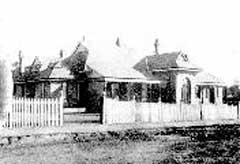
Journal, (Syd, NSW), Sat 12 Aug 1899, p. 33.
Reproduction: Peter de Waal
“All this time Constable Wright was keeping back a hostile mob, and things were looking very ugly. First of all we took Thorn to the Marrickville Cottage Hospital to get a dressing.”
Mr Kidston: Did he make any complaint on the way? — Yes, he said at the station, “This —– mongrel (meaning me) struck me over the head with a baton.” On the 7th of this month, when I was getting him bound over, he accused me of striking him with a handcuff; that was the first time he mentioned the handcuffs.
At any time did you use any more force than was necessary to do your duty?—No, none whatever.
When you struck him with the baton, there was a crowd hostile to you in words and actions?—Yes.
Mr Leary (cross-examining): Isn’t it a fact that you and your mate grabbed these men from behind before a word was spoken?—No.
Continuing, witness did not hear a woman say, “You will knock his brains out with the handcuffs.” He did not lose his head. He knew it was necessary for Thorn to get three stitches for the wound on his head. He would positively swear that he did not strike Thorn with the handcuffs. Much more damage could be done with the baton than the handcuffs. About three months previously he had been assaulted by three men, but did not use his baton. When defendant was on the ground he did not use his baton. There were thirty or forty people on the spot.
OTHER POLICE TESTIMONY.
Constable Albert Wright gave corroborative evidence. One of the girls who interfered said, “He’s my brother; let him alone.” He struggled so violently that they had to throw him down.
Constable Macnamara also generally corroborated Browne’s narrative.
Cross-examined, witness said that he had to let the prisoner Curwan go on account of the trouble with the crowd. He saw Browne use the baton when the prisoner was kicking and struggling, as they tried to put the handcuffs on.
NOT A BED OF ROSES.
Rupert Samuel Thorn, on oath, said he was a laborer residing at Dulwlch Hill. On the evening in question he and his friend Curwan (or Kirwin) met his two sisters and two other friands, and they walked along Enmore-road to get the train. They noticed Browne and his friend walking behind.
Suddenly Browne grabbed him by the arm and Macnamara seized Curwan. After dragging him along, despite the remonstrance of his sister, about 200 yards Browne pulled out his handcuffs, and struck him on the head so that he was knocked down. He remembered very little more till he got to the police station. He was 9st 5lb in weight, and was still under medical attention.
Cross-examined by Mr Kidston: Thorn admitted convictions for various offences including assaults (one on a constable) and inciting a prisoner to resist arrest. He had smashed a man’s nose, and had been found guilty at the Quarter Sessions, although he was innocent. For repeated acts of drunkenness he had been threatened that he would be dealt with as an inebriate.
“PUT THE DARBIES ON HIM!”
Mrs Mabel Russell, widow, and sister of Thorn, said the police came up and one of them said, “Put the darbies on him.” Constable Browne pulled out his handcuffs and knocked Thorn down. Then he put his knee on his neck. The baton was not used. The blood streamed from her brother’s head. The crowd made no attempt to interfere.
To Mr Kidston: A certain man had been arrested from her home. She lived with her parents, but it was not true that criminals had been taken from there.
George Augustus Thorn swore that the handcuffs were used; not the baton.
Mr Leary urged that even if the police story was accepted there was no doubt that unnecessary violence was used. The police could have handcuffed and taken Thorn to the station without knocking hln- on the head.
COULD HAVE USED REVOLVERS.
Mr Jennings held that the police had not used unnecessary violence considering the difficulties they were up against. It must be considered that they were provided with revolvers which they had not attempted to use. Theoretically one witness was as good as another, but in the present case the two constables on duty had acted with a fair amount of discretion.
He imposed a fine of £2 or two weeks’ imprisonment for language, and £3 or three weeks for resisting arrest “I think,” continued Mr Jennings, “the constable was justified in using the baton, and the charge of assault against him is dismissed.”
In spite of Mr Leary’s protests he awarded the Crown £2-2s costs, ample time to pay being given.
~ ~ ~ ~ ~
Evening News, Mon 24 Mar 1924 8
NEWS FROM ALL
QUARTERS
————
On a charge of having stolen 350lb of lead, the property of the Education Department, Henry Pippin, 18, was committed for trial from Newtown Court.
Charles John Walley. 45, was fined 20/-, at Newtown Court, for having been in Marrickville-road, for the purpose of betting.
At Newtown Court, William Yow was fined 40/- for having used a standing vehicle for the sale of goods in the street Thomas Marlow was fined the same sum on a similar charge.
For having played “heading ‘ Emphasis added.” Jack Hamilton. 30, Leslie Lean, 38, James Lean, 40, were each fined 20/- at Newtown Court.
Major Allan Maclean, of the Registrar-General’s Department, is assisting the British Fleet Reception Committee, and is temporarily attached to Mr Hay’s staff.
The fifth of the series of lunch hour addresses arranged by the New South Wales Institute of Journalists will be delivered in the hall of the Royal Colonial Institute, Bligh-st., City, at 1.30 pm to-morrow, by Mr JO Fairfax, whose subject will be “The Press and the Empire.”
“Orphan” sends £5 for Mrs Henry Dodds, who arrived in Sydney some weeks ago from London with four children, to learn that her husband had been drowned.
Two pioneers of Parkes, Mr and Mrs JL Whitmill have just celebrated their golden wedding.
Rupert Samuel Thorn, 23, Charles Thorn, 28. and Martin Danaher, 32. were each fined 30/-, at Newtown Court for having behaved in an offensive manner at Dulwich Hill on Saturday.
At Newtown Court, Thomas Henry Fennelly, 26, pleaded guilty to a charge of having assaulted his wife, and was bound over to keep the peace.
Rupert Samuel Thorn, 1928
[Unfortunately no newspaper reports of Rupert Samuel Thorn’s 9 indecent exposure 11 July1928 Newtown Police Court trial could be located.]
Rupert Samuel Thorn, et al, 1933
The Sydney Morning Herald, Sat 3 Jun 1933 10
SURRENDERED TO POLICE
———◦———
To Prevent Miscarriage
of Justice.
————
It was stated at Redfern Police Court yesterday that two men, who were charged with theft, had given themselves up to prevent a miscarriage of Justice.
Rupert Samuel Thorne, 32, David Grosvenor Williams, 26, and George Branscon, 39, were charged with having stolen 16 oil drums, valued at £4/16/-, the property of Kitchen and Sons, Pty., Ltd. Thorne was fined £10. Williams £3, and Branscon £4.
Constable Langley said that Thorne, when arrested at Kitchen and Son’s works, had 16 oil drums on a lorry. He was drunk. Two other men with him escaped. The next night another man was arrested and charged. Branscon and Williams had surrendered themselves that morning, although the police had no evidence against them.
Mr Twigg, for defendants, said that the action of Branscon and Williams was a laudable one. They could have kept quiet, but they had surrendered to prevent a miscarriage of justice. He asked for leniency for them.
The fourth man who had been arrested was discharged.
1 The Sydney Morning Herald, (NSW), Wed 6 Jun 1917, p. 9. Emphasis added.
2 There is a gaol photograph for Francis John Kitchener Nolan available from: SRNSW: NRS2467, [3/6096], State Penitentiary photographic description book, 1 Jun 1917–3 Oct 1917, No. 15644, p.10, R5145.
3 The Daily Telegraph, (Sydney, NSW), Thu 7 Jun 1917, p. 3. Emphasis added.
4 The Sydney Morning Herald, (NSW), Thu 7 Jun 1917, p. 4.
5 The Sydney Morning Herald, (NSW), Thu 6 Jul 1922, p. 6.
6 There are three gaol photographs for Clarence Henry John Thomas available from: 1) SRNSW: NRS2467, [3/6106], State Penitentiary photographic description book, 14 May 1921–7 Feb 1922, No. 17938, p. 35, R5150;. 2) SRNSW: NRS2467, [3/6107], State Penitentiary photographic description book, 8 Feb 1922–5 Sep 1922, No. 18663 p. 335, R5151; 3) SRNSW: NRS2467, [3/6116], State Penitentiary photographic description book, 30 Dec 1925–2 Jun 1926, No. 21474, p. 143, R5157.
7 Truth, (Syd, NSW), Sun 20 Jan 1924, p. 13. Emphasis in original and added.
8 Evening News, (Sydney, NSW), Mon 24 Mat 1924, p. 6. Emphasis added.
9 There is a gaol photograph for Rupert Samuel Thorn available from: SRNSW: NRS2467, [3/6122], State Penitentiary photographic description book, 29 Jun 1928–7 Nov 1928, No. 23179, pp. 51, 52, R5160.
10 The Sydney Morning Herald, (NSW), Sat 3 Jun 1933, p. 14. Emphasis added.