The Sydney Morning Herald, Thu 12 Oct 1899 1
THE MINISTER AT RYDE.
——
The Minister for Works, accompanied by Mr Dacey, paid a visit to Ryde to-day for the purpose of viewing the proposed park site of the Ryde wharf and Constitution-road leading to Meadow Bank station. An inspection having been made of the park site and the road the party was driven to the council-chambers by Mr Terry, the member of the district, who proposed the toast of the visiting Minister, welcoming Mr O’Sullivan to the district. Aldermen Redshaw, Betts, and Anderson supported the toast, the latter calling the Minister’s attention to the necessity of the Government supplying the township with a post and telegraph office and courthouse, the present postal and legal business being carried on in private property under considerable difficulty. Mr Tucker, from Beecroft, also supported the toast, pointing out that the acquisition of a park at the point indicated would not only benefit Ryde but the whole of the residents from Croydon to the wester suburbs to Hornsby on the Northern line.
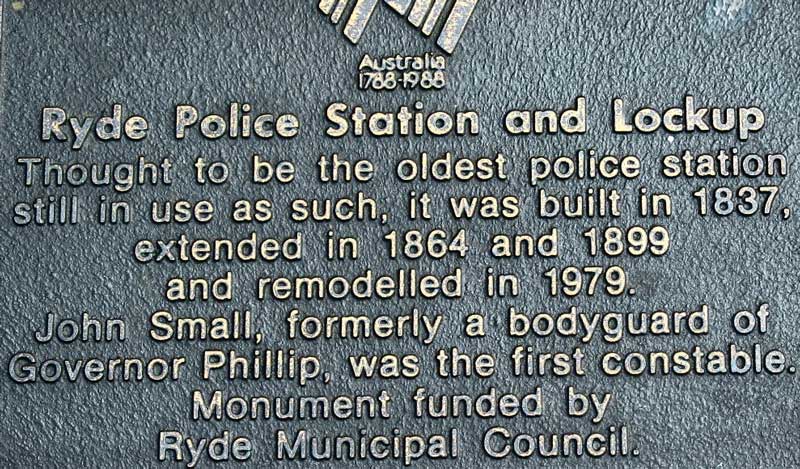
The Minister, in reply to the toast said, that he was so impressed with the necessity of providing a watering place for the western suburbs as well as the settlement along the Northern line, that apart from all local considerations he would advise the Treasurer to set apart an amount to carry out the work as a national undertaking. He was particularly impressed with the beauty of the village of Ryde, which more than anything he had yet seen conveyed to him an idea of the green fields and lanes of an English village. Such beauty would be considerably enhanced by the works he was now asked to carry out. He was pleased to make a note of the other matters brought under his notice, Constitution-road and the approach to the bridge at the head of navigation, but seeing the present Ministry had adopted the motto “Progress tempered by prudence,” these matters would have to wait their turn. He concluded by proposing the health of the member for Ryde, Mr Terry, assuring the audience that Mr Terry was so intent on seeing justice done to the Ryde district that it was sometimes a difficult matter to head him off the Treasury.
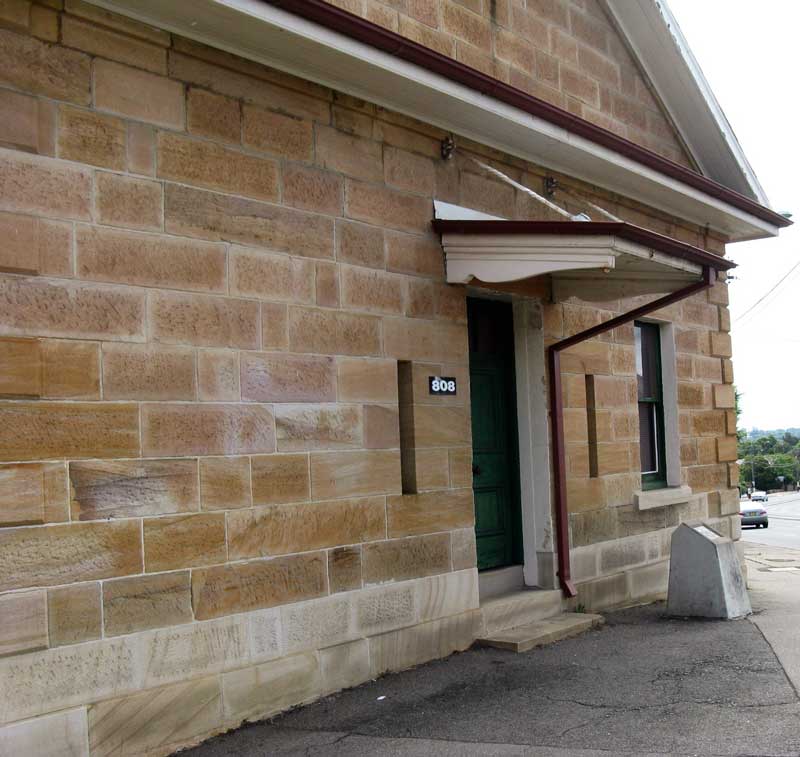
Photo: Peter Bonsall-Boone
Mr Terry, in responding, said he was pleased to have the Minister at Ryde, and pledged himself that as long as the present Ministry proceeded with honest legislation they would have his support.
The Minister further proposed the health of Mr Herring, late Under-Secretary for Mines, whom he was exceedingly pleased to meet, having when a new hand at Parliamentary duties received material assistance from that gentleman.
Mr Herring, in responding, said he was particularly pleased with the compliment paid him by the Minister.
The toast of the “Ryde District” by the Minister brought the proceedings so far as Ryde was concerned to a close.
The party adjourned to Gladesville, where an inspection was made of Looking Glass Bay, to reclaim which Mr Herring assured Mr O’Sullivan that a sum of money had been placed on the Estimates in Mr Farnell’s time, but had unfortunately been allowed to lapse. The Minister promised that should the work not exceed a certain amount when funds were available it would be carried out.
An adjournment was made to the residence of Mr EM Betts, where the party were entertained by Mr and Mrs Betts prior to a trip through the inviting grounds of the Gladesville Hospital for Insane, to the Government steam launch, and thence to town.
~ ~ ~ ~ ~
The Sydney Morning Herald, Mon 4 Jun 1900 2
PARRAMATTA DISTRICT.
———◦———
MINISTERIAL VISIT TO RYDE.
———
As a result of the agitations for a Courthouse and Post and Telegraph Office at Ryde, the Minister for Justice, in company with the member for the electorate, paid a visit to Ryde on Saturday afternoon, when he was met by the Mayor (Alderman Hibble), Aldermen Jordan and Redshaw, and the council clerk. An inspection of the building at present used as a courthouse was made. Mr Wood expressed the opinion that with an addition of space in the main building, and accommodation for witnesses, the present building would meet all requirements for some years. The Minister also inspected the Post and Telegraph Office, and was satisfied that the space under existing arrangements was altogether inadequate for requirements. He promised to communicate his impressions to his colleague, the Postmaster-General.
~ ~ ~ ~ ~
Evening News, Mon 23 Sep 1907 3
RYDE COURTHOUSE.
————
There never has been accommodation of any sort of witnesses at the Ryde Courthouse, and when ordered to “leave the court and from within the vicinity of the court,” they have up to the present had to go into the street to wait their turn. During hot, and especially during cold and wet weather, this is very trying to persons who come to assist in the administration of justice. However, this omission is about to be remedied by the department. The adjoining premises, until recently occupied as the Ryde Post and Telegraph Office, have been secured at a nominal rental from Mr GM Pope, and are to be divided into three rooms—a witnesses’ room, solicitors’ room, and a record room for the CPS.
~ ~ ~ ~ ~
The Cumberland Argus and Fruitgrowers’ Advocate, Sat 12 Jun 1915 4
NEW COURTHOUSE WANTED.
For one of the oldest towns in the State, Ryde has, perhaps, the most inadequate Court and police station accommodation possible. The Court-room is smaller than an ordinary office. In the portion reserved for the use of the police, the press, and the legal fraternity, there is barely room to swing the proverbial cat around. The room is badly lighted, and is cold and draughty. The office of the CPS adjoining is even more inconvenient. It is so small that persons unacquainted with its exact situation overtook it, and go away disappointed with their business left undone, thinking it must be one of those days when the CPS is saving the Department the salary of an officer who should be permanently employed at Hornsby. There is plenty of work at Ryde to occupy the clerk’s whole time; but that officer has to struggle through as best he can, and attend to the Hornsby Court’s work as well. On court days, people who have business to do with the CPS, who is also registrar of births, marriages, and deaths for the Ryde district, have to wait until the Court is over before they can transact the business which has taken them to Ryde. This is neither fair to the large and constantly increasing population, or to the clerk. The Courthouse is also situated at a considerable distance from the police station and lockup, so that prisoners have to be marched along the public highway, exposed to the public gaze. It is not right that men, possible innocent of the crimes on account of which they have been arrested, should be subjected to this humiliating and unnecessary publicity of being marched to the place of their trial, under police escort. The police station is neither commodious or up-to-date. A weatherboard shanty, which is a relic of Ryde’s humble past, and an eyesore to Ryde of the present, has to do duty for a charge-room, office, and quarters for a single man. Candles—ordinary tallow candles in these times of incandescent gas!—provide illumination for the police to do their clerical work by. At their own expense the police have purchased typewriting machines; and the contrast between these privately owned evidences of modernity with the Government’s adherence to a century’s old method of lighting is a powerful tribute to the enterprise of the policeman as a private individual. This old crib should be pulled down, otherwise it may fall down and perhaps kill a policeman. It cannot last much longer under the most favorable circumstances, as a good deal of the timber is decayed. Could not the council condemn it as unfit for human habitation? There are a number of similar old rookeries around Ryde that are an offence to the eye and a danger to the health of the neighbourhood. The sergeant’s residence is connected with the telephone system, but the charge room, which is some distance away, and which is where the police do their clerical work, has no extension ’phone, so that the sergeant’s wife or daughter has to go in search of a constable when one is wanted at the telephone. Meanwhile the caller has probably been disconnected. Besides, a telephone in the hallway of a private house is not a desirable place for an instrument of the kind, used on business of such an important and confidential nature as that of a police ’phone. The writer of this par has not been inspired by the police, but is writing from his own knowledge of the facts.
~ ~ ~ ~ ~
The Cumberland Argus and Fruitgrowers’ Advocate, Sat 11 Nov 1916 5
RYDE.
———◦———
NEW COURTHOUSE WANTED.
The pokey little building which does duty as a courthouse at Ryde has for many years been found inconvenient and unsuitable for the purpose, but the Government does not appear willing to provide anything better though the rental of the present building would pay the interest on the cost of construction of a fairly decent courthouse. The deposition clerk now has a typewriter, but as there is no cover to it to dreaded the sound, the clacking of the keys makes it difficult for the pressmen to hear what the witnesses say.
~ ~ ~ ~ ~
The Sydney Morning Herald, Sat 6 May 1922 6
RYDE COURT-HOUSE DILAPIDATED.
——————
The Minister for Justice (Mr TJ Ley), accompanied by the member for the district, Mr DM Anderson, and the Government architect, inspected the courthouse at Ryde. Representations had been made to the Minister that the present building was in a dilapidated condition, and was totally inadequate for the needs of the district, solicitors and witnesses being forced to conduct their interviews on the footpath outside. After his inspection yesterday Mr Ley promised to obtain a report from the Government architect as to the best way of providing a decent court-house, and the probable cost. When he receives this information the Minister will decide on what measured will be taken.
~ ~ ~ ~ ~
The Cumberland Argus and Fruitgrowers’ Advocate, Sat 7 Oct 1922 7
RYDE’S NEW COURTHOUSE.
————
DETAILS FINALISED.
The purchase of a block of land for the purpose of erecting a new Court-house at Ryde, was finalised this week.
The new Court-house will be erected next door to the present Police Station. This decision to provide a more commodious and up-to-date building will come as good news to those who have been agitating for years for something better than the present out-of-date structure.
~ ~ ~ ~ ~
The Cumberland Argus and Fruitgrowers’ Advocate, Sat 7 Apr 1923 8
RYDE
———◦———
RYDE’S NEW COURT HOUSE
Tenders have been invited for the building of the new Courthouse at Ryde. The site selected is close to Sergeant Kincade’s residence, and will be found much more convenient for officials and others concerned.
~ ~ ~ ~ ~
The Sydney Morning Herald, Wed 18 Apr 1923 9
GOVERNMENT CONTRACTS.
————
TENDERS RECEIVED.
————
Tenders for the following works were opened by the Tender Board of the Public Works Department on Monday:—Erection of new building, Courthouse, Ryde; Four tenders, constructor of buildings, £5228, lowest. Construction and delivery of two 550-ton steel hopper punts for the dredge service; Four tenders received; to be reported upon. Manufacture, supply, and delivery of switchgear and lightning arresters, Kiama transmission line; Four tenders received; to be reported upon. Additions and repairs, police station, Jugiong; One tender received; to be reported upon. Erection of glass house, Botanical Gardens, Sydney; One tender received; to be reported upon.
~ ~ ~ ~ ~
Sunday Times, Sun 5 Aug 1923 10
AFTER 52 YEARS
———◦———
COURTHOUSE FOR RYDE
————
“I have been in office only fifteen months,” declared Mr Ley, Minister for Justice, at Ryde yesterday, when laying the foundation stone of a new court house, “and will you believe me, no one has asked me for justice; they all ask for mercy.”
Then Mr Ley told a story of a man convicted of murdering his widowed mother, who pleaded for clemency on the ground that he was orphan. Mr Ley said the people of Ryde had been clamoring for 52 years for a court house, and if it had not been for the lack of money, it would have had one long ago. If money had not been squandered upon such frivolities as State trawlers, State brickyards, and State timber yards there would have been a much better chance for the erection of court houses, schools, and hospitals.
Mr DM Anderson presented a silver trowel to Mr Ley, and addresses were given by Sir Thos Henley, MLA, Mr EJ Loxton, KC, MLA.
Mr Loxton said he was not altogether keen on the building of a court house; he would have preferred to see erected in its place a library or an art gallery.
The Mayor of Ryde (Alderman C Dyer) presided, and there was a large gathering of residents. It was stated that the court house would be constructed of brick on stone, with adequate accommodation for the magistrate, officers, police, and witnesses. The cost will be £5500.
~ ~ ~ ~ ~
The Sydney Morning Herald, Mon 6 Aug 1923 11
COURTHOUSE FOR RYDE.
———◦———
FOUNDATION STONE LAID.
———
At Ryde on Saturday Mr TJ Ley, Minister for Justice, laid the foundation-stone of a courthouse which is to be erected at a cost of £5500.
In a subsequent address Mr Ley said that he had been told the people of Ryde had been waiting 52 years for a proper courthouse. Certainly the building they had been using as a court was the worst in the State, and the officials had been working under conditions which the Board of Trade would not tolerate. It had to be remembered that while courthouses were lacking, the community was short of hospitals and schools. Yet other Governments had been spending money on such expensive schemes as State trawlers and State timber yards.
Sir Thomas Henley said that as it was the Nationalist party which gave the people of Ryde their courthouse, so while the Nationalist party was in power they would get justice as well.
Mr Loxton, MLA, said one of the weaknesses of our arbitration system was that it compelled disputants to fight their case out in court, Ryde, he believed, was going to be a great industrial centre, and the people would be wise to settle their disagreements by arbitration instead of by litigation.
~ ~ ~ ~ ~
The Cumberland Argus and Fruitgrowers’ Advocate, Wed 8 Aug 1923 12
LAYING FOUNDATION STONE.
———◦———
NEW COURTHOUSE AT RYDE.
———◦———
“When I entered the Justice Department I found affairs in a deplorable condition. It was shameful to think that it was so, and that thousands of pounds had been wasted on State enterprises, which could have been put to beneficial use.”—The Hon TJ Ley, Minister for Justice, speaking at the laying of the foundation stone of the new Court House at Ryde, on Saturday last.
————
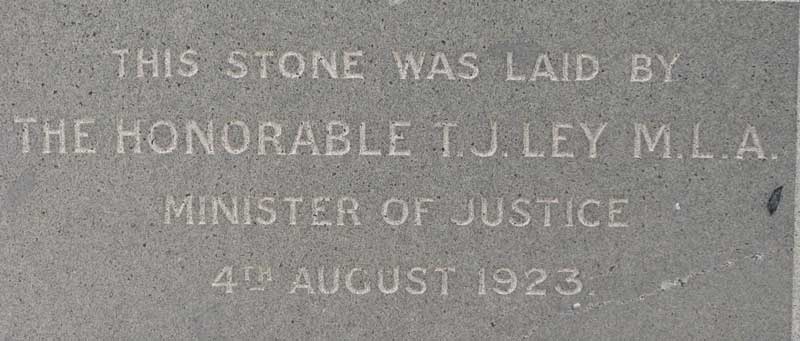
The ceremony of laying the foundation stone of the new Court House at Ryde was performed on Saturday by the Minster for Justice, Hon TJ Ley, in the presence of a large gathering of residents and visitors.
The ordinary foundations have already been put down, and it is apparent that a very substantial building will meet the eye of the law seeker. The edifice for which the district members have been agitating for over half a century will cost £5,500. For Saturday’s function a temporary stage had been erected, and the surrounding area was linberally beflagged. The Mayor (Alderman Dyer) occupied the chair, and amongst those on the platform were:—Sir Thomas Henley, MLA, Mr EJ Loxton, KC, MLA, and Mr DM Anderson, MLA. Gathered round in close proximity were Aldermen Chamberlain, McDuff, Chatfield, Law, Westman, Butcher, Atkinson, Greenwood, of Ryde, and the Mayor of Eastwood, Ald Featherstone. Apologies were announced from Mr Bavin, Attorney-General, Mr HE Pratten, MHR, and Mr Greig, MLA.
In opening proceedings the Mayor said the new court house was long overdue. They had good officers, but bad buildings. New quarters were required also for the police and he was sure the Government would recognise the necessity for up-to-date premises. The laying of the foundation stone that afternoon marked another milestone on the road to progress.
Mr DM Anderson, MLA, who introduced the Minister, said that he was sure the Ryde people would gladly welcome him as he was the only member of the Government who could be prevailed upon to give them a new court house. Mr Ley recognised that their building was inadequate, as was also the police quarters. He was pleased to say that he had interviewed Mr Oakes on the latter subject, and that gentleman, in company with the Inspector General of Police, had visited the site a week previously and had decided upon a new residence for the sergeant. On behalf of the Mayor and alderman of Ryde he presented Mr Ley with a silver trowel, suitably inscribed, with which to perform his historic task.
The Minister, who was warmly greeted, said that he was pleased that the direction for the building had come from him. He hopped soon to see a structure arise that would be an architectural adorment [sic] to the district. Courthouses were, he was sorry to say, a necessity, and if people would but realise that for the good of all they should pull together we might be able to close some of them. He then, with the aid of the contractor, arranged the stone in position and declared it “well and truly laid.” Continuing, he said, that around and upon that stone would rise a temple of justice of which they may feel proud. During his occupancy of Ministerial office, it was the first occasion on which he had been asked for justice—but he had been continually appealed to for mercy. As Ryde had waited 52 years for the day they were celebrating, it gave him much pleasure to perform the ceremony. The time was far distant when we would be able to do without courthouses, and in the meantime we must refer our disputes to some authority. He was proud to say that the Courts of Justice throughout the land were manned by officers in whom all had the greatest confidence, and the temple they were erecting would be occupied by men of the same type. The delay the Ryde fold had experienced was caused by the difficulty in finding money. When he entered the Justice Department he found affairs in a deplorable condition. It was shameful to think that it was so, and that thousands of pounds had been wasted on State enterprises, which could have been put to beneficial use.
Sir Thos Henley, in proposing a vote of thanks to the Minister, said that the thanks of the people were due to Mr DM Anderson for the determination he had shown in his effort to obtain the new courthouse. While they kept the Nationalists in power, they would get consideration, and justice as well. He congratulated the Mayor, the aldermen, and the people on securing such a splendid building.
Mr Loxton, KC, MLA, in support, said that Mr Ley was a great reformer, and he was sure that he would agree that some day they should pull down some of the buildings they were now erecting. Ryde would ultimately be a great industrial centre, but he was sorry to say that the weakness of the industrial arbitration system was that it compelled people to fight one another in the law courts. If they could only arrange their differences by agreement instead of litigation, it would be better for everybody. He honestly believed that the men of the past occupied judicial positions, as well as those in similar office to-day, were men of the highest integrity who carried out their duties concientiously [sic] and well.
The Mayor conveyed a vote of thanks to Mr Ley who, after briefly responding, proposed a similar vote to the Mayor. The latter returned thanks and the singing of the National Anthem terminated that section of the proceedings.
~ ~ ~ ~ ~
The Cumberland Argus and Fruitgrowers’ Advocate, Sat 9 Feb 1924 13
THE NEW COURTHOUSE.
Mr DM Anderson, MLA, is to be invited to officially open the new courthouse at Ryde, which is now nearing completion. It is anticipated that the function will take place towards the end of the present month. A committee comprising the Mayor (Alderman Dyer), Alderman Chamberlain, Messrs Macauley, Rickard, McPherson, and Starr will attend to the arrangements.
~ ~ ~ ~ ~
Evening News, Fri 15 Feb 1924 14
LIFE SENTENCE
————
OLD RYDE COURT-HOUSE
————
Business at the Ryde Court was conducted yesterday for the first time in its 60 years’ history without the coat of arms—a bleary eyed lion and a rather tire-looking unicorn.
The court was also minus other things, the Press table and chairs, furnishings of the magistrate’‘s rooms, and so forth; but there was a superabundance of dust and cobwebs.
The removal to the new court house had begun.
The new court house, which is to be officially opened tomorrow, cost £6000. The old building was built to meet the requirements of the Justice Department by the late Mr GM Pope, who was the first CPS at Ryde, likewise the first Town Clerk of Ryde.
~ ~ ~ ~ ~
The Sydney Morning Herald, Mon 18 Feb 1924 15
NEW COURTHOUSE AT RYDE.
———◦———
The new courthouse in Parramatta-road, Ryde, was opened by Mr DM Anderson, MLA, on Saturday afternoon. Mr Anderson, in his address, spoke of the time when the first courthouse was established, and remarked upon the rapidity with which the suburb was growing. At the conclusion of the ceremony a banquet was held in Ryde Town Hall. Those present included Sir Thomas Henley, MLA, Mr Loxton, MLA, the Mayor of Ryde (Alderman Dyer), and other prominent citizens of the district.
The courthouse is a spacious building, built of brick and is thoroughly modern and up to date in every respect.
~ ~ ~ ~ ~
The Cumberland Argus and Fruitgrowers’ Advocate, Sat 23 Feb 1924 16
RYDE’S COURT HOUSE.
———◦———
OFFICIAL OPENING CEREMONY.
————
Apparently, the people of Ryde do not take any interest in the opening of new “Halls of Justice.” The attendance at the function on Saturday afternoon last was extremely meagre.
————
Apart from the parliamentary, municipal official, and legal representatives, there were practically no members of the general public present.
The proceedings were of a quiet, unostentatious character.
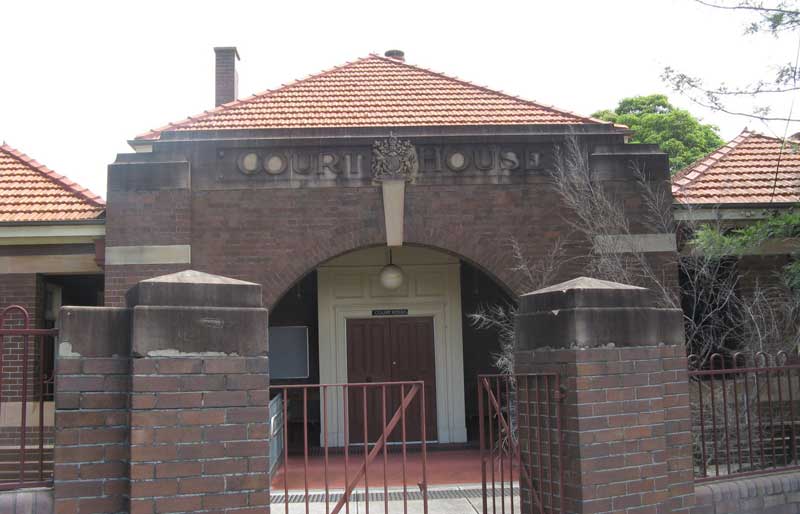
The new Courthouse, which is centrally situated in Parramatta-road, adjoining the Police Station, is an imposing, solid structure, and does credit to the rapidly-growing town of Ryde. The total cost of the land and building was £5588.
The original Ryde Courthouse was established on June 16th, 1863, and the first sitting took place on June 27th of the same year. It is interesting to recall that the first case heard was that of a woman charged with having used insulting language. The defendant was discharged.
The Mayor (Alderman C Dyer) presided at Saturday afternoon’s function. At the entrance he briefly addressed the assemblage, remarking that the provision of a new Courthouse at Ryde was long overdue.. In presenting Mr DM Anderson, MLA, with a golden key, to officially open the building, the Mayor referred to the good work done by Mr Anderson in the direction of securing this new Courthouse.
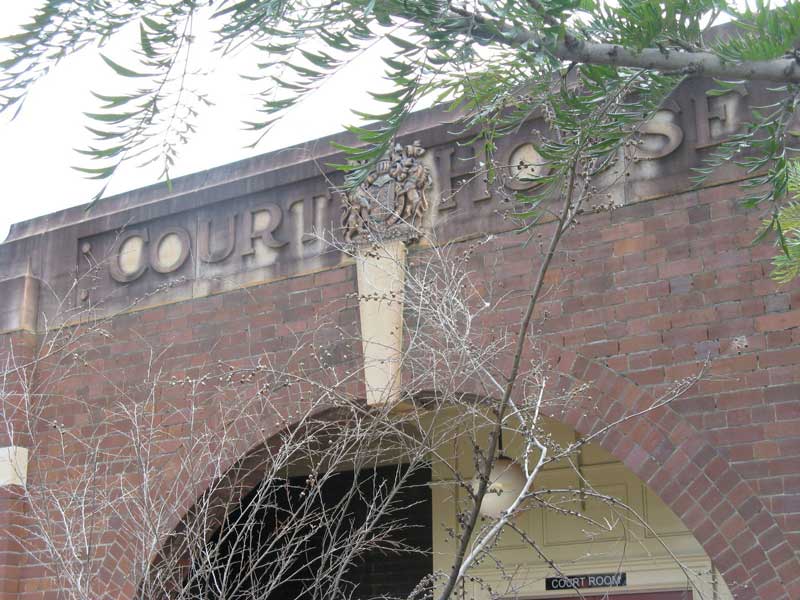
Mr Anderson then unlocked the door, and declared the Courthouse officially open.
The company then assembled in the spacious courtroom.
Mr DM Anderson, in the course of a brief address, remarked that, during the past 20 years, there had been an agitation to secure a suitable Courthouse for Ryde. On being elected as one of their parliamentary representatives, he set to work to try to secure this much-needed building. He related the efforts which he made, and the ultimate success. This Courthouse was the first new building sanctioned by the present Minister for Justice (Mr Ley), and it was certainly a credit to the district. Mr Anderson also gave a resume of the Ryde Court since its inception, 61 years ago. In returning thanks for the golden key presented to him, he stated that he would place it where he could see it very frequently. He would have a pin made for it and place it on his wife’s breast. (Applause.)
Mr Rickard (representing the legal profession), and Inspector Walker (on behalf of the police), congratulated the people of Ryde on having secured such a fine Courthouse. Incidentally, Mr Rickard expressed regret that Mr Blix, PM, was not present that afternoon to take his seat on the Bench.
Sir Thomas Henley, in moving a vote of thanks to Mr Anderson, said that the latter had undoubtedly done the lion’s share in securing the new Courthouse for Ryde. The fine building was evidence of the growth of the district. He congratulated the builders on the splendid structure. Sir Thomas facetiously remarked that he did not know why the people of Ryde wanted a Courthouse, but he supposed that they wanted to be in the fashion. (Laughter.)
The motion was seconded by Mr Loxton, KC, MLA, who added words of a congratulatory nature.
Subsequently, the company adjourned to the Town Hall, where a function of a social character took place. A number of toasts were honored.
In responding to the toas of Parliament, Mr DM Anderson referred to the comment which had been made regarding his criticism of the attitude taken up by the State Treasurer (Sir Arthur Cocks) concerning the tightness of the money market. He (Mr Anderson) claimed that, as a result of the Treasurer’s remarks, the money market had tightened, and a larger rate of interest was being demanded. Such a condition of affairs was bad for the country.
~ ~ ~ ~ ~
The Sydney Morning Herald, Tue 17 Sep 1935 17
CHURCH HALL AT RYDE.
————
An old landmark at Ryde formerly used as a post office and court-house in Church-street, was recently demolished and on the site is being erected a new parish and Sunday-school hall for St Anne’s, Church of England. The building, now in course of erection, will have its main entrance in Church-street, and the foundation will be set by the Archbishop of Sydney.
The new hall, which will cost £4000, will comprise an assembly hall capable of seating 550, together with several classrooms, modern kindergarten, and primary section, fitted with sound-proof ceiling and a kitchen and servery. The hall will be fitted to comply with the, Theatres and Public Halls Act , and will have a first-class stage. The new hall will be completed at the end of the year.
The old court-house and post-office, which the new hall replaces, recalls to old residents the fact that the first postmaster at Ryde, the late GM Pope, was also clerk of petty sessions, registrar of births, deaths, and marriages, town clerk, and in addition to these duties acted for years as organist at St Anne’s Church.
1 The Sydney Morning Herald, Thu 12 Oct 1899, p. 8. Emphasis added.
2 The Sydney Morning Herald, Mon 4 Jun 1900, p. 5.
3 Evening News, (Sydney, NSW), Mon 23 Sep 1907, p. 4.
4 The Cumberland Argus and Fruitgrowers’ Advocate (Parramatta), Sat 12 Jun 1915, p. 8.
5 The Cumberland Argus and Fruitgrowers’ Advocate (Parramatta), Sat 11 Nov 1916, p. 8.
6 The Sydney Morning Herald, Sat 6 May 1922, p. 9.
7 The Cumberland Argus and Fruitgrowers’ Advocate (Parramatta), Sat 7 Oct 1922, p. 8. Emphasis in original.
8 The Cumberland Argus and Fruitgrowers’ Advocate (Parramatta), Sat 7 Apr 1923, p. 8.
9 The Sydney Morning Herald, Wed 18 Apr 1923, p. 9. Emphasis added.
10 Sunday Times, (Sydney, NSW), Sun 5 Aug 1923, p. 7.
11 The Sydney Morning Herald, Mon 6 Aug 1923, p. 10.
12 The Cumberland Argus and Fruitgrowers’ Advocate (Parramatta), Wed 8 Aug 1923, p. 1. Emphasis in original.
13 The Cumberland Argus and Fruitgrowers’ Advocate (Parramatta), Sat 9 Feb 1924, p. 6.
14 Evening News, (Sydney, NSW), Fri 15 Feb 1924, p. 13.
15 The Sydney Morning Herald, Mon 18 Feb 1924, p. 10. Emphasis added.
16 The Cumberland Argus and Fruitgrowers’ Advocate (Parramatta), Sat 23 Feb 1924, p. 6. Emphasis in original.
17 The Sydney Morning Herald, Tue 17 Sep 1935, p. 3. Emphasis added.